
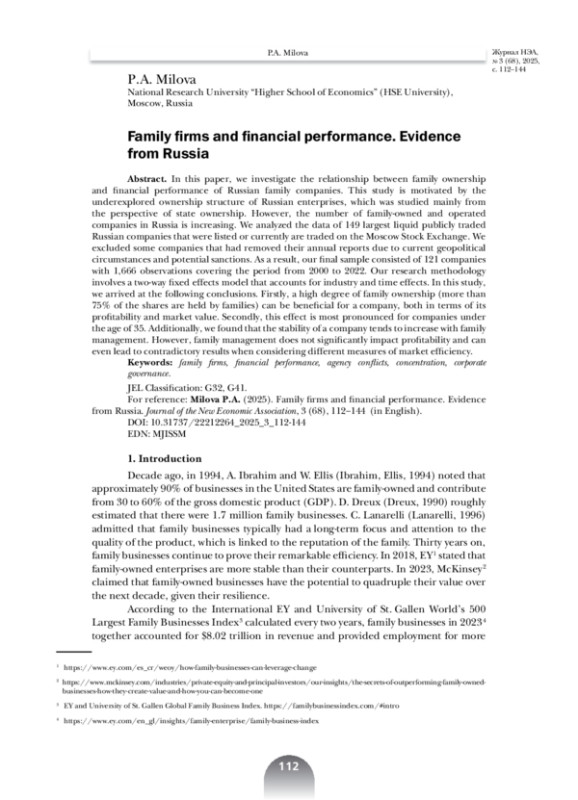
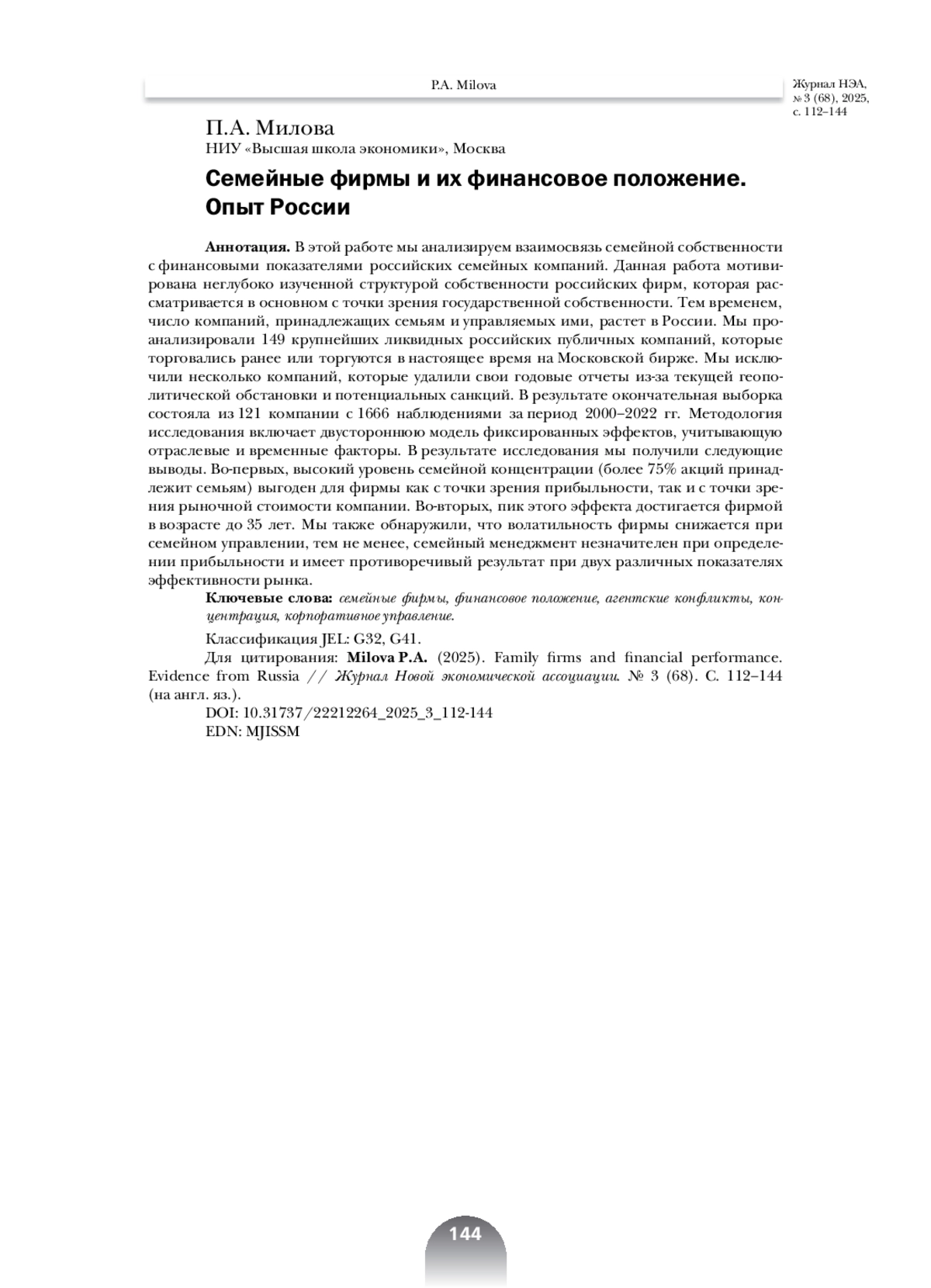
In this paper, we investigate the relationship between family ownership and financial performance of Russian family companies. This study is motivated by the underexplored ownership structure of Russian enterprises, which was studied mainly from the perspective of state ownership. However, the number of family-owned and operated companies in Russia is increasing. We analyzed the data of 149 largest liquid publicly traded Russian companies that were listed or currently are traded on the Moscow Stock Exchange. We excluded some companies that had removed their annual reports due to current geopolitical circumstances and potential sanctions. As a result, our final sample consisted of 121 companies with 1,666 observations covering the period from 2000 to 2022. Our research methodology involves a two-way fixed effects model that accounts for industry and time effects. In this study, we arrived at the following conclusions. Firstly, a high degree of family ownership (more than 75% of the shares are held by families) can be beneficial for a company, both in terms of its profi tability and market value. Secondly, this effect is most pronounced for companies under the age of 35. Additionally, we found that the stability of a company tends to increase with family management. However, family management does not significantly impact profitability and can even lead to contradictory results when considering different measures of market efficiency
Предпросмотр статьи
Идентификаторы и классификаторы
- SCI
- Экономика
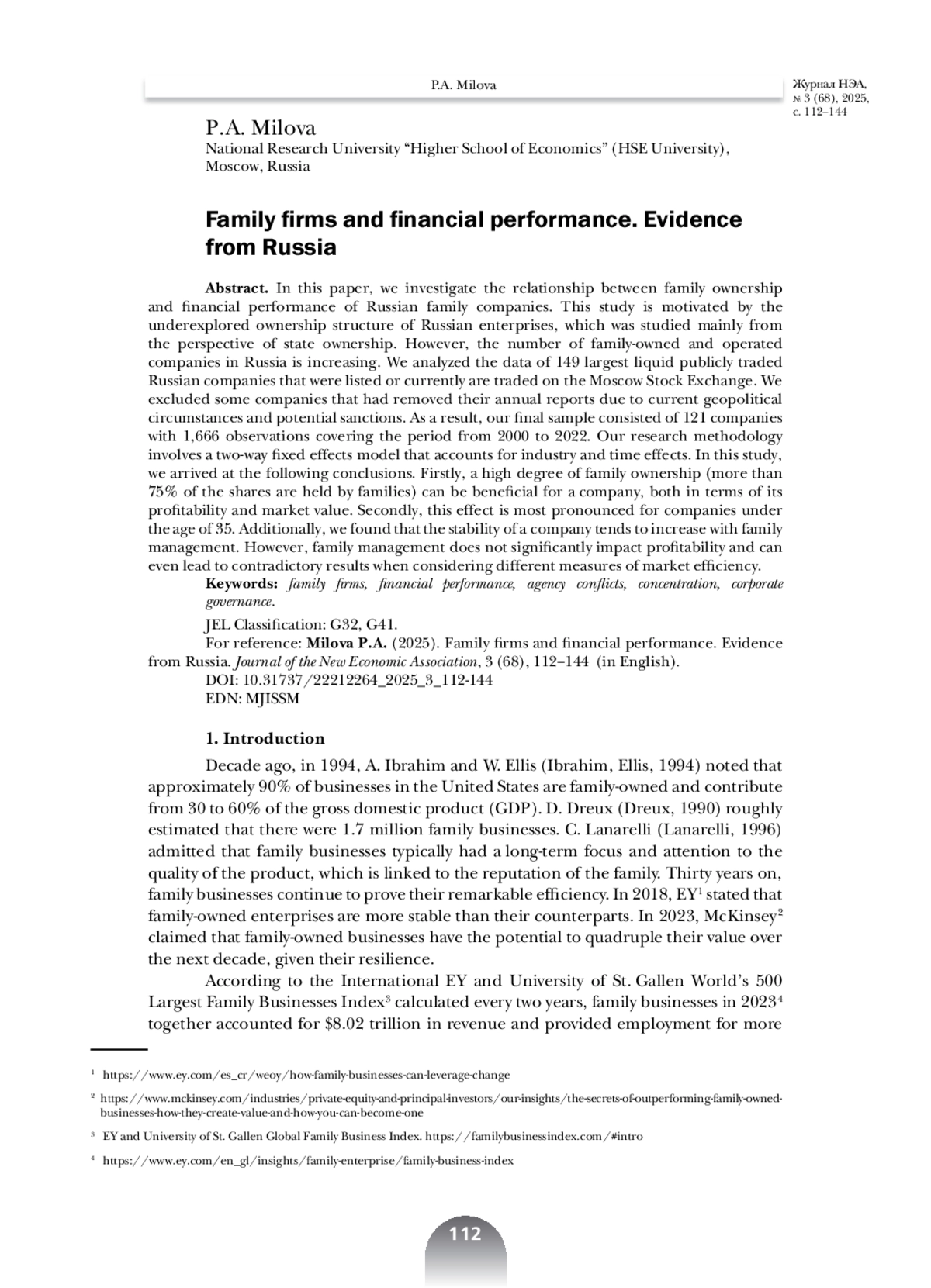
Decade ago, in 1994, A. Ibrahim and W. Ellis (Ibrahim, Ellis, 1994) noted that approximately 90% of businesses in the United States are family-owned and contribute from 30 to 60% of the gross domestic product (GDP). D. Dreux (Dreux, 1990) roughly estimated that there were 1.7 million family businesses. C. Lanarelli (Lanarelli, 1996) admitted that family businesses typically had a long-term focus and attention to the quality of the product, which is linked to the reputation of the family. Thirty years on, family businesses continue to prove their remarkable efficiency. In 2018, EY 1 stated that family- owned enterprises are more stable than their counterparts. In 2023, McKinsey 2 claimed that family-owned businesses have the potential to quadruple their value over the next decade, given their resilience
Если у вас возникли вопросы или появились предложения по содержанию статьи, пожалуйста, направляйте их в рамках данной темы.
Список литературы
1. Abor J. (2005). The effect of capital structure on profitability: An empirical analysis of listed firms in Ghana. The Journal of Risk Finance, 6 (5), 438-445.
2. Abramov A., Radygin A., Chernovа M. (2017). State-owned enterprises in the Russian market: Ownership structure and their role in the economy.Russian Journal of Economics, 3 (1), 1-23 (in English).
3. Agca D., Kizildag D. (2013). Linking generational involvement to intrapreneurship activities in Turkish family firms: An empirical study. Business Management Dynamics, 2 (12), 47-57.
4. Altindag E., Zehir C., Acar A. (2011). Strategic orientations and their effects on firm performance in Turkish family owned firms. Eurasian Business Review, 1 (1), 18-36. EDN: JDVQGK
5. Amato S., Patuelli A., Basco R., Lattanzi N. (2021). Family firms amidst the global financial crisis: A territorial embeddedness perspective on downsizing. Journal of Business Ethics, 183 (1), 213-236.
6. Amin Q.A., Liu J. (2020). Shareholders’ control rights, family ownership and the firm’s leveragedecisions.International Review of Financial Analysis, 72, 101591. EDN: GGEUWU
7. Amore M.D., Pelucco V., Quarato F. (2022). Family ownership during the Covid-19 pandemic.Journal of Banking & Finance, 135, 106385. EDN: UYJNKC
8. Anderson R. C., Reeb D.M. (2003). Founding-family ownership and firm performance: Evidence from the S&P 500. TheJournalof Finance, 58 (3), 1301-1328.
9. Anderson R.C., Reeb D.M. (2004). Board composition: Balancing family influence in S&P 500 firms. Administrative Science Quarterly, 49, 209-237.
10. Arellano M. (1987). Practitioners’ corner: Computing robust standard errors for within-groups estimators. Oxford Bulletin of Economics and Statistics, 49 (4), 431-434.
11. Ashwin A., Krishnan R.T., George R. (2015). Family firms in India: Family involvement, innovation and agency and stewardship behaviors. Asia Pacific Journal of Management, 32 (4), 869-900. EDN: KQEESX
12. Awunyo-Vitor D., Badu J. (2012). Capital structure and performance of listed banks in Ghana. Global Journal of Human-Social Science Research, 12 (5).
13. Bartholomeusz S., Tanewski G. (2006). The relationship between family firms and corporate governance. Journal of Small Business Management, 44 (2), 245-267.
14. Bodnaruk A., Massa M., Yadav V. (2017). Family ownership, country governance, and foreign portfolio investment. Journal of Empirical Finance, 41, 96-115.
15. Buccellato T., Fazio G., Rodionova Y., Vershinina N. (2015). Ownership structure, cash constraints and investment behaviour in Russian family firms. In: Leo-Paul D., Veland R. (eds.). Family Businesses in Transition Economies: Management, Succession and Internationalization, 127, 239-264. Heidelberg: Springer. EDN: VGCYID
16. Bui N.T.H. (2017). The impact of financial leverage on firm performance: A case study of listed oil and gas companies in England.International Journal of Economics, Commerce and Management, 5 (6), 477-485.
17. Bykova A., Molodchik M., Shumilova E. (2017). Concentration of ownership as a mechanism of corporate governance in Russian public companies: Impact on financial performance. Applied Econometrics, 1 (45), 50-74 (in Russian). EDN: YIUFRZ
Быкова А.Ф., Молодчик М.Ф., Шамилова Е.Г. (2017). Концентрация собственности как механизм корпоративного управления В российских публичных компаниях: влияние на финансовые результате деятельности // Прикладная эконометрика. № 1. С. 50-74.]. EDN: YIUFRZ
18. Chang S., Tsai M., Lee M., Ho J. (2021). Optimal QOE scheduling in MPEG-DASH video streaming.International Journal of Interactive Multimedia and Artificial Intelligence, 6 (7), 71. DOI: 10.9781/ijimai.2021.06.003 EDN: XFMMIY
19. Chen G., Chittoor R., Vissa B. (2021). Does nepotism run in the family? CEO pay and pay-performance sensitivity in Indian family firms. Strategic Management Journal, 42 (7), 1326-1343. EDN: XNBCNK
20. Chen S., Chen X., Cheng Q., Shevlin T. (2010). Are family firms more tax aggressive than nonfamily firms. Journal of Financial Economics, 95 (1), 41-61.
21. Cherkasova V.A., Baron A.A. (2021). The impact of the ownership structure on the innovative activity of Russian companies. St. Petersburg University Journal of Economic Studies, 37 (4), 570-600 (in English). DOI: 10.21638/spbu05.2021.403
22. Chernykh L. (2008). Ultimate ownership and control in Russia. Journal of Financial Economics, 88 (1), 169-192 (in English). Available at SSRN: https://ssrn.com/abstract=2745279.
23. Chi Y. (2023). The agency costs of family ownership: Evidence from innovation performance. Journal of Banking and Finance, 148, 106737. EDN: TMNWUY
24. Chiu W., Wang C.W. (2019). Rollover risk and cost of bank debt: The role of family-control ownership. Pacific-Basin Finance Journal, 53, 362-378.
25. Chrisman J.J., Chua J.H., Pearson A.W., Barnett T. (2012). Family involvement, family influence, and family-centered non-economic goals in small firms. Entrepreneurship Theory and Practice, 36 (2), 267-293.
26. Chrisman J.J., Chua J. H., Kellermanns F.W., Chang E.P. (2007). Are family managers agents or stewards? An exploratory study in privately held family firms. Journal of Business Research, 60, 1030-1038.
27. Christensen-Salem A., Mesquita L.F., Hashimoto M., Hom P.W., Gomez-Mejia L.R. (2021). Family firms are indeed better places to work than non-family firms! Socioemotional wealth and employees’ perceived organizational caring. Journal of Family Business Strategy, 12 (1), 100412. EDN: MAFBTI
28. Cucculelli M., Micucci G. (2008). Family succession and firm performance: Evidence from Italian family firms. Journal of Corporate Finance, 14 (1), 17-31.
29. Daniel J., Su X. (2017). The dynamics of performance volatility and firm valuation. Journal of Financial and Quantitative Analysis, 52 (1), 111-142.
30. Davis J.H., Schoorman F.D., Donaldson L. (1997). Toward a stewardship theory of management. The Academy of Management Review, 22 (1), 20-47. EDN: CNAHXJ
31. Dawson A. (2011). Private equity investment decisions in family firms: The role of human resources and agency costs. Journal of Business Venturing, 26, 189-199.
32. Debicki B.J., Kellermanns F.W., Chrisman J.J., Pearson A.W., Spencer B.A. (2016). Development of a socioemotional wealth importance (SEWI) scale for family firm research. Journal of Family Business Strategy, 7 (1), 47-57.
33. Deephouse D.L., Jaskiewicz P. (2013). Do family firms have better reputations than non-family firms? An integration of socioemotional wealth and social identity theories. Journal of Management Studies, 50 (3), 337-360.
34. Dickey D.A., Fuller W.A. (1981). Likelihood ratio statistics for autoregressive time series with a unit root. Econometrica, 49 (4), 1057-1072.
35. Dinh T.Q., Calabro A. (2018). Asian family firms through corporate governance and institutions: A systematic review of the literature and agenda for future research.International Journal of Management Reviews, 21 (1), 50-75.
36. Dodd O., Zheng B. (2022). Does board cultural diversity contributed by foreign directors improve firm performance? Evidence from Australia. Journal of Risk and Financial Management, 15 (8), 332. EDN: QDDRQR
37. Dreux D.R. (1990). Financing family business: Alternatives to selling out or going public. Family Business Review, 3, 225-243.
38. Dybvig P.H., Warachka M. (2010). Tobin’s Q does not measure firm performance: Theory, empirics, and alternatives. SSRN Electronic Journal,. Available at: https://ssrn.com/abstract=1562444.
39. Eddleston K.A., Kellermanns F.W., Zellweger T.M. (2012). Exploring the entrepreneurial behavior of family firms: Does the stewardship perspective explain differences. Entrepreneurship: Theory & Practice, 36, 347-367.
40. Elsayed K. (2007). Does CEO duality really affect corporate performance. Corporate Governance: An International Review, 15 (6), 1203-1214.
41. Erdem F., Ba§er G.G. (2010). Family and business values of regional family firms: A qualitative research.InternationalJournal of Islamic and Middle Eastern Finance and Management, 3 (1), 47-64.
42. Ergun B., Doruk O.T. (2020). Effect of financial constraints on the growth of family and nonfamily firms in Turkey. Financial Innovation, 6 (1). DOI: 10.1186/s40854-020-00188-z EDN: FQMASZ
43. Espinosa-Mendez C., Jara-Bertin M., Maquieira C. (2018). The influence of family and pyramidal ownership on corporate diversification in Chile. The North American Journal of Economics and Finance, 43, 158-168. EDN: YEIBTF
44. Eugster N., Isakov D. (2019). Founding family ownership, stock market returns, and agency problems. Journal of Banking & Finance, 107, 105600.
45. Eulaiwi B., Al-Hadi A., Taylor G., Al-Yahyaee K.H., Evans J. (2016). Multiple directorships, family ownership and the board nomination committee: International evidence from the GCC. Emerging Markets Review, 28, 61-88.
46. Fan J. P.H., Leung W.S.C. (2020). The impact of ownership transferability on family firm governance and performance: The case of family trusts. Journal of Corporate Finance, 61, 101409. EDN: UQDXZC
47. Filatotchev I., Toms S., Wright M. (2006). The firm’s strategic dynamics and corporate governance life-cycle.International Journal of Managerial Finance, 2 (4), 256-279.
48. Filbeck G., Lee S. (2000). Financial management techniques in family businesses. Family Business Review, 13 (3), 201-216. EDN: FMUAVT
49. Gaddy C. G., Ickes B.W. (2010).Russia after the global financial crisis. Eurasian Geography and Economics, 51 (3), 281-311. EDN: NBEGOL
50. Gill S., Kaur P. (2015). Family involvement in business and financial performance: A panel data analysis. VIKALPA. The Journal for Decision Makers, 40 (4), 395-420.
51. Gladysheva A., Kishilova Yu. (2018). The influence of political connections and government ownership on firm performance: Evidence from Russia. Journal of Corporate Finance Research, 12 (1), 20-43 (in Russian). EDN: CQPQKE
Гладышева А., Кишилова Ю. (2018). Влияние политических связей и государственной собственности на деятельность фирм в России // Корпоративные финансы. № 12 (1). С. 20-43.]. EDN: CQPQKE
52. Goel U., Chadha S., Sharma A.K. (2015). Operating liquidity and financial leverage: Evidences from Indian machinery industry. Procedia-Social and Behavioral Sciences, 189, 344-350.
53. Gomez-Mejia L.R., Haynes K.T., Nickel M.N., Jacobson K.J.L., Moyano-Fuentes J. (2007). Socioemotional wealth and business risks in family-controlled firms: Evidence from Spanish olive oil mills. Administrative Science Quarterly, 52 (1), 106-137.
54. Gonzalez M., Guzman A., Pombo C., Trujillo M.-A. (2012). Family firms and financial performance: The cost of growing. Emerging Markets Review, 13 (4), 626-649.
55. Gonzalez M., Guzman A., Pombo C., Trujillo M.-A. (2013). Family firms and debt: Risk aversion versus risk of losing control. Journal of Business Research, 66 (11), 2308-2320.
56. Green C.P., Homroy S. (2018). Female directors, board committees and firm performance. European Economic Review, 102, 19-38.
57. Greene W. (2012). Econometric analysis. Edinburgh Gate, Harlow: Pearson Education Limited.
58. Guest P.M. (2009). The impact of board size on firm performance: Evidence from the UK. The European Journal of Finance, 15 (4), 385-404.
59. Gupta A., Nashier T. (2017). Family ownership and firm performance: Evidence from India. Quarterly Journal of Finance and Accounting, 55 (3-4), 37-68.
60. Hansen C., Block J., Neuenkirch M. (2020). Family firm performance over the business cycle: A meta-analysis. Journal of Economic Surveys, 34 (3), 476-511. EDN: PDRUQU
61. Hegde S.P., Seth R., Vishwanatha S. (2020). Ownership concentration and stock returns: Evidence from family firms in India. Pacific-Basin Finance Journal, 61, 101330. EDN: UQGYVY
62. Hirsch B., Seaks T. (1993). Functional form in regression models of Tobin’s Q. The Review of Economics and Statistics, 75 (2), 381-385. EDN: BOLSHN
63. Ibrahim A. B., Ellis W.H. (1994). Family business management. Concepts and practice. Dubuque, Iowa: Kendall Hunt.
64. Issah W.B., Anwar M., Clau B. T., Kraus S. (2023). Managerial capabilities and strategic renewal in family firms in crisis situations: The moderating role of the founding generation. Journal of Business Research, 156, 113486. EDN: DRMQTF
65. Iwasaki I., Mizobata S., Muravyev A. (2018). Ownership dynamics and firm performance in an emerging economy: A meta-analysis of the Russian literature. Post-Communist Economies, 30 (3), 290-333. EDN: XXIUGD
66. Izadi J., Pratt M., Khorashadi M., Foroudi P., Pallazo M. (2023). Do family firms pay more attention to audit fees and audit choices than non-family firms. SSRN Electronic Journal. Available at: https://ssrn.com/abstract=4533778.
67. Jaskiewicz P., Block J.H., Miller D., Combs J.G. (2014). Founder versus family owners’ impact on pay dispersion among non-CEO top managers: Implications for firm performance. Journal of Management, 43(5), 1524-1552.
68. Jatoi M.Z., Rasheed A., Wahla K. (2023). Impact of dividend policy on firm performance: Evidence from non-financial firms of Pakistan. Pakistan Journal of Humanities and Social Sciences, 11 (2), 1220-1228. EDN: EWWSVH
69. Jensen M. C., Meckling W.H. (1976). Theory of the firm: Managerial behavior, agency costs and ownership structure. Journal of Financial Economics, 3 (4), 305-360.
70. Kalsie A., Shrivastav S.M. (2016). Analysis of board size and firm performance: Evidence from NSE companies using panel data approach. Indian Journal of Corporate Governance, 9 (2), 148-172.
71. Karaevli A., Yurtoglu B.B. (2021). Family ownership, market development, and internationalization of Turkish business groups (1925-2017). Journal of World Business, 56 (6), 101264. EDN: GVGTYZ
72. Karra N., Tracey P., Phillips N. (2006). Altruism and agency in the family firm: Exploring the role of family, kinship, and ethnicity. Entrepreneurship: Theory & Practice, 30, 861-877.
73. Kets de Vries M.F.R., Carlock R.S., Florent-Treacy E. (2007). Family business on the couch. L.: John Wiley & Sons Ltd.
74. Kilincarslan E. (2021). The influence of board independence on dividend policy in controlling agency problems in family firms.International Journal of Accounting and Information Management, 29 (4), 552-582. EDN: KOJGYZ
75. Kraus S., Kallmuenzer A., Stieger D., Peters M., Calabro A. (2018). Entrepreneurial paths to family firm performance. Journal of Business Research, 88, 382-387.
76. Lanarelli C. (1996). Family owned businesses. The Encyclopedia of Business. Detroit: Gale Research.
77. Larmou S., Vafeas N. (2009). The relation between board size and firm performance in firms with a history of poor operating performance. Journal of Management & Governance, 14 (1), 61-85.
78. Lartey V.C., Antwi S., Boadi E.K. (2013). The relationship between liquidity and profitability of listed banks in Ghana.International Journal of Business and Social Science, 4 (3), 48-56.
79. Lee E.J., Chae J., Lee Y.K. (2018). Family ownership and risk taking. Finance Research Letters, 25, 69-75.
80. Lee J. (2006). Family firm performance: Further evidence. Family Business Review, 19 (2), 103-114.
81. Liadze I., Macchiarelli C., Mortimer-Lee P., Juanino P.S. (2022). Economic costs of the Russia-Ukraine war. World Economy, 46 (4), 874-886.
82. Lin W.T. (2012). Family ownership and internationalization processes: Internationalization pace, internationalization scope, and internationalization rhythm. European Management Journal, 30 (1), 47-56. EDN: PIUJBL
83. Lozano M.B., Yaman S. (2020). The determinants of cash flow sensitivity of cash: The family ownership effect. Research in International Business and Finance, 53, 101204. EDN: TBLFTB
84. Madden L.T., McMillan A.G., Harris O. (2020). Drivers of selectivity in family firms: Understanding the impact of age and ownership on CSR. Journal of Family Business Strategy, 11 (2), 100335. EDN: LVWPAL
85. Martinez J.I., Stohr B.S., Quiroga B. F. (2007). Family ownership and firm performance: Evidence from public companies in Chile. Family Business Review, 20 (2), 83-94.
86. Martinez-Garcia I., Basco R., Gomez-Anson S. (2021). Dancing with giants: Contextualizing state and family ownership effects on firm performance in the Gulf Cooperation Council. Journal of Family Business Strategy, 12 (4), 100373. EDN: QCDMVS
87. Masulis R.W., Wang C., Xie F. (2012). Globalizing the boardroom - the effects of foreign directors on corporate governance and firm performance. Journal of Accounting and Economics, 53 (3), 527-554.
88. McConaughy D., Matthews C., Fialko A. (2001). Founding family controlled firms: Performance, risk, and value. Journal of Small Business Management, 39, 31-49. EDN: DYSMIH
89. Meah M.R., Chaudhory N.U. (2019). The impact of audit characteristics on firm performance: An Empirical study from an emerging economy. Journal of Asian Finance Economics and Business, 6 (1). DOI: 10.13106/jafeb.2019.vol6.no1.59
90. Miller D., Le Breton-Miller I., Lester R.H., Cannella A.A. (2007). Are family firms really superior performers. Journal of Corporate Finance, 13 (5), 829-858.
91. Miller D., Le Breton-Miller I., Scholnick B. (2008). Stewardship vs. stagnation: An empirical comparison of small family and non-family businesses. Journal of Management Studies, 45 (1), 51-78.
92. Minichilli A., Corbetta G., MacMillan I.C. (2010). Top management teams in family-controlled companies: ‘Familiness’, ‘faultlines’, and their impact on financial performance. Journal of Management Studies, 47 (2), 205-222. EDN: NAPFDN
93. Mulyani E., Singh H., Mishra S. (2016). Dividends, leverage, and family ownership in the emerging Indonesian market. Journal of International Financial Markets, Institutions and Money, 43, 16-29.
94. Murro P., Peruzzi V. (2019). Family firms and access to credit. Is family ownership beneficial. Journal of Banking & Finance, 101, 173-187.
95. Nowak E., Ehrhardt O., Weber F. (2006). ‘Running in the family’: The evolution of ownership, control, and performance in German family-owned firms, 1903-2003. Swiss Finance Institute Research Paper, 06 (13). Available at SSRN: https://ssrn.com/abstract=891255.
96. Pearson A.W., Marler L.E. (2010). A leadership perspective of reciprocal stewardship in family firms. Entrepreneurship Theory and Practice, 34 (6), 1117-1124.
97. Peng M.W., Zhang S., Li X. (2007). CEO duality and firm performance during China’s institutional transitions. Management and Organization Review, 3 (2), 205-225. EDN: XVZNHU
98. Poutziouris P., Savva C.S., Hadjielias E. (2015). Family involvement and firm performance: Evidence from UK listed firms. Journal of Family Business Strategy, 6 (1), 14-32.
99. Purg D., Saginova O., Skorobogatykh I., Musatova Z. (2016). Family owned hidden champions in Russia: Innovations, human capital and internationalization. Indian Journal of Science and Technology, 9 (12), 1-10. EDN: WSTVFT
100. Ray S., Mondal A., Ramachandran K. (2018). How does family involvement affect a firm’s internationalization? An investigation of Indian family firms. Global Strategy Journal, 8 (1), 73-105.
101. Reddy K., Wellalage N.H. (2023). Effects of family ownership and family management on the performance of entrepreneurial firms. Research in International Business and Finance, 65, 101977. EDN: XMCMVS
102. Ricotta F., Golikova V., Kuznetsov B. (2017). Innovation performance of family firms in comparative perspective: The role of regional corruption in Europe and Russia. Innovation, Entrepreneurship and Industrial Dynamics in Internationalized Regional Economies, 239-258. Revised papers presented at the 20th Uddevalla Symposium, 15-17 June. Ed. by I. Bernhard. Trollhattan (Sweden): University West.
103. Roberts M.R., Whited T.M. (2013). Endogeneity in empirical corporate finance. In: “Handbook ofthe economics of finance”. Vol. 2. Part A. Amsterdam: Elsevier, 493-572.
104. Rodionov D., Pshenichnikov V., Zherebov E. (2015). Currency crisis in Russia on the SPUN of 2014 and 2015: Causes and consequences. Procedia: Social & Behavioral Sciences, 207, 850-857. DOI: 10.1016/j.sbspro.2015.10.176 EDN: YRTZUJ
105. Rybalka A. (2020). The relationship between the ownership structure and performance of high-tech companies. Studies on Russian Economic Development, 31 (3), 264-270 (in English).
106. Santiago A., Pandey S., Manalac M.T. (2019). Family presence, family firm reputation and perceived financial performance: Empirical evidence from the Philippines. Journal of Family Business Strategy, 10 (1), 49-56.
107. Schulze W., Lubatkin M., Dino R., Buchholtz A. (2001). Agency relationships in family firms: Theory and evidence. Organization Science, 12, 99-116.
108. Scott W.R. (1995). Institutions and organizations. Thousand Oaks: SAGE publications.
109. Shakir R. (2008). Board size, executive directors and property firm performance in Malaysia. Pacific Rim Property Research Journal, 14 (1), 66-80.
110. Sharma P., Chrisman J., Pablo A., Chua J. (2001). Determinants of initial satisfaction with the succession process in family firms: A conceptual model. Entrepreneurship: Theory and Practice, 25 (3), 17-35. EDN: DYHWRJ
111. Sharma P., Rao A. (2000). Successor attributes in Indian and Canadian family firms: A comparative study. Family Business Review, 13 (4), 313-330. EDN: FMTSIZ
112. Shruti R., Thenmozhi M. (2023). Founder ownership and value relevance of IFRS convergence: Role of institutional investors. Pacific-Basin Finance Journal, 79, 101989. EDN: NVLOMZ
113. Singal M., Gerde V.W. (2015). Is diversity management related to financial performance in family firms. Family Business Review, 28 (3), 243-259.
114. Singla C., Veliyath R., George R. (2013). Family firms and internationalization-governance relationships: Evidence of secondary agency issues. Strategic Management Journal, 35 (4), 606-616.
115. Smith B.F., Amoako-Adu B. (1999). Management succession and financial performance of family controlled firms. Journal of Corporate Finance, 5 (4), 341-368.
116. Stepanova A., Kopyrina O. (2023). The influence of ownership structure and board independence on the cost of debt in BRIC countries. Economic Systems, 47 (2), 101097. DOI: 10.1016/j.ecosys.2023.101097 EDN: KBBLHA
117. Stewart A., Hitt M. (2012). Why can’t a family business be more like a nonfamily business? Modes of professionalization in family firms. Family Business Review, 25 (1), 58-86.
118. Taipi E., Ballkoci V. (2017). Capital expenditure and firm performance evidence from Albanian construction sector. European Scientific Journal, 13 (28), 231-238.
119. Tsao S.M., Lien W.H. (2013). Family management and internationalization: The impact on firm performance and innovation. MIR: Management International Review, 53 (2), 189-213. EDN: IAPGHE
120. Velnampy T., Nimalathasan B. (2010). Firm size on profitability: A comparative study of Bank of Ceylon and Commercial Bank of Ceylon Ltd in Sri Lanka. GlobalJournal of Management and Business Research, 10 (2).
121. Wagner D., Block J., Miller D., Schwens C., Xi G. (2015). A meta-analysis of the financial performance of family firms: Another attempt. Journal of Family Business Strategy, 6 (1), 3-13.
122. Wang F., Wang X., Li B., Liu Y.S. (2023). Ownership structure and eco-innovation: Evidence from Chinese family firms. Pacific-Basin Finance Journal, 82, 102158. EDN: RQVBWM
123. Wang K.T., Shailer G. (2017). Family ownership and financial performance relations in emerging markets.International Review of Economics & Finance, 51, 82-98. EDN: YFNSZC
124. Wellalage N.H., Thrikawala S., Ghardallou W. (2022). Political connections, family ownership and access to bank credit. Finance Research Letters, 50, 103347. EDN: VQTDZQ
125. Westhead P., Howorth C. (2006). Ownership and management issues associated with family firm performance and company objectives. Family Business Review, 19 (4), 301-316.
126. Yang T., Zhao S. (2014). CEO duality and firm performance: Evidence from an exogenous shock to the competitive environment. Journal of Banking and Finance, 49, 534-552.
127. Zahra S.A., Hayton J.C., Neubaum D.O., Dibrell C., Craig J. (2008). Culture of family commitment and strategic flexibility: The moderating effect of stewardship. Entrepreneurship: Theory & Practice, 32, 1035-1054.
128. Zhou H., He F., Wang Y. (2017). Did family firms perform better during the financial crisis? New insights from the S&P 500 firms. Global Finance Journal, 33, 88-103.
129. Ziberova O. (2014). Offshore jurisdictions: the concept and principles of the organization. Harnessing the power of offshore companies for criminal purposes. Bulletin of the Kaliningrad branch of the St. Petersburg University of the Ministry of Internal affairs of Russia, 3 (37), 39-42 (in Russian).
Зиберова О. (2014). Офшорные юрисдикции: понятие и принципы организации. Использование возможностей офшоров в преступных целях // Вестник Калининградского филиала Санкт-Петербургского университета МВД России. № 3 (37). С. 39-42.].
130. Zubarevich N., Safronov S. (2020).Russian regions in the acute phase of the coronavirus crisis: Differences from Previous Economic Crises of the 2000s. Regional Research of Russia, 10 (4), 443-453, October (in English). DOI: 10.1134/S2079970520040115
Выпуск

Другие статьи выпуска
Статья представляет собой обзор существующих исследований, посвященных связи обобщенного доверия c образованием. Все потенциальные механизмы позитивного воздействия образования на доверие можно разделить на три группы: 1) улучшение когнитивных способностей и снижение рисков обмана; 2) формирование ценностного единства; 3) снижение межгрупповой напряженности через межгрупповые контакты. Анализ эмпирических исследований показывает, что обозначенные механизмы не универсальны, а укоренены в социальный контекст в виде этнической гетерогенности, равенства доходов, ценностно-нормативного сходства, а также эффективных институтов. Благоприятный социальный климат способен актуализировать и усиливать положительную связь между обобщенным доверием и образованием. Если эти условия отсутствуют, образованные люди, наоборот, выбирают недоверие как адаптационную стратегию к негативным вызовам среды. В России выраженной и устойчивой позитивной корреляции между обобщенным доверием и образованием не обнаружено
В статье проводится комплексный анализ системы нематериального стимулирования и материальной поддержки работников сферы культуры в исторической ретроспективе. На основе сравнительного подхода исследуются особенности мотивационных механизмов в СССР и современной России. Теоретическая часть работы раскрывает экономическую природу мотивации творческого труда, а практическая — выявляет трансформацию инструментов поддержки в условиях смены общественноэкономических парадигм. Особое внимание уделяется взаимодействию государственных и негосударственных институтов в создании эффективной системы стимулирования творческих работников. Делается вывод о необходимости комплексного подхода к построению системы мотивации, сочетающей как нематериальные стимулы, связанные с самореализацией и признанием, так и справедливую материальную оценку труда

В статье рассматриваются основные проблемы, которые возникают при обсуждении темы взаимосвязи образования и здоровья. Обзор исследований показывает, что образование является одной из важнейших социально-экономических детерминант здоровья, уровень образования в целом существенно, хотя и вариативно, влияет на состояние здоровья. Рассмотрены каналы, задействованные в передаче такого влияния. Подчеркнута обратная зависимость результатов образования от здоровья, что, в свою очередь, определяет методологические проблемы для исследователей данной проблематики. Показана важность теории человеческого капитала для понимания взаимосвязей образования со здоровьем, которые определяются как два важных источника человеческого капитала, повышающие производительный потенциал человека. Обсуждена важность институциональной среды, прежде всего организации систем образования и здравоохранения для реализации рассматриваемой взаимосвязи. Тем более, что в современных условиях в ней происходят существенные изменения, связанные с развитием новых технологий, необходимостью обеспечения доступности, поиском баланса между личным и общественным. Делается вывод о том, что государство, проводя определенную социальную политику, используя в том числе и межотраслевой подход, может как нивелировать отрицательные, так и усиливать положительные эффекты взаимосвязи образования со здоровьем
В статье рассматривается влияние образования на немонетарные аспекты положения человека в сфере труда. В числе немонетарных выгод, которые дает образование, отмечаются снижение риска безработицы и ухода в экономическую неактивность, а также доступ к рабочим местам, благоприятным с точки зрения содержания и условий труда, профессиональной самореализации и баланса жизни и работы. Обобщение результатов зарубежных исследований показало, что позитивный эффект образования в части немонетарной отдачи сохраняется при контролировании других, сопряженных с его получением факторов, — таких как характеристики семьи, индивидуальные способности и уровень заработков. При этом немонетарные выгоды, которые дает образование, являются более предсказуемыми, чем ожидаемый от его получения прирост дохода от занятости. Результаты, полученные на российских данных, в целом согласуются с выводами исследований, проведенных в других странах. Обладатели профессионального образования любого уровня вне зависимости от возраста практически полностью защищены от безработицы, имеют бóльшую продолжительность трудовой жизни и в целом демонстрируют лучшие показатели удовлетворенности работой в большинстве отслеживаемых аспектов, включая удовлетворенность заработком. При этом немонетарные выгоды от полученного образования намного более ощутимы, когда профиль полученного образования соответствует требованиям рабочего места
В статье представлен анализ спроса и предложения на высшее образование на разные направления подготовки в контексте государственной политики. Изучая спрос со стороны семей на различные программы высшего образования, выделяются три направления государственной политики, непосредственно влияющие на предложение и спрос на высшее образования. Первое направление — увеличение бюджетного набора в вузы, осуществлявшееся с начала пандемии и мотивированное намерением снизить последствия ухудшения экономического положения семей. Второе направление — поддержка региональных вузов, в том числе с помощью перераспределения в их пользу бюджетных мест. Это направление нацелено на снижение диспропорций финансирования в системе высшего образования, возникших за последние десятилетия. Третье направление — приоритет инженерных направлений подготовки, включая информационные технологии, над другими направлениями для интенсификации технологического развития страны. Эти направления сформулированы на основе анализа официальных заявлений представителей государственных органов и данных статистики. Исследование выполнено на основе данных исследования НИУ ВШЭ «Мониторинг качества приема» за 2018–2024 гг. В статье доказывается, что наблюдается устойчивый дисбаланс спроса и предложения в системе высшего образования; спрос развивается крайне неравномерно как по регионам России, так и по направлениям подготовки. Перспективные креативные компетенции в основном приобретаются за счет платного образования. Таким образом, компетенции для развития качественных характеристик человеческого капитала формируются в сегменте рыночных благ, подготовка специалистов за счет бюджетных средств для отраслей инновационной экономики ограничена и сосредоточена преимущественно в секторе традиционных творческих специальностей. Ядро креативных индустрий составляют творческие люди, дефицит которых становится главным тормозом развития инновационной экономики
В статье обсуждаются возможности и ограничения для организации международных расчетов стран БРИКС в условиях санкций, ограничений и дефрагментации мировой экономики. Доминирование доллара США и евро в международной валютно-финансовой системе объективно не соответствует интересам стран БРИКС, однако круг возможных системных альтернатив достаточно узкий. Они включают: 1) создание единой валюты БРИКС; 2) создание единой платежной системы внутри БРИКС; 3) использование потенциала криптовалют / технологии блокчейн. Показано, что каждая из данных альтернатив имеет существенные недостатки, связанные с механизмом ее применения в условиях нестабильности мировой экономики и возникновения новых пакетов санкций, направленных на противодействие путей нейтрализации последствий предыдущих инструментов. Однако в условиях существующих валютных ограничений, в том числе выходящих за государственные границы их инициаторов, в национальных валютах и цифровых валютах центральных банков с учетом баланса платежей между странами реалистичным видится консервативный сценарий развития системы международных расчетов
В настоящее время США и их союзники применяют в отношении России практически весь спектр односторонних ограничительных мер (санкций). Среди них блокирующие финансовые санкции являются наиболее проблемными. Они осложняют возможности финансовых транзакций российских компаний как с инициаторами санкций, так и с теми, кто их не вводил — дружественными странами. Лидерская роль доллара США в мировых расчетах и резервах, а также плотная сеть связанных с юрисдикцией США компаний в мировой экономике позволяет американским властям использовать финансы как оружие. Закономерным ответом России стала активная политика, направленная на создание собственной платежной системы, системы передачи финансовых сообщений, снижения доллара в международных расчетах. Однако открытым остается вопрос о том, почему крупный бизнес, прежде всего финансовые институты зарубежных стран, уклоняются от использования соответствующих инструментов. Основной тезис статьи состоит в том, что осторожность бизнеса в области финансовых отношений с Россией определяется активной политикой США, направленной на принуждение как своих, так и зарубежных компаний исполнять санкционные режимы. Сам по себе отказ от доллара в расчетах и снижение валютных рисков не снимают проблем, связанных с санкциями США, так как их принудительные меры выходят далеко за пределы долларовых расчетов и американской юрисдикции
В статье проводится анализ предпосылок и дается оценка реалистичности предложений по реформированию международной валютной системы, обсуждаемых в последние годы в академических и экспертных кругах. Продемонстрировано, что ни возрождение отдельных элементов системы золотого стандарта, ни превращение специальных прав заимствования (СПЗ) в инструмент международных платежей и полноценную резервную валюту, ни введение новых международных валют в настоящее время не являются жизнеспособными вариантами решения существующих проблем. Ни одна из этих схем не имеет шансов заручиться не только консенсусной международной поддержкой, но и поддержкой со стороны тех государств, которые потенциально заинтересованы в реформировании международной валютной системы. В условиях высокой уязвимости широкого круга стран к фактически действующим и потенциальным валютным ограничениям, а также к применению «вторичных санкций» за сотрудничество с подсанкционными государствами, наибольший интерес представляют предложения, направленные на понижение уровня прозрачности валютных операций для недружественных стран. Реализации данного принципа может служить активное использование в системе международных платежей новых цифровых активов — от цифровых валют центральных банков до стейблкойнов и «классических» криптовалют. Другим направлением совершенствования сотрудничества в валютной сфере является организация клиринговых площадок, обеспечивающих возможности многосторонней балансировки платежей, совершаемых в национальных валютах. В первую очередь такой механизм может представлять интерес для осуществления платежей между странами–членами БРИКС
Из-за значительной вовлеченности России в международную торговлю проработка перспектив развития страны должна обязательно принимать во внимание возможные направления трансформации современной международной валютной системы. Работа посвящена анализу этих направлений. Его предваряет описание прошлого и настоящего валютной системы. При этом прослеживается, во-первых, путь доллара США от не пользующейся авторитетом периферийной валюты к доминированию в нынешней валютной системе. Во-вторых, показываются последствия этого — «непомерную привилегию» США, позволяющую им жить за счет остального мира, расплачиваясь ничем не обеспеченными долларами. Рассматривается спектр путей трансформации международной валютной системы. Исследование — не попытка прогноза, а анализ потенциально возможных сценариев с оценками реалистичности их реализации. Один конец спектра трансформации валютной системы — создание единой наднациональной валюты на основе преобразования существующих Специальных прав заимствования МВФ. Другой конец спектра — распад единой валютной системы, частично происходящий уже сейчас. В промежутке между ними находится возврат к золотому стандарту и вытеснение доллара США китайским юанем. Однако возможен и непредсказуемый вариант, обусловленный переходом денег в цифровую форму.
Статья посвящена переосмыслению роли управляемых лесных экосистем в достижении углеродной нейтральности России с учетом данных о балансе парниковых газов, опубликованных в «Национальном кадастре парниковых газов» в ноябре 2024 г. Целью исследования является обсуждение новой траектории достижения углеродной нейтральности РФ с учетом последних данных о поглощении в секторе «Землепользование, изменения в землепользовании и лесное хозяйство» (ЗИЗЛХ, LULUCF)), т. е. в управляемых лесах, а также разработка предложений, направленных на совершенствование управления лесами для достижения углеродной нейтральности. Представлены новые варианты сценария достижения углеродной нейтральности РФ с учетом удвоения роли ЗИЗЛХ в поглощении парниковых газов. Анализируются изменения во второй версии операционного плана «Стратегии социально-экономического развития России с низким уровнем выбросов парниковых газов до 2050 года» (СНУР), сделан вывод об улучшении ее содержания в разделе о повышении поглощений в секторе ЗИЗЛХ. Сформулированы предложения, направленные на развитие национальной лесной политики с целью увеличения секвестрации углерода лесами
Сложившиеся недостаточные темпы роста совокупной факторной производительности (СФП) иллюстрируют недостаточно высокую эффективность производства в большинстве регионов Казахстана. Сохраняется отставание Казахстана от стран ЕАЭС по эффективности производства, урожайности основных сельскохозяйственных культур. Цель — выяснить наличие и характер связи субсидий с темпами роста СФП сельского хозяйства в Казахстане. Представлены материалы сравнительного анализа регионов, что позволило выявить различия в темпах роста СФП регионального аграрного сектора. Атырауская и Туркестанская области значительно превосходили остальные по накопленному росту СФП в сфере сельского хозяйства за 2011–2024 гг. Кызылординская область и Северный Казахстан характеризовались удручающей динамикой СФП. Не выявлено свидетельств в пользу влияния субсидирования на динамику СФП сельского хозяйства в Казахстане. Зато отмечены свидетельства положительной связи между субсидиями, производительностью труда и валовым выпуском сельского хозяйства. В качестве общей рекомендации предложено первоочередное внимание уделять регионам с низкими темпами роста СФП, где необходимы меры совершенствования поддержки и поиск новых источников повышения СФП. Это позволит поднять темпы роста СФП аграрного сектора в Казахстане
Нейтральная процентная ставка служит ориентиром для определения, является ли политика центрального банка стимулирующей, сдерживающей или нейтральной. При этом изменения экономических условий могут повлиять на уровень нейтральной ставки и, соответственно, на направление эффекта денежно- кредитной политики. В настоящей работе с помощью DSGE-модели с гибкими ценами, построенной для российской экономики, проводится анализ влияния на уровень нейтральной ставки разных параметров бюджетной политики. В модель вводятся реалистичные предпосылки об ограничении заимствований из-за границы. Рассматриваются два типа шоков: отклонение от таргетирования нулевого уровня структурного дефицита в сторону его увеличения и рост базовой цены на нефть. Анализ показал, что, во-первых, способ финансирования бюджетной политики — один из ключевых факторов в оценке влияния на нейтральную ставку. Во-вторых, ограничения по внешнему заимствованию оказывают влияние на способы финансирования, и, соответственно, на реакцию нейтральной ставки. В-третьих, реакция ставки более чувствительна к персистентности шока в экономике без ограничений на внешние заимствования
В статье подводятся итоги опроса российских ученых- экономистов, позволившего составить социодемографический портрет дисциплины. В российской экономической науке женщины численно преобладают над мужчинами (61% женщин и 39% мужчин), а медианный возраст российского экономиста составляет 50 лет. Около 30% опрошенных проживают в Москве, в которой концентрация докторов наук — также выше среднего по стране. Те, кто не защищает кандидатских диссертаций до 30 с небольшим лет, редко задерживаются в науке. Мы не наблюдаем аналогичного возрастного потолка для докторских диссертаций. Экономические специальности характеризуются собственным демографическим профилем. Существуют преимущественно мужские (эконометрика) и женские (бухгалтерский учет, маркетинг, менеджмент) специальности. Специальности отличаются средним возрастом их представителей (политэкономия — 55 лет, экономика и право — 44 года), долей столичных жителей (экономика региона с самой низкой долей москвичей, мировая экономика — с самой высокой) и долей докторов наук. Экономисты преимущественно происходят из высокобразованных семей, в том числе — семей, в которых родители имеют ученую степень
В работе разработана и параметризована DSGE-модель с тремя типами домохозяйств — THRANK (Three Agent New Keynesian), которая позволяет изучать различные аспекты неравенства/неоднородности домохозяйств в рамках моделей этого класса. В модель вводится гетерогенность домохозяйств по доступу к финансовому рынку и величине субъективного дисконта. Параметры модели калибруются и оцениваются на основе как микроданных (RLMS-HSE, ОБДХ), так и макростатистики Российской Федерации. Показано, что учет в модели поведения группы домохозяйств, не имеющих доступа к финансовому рынку, слабо влияет на трансмиссию шоков денежно- кредитной политики (ДКП), но усиливает действие большинства других структурных шоков. Поведение группы нерикардианских домохозяйств, которые берут максимальный с учетом их финансового ограничения объем кредитов (закредитованные домохозяйства), напротив, усиливает реакцию макроэкономических переменных на шок ДКП, но слабо влияет на отклики этих переменных на большинство других структурных шоков. Разработанная модель позволяет анализировать вопросы, связанные с неоднородностью потребления домохозяйств, поведением закредитованных домохозяйств, а также анализировать взаимное влияние неравенства и ДКП.
This study investigates Russian banks’ strategy of infl ating deposit interest rates in attempt to raise additional funds before leaving the market. We use unique data on bank-level deposit interest rates for various maturities from 2015 to 2016, along with bank fundamentals. Unlike previous studies that rely on implicit deposit interest rates, we utilize data on actual interest rates offered by banks, observed by retail depositors. Our analysis focuses on the relationship between abnormally high deposit interest rates on long-term deposits (overstatement strategy) and the likelihood of bank failure within the subsequent 2–3 quarters. We show that banks offering excessively generous interest rates for deposits spanning 180– 365 days serve as a signifi cant signal of an increased probability of license withdrawal within 3 quarters. When confronted with a nearing default, banks assign the highest rates to the longestterm deposits with the maturity over one year in an urgent attempt to attract funds. However, interest rates that surpass the market average drastically raise the probability of bank failure within 2 quarters. Our paper is the fi rst to examine the substantial increase in deposit interest rates as a predictor of bank failure in an emerging market
This study examines moderating effect of income expectations on the infl uence of inflation expectations on consumption decisions in a laboratory setting. Using a multi-round life-cycle consumption-saving model, the research manipulates participants’ beliefs on the future prices and income. Contrary to the hypothesis that expected income growth would attenuate the effect of expected price increases on consumption, the study finds no significant moderating effect of income expectations on this relationship. Participants allocated similar proportion of their income to consumption regardless of whether they anticipated increases in income alongside inflation. This fi nding challenges the conventional view that future income expectations buffer the impact of inflation on spending decisions. The experimental design ensures high internal validity by directly measuring consumption behavior under controlled conditions; however, external validity remains limited due to the artificial nature of the laboratory setting. Overall, the study contributes new experimental evidence to the behavioral macroeconomics literature and offers valuable insights for policymakers, particularly central banks, by clarifying how consumers respond to conflicting signals of price and income increases

Following the change in the Chicago school admission system, P. Pathak and T. Sönmez (School admissions reform in Chicago and England: Comparing mecha nisms by their vulnerability to manipulation, 2013) showed that the change was justified from the manipulability perspective — the Boston mechanism, indeed, remained more manipulable than the Gale–Shapley mechanism, when students were only allowed to submit constrained preference lists (the same constraint for both mechanisms). They worked under the assumption that all information is revealed to students. However, usually, students do not have access to the complete information on the priorities of schools and the preferences of other students. This work extends the research to the incomplete information settings. We provide the results theoretically, to some extent, contradictory to the literature on school choice, but at the same time, supporting the literature from a practical perspective. More precisely, we argue that while theoretically the switch from the constrained Boston mechanism to the constrained Gale–Shapley mechanism cannot be supported unequivocally in terms of manipulability, if we realistically assume incomplete information in the model, practical estimations of the degrees of manipulability generally support the switch from the former mechanism to the latter
Издательство
- Регион
- Россия, Москва
- Почтовый адрес
- 117218, г Москва, Академический р-н, Нахимовский пр-кт, д 32
- Юр. адрес
- 117218, г Москва, Академический р-н, Нахимовский пр-кт, д 32
- ФИО
- Полтерович Виктор Меерович (ГЛАВНЫЙ РЕДАКТОР)
- E-mail адрес
- borisr@comtv.ru
- Контактный телефон
- +7 (891) 6120357