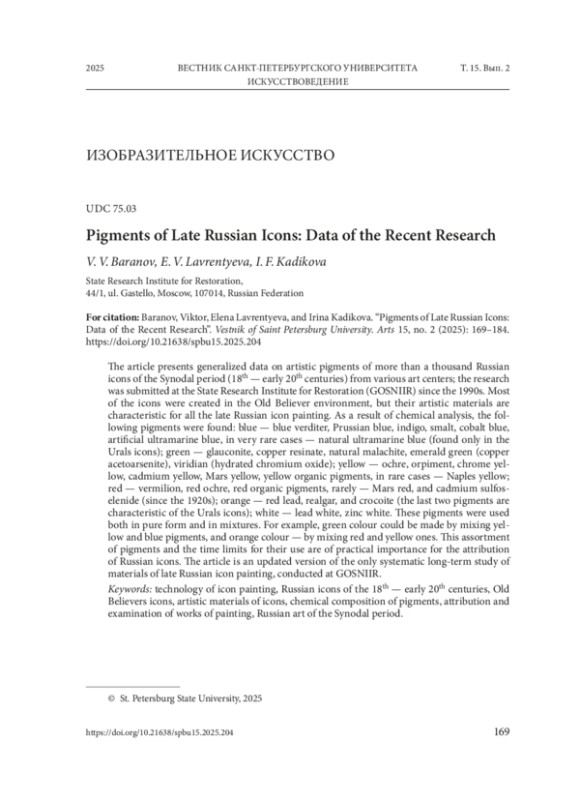
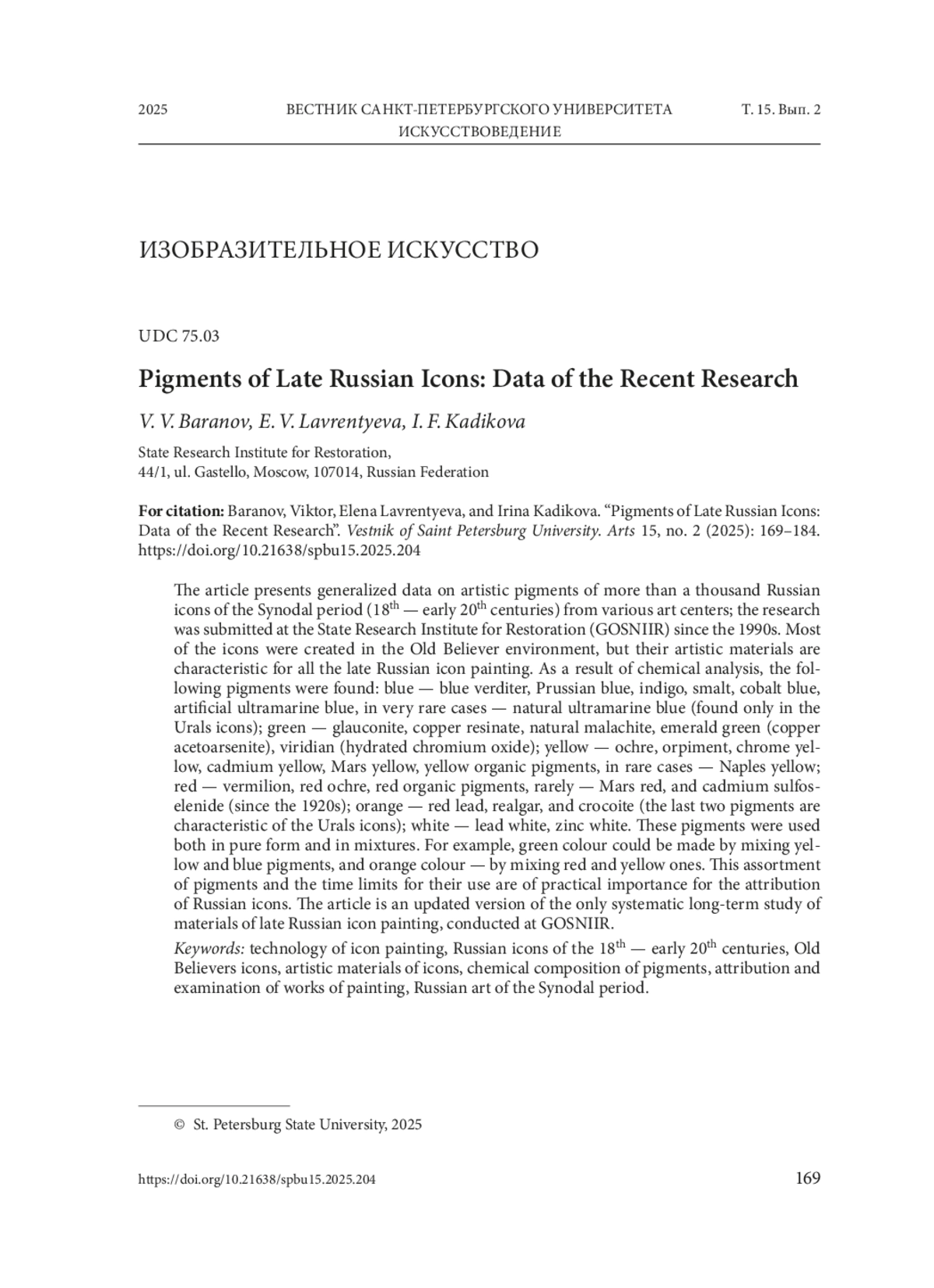
The article presents generalized data on artistic pigments of more than a thousand Russian icons of the Synodal period (18th — early 20 th centuries) from various art centers; the research was submitted at the State Research Institute for Restoration (GOSNIIR) since the 1990s. Most of the icons were created in the Old Believer environment, but their artistic materials are characteristic for all the late Russian icon painting. As a result of chemical analysis, the following pigments were found: blue — blue verditer, Prussian blue, indigo, smalt, cobalt blue, artificial ultramarine blue, in very rare cases — natural ultramarine blue (found only in the Urals icons); green — glauconite, copper resinate, natural malachite, emerald green (copper acetoarsenite), viridian (hydrated chromium oxide); yellow — ochre, orpiment, chrome yellow, cadmium yellow, Mars yellow, yellow organic pigments, in rare cases — Naples yellow; red — vermilion, red ochre, red organic pigments, rarely — Mars red, and cadmium sulfoselenide (since the 1920s); orange — red lead, realgar, and crocoite (the last two pigments are characteristic of the Urals icons); white — lead white, zinc white. These pigments were used both in pure form and in mixtures. For example, green colour could be made by mixing yellow and blue pigments, and orange colour — by mixing red and yellow ones. This assortment of pigments and the time limits for their use are of practical importance for the attribution of Russian icons. The article is an updated version of the only systematic long-term study of materials of late Russian icon painting, conducted at GOSNIIR
Идентификаторы и классификаторы
- SCI
- Искусство
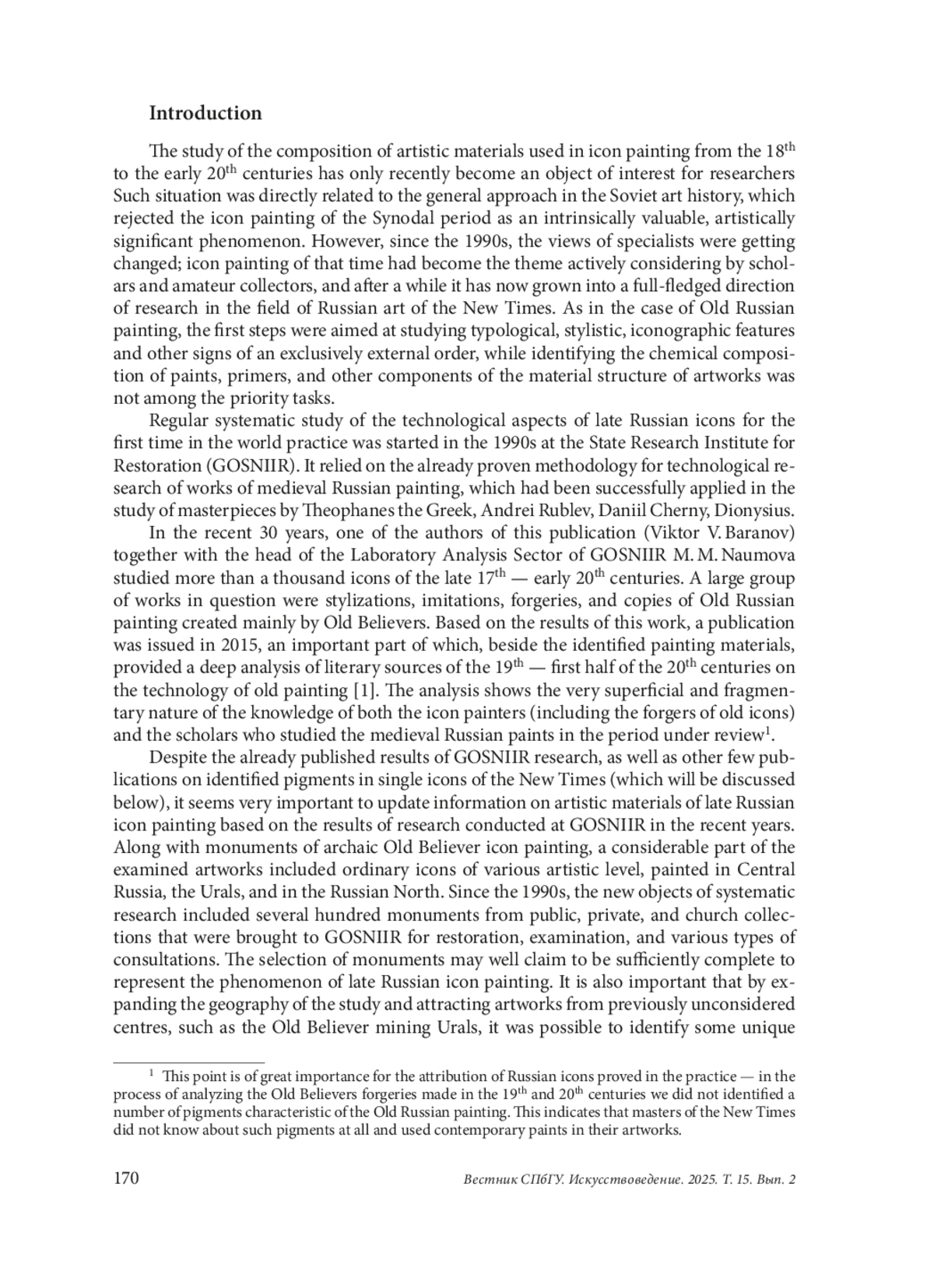
The study of the composition of artistic materials used in icon painting from the 18th to the early 20th centuries has only recently become an object of interest for researchers Such situation was directly related to the general approach in the Soviet art history, which rejected the icon painting of the Synodal period as an intrinsically valuable, artistically significant phenomenon. However, since the 1990s, the views of specialists were getting changed; icon painting of that time had become the theme actively considering by scholars and amateur collectors, and after a while it has now grown into a full-fledged direction of research in the field of Russian art of the New Times. As in the case of Old Russian painting, the first steps were aimed at studying typological, stylistic, iconographic features and other signs of an exclusively external order, while identifying the chemical composition of paints, primers, and other components of the material structure of artworks was not among the priority tasks
Если у вас возникли вопросы или появились предложения по содержанию статьи, пожалуйста, направляйте их в рамках данной темы.
Список литературы
1. Baranov, Viktor. “Technology of Late Russian Icon Painting”. In Ekspertiza i atributsiia proizvedenii izobrazitel’nogo i dekorativno-prikladnogo iskusstva. Materialy 19 nauchnoi konferentsii (26-28 noiabria 2014), ed. by Lidiia Iovleva, 10-17. Moscow: Magnum Ars Publ., 2015. (In Russian).
2. Lelekova, Ol’ga, and Maiia Naumova. Date on Icons Pigments Composition and their Attributive Value. ICOM, Ottawa: The International Council of Museums Publ., 1981. Accessed September 15, 2024. https://www.icom-cc-publications-online.org/3767/Data-on-icons-pigments-composition-and-their-attributive-value.
3. Lelekova, Ol’ga. Russian classical iconostasis. Iconostasis from the Assumption Cathedral of the Kirillo-Belozersky Monastery. 1497. Moscow: Indrik Publ., 2011. (In Russian).
4. Lelekova, Ol’ga. “Research and conservation of Dionisy’s frescoes in the Cathedral of the Virgin Mary Nativity of the Ferapontov Monastery”. In Materialy nauchno-metodicheskoi konferentsii, 13-15 sentiabria 2011 goda, Kirillov - Ferapontovo, ed. by Aleksandr Trezvov, 66-71. Moscow: [s. n.], 2012. (In Russian).
5. Vzdornov, Gerol’d. Archaeology of Art. Collection of articles and materials in memory of O. V. Lelekova (1932-2015). Moscow: Indrik Publ., 2016. (In Russian).
6. Grenberg, Iurii. Technology of Easel Painting. History and Research: Textbook. St. Petersburg: Lan’ Publ.; Planeta muzyki Publ., 2019. (In Russian).
7. Naumova, Maiia. Late Antiquity. Middle Ages. Renaissance. Moscow: Indrik Publ., 2018. (In Russian).
8. Pisareva, Svetlana. Methods for the Identification of Prime Materials and Paintings Pigments. Izhevsk: [s. n.], 2017. (In Russian).
9. Baranov, Viktor, Sof ‘ia Sverdlova, and Dmitrii Pershin. “Comparative analysis of the technical and technological features of A. Rublev’s ‘Trinity’ and the icons of the Zvenigorod range“. In Sbornik trudov po istorii Zvenigorodskogo kraia, comp. by Dmitrii Sedov, 156-95. Zvenigorod: Zvenigorodskii istoriko-arkhitekturnyi i khudozhestvennyi muzei Publ., 2019, vol. 4. (In Russian).
10. Baranov, Viktor. “On the question about the original form of iconostases of Rublev time in the Assumption cathedrals of Zvenigorod and Vladimir”. In Sbornik trudov po istorii Zvenigorodskogo kraia, comp. by Dmitrii Sedov, 218-29. Zvenigorod: Zvenigorodskii istoriko-arkhitekturnyi i khudozhestvennyi muzei Publ., 2019, vol. 4. (In Russian).
11. Dedova, Arina, Tamara Anisimova, Nikolai Brandt, Andrei Chikishev, Elena Kononova, and Irina Balakhnina. “Microsampling of Veliky Novgorod frescoes using laser ablation”. Optical and Quantum Electronics, no. 55:511 (2023). DOI: 10.1007/s11082-023-04804-x
12. Iakovleva, Anna, and Maiia Naumova. “Pigments and Primers of Icons of the 18th-19th Centuries from the Collection of the Moscow Kremlin Museum and the Significance of Their Research for Attribution”. In Problemy restavratsii muzeinykh pamiatnikov, 37-40. Moscow: Gosudarstvennyi istoriko-kul’turnyi muzei-zapovednik “Moskovskii Kreml’” Publ., 2001. (In Russian).
13. Krasilin, Mikhail, Elena Danchenko, and Maiia Naumova. “About One Palekh Icon of the 18th century”. In Issledovaniia v restavratsii: materialy mezhdunarodnoi nauchno-issledovatel’skoi konferentsii (Moskva, 4-6 dekabria 2001), 93-101. Moscow: Gosudarstvennyi nauchno-issledovatel’skii institut restavratsii Publ., 2002. (In Russian).
14. Krasilin, Mikhail, Maiia Naumova, and Elena Danchenko. “About One Group of Nevyansk Icons”. Iskusstvo khristianskogo mira, no. 10 (2007): 404-16. (In Russian).
15. Krasilin, Mikhail. “Comprehensive Study of the Group of Icons in the Period from 2009 to 2011 (on the Material of Museums and Private Collections)”. Khudozhestvennoe nasledie. Khranenie. Issledovanie. Restavratsiia, no. 32-33 (2021): 31-65. (In Russian).
16. Afanas’ev, Iurii, Andrei Afanas’ev, and Valeriia Iarosh. “Paints of Velikopozhensky Monastery Icons”. Antikvariat i predmety kollektsionirovaniia, no. 5 (2012): 10-16. (In Russian).
17. Astakhova, Irina, and Natal’ia Plaksina. “Mineral Composition of Paints of Icons from the Lower Pechora River”. Vestnik Instituta geologii Komi nauchnogo tsentra Ural’skogo otdeleniia Rossiiskoi akademii nauk, no. 4 (2016): 29-33. (In Russian). DOI: 10.19110/2221-1381-2016-4-29-33
18. Astakhova, Irina, and Natal’ia Plaksina. “Paints of Old Believer Carved Icons of the Lower Pechora: Technological and Historical-Archival Aspects of Research”. Izvestiia Ural’skogo federal’nogo universiteta. Gumanitarnye nauki 2, no. 25 (2023): 226-36. (In Russian). DOI: 10.15826/izv2.2023.25.2.034
19. Kadikova, Irina, Ekaterina Morozova, and Dmitrii Pershin. “Results of the study of the wooden panels, primer materials and pigments of the paint layer of two icons of the Mother of God of Kazan”. In Chudotvornyi Kazanskii obraz Bogomateri. Kazanskii Bogoroditskii monastyr’, 61-76. Kazan, Izdatel’stvo Sergeia Buzukina Publ., 2016, vol. 2. (In Russian).
20. Baranov, Viktor, Dmitrii Pershin, Svetlana Pisareva, Irina Kadikova, and Ekaterina Morozova. “Technological features of gold-background icons created in the workshop of the Kazan Bogoroditsky Monastery in the late 19th - early 20th century”. In Ikony masterskoi Kazanskogo Bogoroditskogo monastyria - svideteli istorii Kazanskogo kraia, 9-23. Kazan, Izdatel’stvo Sergeia Buzukina Publ., 2019. (In Russian).
21. Lavrent’eva, Elena, and Irina Kadikova. “Icons of the Old Believers Mining Urals of the First Half of the 18th Century: Research of Technology and Artistic Materials”. In Vos’moi Vserossiiskii konkurs molodykh uchenykh v oblasti iskusstv i kul’tury: sbornik rabot laureatov, 6-63. Moscow: Institut naslediia Publ., 2021. (In Russian).
22. Kadikova, Irina, and Elena Lavrent’eva. “The Chemical Composition of Paints and Primers as an Important Aspect of the Attribution of Late Russian Icons of the Urals Region”. Aktual’nye problemy teorii i istorii iskusstva, no. 13 (2023): 767-80. (In Russian). DOI: 10.18688/aa2313-9-61 EDN: RRBYFQ
23. Lavrent’eva, Elena, Irina Kadikova, and Vladimir Karpenko. “New Data on Orange Mineral Pigments in the Works of the Nevyansk School of Icon Painting”. Secreta Artis 2, no. 6 (2023): 22-49. (In Russian). DOI: 10.51236/2618-7140-2023-6-2-22-49
24. Gordienko, Tat’iana. “Technological Analysis of Prime and Polyment of the Nev’yansk Icons of the 1st Quarter of the 60s of the 19th Century”. In Dekabr’skie dialogi: materialy Vserossiiskoi nauchnoi konferentsii pamiati Fedora Melekhina (19-21 dekabria 2005 g.), ed. by Alla Gumeniuk, 116-9. Omsk: [s. n.], 2006. (In Russian).
25. Vasilieva, Anastasiia, and Vadim Parfenov. “Identification of pigments of Russian icons by means of X-ray fluorescence spectroscopy”. Journal of Physics 1, no. 2086 (2021): 012172. DOI: 10.1088/1742-6596/2086/1/012172
26. Filip, Dumitrița-Daniela, Cristina Carșote, and Elena Badea. “New Insights into the Trasfer and Reception of Russian Icons in Transylvania Based on the Interdisciplinary Research of the Ricontrans Project. A Conservation-Restoration Perspective”. In Russian Icons from Transylvania: Exhibition Catalogue, ed. by Ana Dumitran and Filip Dumitrița-Daniela, 45-88. Alba Iulia: Editura Muzeului Naţional al Unirii Alba Iulia Publ.; Cluj-Napoca: Mega Publ., 2023.
27. Baranov, Viktor. “Microscopic Research of the Icon ‘The Old Testament Trinity’ by Andrey Rublev. On the question of the features of icons technological research”. In Issledovaniia v konservatsii kul’turnogo naslediia: materialy mezhdunarodnoi nauchno-metodicheskoi konferentsii, 16-24. Moscow: Indrik Publ., 2012. (In Russian).
28. Lugina, Lidiia, and Iuliia Bratushko. “The role of cross-section research for painting attribution”. In Materialy V nauchnoi konferentsii “Ekspertiza i atributsiia proizvedenii izobrazitel’nogo iskusstva”, 267-70. Moscow: Magnum Ars Publ., 2001. (In Russian).
29. Berrie, Barbara. “Prussian Blue”. In Artists’ Pigments. A Handbook of their History and Characteristics, ed. by Elizabeth FitzHugh, 191-218. Washington: National Gallery of Art Publ.; London: Archetype Publications, 1997, vol. 3.
30. Luk’ianov, Pavel. History of Chemical Trades and Chemical Industry in Russia Until the End of the 19th Century. 6 vols. Moscow: Izdatel’stvo Akademii nauk SSSR Publ., 1955, vol. 4: Istoriia proizvodstva krasok. (In Russian).
31. Images and Symbols of the Old Faith. Works of Art from the Collection of the State Russian Museum. St. Petersburg: Palace Editions - Craficart Publ., 2008. (In Russian).
32. Kyzlasova, Irina. “On the Problem of Counterfeiting and Copying of Icons in the 19th - early 20th Century”. Iskusstvo Khristianskogo mira, no. 2 (1998): 64-73. (In Russian).
33. Eastaugh, Nicholas, Valentine Walsh, Tracey Chaplin, and Ruth Siddall. Pigment Compendium. A Dictionary of Historical Pigments. Amsterdam: Elsevier - Butterworth Heinemen Publ., 2004.
34. Baranov, Viktor. “On the question of the authorship of the copy of Rublev’s Trinity from the Trinity Cathedral”. In Troitse-Sergieva Lavra v istorii, kul’ture i dukhovnoi zhizni Rossii, 84-93. Sergiev Posad: Tsvetografika Publ., 2022. (In Russian).
35. Kühn, Hermann, and Mary Curran. “Chrome Yellow and Others Chromate Pigments”. In Artists Pigments: A Handbook of their History and Characteristics, ed. by Robert Feller, 187-217. Washington: National Gallery of Art; London: Archetype Publications, 1986, vol. 1.
36. Newman, Richard. “Chromium Oxide Greens”. In Artists Pigments: A Handbook of their History and Characteristics, ed. by Elizabeth FitzHugh, 273-94. Washington: National Gallery of Art; London: Archetype Publications, 1997, vol. 3.
37. Semenov, Vladimir. Malachite. Chronicle. Documents. Comments. 2 vols. Sverdlovsk: Sredne-Ural’skoe knizhnoe izdatel’stvo Publ., 1987, vol. 2. (In Russian).

Выпуск
Другие статьи выпуска
На основе архивных и опубликованных материалов, а также натурного обследования рассматриваются вопросы, связанные с проектировкой и строительством железнодорожных поселков на Дальнем Востоке вдоль соединительной линии между Уссурийской и Китайско-Восточной железными дорогами. Специфика данного отрезка Великого Сибирского пути заключалась в его трансграничном характере и привлечении к сооружению коммерческого Общества КВЖД, что во многом способствовало сокращению сроков строительства. Наличие подведенной к начальной станции Уссурийской железной дороги и близость порта Владивостока обеспечили стабильную поставку строительных материалов и экономию средств. Последнее стало также возможным благодаря отчуждению под строительство государственных земель, находящихся в аренде у крестьян и казаков. Сокращение затрат позволило инженерам Общества КВЖД улучшить технические характеристики возводимых в населенных поселках строений. На этапе ввода в эксплуатацию линии здания в основном были деревянными с каменными фундаментами и цоколями, только по мере роста численности населения и усложнения функционала станций появлялись каменные постройки. Планировочная структура железнодорожных поселков, ориентированная в первую очередь на нужды дороги, имела типовой характер. В центре всегда находилось пассажирское здание, на него были ориентированы остальные технические и гражданские сооружения. В состав населенных пунктов при крупных станциях обязательно входили жилые дома служащих, больница, церковь, школа. Бóльшая часть возводимых зданий имела утилитарный характер и возводилась по типовым проектам, разработанным Министерством путей сообщения. Вместе с тем трансграничное положение Никольской железнодорожной ветки, активный товаро- и пассажиропотоки стимулировали рост численности населения, развитие архитектурного облика поселков и усложнение планировочной структуры при сохранении градообразующей функции железной дороги
This article examines the historical and architectural significance of Erzincan’s Kurma Evler, earthquake-resistant houses constructed in response to the devastating 1939 earthquake. It aims to assess the Kurma Evler’s role in modern heritage and their potential as sustainable models for earthquake-resistant construction. The study involves a comparative analysis of Kurma Evler with similar post-disaster housing projects globally. It evaluates their design, construction techniques, and sustainability features. The research also explores the impact of Erzincan’s historical context and the 1939 earthquake on the city’s architecture and urban planning. The Kurma Evler, built between 1949 and 1951, exemplify modern heritage through their earthquake-resistant design and prefabricated construction. These single-story, detached houses with gardens represent significant advances in building techniques and offer valuable lessons for earthquake-prone regions. The comparison with international post-disaster housing projects highlights commonalities in design and construction practices. Limited Scope of Surviving Structures: the focus is on the Kurma Evler that have survived, but there is no detailed analysis of those that have been demolished or are no longer accessible. This limits understanding of the full impact of urban development on these historic structures. The study emphasizes the importance of preserving the Kurma Evler as a cultural and architectural legacy. It advocates for a collaborative preservation approach involving local communities, government authorities, and international organizations. Proposed initiatives include educational programs, community-led preservation efforts, and heritage registration. This paper contributes to the understanding of modern heritage by highlighting the Kurma Evler as a model for sustainable and earthquake-resistant construction. It offers recommendations for their preservation and restoration, underscoring their significance in architectural evolution and societal resilience.
Исследования доктора искусствоведения И. В. Линник занимают особое место в отечественной науке и музейном деле. Ее профессиональные интересы были сосредоточены в области атрибуции живописи старых западноевропейских мастеров, в первую очередь фламандских и голландских. Работая в Государственном Эрмитаже, она большое внимание уделяла также изучению фондов художественных музеев в различных регионах Советского Союза. И. В. Линник установлено авторство около 300 произведений художников Фландрии и Голландии XVII в. и некоторых мастеров других европейских стран. Ее вклад в науку не ограничен только практической музейной работой. Монография Линник «Голландская живопись XVII века и проблемы атрибуции картин» (1980) представляет собой уникальный для отечественного и западного искусствознания труд, объединяющий вопросы национального своеобразия и эволюции голландской школы в широком общеевропейском контексте с атрибуционной проблематикой. В этом исследовании систематизирован и проанализирован не только собственный практический опыт автора, но и достижения западной и отечественной науки конца XIX — середины XX в. в деле изучения голландской и фламандской живописи. И. В. Линник создана тщательно продуманная методика атрибуции на основе сравнительного образно-стилистического анализа, получившая детальную теоретическую разработку и показавшая свою эффективность на практике. В статье научное наследие И. В. Линник рассматривается с точки зрения разнообразия конкретных случаев атрибуции, методики исследования и полученных результатов. На основе историографического анализа публикаций ученого показан ее вклад в изучение наследия большого числа выдающихся (Ф. Хальс, Рембрандт, Рубенс, караваджисты) и более скромных фламандских и голландских мастеров, совершенствование методологии и методики атрибуционной работы
Петроградское Скрябинское общество — объединение, деятельность которого, вдохновленная идеями и творчеством автора «Поэмы экстаза» и «Прометея», остается малоизученной. Образованное в 1915 г., Общество просуществовало два года, после октябрьских событий 1917 г. постепенно прекратив свои собрания. За обозначенный период членами объединения проводились закрытые и публичные встречи, концерты, были напечатаны устав и два выпуска «Известий», в которых зафиксированы важные позиции участников Петроградского и Московского обществ, касающиеся рассмотрения наследия Скрябина, и негласные установки, объединяющие скрябинский круг. В статье приводятся опубликованные доклады деятелей Петроградского Скрябинского общества, вводится материал сообщения одного из учредителей Общества С. К. Маковского «Касание музыки Скрябина к пластическим искусствам», автограф которого хранится в Отделе рукописей Государственного Русского музея; определяется значение журнала «Аполлон» в истории развития Общества; уточняется состав участников, характерным признаком которого является привлечение не только музыкантов, но и философов, искусствоведов, писателей и пр. Выделяются ключевые этапы деятельности Общества: от идеи создания к официальному открытию и регулярным собраниям. Одним из центральных событий истории Общества стала дискуссия, посвященная опубликованной в 1916 г. Л. Л. Сабанеевым книге «Скрябин». Работа Сабанеева вызвала большое волнение и серьезные замечания остальных участников Петроградского и Московского обществ. Примечательным представляется смена ракурса докладов в 1917 г. В этот период начинает преобладать революционная тематика. Обозначенные в документах Петроградского Скрябинского общества направления составляют важный этап исследования творчества композитора и развития творческих содружеств 1910-х годов.
Поднимается проблема источниковедческого анализа нотных и звуковых публикаций русского музыкального фольклора. В этномузыкознании она считается актуальной по отношению к изданиям эпохи слуховых записей: необходимость их оценки на предмет документальной значимости объясняется объективными сложностями собирательского процесса. Е. В. Гиппиус, впервые заявивший в 1957 г. об обязательности критического анализа подобных источников, показал эффективность структурно-типологического метода в процессе реконструкции нотных образцов, записанных слуховым способом. Объектом изучения в настоящей работе стали сборники фольклорных материалов известного советского и российского собирателя и публикатора Г. М. Науменко. В историю отечественной фольклористики (музыкальной и филологической) он вошел как авторитетный специалист в области детского и материнского фольклора, собравший коллекцию редких и даже уникальных текстов. Его перу принадлежит множество изданий, выходивших в свет начиная с 1977 г. Однако проведенный структурно-типологический анализ опубликованных этим автором музыкально-поэтических образцов продемонстрировал их разительное несоответствие всем известным законам структурной организации народных песенных текстов восточнославянской традиции. В силу отсутствия в опубликованных нотных транскрипциях типовых музыкальноритмических и ладово-мелодических форм данные песни невозможно признать подлинными фольклорными образцами и следует квалифицировать как подделку. Такими же фальсификатами являются и вербальные песенные тексты, равно как и произведения прозаических жанров фольклора — сказки, скороговорки, загадки. Едва ли не все они — продукт авторского дилетантского творчества и были сочинены, по-видимому, самим Науменко. Изданный этим собирателем звуковой архив также требует критического отношения. Достоверными в нем, да и то лишь отчасти, можно считать записи от исполнителей старшего возраста. Проведенное исследование актуализирует проблему источниковедческого анализа фольклорных публикаций, в том числе современных, как необходимого этапа научной работы в этномузыкознании
The article deals with the detailed analysis of the instrumentation of the soprano aria “Laßt der Spötter Zungen schmähen” (no. 5), in which the first violin part standing out fragmentarily from the unison of the high-pitched strings accompanying the singer. The Cantata BWV 70, created by Bach during his Weimar period, was revived with a few alterations in Leipzig in 1723. The author covers the issue of the number of players in Bach’s orchestra during these periods and concludes that most likely each violin part was performed by three musicians and the viola part was performed by two musicians in Leipzig; while in Weimar the cast was much more limited and there was only one performer for each instrument. In the handwritten pieces of the first violin part of the soprano aria, the indicated dynamics coincide with the beginning and ending of pauses in the second violin and viola parts. The comparison of this peculiar feature of the notation with other manuscripts of Bach’s compositions, some improvisatory traits of the piano fragments, and the potential opportunity to create timbre contrast suggests that the dynamic markings forte — piano become an alternative to indications tutti — solo, and individual fragments of the aria, marked with piano, should be performed by a soloist. We do not know for certain, what was the exact sound of this music in 1723. However, at present, having much superior performing resources than Bach had in Leipzig, we can assign separate pieces to a soloist, regardless of the number of orchestra musicians. Thanks to this solution, music appears much more convincing and gains a certain splendor, that is supported by the rare examples of contemporary performing practice
Издательство
- Издательство
- СПБГУ
- Регион
- Россия, Санкт-Петербург
- Почтовый адрес
- Россия, 199034, Санкт-Петербург, Университетская наб., д. 7–9
- Юр. адрес
- 199034, г Санкт-Петербург, Василеостровский р-н, Университетская наб, д 7/9
- ФИО
- Кропачев Николай Михайлович (РЕКТОР)
- E-mail адрес
- spbu@spbu.ru
- Контактный телефон
- +7 (812) 3282000
- Сайт
- https://spbu.ru/