
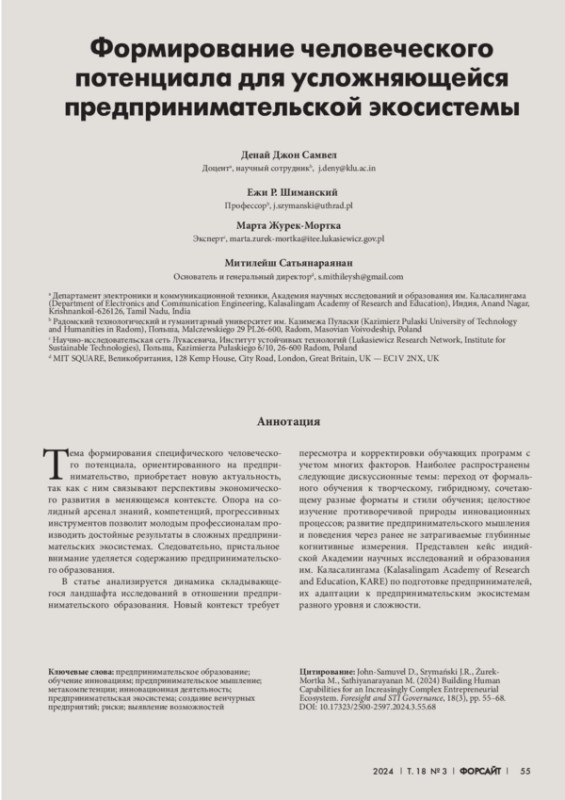
Тема формирования специфического человеческого потенциала, ориентированного на предпринимательство, приобретает новую актуальность, так как с ним связывают перспективы экономического развития в меняющемся контексте. Опора на солидный арсенал знаний, компетенций, прогрессивных инструментов позволит молодым профессионалам производить достойные результаты в сложных предпринимательских экосистемах. Следовательно, пристальное внимание уделяется содержанию предпринимательского образования. В статье анализируется динамика складывающегося ландшафта исследований в отношении предпринимательского образования. Новый контекст требует пересмотра и корректировки обучающих программ с учетом многих факторов. Наиболее распространены следующие дискуссионные темы: переход от формального обучения к творческому, гибридному, сочетающему разные форматы и стили обучения; целостное изучение противоречивой природы инновационных процессов; развитие предпринимательского мышления и поведения через ранее не затрагиваемые глубинные когнитивные измерения. Представлен кейс индийской Академии научных исследований и образования им. Каласалингама (Kalasalingam Academy of Research and Education, KARE) по подготовке предпринимателей, их адаптации к предпринимательским экосистемам разного уровня и сложности
Предпросмотр статьи
Идентификаторы и классификаторы
- SCI
- Экономика
The topic of nurturing specific entrepreneurial human capital acquires new relevance as the prospects for economic development in a changing context are associated with it. Relying on a solid base of knowledge, competencies, and progressive tools would allow young professionals to produce decent results in complex entrepreneurial ecosystems. Consequently, close attention is paid to the content of entrepreneurial education. This article analyzes the dynamics of the emerging research landscape regarding entrepreneurial education. The new context calls for a revision and adjustment of training programs based on many factors. The most common topics of discussion are the following: the transition from formal to creative, hybrid learning that combines different formats and learning styles, the holistic study of the contradictory nature of innovation processes, and the development of entrepreneurial thinking and behavior through previously untouched deep cognitive dimensions. The case of the Kalasalingam Academy of Research and Education (KARE) in India on training entrepreneurs and their adaptation to entrepreneurial ecosystems of different levels and complexity is presented
Если у вас возникли вопросы или появились предложения по содержанию статьи, пожалуйста, направляйте их в рамках данной темы.
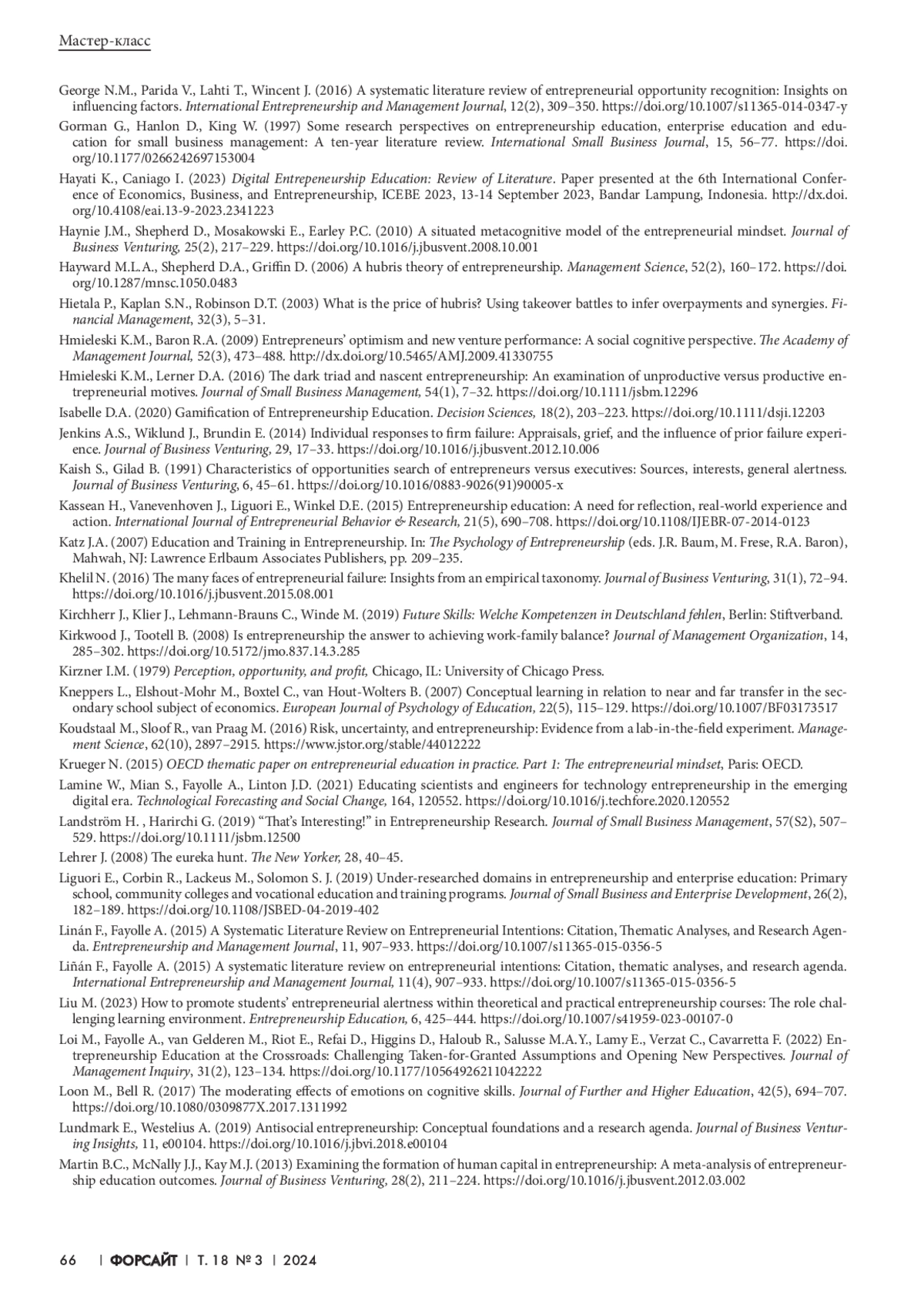
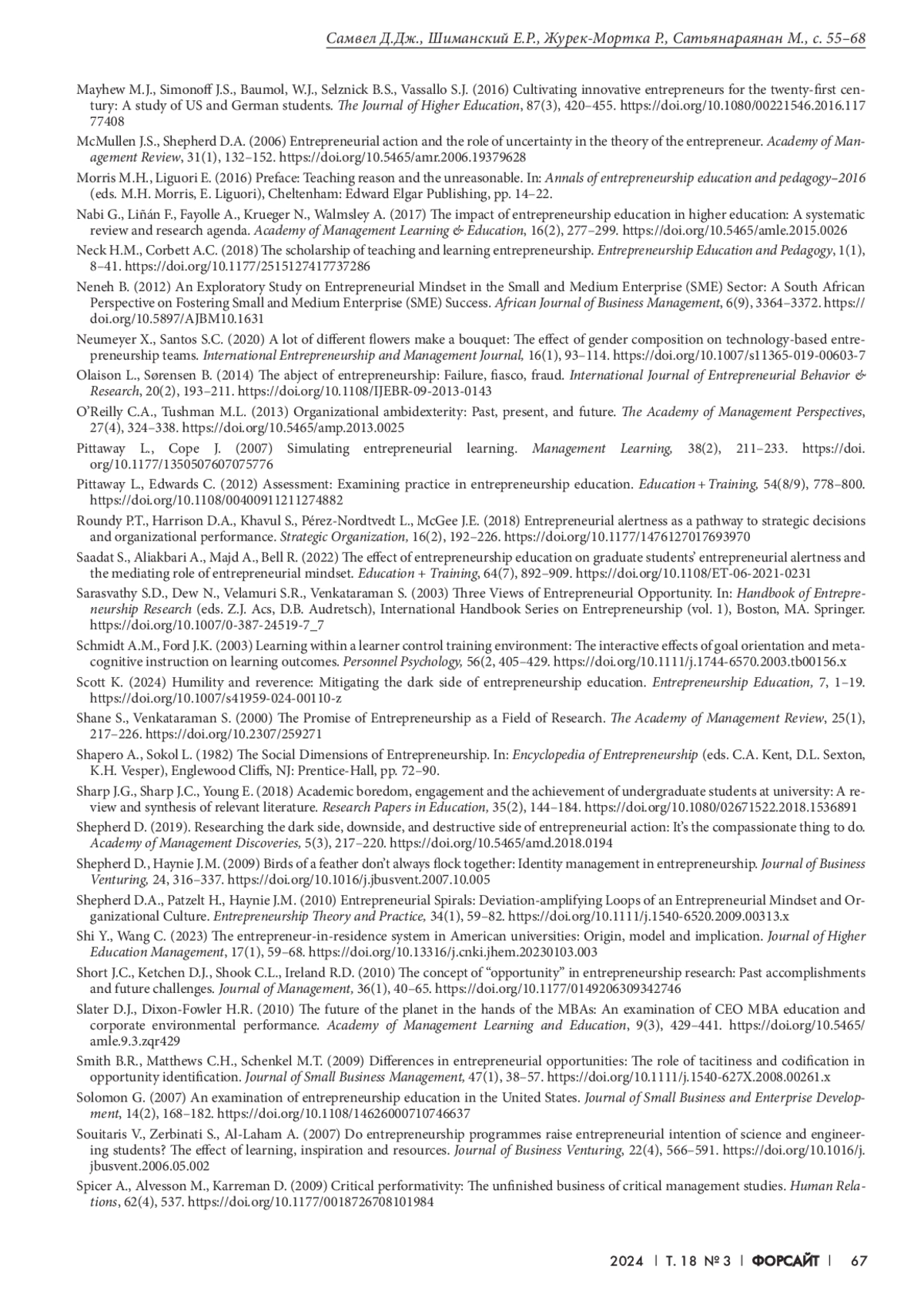
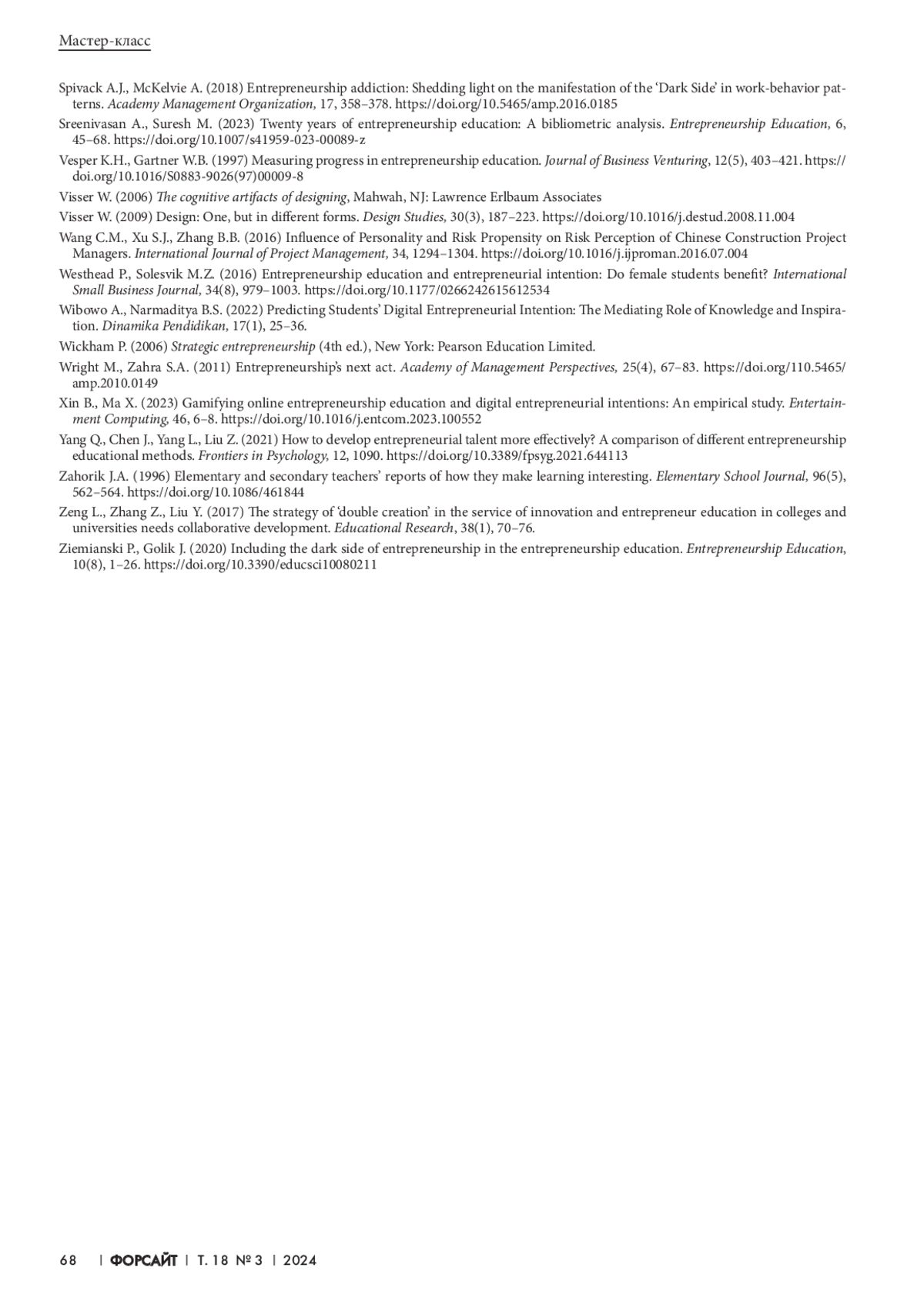
Список литературы
1. Ajzen I. (1991) The theory of planned behavior. Organizational Behavior and Human Decision Processes, 50(2), 179-211. DOI: 10.1016/0749-5978(91)90020-T
2. Alvarez S.A., Barney J.B. (2017) Resource-based theory and the entrepreneurial firm. In: Strategic Entrepreneurship: Creating a New Mindset (eds. M.A. Hitt, R.D. Ireland, S.M. Camp, D.L. Sexton), New York: Wiley, pp. 87-105. DOI: 10.1002/9781405164085.ch5
3. Armstrong P. (2005) Critique of entrepreneurship: People and policy, London: Palgrave Macmillan.
4. Baierl R., Thamm R. (2023) Entrepreneurship Education in Digital Environments: Developing a Didactic Framework for a New Era. In: Progress in Entrepreneurship Education and Training. FGF Studies in Small Business and Entrepreneurship (eds. J.H. Block, J. Halberstadt, N. Högsdal, A. Kuckertz, H. Neergaard), Cham: Springer, pp. 1-13. DOI: 10.1007/978-3-031-28559-2_18
5. Bandera C., Eminet A., Passerini K., Pon K. (2018) Using mind maps to distinguish cultural norms between French and United States entrepreneurship students. Journal of Small Business Management, 56(S1), 177-196. DOI: 10.1111/jsbm.12398
6. Bandera C., Santos S.C., Liguori E.W. (2021) The Dark Side of Entrepreneurship Education: A Delphi Study on Dangers and Unintended Consequences. Entrepreneurship Education and Pedagogy, 4(4), 609-636. DOI: 10.1177/2515127420944592 EDN: PYPPIA
7. Barnard A., Pittz T., Vanevenhoven J. (2019). Entrepreneurship education in U.S. community colleges: A review and analysis. Journal of Small Business and Enterprise Development, 26(2), 190-208. DOI: 10.1108/JSBED-06-2018-017
8. Baron R.A. (2006) Opportunity recognition as pattern recognition: How entrepreneurs “connect the dots” to identify new business opportunities. Academy of Management Perspectives, 20(1), 104-119. DOI: 10.5465/amp.2006.19873412
9. Barry D., Meisiek S. (2015) Discovering the business studio. Journal of Management Education, 39(1), 153-175. DOI: 10.1177/1052562914532801
10. Boubker O., Arroud M., Ouajdouni A. (2021) Entrepreneurship education versus management students’ entrepreneurial intentions. A PLS-SEM approach. The International Journal of Management Education, 19(1), 100450. DOI: 10.1016/j.ijme.2020.100450 EDN: JMVQSH
11. Bronfenbrenner U. (1979) The ecology of human development: Experiments by nature and design, Cambridge, MA: Harvard University Press.
12. Byrne O., Shepherd D. (2015) Different strokes for different folks: Entrepreneurial narrative of emotion, cognition, and making sense of business failure. Entrepreneurship Theory and Practice, 39(2), 375-405. DOI: 10.1111/etap.12046
13. Csikszentmihalyi M. (1990) Flow. The psychology of optimal experience, New York: Harper Perennial.
14. Cui J., Sun J., Bell R. (2021) The Impact of Entrepreneurship Education on the Entrepreneurial Mindset of College Students in China: The mediating role of inspiration and the role of educational attributes. International Journal of Management Education, 19(1), 100296. DOI: 10.1016/j.ijme.2019.04.001 EDN: QREJGU
15. Da Silva G.B., Costa H.G., De Barros M.D. (2015) Entrepreneurship in engineering education: A literature review. International Journal of Engineering Education, 31(6), 1701-1710.
16. Deny J.S. (2020) JD Paradigm for Student Innovation, Start-ups, and Entrepreneurial Ecosystem. TEST Journal of Engineering and Management (May-June), 12310-12312.
17. Dong A., Garbuio M., Lovallo D. (2016) Generative sensing: A design perspective on the microfoundations of sensing capabilities. California Management Review, 58(4), 97-117. DOI: 10.1525/cmr.2016.58.4.97
18. Dorst K. (2011) The core of ‘design thinking’ and its application. Design Studies, 32(6), 521-532. DOI: 10.1016/j.destud.2011.07.006
19. Edelman L.F., Manolova T.S., Brush C.G. (2008) Entrepreneurship education: Correspondence between practices of nascent entrepreneurs and textbook prescriptions for success. Academy of Management Learning and Education, 7(1), 56-70. https://www.jstor.org/stable/40214497.
20. Ernst & Young (2011) Nature or nurture? Decoding the DNA of the entrepreneur, Kansas City, MO: Ewing Marion Kauffman Foundation.
21. Fast L.A., Lewis J.L., Bryant M.J., Bocian K.A., Cardullo R.A., Rettig M., Hammond K.A. (2010) Does math self-efficacy mediate the effect of the perceived classroom environment on standardized math test performance? Journal of Educational Psychology, 102(3), 729-740. DOI: 10.1037/a0018863
22. Fayolle A. (2013) Personal views on the future of entrepreneurship education. Entrepreneurship & Regional Development, 25(7-8), 692-701. DOI: 10.1080/08985626.2013.821318
23. Fayolle A., Klandt H. (2006) Issues and Newness in the Field of Entrepreneurship Education: New Lenses for New Practical and Academic Questions. In: International Entrepreneurship Education (ed. A. Fayolle), Cheltenham: Edward Elgar Publishing, pp. 1-17.
24. Fayolle A., Lamine W., Mian S., Phan P. (2021) Effective models of science, technology and engineering entrepreneurship education: Current and future research. Journal of Technology Transfer, 46, 277-287. DOI: 10.1007/s10961-020-09789-3 EDN: GWCDEO
25. Fellnhofer K. (2019) Toward a taxonomy of entrepreneurship education research literature: A bibliometric mapping and visualization. Educational Research Review, 27, 28-55. DOI: 10.1016/J.EDUREV.2018.10.002
26. Ferreira J., Fayolle A., Ratten V., Raposo M. (2018) Entrepreneurial Universities, Cheltenham: Edward Elgar Publishing.
27. Frese M., Gielnik M.M. (2014) The psychology of entrepreneurship. Annual Review of Organizational Psychology and Organizational Behavior, 1(1), 413-438. DOI: 10.1146/annurev-orgpsych-031413-091326
28. Fretschner M., Weber S. (2013) Measuring and Understanding the Effects of Entrepreneurial Awareness Education. Journal of Small Business Management, 51, 410-428. DOI: 10.1111/jsbm.12019
29. Furnham A., Ribchester T. (1995) Tolerance of Ambiguity: A Review of the Concept, Its Measurement and Applications. Current Psychology, 14, 179-199. DOI: 10.1007/BF02686907 EDN: ISFVFF
30. Gao W., Zhang L. (2024) Entrepreneurs-in-residence programmes: The SUIBE approach. Entrepreneurship Education, 7, 87-103. DOI: 10.1007/s41959-024-00113-w EDN: OWJLUZ
31. Garbuio M., Dong A., Lin N., Tschang T., Lovallo D. (2018) Demystifying the genius of entrepreneurship: How design cognition can help create the next generation of entrepreneurs. The Academy of Management Learning and Education, 17(1), 41-61. DOI: 10.5465/amle.2016.0040
32. George N.M., Parida V., Lahti T., Wincent J. (2016) A systematic literature review of entrepreneurial opportunity recognition: Insights on influencing factors. International Entrepreneurship and Management Journal, 12(2), 309-350. DOI: 10.1007/s11365-014-0347-y
33. Gorman G., Hanlon D., King W. (1997) Some research perspectives on entrepreneurship education, enterprise education and education for small business management: A ten-year literature review. International Small Business Journal, 15, 56-77. DOI: 10.1177/0266242697153004 EDN: JMSRNP
34. Hayati K., Caniago I. (2023) Digital Entrepeneurship Education: Review of Literature. Paper presented at the 6th International Conference of Economics, Business, and Entrepreneurship, ICEBE 2023, 13-14 September 2023, Bandar Lampung, Indonesia. DOI: 10.4108/eai.13-9-2023.2341223
35. Haynie J.M., Shepherd D., Mosakowski E., Earley P.C. (2010) A situated metacognitive model of the entrepreneurial mindset. Journal of Business Venturing, 25(2), 217-229. DOI: 10.1016/j.jbusvent.2008.10.001
36. Hayward M.L.A., Shepherd D.A., Griffin D. (2006) A hubris theory of entrepreneurship. Management Science, 52(2), 160-172. DOI: 10.1287/mnsc.1050.0483
37. Hietala P., Kaplan S.N., Robinson D.T. (2003) What is the price of hubris? Using takeover battles to infer overpayments and synergies. Financial Management, 32(3), 5-31.
38. Hmieleski K.M., Baron R.A. (2009) Entrepreneurs’ optimism and new venture performance: A social cognitive perspective. The Academy of Management Journal, 52(3), 473-488. DOI: 10.5465/AMJ.2009.41330755
39. Hmieleski K.M., Lerner D.A. (2016) The dark triad and nascent entrepreneurship: An examination of unproductive versus productive entrepreneurial motives. Journal of Small Business Management, 54(1), 7-32. DOI: 10.1111/jsbm.12296
40. Isabelle D.A. (2020) Gamification of Entrepreneurship Education. Decision Sciences, 18(2), 203-223. DOI: 10.1111/dsji.12203 EDN: MEBQPR
41. Jenkins A.S., Wiklund J., Brundin E. (2014) Individual responses to firm failure: Appraisals, grief, and the influence of prior failure experience. Journal of Business Venturing, 29, 17-33. DOI: 10.1016/j.jbusvent.2012.10.006
42. Kaish S., Gilad B. (1991) Characteristics of opportunities search of entrepreneurs versus executives: Sources, interests, general alertness. Journal of Business Venturing, 6, 45-61. DOI: 10.1016/0883-9026(91)90005-x
43. Kassean H., Vanevenhoven J., Liguori E., Winkel D.E. (2015) Entrepreneurship education: A need for reflection, real-world experience and action. International Journal of Entrepreneurial Behavior & Research, 21(5), 690-708. DOI: 10.1108/IJEBR-07-2014-0123
44. Katz J.A. (2007) Education and Training in Entrepreneurship. In: The Psychology of Entrepreneurship (eds. J.R. Baum, M. Frese, R.A. Baron), Mahwah, NJ: Lawrence Erlbaum Associates Publishers, pp. 209-235.
45. Khelil N. (2016) The many faces of entrepreneurial failure: Insights from an empirical taxonomy. Journal of Business Venturing, 31(1), 72-94. DOI: 10.1016/j.jbusvent.2015.08.001
46. Kirchherr J., Klier J., Lehmann-Brauns C., Winde M. (2019) Future Skills: Welche Kompetenzen in Deutschland fehlen, Berlin: Stiftverband.
47. Kirkwood J., Tootell B. (2008) Is entrepreneurship the answer to achieving work-family balance? Journal of Management Organization, 14, 285-302. DOI: 10.5172/jmo.837.14.3.285
48. Kirzner I.M. (1979) Perception, opportunity, and profit, Chicago, IL: University of Chicago Press.
49. Kneppers L., Elshout-Mohr M., Boxtel C., van Hout-Wolters B. (2007) Conceptual learning in relation to near and far transfer in the secondary school subject of economics. European Journal of Psychology of Education, 22(5), 115-129. DOI: 10.1007/BF03173517
50. Koudstaal M., Sloof R., van Praag M. (2016) Risk, uncertainty, and entrepreneurship: Evidence from a lab-in-the-field experiment. Management Science, 62(10), 2897-2915. https://www.jstor.org/stable/44012222. EDN: VKPSUS
51. Krueger N. (2015) OECD thematic paper on entrepreneurial education in practice. Part 1: The entrepreneurial mindset, Paris: OECD.
52. Lamine W., Mian S., Fayolle A., Linton J.D. (2021) Educating scientists and engineers for technology entrepreneurship in the emerging digital era. Technological Forecasting and Social Change, 164, 120552. DOI: 10.1016/j.techfore.2020.120552 EDN: DDRRAY
53. Landström H., Harirchi G. (2019) “That’s Interesting!” in Entrepreneurship Research. Journal of Small Business Management, 57(S2), 507-529. DOI: 10.1111/jsbm.12500
54. Lehrer J. (2008) The eureka hunt. The New Yorker, 28, 40-45.
55. Liguori E., Corbin R., Lackeus M., Solomon S. J. (2019) Under-researched domains in entrepreneurship and enterprise education: Primary school, community colleges and vocational education and training programs. Journal of Small Business and Enterprise Development, 26(2), 182-189. DOI: 10.1108/JSBED-04-2019-402
56. Linán F., Fayolle A. (2015) A Systematic Literature Review on Entrepreneurial Intentions: Citation, Thematic Analyses, and Research Agenda. Entrepreneurship and Management Journal, 11, 907-933. DOI: 10.1007/s11365-015-0356-5 EDN: VENXRB
57. Liñán F., Fayolle A. (2015) A systematic literature review on entrepreneurial intentions: Citation, thematic analyses, and research agenda. International Entrepreneurship and Management Journal, 11(4), 907-933. DOI: 10.1007/s11365-015-0356-5 EDN: VENXRB
58. Liu M. (2023) How to promote students’ entrepreneurial alertness within theoretical and practical entrepreneurship courses: The role challenging learning environment. Entrepreneurship Education, 6, 425-444. DOI: 10.1007/s41959-023-00107-0 EDN: KHUFLA
59. Loi M., Fayolle A., van Gelderen M., Riot E., Refai D., Higgins D., Haloub R., Salusse M.A.Y., Lamy E., Verzat C., Cavarretta F. (2022) Entrepreneurship Education at the Crossroads: Challenging Taken-for-Granted Assumptions and Opening New Perspectives. Journal of Management Inquiry, 31(2), 123-134. DOI: 10.1177/10564926211042222 EDN: PLXQFN
60. Loon M., Bell R. (2017) The moderating effects of emotions on cognitive skills. Journal of Further and Higher Education, 42(5), 694-707. DOI: 10.1080/0309877X.2017.1311992 EDN: VCUBLM
61. Lundmark E., Westelius A. (2019) Antisocial entrepreneurship: Conceptual foundations and a research agenda. Journal of Business Venturing Insights, 11, e00104. DOI: 10.1016/j.jbvi.2018.e00104
62. Martin B.C., McNally J.J., Kay M.J. (2013) Examining the formation of human capital in entrepreneurship: A meta-analysis of entrepreneurship education outcomes. Journal of Business Venturing, 28(2), 211-224. DOI: 10.1016/j.jbusvent.2012.03.002
63. Mayhew M.J., Simonoff J.S., Baumol, W.J., Selznick B.S., Vassallo S.J. (2016) Cultivating innovative entrepreneurs for the twenty-first century: A study of US and German students. The Journal of Higher Education, 87(3), 420-455. DOI: 10.1080/00221546.2016.11777408
64. McMullen J.S., Shepherd D.A. (2006) Entrepreneurial action and the role of uncertainty in the theory of the entrepreneur. Academy of Management Review, 31(1), 132-152. DOI: 10.5465/amr.2006.19379628
65. McMullen J.S., Shepherd D.A. (2006) Entrepreneurial action and the role of uncertainty in the theory of the entrepreneur. Academy of Management Review, 31, 132-152. DOI: 10.5465/amr.2006.19379628
66. Morris M.H., Liguori E. (2016) Preface: Teaching reason and the unreasonable. In: Annals of entrepreneurship education and pedagogy-2016 (eds. M.H. Morris, E. Liguori), Cheltenham: Edward Elgar Publishing, pp. 14-22.
67. Nabi G., Liñán F., Fayolle A., Krueger N., Walmsley A. (2017) The impact of entrepreneurship education in higher education: A systematic review and research agenda. Academy of Management Learning & Education, 16(2), 277-299. DOI: 10.5465/amle.2015.0026 EDN: YFSSDM
68. Neck H.M., Corbett A.C. (2018) The scholarship of teaching and learning entrepreneurship. Entrepreneurship Education and Pedagogy, 1(1), 8-41. DOI: 10.1177/2515127417737286
69. Neneh B. (2012) An Exploratory Study on Entrepreneurial Mindset in the Small and Medium Enterprise (SME) Sector: A South African Perspective on Fostering Small and Medium Enterprise (SME) Success. African Journal of Business Management, 6(9), 3364-3372. DOI: 10.5897/AJBM10.1631
70. Neumeyer X., Santos S.C. (2020) A lot of different flowers make a bouquet: The effect of gender composition on technology-based entrepreneurship teams. International Entrepreneurship and Management Journal, 16(1), 93-114. DOI: 10.1007/s11365-019-00603-7 EDN: XHBWJY
71. Olaison L., Sørensen B. (2014) The abject of entrepreneurship: Failure, fiasco, fraud. International Journal of Entrepreneurial Behavior & Research, 20(2), 193-211. DOI: 10.1108/IJEBR-09-2013-0143
72. O’Reilly C.A., Tushman M.L. (2013) Organizational ambidexterity: Past, present, and future. The Academy of Management Perspectives, 27(4), 324-338. DOI: 10.5465/amp.2013.0025
73. Pittaway L., Cope J. (2007) Simulating entrepreneurial learning. Management Learning, 38(2), 211-233. DOI: 10.1177/1350507607075776 EDN: JOMNUB
74. Pittaway L., Edwards C. (2012) Assessment: Examining practice in entrepreneurship education. Education + Training, 54(8/9), 778-800. DOI: 10.1108/00400911211274882
75. Roundy P.T., Harrison D.A., Khavul S., Pérez-Nordtvedt L., McGee J.E. (2018) Entrepreneurial alertness as a pathway to strategic decisions and organizational performance. Strategic Organization, 16(2), 192-226. DOI: 10.1177/1476127017693970
76. Saadat S., Aliakbari A., Majd A., Bell R. (2022) The effect of entrepreneurship education on graduate students’ entrepreneurial alertness and the mediating role of entrepreneurial mindset. Education + Training, 64(7), 892-909. DOI: 10.1108/ET-06-2021-0231 EDN: YZXKXQ
77. Sarasvathy S.D., Dew N., Velamuri S.R., Venkataraman S. (2003) Three Views of Entrepreneurial Opportunity. In: Handbook of Entrepreneurship Research (eds. Z.J. Acs, D.B. Audretsch), International Handbook Series on Entrepreneurship (vol. 1), Boston, MA. Springer. DOI: 10.1007/0-387-24519-7_7
78. Schmidt A.M., Ford J.K. (2003) Learning within a learner control training environment: The interactive effects of goal orientation and metacognitive instruction on learning outcomes. Personnel Psychology, 56(2, 405-429. DOI: 10.1111/j.1744-6570.2003.tb00156.x EDN: EAGAAH
79. Scott K. (2024) Humility and reverence: Mitigating the dark side of entrepreneurship education. Entrepreneurship Education, 7, 1-19. DOI: 10.1007/s41959-024-00110-z EDN: VELRCX
80. Scott K. (2024) Humility and reverence: Mitigating the dark side of entrepreneurship education. Entrepreneurship Education, 7, 1-19. DOI: 10.1007/s41959-024-00110-z EDN: VELRCX
81. Shane S., Venkataraman S. (2000) The Promise of Entrepreneurship as a Field of Research. The Academy of Management Review, 25(1), 217-226. DOI: 10.2307/259271 EDN: DGJQRN
82. Shapero A., Sokol L. (1982) The Social Dimensions of Entrepreneurship. In: Encyclopedia of Entrepreneurship (eds. C.A. Kent, D.L. Sexton, K.H. Vesper), Englewood Cliffs, NJ: Prentice-Hall, pp. 72-90.
83. Sharp J.G., Sharp J.C., Young E. (2018) Academic boredom, engagement and the achievement of undergraduate students at university: A review and synthesis of relevant literature. Research Papers in Education, 35(2), 144-184. DOI: 10.1080/02671522.2018.1536891
84. Shepherd D. (2019). Researching the dark side, downside, and destructive side of entrepreneurial action: It’s the compassionate thing to do. Academy of Management Discoveries, 5(3), 217-220. DOI: 10.5465/amd.2018.0194
85. Shepherd D., Haynie J.M. (2009) Birds of a feather don’t always flock together: Identity management in entrepreneurship. Journal of Business Venturing, 24, 316-337. DOI: 10.1016/j.jbusvent.2007.10.005
86. Shepherd D.A., Patzelt H., Haynie J.M. (2010) Entrepreneurial Spirals: Deviation-amplifying Loops of an Entrepreneurial Mindset and Organizational Culture. Entrepreneurship Theory and Practice, 34(1), 59-82. DOI: 10.1111/j.1540-6520.2009.00313.x
87. Shi Y., Wang C. (2023) The entrepreneur-in-residence system in American universities: Origin, model and implication. Journal of Higher Education Management, 17(1), 59-68. DOI: 10.13316/j.cnki.jhem.20230103.003
88. Short J.C., Ketchen D.J., Shook C.L., Ireland R.D. (2010) The concept of “opportunity” in entrepreneurship research: Past accomplishments and future challenges. Journal of Management, 36(1), 40-65. DOI: 10.1177/0149206309342746
89. Slater D.J., Dixon-Fowler H.R. (2010) The future of the planet in the hands of the MBAs: An examination of CEO MBA education and corporate environmental performance. Academy of Management Learning and Education, 9(3), 429-441. DOI: 10.5465/amle.9.3.zqr429
90. Smith B.R., Matthews C.H., Schenkel M.T. (2009) Differences in entrepreneurial opportunities: The role of tacitiness and codification in opportunity identification. Journal of Small Business Management, 47(1), 38-57. DOI: 10.1111/j.1540-627X.2008.00261.x
91. Solomon G. (2007) An examination of entrepreneurship education in the United States. Journal of Small Business and Enterprise Development, 14(2), 168-182. DOI: 10.1108/14626000710746637
92. Souitaris V., Zerbinati S., Al-Laham A. (2007) Do entrepreneurship programmes raise entrepreneurial intention of science and engineering students? The effect of learning, inspiration and resources. Journal of Business Venturing, 22(4), 566-591. DOI: 10.1016/j.jbusvent.2006.05.002
93. Spicer A., Alvesson M., Karreman D. (2009) Critical performativity: The unfinished business of critical management studies. Human Relations, 62(4), 537. DOI: 10.1177/0018726708101984
94. Spivack A.J., McKelvie A. (2018) Entrepreneurship addiction: Shedding light on the manifestation of the ‘Dark Side’ in work-behavior patterns. Academy Management Organization, 17, 358-378. DOI: 10.5465/amp.2016.0185
95. Sreenivasan A., Suresh M. (2023) Twenty years of entrepreneurship education: A bibliometric analysis. Entrepreneurship Education, 6, 45-68. DOI: 10.1007/s41959-023-00089-z EDN: EVUTNG
96. Vesper K.H., Gartner W.B. (1997) Measuring progress in entrepreneurship education. Journal of Business Venturing, 12(5), 403-421. DOI: 10.1016/S0883-9026(97)00009-8 EDN: AKIDNZ
97. Visser W. (2006) The cognitive artifacts of designing, Mahwah, NJ: Lawrence Erlbaum Associates.
98. Visser W. (2009) Design: One, but in different forms. Design Studies, 30(3), 187-223. DOI: 10.1016/j.destud.2008.11.004
99. Wang C.M., Xu S.J., Zhang B.B. (2016) Influence of Personality and Risk Propensity on Risk Perception of Chinese Construction Project Managers. International Journal of Project Management, 34, 1294-1304. DOI: 10.1016/j.ijproman.2016.07.004
100. Westhead P., Solesvik M.Z. (2016) Entrepreneurship education and entrepreneurial intention: Do female students benefit? International Small Business Journal, 34(8), 979-1003. DOI: 10.1177/0266242615612534 EDN: XZNQRZ
101. Wibowo A., Narmaditya B.S. (2022) Predicting Students’ Digital Entrepreneurial Intention: The Mediating Role of Knowledge and Inspiration. Dinamika Pendidikan, 17(1), 25-36. EDN: HOURMA
102. Wickham P. (2006) Strategic entrepreneurship (4th ed.), New York: Pearson Education Limited.
103. Wright M., Zahra S.A. (2011) Entrepreneurship’s next act. Academy of Management Perspectives, 25(4), 67-83. 1. DOI: 10.5465/amp.2010.0149
104. Xin B., Ma X. (2023) Gamifying online entrepreneurship education and digital entrepreneurial intentions: An empirical study. Entertainment Computing, 46, 6-8. DOI: 10.1016/j.entcom.2023.100552 EDN: SKLLZI
105. Yang Q., Chen J., Yang L., Liu Z. (2021) How to develop entrepreneurial talent more effectively? A comparison of different entrepreneurship educational methods. Frontiers in Psychology, 12, 1090. DOI: 10.3389/fpsyg.2021.644113 EDN: OHPEVW
106. Zahorik J.A. (1996) Elementary and secondary teachers’ reports of how they make learning interesting. Elementary School Journal, 96(5), 562-564. DOI: 10.1086/461844
107. Zeng L., Zhang Z., Liu Y. (2017) The strategy of ‘double creation’ in the service of innovation and entrepreneur education in colleges and universities needs collaborative development. Educational Research, 38(1), 70-76.
108. Ziemianski P., Golik J. (2020) Including the dark side of entrepreneurship in the entrepreneurship education. Entrepreneurship Education, 10(8), 1-26. DOI: 10.3390/educsci10080211 EDN: OPMITQ
Выпуск

Другие статьи выпуска
Исследование описывает интеграцию структурированной стратегии обратного цикла (СОЦ) в бизнес-модель замкнутого цикла (БМЗЦ) на примере производства сахарного тростника в регионе Восточная Ява (Индонезия). При помощи метода шаблона бизнес-модели (Business Model Canvas) авторы визуализируют и анализируют бизнес-процессы, оценивают эффект внедрения 10 принципов СОЦ (10R) и их взаимодействие. К числу принципов 10R, разработанных для перехода от линейной экономики к циклической, относятся: отказ (Refuse), переосмысление (Rethink), сокращение (Reduce), вторичное использование (Reuse), ремонт (Repair), восстановление (Refurbish), модернизация (Remanufacture), переназначение (Repurpose), переработка (Recycle) и извлечение (Recover). Исследование показывает, что интеграция всех принципов СОЦ повышает цикличность бизнесмодели и способствует достижению целей устойчивого развития. В отличие от существующих исследований, сосредоточенных лишь на нескольких принципах из десяти, в работе продемонстрированы преимущества целостного (холистического) подхода с позиций эффективности бизнес-процессов и решения экологических проблем. Предложенная модель способствует распространению устойчивых форм ведения бизнеса в рамках экономики замкнутого цикла
Внушительные запасы нефти и газа и стратегическое расположение Ирана открывают большие перспективы перед нефтехимической промышленностью страны. Вместе с тем, быстрые и сложные политико-экономические, технологические и правовые перемены порождают серьезные вызовы для будущего отрасли. Для изучения возможных вариантов развития событий в исследовании представлены результаты Форсайт-анализа иранской нефтехимической индустрии, выполненного совместно с профильными торгово-промышленными палатами по методологии сценарного планирования Глобальной бизнес-сети (Global Business Network, GBN). Первичные и вторичные данные для исследования были собраны с применением различных методов, включая углубленный анализ литературы, межстрановый сравнительный анализ и подробные интервью с экспертами. Данный подход позволил выявить ключевые факторы, определяющие траекторию развития отрасли, которые были классифицированы по уровню неопределенности и значимости для ее развития. Результаты анализа легли в основу четырех сценариев, отражающих полный спектр потенциальных траекторий развития нефтехимической отрасли Ирана: «Феникс» (потенциальное возрождение), «Проблески» (умеренный рост), «Застой» (отсутствие динамики) и «Амфибия» (борьба за выживание). Кроме того, были выявлены индикаторы реализации каждого из сценариев. Исследование не ограничивается простым описанием возможных вариантов будущего: участие в сценарном планировании руководителей отрасли позволило определить ключевые возможности и угрозы, соответствующие каждой из выявленных траекторий. Подобный комплексный подход обеспечил более глубокое понимание эволюции отрасли, чтобы заинтересованные стороны могли разрабатывать обоснованную политику и предлагать стратегии достижения успеха в постоянно меняющемся мире

Форсайт-исследователи, как и другие профессиональные сообщества, эволюционируя, совершают переходы к более сложным теориям и практикам, позволяющим решать комплексные задачи на новых уровнях, требующих целостного охвата в работе со сложными социальными, экономическими, технологическими и экологическими системами. Возникает необходимость понимания природы сложных систем для формирования соответствующего мышления, выходящего за рамки устоявшихся представлений о природе возможностей. Неоднородная способность к освоению новых знаний привела к появлению в кругах Форсайт-исследователей философского разделения между относительно узким (в логике корпоративных стратегий) и более целостным, трансформативным взглядами на будущее. В статье оценивается степень такого разделения и динамика его изменения посредством выборочного анализа практик ведущих мировых Форсайт-центров. Представлен обзор их философий, концепций и практик, оценена степень готовности к системному подходу сквозь призму пяти измерений Форсайта. Исследование выявило не столь очевидный тренд — многие центры понимают ценность и действенность теории систем для решения современных проблем в усложняющемся контексте и вводят «системность» в свою философию. Однако возникают трудности с синтезом рациональных и иррациональных аспектов в стратегическом мышлении, которые заложены историческими и когнитивными аспектами. Преодоление этой когнитивной дитохомии позволяет специалистам по Форсайту «видеть будущее далеко, глубоко и всеохватно в целостности» и получать более точное представление о том, что приближается и как к этому превентивно подготовиться
Малый и средний бизнес вносит существенный вклад в ВВП как развитых, так и развивающихся экономик. Предприятия этого сегмента стараются подражать крупным компаниям — разрабатывают инновации, корректируют бизнес-модели, трансформируют производственные процессы и т. п. Среди прогрессивных подходов, позволяющих перейти на более высокие уровни развития, — открытые инновации и цифровые платформы. Вместе они открывают новый тип возможностей, освоение которых возможно только при условии определенной подготовки, зрелости и наличия редких компетенций. В статье на примере индонезийского бизнеса анализируются эффекты подобной комбинации, которая генерирует естественный переток информации, идей, знаний и других ценных ресурсов. Исследование обогащает концептуальную и эмпирическую базы знаний о потенциале, возникающем для малого и среднего бизнеса в результате синтеза открытых инноваций и цифровых платформ

Управленческий консалтинг принадлежит к числу самых динамично растущих секторов современной мировой экономики, отличающихся высокой устойчивостью к колебаниям макроэкономической конъюнктуры. Тем не менее исследователи отмечают подрывные тенденции в глобальном консалтинговом бизнесе, связанные с распространением цифровых технологий, в особенности аналитики больших данных и искусственного интеллекта, и прогнозируют их разрушительные последствия для традиционных лидеров индустрии. В попытке разобраться с обоснованностью подобных оценок автор статьи последовательно анализирует специфику отраслевого ландшафта управленческого консалтинга и его эволюцию, исследует ключевые факторы подрывных изменений, которые несет для индустрии углубление цифровизации, и рассматривает основные механизмы, применяемые глобальными лидерами отрасли для адаптации к стремительно развивающейся среде. Показано, что, несмотря на вызовы цифровой трансформации, ведущие игроки мирового рынка консалтинговых услуг не только продолжают динамичный рост, сохраняя конкурентные позиции, но и ведут активную экспансию в новые рыночные сегменты, порождаемые цифровыми сдвигами
Технологические переходы и связанная с ними трансформация ключевых секторов радикально меняют всю социально-экономическую систему. Аграрный сектор как одно из ее ключевых звеньев сегодня интенсивно насыщается новыми технологиями и управленческими инновациями. Впервые возникает возможность «вести дела совершенно иначе», восстанавливать и развивать как природный, так и человеческий потенциал сельских территорий. Это позволяет создавать умные производства с их динамичными цепочками, сложной инфраструктурой, масштабными цифровыми платформами и сетями, реализовывать концепции устойчивого развития, осуществлять переход от продуктивизма (исключительная ставка на производительность) к постпродуктивизму (баланс между обеспечением экономических интересов и здоровой целостности природного многообразия). В статье анализируются текущее состояние и перспективы агросектора Китая с точки зрения двух уровней — «сверху вниз» (инициативы государства) и «снизу вверх» (видения производителей продукции, выявленные в ходе регионального Форсайт-проекта, но, по всей видимости, характерные для большинства китайских сельских территорий). Ключевой сдерживающей силой в освоении рассматриваемых концепций является слишком медленный процесс формирования человеческого капитала, проживающего непосредственно в сельских районах, и развития в них смежных секторов
Статистика статьи
Статистика просмотров за 2026 год.
Издательство
- Издательство
- ВШЭ
- Регион
- Россия, Москва
- Почтовый адрес
- 101000, г. Москва, ул. Мясницкая, д. 20
- Юр. адрес
- 101000, г. Москва, ул. Мясницкая, д. 20
- ФИО
- Анисимов Никита Юрьевич (Ректор)
- E-mail адрес
- hse@hse.ru
- Контактный телефон
- +7 (___) _______
- Сайт
- https://www.hse.ru/