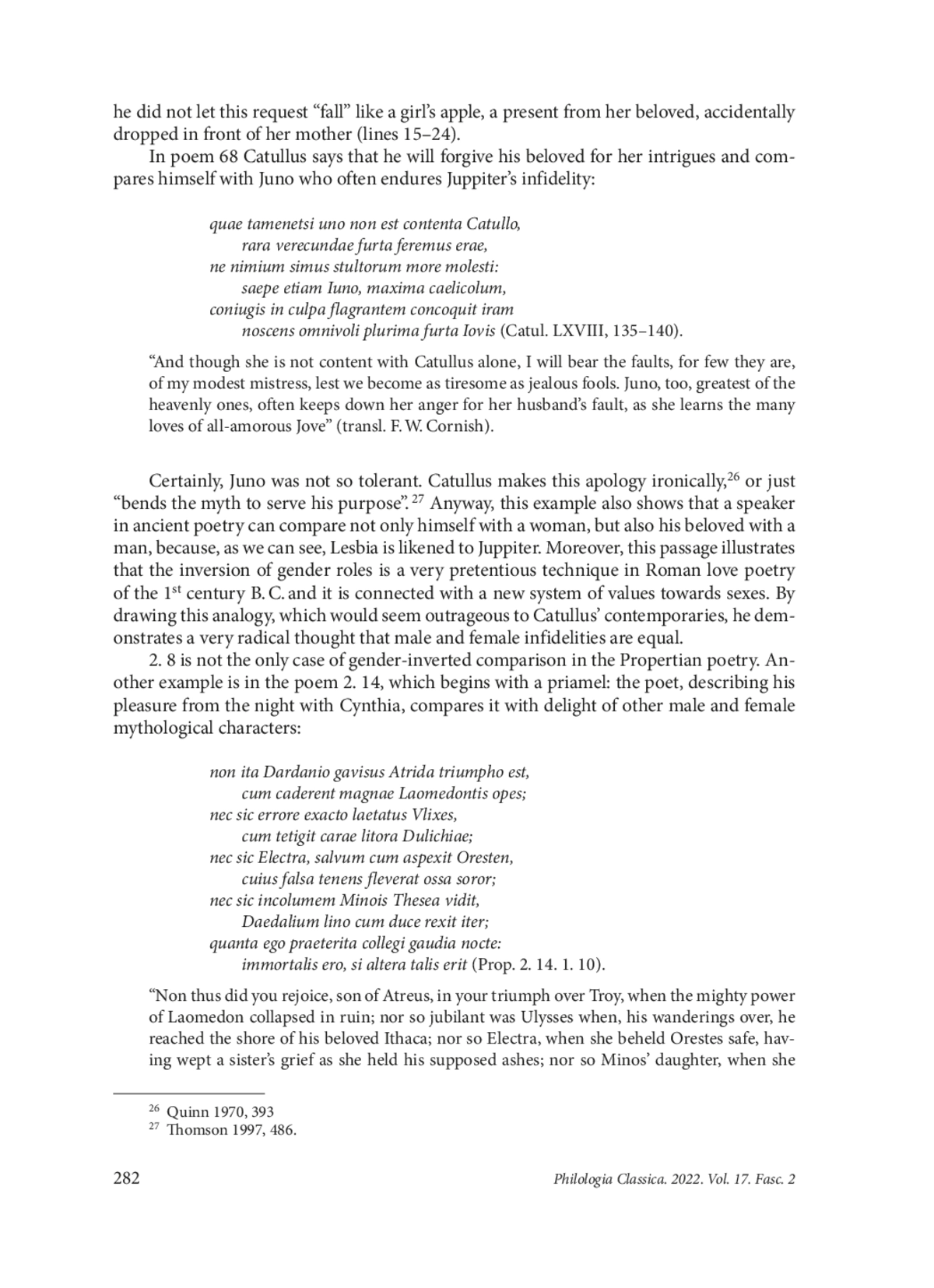
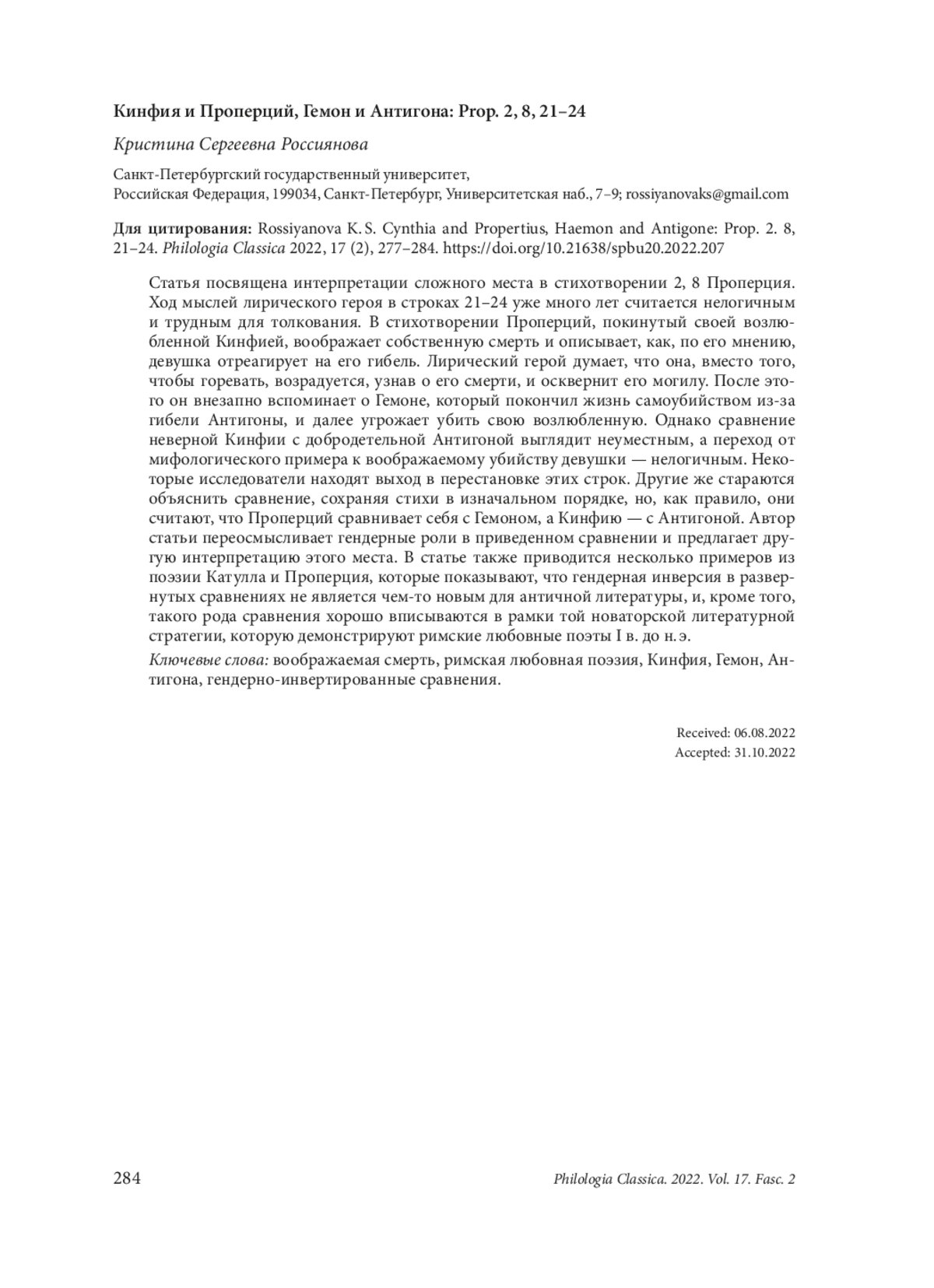
The piece deals with the interpretation of Prop. 2. 8. 21–24. These verses seem to be problematic and illogical over the years. In the poem, the speaker, deserted by his beloved Cynthia, imagines himself dead and then describes the heroine’s reaction to this disastrous event. Propertius thinks that she will be happy about his death and defile his grave. Then he suddenly turns to Haemon, who commits suicide in despair of the Antigone’s death, and after that threatens Cynthia to kill her. Firstly, it is incorrect to compare the righteous Antigone with the unfaithful Cynthia. Secondly, the decision to kill the beloved is inept. Some scholars transpose the verses in order to avoid the incoherence. Others try to interpret the passage, leaving the lines in their initial order, but they usually think that Propertius compares himself with Haemon and Cynthia with Antigone. The author of the article reconsiders gender roles in this comparison and suggests a new interpretation. There are also some examples from the Catullan and Propertian poetry, which show that the gender-inverted comparisons are widely used in ancient literature and especially in Roman love poetry of the 1st century B. C., in which they, probably, are part of a new literary strategy.
Предпросмотр статьи
Идентификаторы и классификаторы
- SCI
- Литература
Если у вас возникли вопросы или появились предложения по содержанию статьи, пожалуйста, направляйте их в рамках данной темы.