
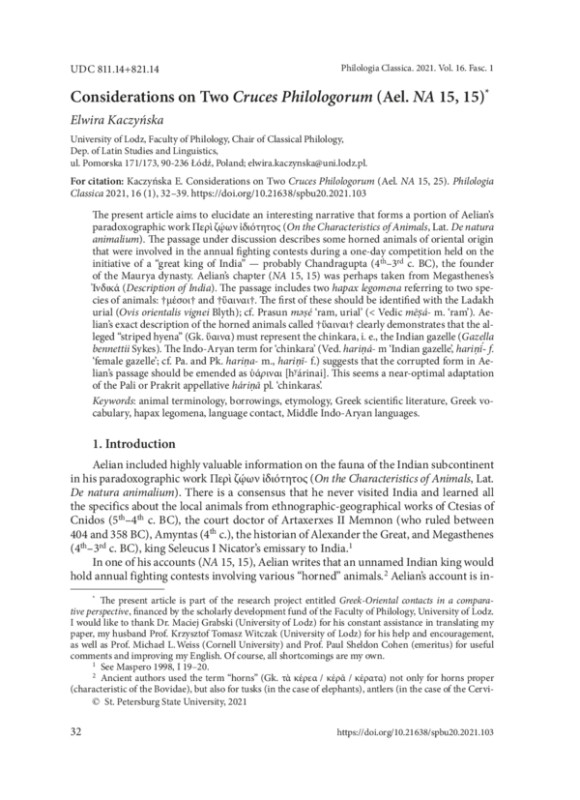
The present article aims to elucidate an interesting narrative that forms a portion of Aelian’s paradoxographic work Περὶ ζῴων ἰδιότητος (On the Characteristics of Animals, Lat. De natura animalium). The passage under discussion describes some horned animals of oriental origin that were involved in the annual fighting contests during a one-day competition held on the initiative of a “great king of India” — probably Chandragupta (4th–3rd c. BC), the founder of the Maurya dynasty. Aelian’s chapter (NA 15, 15) was perhaps taken from Megasthenes’s Ἰνδικά (Description of India). The passage includes two hapax legomena referring to two species of animals: †μέσοι† and †ὕαιναι†. The first of these should be identified with the Ladakh urial (Ovis orientalis vignei Blyth); cf. Prasun məṣé ‘ram, urial’ (< Vedic mēṣá- m. ‘ram’). Aelian’s exact description of the horned animals called †ὕαιναι† clearly demonstrates that the alleged “striped hyena” (Gk. ὕαινα) must represent the chinkara, i. e., the Indian gazelle (Gazella bennettii Sykes). The Indo-Aryan term for ‘chinkara’ (Ved. hariṇá- m ‘Indian gazelle’, hariṇī́- f. ‘female gazelle’; cf. Pa. and Pk. hariṇa- m., hariṇī- f.) suggests that the corrupted form in Aelian’s passage should be emended as ὑάριναι [hyárinai]. This seems a near-optimal adaptation of the Pali or Prakrit appellative háriṇā pl. ‘chinkaras’
Предпросмотр статьи
Идентификаторы и классификаторы
- SCI
- Литература
Aelian included highly valuable information on the fauna of the Indian subcontinent in his paradoxographic work Περὶ ζῴων ἰδιότητος (On the Characteristics of Animals, Lat. De natura animalium). There is a consensus that he never visited India and learned all the specifics about the local animals from ethnographic-geographical works of Ctesias of Cnidos (5th–4th c. BC), the court doctor of Artaxerxes II Memnon (who ruled between 404 and 358 BC), Amyntas (4 th c.), the historian of Alexander the Great, and Megasthenes (4 th–3rd c. BC), king Seleucus I Nicator’s emissary to India.
Если у вас возникли вопросы или появились предложения по содержанию статьи, пожалуйста, направляйте их в рамках данной темы.
Список литературы
1. Abramowiczówna Z. Słownik grecko-polski, vol. IV. Warszawa, PWN, 1965.
2. Bailey H. W. Dictionary of Khotan Saka. Cambridge - London - New York - Melbourne, Cambridge University Press, 1979.
3. Bańkowski A. Etymologiczny słownik języka polskiego, vol. II. Warszawa, Wydawnictwo Naukowe PWN, 2000.
4. Bartholomae Ch. Altiranisches Wörterbuch. Strassburg, Verlag von Karl J. Trübner, 1904.
5. Beekes R. Etymological Dictionary of Greek. Leiden - Boston, Brill, 2010.
6. Boryś W. Słownik etymologiczny języka polskiego. Kraków, Wydawnictwo Literackie, 2005.
7. Brust M. Die indischen und iranischen Lehnwörter im Griechischen. Innsbruck, Institut für Sprachen und Literaturen der Universität Innsbruck, 2005.
8. Brückner A. Słownik etymologiczny języka polskiego. Kraków, Krakowska Spółka Wydawnicza, 1927.
9. Christol A. Greek and Indian Languages, in: A.-F. Christidis (ed.), A History of Ancient Greek from the Beginnings to Late Antiquity, vol. I. Cambridge, Cambridge University Press, 2015, 836-843.
10. de Vaan M. Etymological Dictionary of Latin and the other Italic Languages. Leiden - Boston, Brill, 2008.
11. Dobroluka L. J. Mammals. Prague, Blitz Editions, 1998.
12. Fraenkel E. Litauisches etymologisches Wörterbuch, vol. I. Heidelberg, Carl Winter, 1962.
13. García Valdés M., Llera Fueyo L. A., Rodríguez-Noriega Guillén L. Claudius Aelianus, De natura animalium. Berolini - Novi Eboraci, De Gruyter, 2009.
14. Gesner C. (ed.) Αἰλιανοῦ τὰ εὑρισκόμενα ἅπαντα. Claudii Aeliani opera quae extant omnia. Tiguri, apud Gesneros fratres, 1556.
15. Hercher R. (ed.) Claudii Aeliani De natura animalium libri XVII. Lipsiae, B. G. Teubner, 1864.
16. Jurewicz O. Słownik grecko-polski, vol. II. Warszawa, Wydawnictwo Szkolne PWN, 2001.
17. Kitchell K. F. Animals in the Ancient World from A to Z. London - New York, Routledge, 2014. EDN: WTEKJF
18. Kowalski K. (ed.). Mały słownik zoologiczny. Ssaki. Warszawa, Wiedza Powszechna, 1991.
19. Kochergina V. A. Sanskritsko-russkii slovar‘. Moskva, Izdatel’stwo “Russkii Iazyk”, 1987. [Kochergina V. A. Sanskrit-Russian Dictionary. Moscow, Publishing House “Russian Language”, 1987]. (In Russian).
20. Kroonen G. Etymological Dictionary of Proto-Germanic. Leiden - Boston, Brill, 2013.
21. Latte K. (ed). Hesychii Alexandrini Lexicon, vol. II. Hauniae, Ejnar Munksgaard Editore, 1966.
22. Mańczak W. Polski słownik etymologiczny. Kraków, Polska Akademia Umiejętności, 2017.
23. Maspero F. Claudio Eliano, La natura degli animali, vol. I-II. Milano, RSC Libri, 1998.
24. Mayrhofer M. Kurzgefaßtes etymologisches Wörterbuch des Altindischen, vol. II-III. Heidelberg, Carl Winter, 1963-1964.
25. Mayrhofer M. Etymologisches Wörterbuch des Altindoarischen, vol. II. Heidelberg, Carl Winter, 1996.
26. Monier-Williams M. A Sanskrit-English Dictionary. Delhi, Motilal Banarsidass Publishers, 1999.
27. Montanari F. The Brill Dictionary of Ancient Greek. Leiden - Boston, Brill, 2018.
28. Morgenstierne G. An Etymological Vocabulary of Pashto. Oslo, I Kommisjon Hos Jacob Dybwad, 1927.
29. Morgenstierne G. Etymological Vocabulary of the Shughni Group. Wiesbaden, Dr. Ludwig Reichert Verlag, 1974.
30. Morgenstierne G. A New Etymological Vocabulary of Pashto. Wiesbaden, Dr. Ludwig Reichert Verlag, 2003.
31. Mylius K. Wörterbuch Sanskrit-Deutsch. Leipzig, VEB Verlag Enzyklopädie, 1980.
32. Pobożniak T. Języki indyjskie [Indo-Aryan Languages], in: L. Bednarczuk (ed.), Języki indoeuropejskie [Indo-European Languages], vol. I. Warszawa, PWN, 1986, s. 245-273.
33. Pokorny J. Indogermanisches etymologisches Wörterbuch. Bern-München, Francke Verlag, 1959.
34. Pontillo T. Dizionario sanscrito. Milano, Garzanti Editore, 1996.
35. Scholfield A. F. (ed.) Aelian, On the Characteristics of Animals, vol. II-III. London, William Heineman-Cambridge (MA), Harvard University Press, 1959.
36. Smoczyński W. Słownik etymologiczny języka litewskiego. Wilno, Uniwersytet Wileński, 2007.
37. Stein O. Megasthenes, in: RE 1931 XV (29), 230-326.
38. Tsabolov R. L. Etimologicheskii slovar’ kurdskogo iazyka, vol. I. Moskva, Izdatel’skaia Firma “Vostochnaia Literatura” RAN, 2001. [Tsabolov R. L. Etymological Dictionary of the Kurdish language, vol. I. Moscow, Publishing House “Eastern Literature” of the Russian Academy of Sciences, 2001]. (In Russian).
39. Turner R. L. A Comparative Dictionary of the Indo-Aryan Languages. London - New York - Toronto, Oxford University Press, 1966.
40. Witczak K. T. New Evidence for the Indo-European Terminology for ‘sheep’. Lingua Posnaniensis 2003, 45, 143-150.
41. Yule H., Burnell A. C. Hobson-Jobson. The Anglo-Indian Dictionary. London, Wordsworth Editions, 1996.
Выпуск

Другие статьи выпуска
In this article, twelve new emendations are offered on the text of Lucretius’ De Rerum Natura. At 1.454 non tactus is proposed for the unparalleled intactus; at 2.99 et partim is suggested for the awkward pars etiam; at 2.258 quomque (late-Republican cumque) is advanced for quemque; at 2.615 the metrically problematic inuenti sint is altered to inueniantur; at 2.733 the unique use of nigrant is dispensed with by reading the expected nigra sunt; at 3.267 et tamen is made more naturally adversarial as at tamen; at 3.774 ne fessa is altered to the more Lucretian defessa (reading ne for et earlier in the line); at 4.160 the unusual feminine celer (his) is altered to (his) celeris; at 4.306 (331) the difficult gerund insinuando is changed to the gerundive insinuandis; at 4.318 (343) multisque is replaced with the more idiomatic multoque; at 5.323 the stark phrase deminui debet recreari is reordered as debet deminui et recreari; finally, at 6.266 uementes is read for the otiose uenientes. The discussion proceeds on the basis of the universally accepted stemma, namely that the three Carolingian manuscripts (O, Q, S) are the sole manuscripts with textual authority. The more than fifty surviving Renaissance manuscripts ultimately derive from O, but they remain a fertile source for conjectures
Im Folgenden werden die Satzlehre-Bände der „Ausführlichen Grammatik der lateinischen Sprache“ von Raphael Kühner, die 1878/79 zuerst erschien und in ihrer Bearbeitung durch Carl Stegmann 1914 bis heute eine verbreitete Lateingrammatik ist, mit der neu erschienenen „Oxford Latin Syntax“ von Harm Pinkster in der Konzeption verglichen. Zwischen beiden Satzlehren aus sehr unterschiedlichen Zeiten und sprachwissenschaftlichen Kontexten gibt es natürlich deutliche Unterschiede: zunächst die andere Gesamtkonzeption, ferner die Art des Korpus, den Satzbegriff, die Stellung der Kasussyntax, nicht zuletzt die Behandlung infiniter Konstruktionen und schließlich den Geltungsbereich der Syntax. Von diesen Unterschieden abgesehen finden sich aber auch einige Gemeinsamkeiten: zunächst eine korpusbasierte Form, wonach beide Satzlehren ihre Ausführungen auf zahlreiche sprachliche Belege stützen. Zweitens steht die Einzelsprache des Lateinischen im Vordergrund und es bleibt wenig Raum für sprachliche Vergleiche. Drittens sind beide Satzlehren rein deskriptiv, was im Falle des Kühner-Stegmanns das Gegenteil zu normativ, im Falle der OLS aber zu formallinguistisch oder theorielastig bedeutet im Sinne formaler Ansätze der neueren Linguistik, womit etwa die verschiedenen Movement-Regeln der generativen Theorie gemeint sind. Ein wichtiges Ergebnis lautet, dass beide syntaktischen Ansätze legitim sind und beide mit wachem Methodenbewusstsein weiter gebraucht werden sollten, um Probleme der lateinischen Syntax zu lösen
The fragment of the Syriac translation of Aristotle’s Poetics preserved by Jacob (Severus) Bar Shakko (d. 1241) comprises Poet. VI 1449b24–1450a10. In spite of its small size, it serves as an important witness both to the Greek text of the Poetics, and to the reception of this work in the Christian Orient and, later on, in the Muslim world. The fragment derives from a translation, which most likely appeared in West Syriac circles in the 7th/8th centuries AD and later served as the basis for the Arabic translation of the Poetics made by Abū Bishr Mattā ibn Yūnus in the 10 th century. The present article includes a new edition of the Syriac text preserved by Bar Shakko, which is based on the collation of six manuscripts and is accompanied by an English translation. The article also provides a detailed analysis of the Syriac fragment as compared to the transmitted Greek text of the Poetics, on the one hand, and to the Arabic translation of it by Abū Bishr, on the other. This comparison allows an assumption that the Syriac version is most likely based on a Greek manuscript, which may have contained glosses and scholia. A Greek and Syriac glossary is attached at the end of the article
Le présent article concerne l’influence de l’érudition humaniste sur les pratiques étymologiques du XVIe siècle, dont témoignent les ouvrages de référence néo-latins et les traités spéciaux de linguistique et d’histoire. Étant une partie importante de la recherche historique, qui reposait principalement sur des sources littéraires grecques et latines, l’étymologie ne pouvait qu’adopter certains principes et instruments importants de la philologie contemporaine, notamment la critique des sources. La règle principale était d’étudier les textes dans leur langue et leur forme d’origine et d’éliminer toute donnée corrompue ainsi que toute information non attestée par des sources écrites. Cela présumait que chaque texte avait sa propre histoire écrite, comprise principalement comme une détérioration progressive de son état, représentée par la tradition manuscrite, qui était sujette aux erreurs des scribes et aux interprétations erronées. Ce point de vue des humanistes sur l’histoire textuelle correspondait à celui sur l’histoire des langues, qui était traitée comme une corruption permanente et une dégénérescence inévitable de l’état noble et parfait de leurs ancêtres anciens. Visant à restaurer le texte original, la philologie utilisait l’emendatio comme remède contre les abus de scribes et les pertes textuelles; de même, les historiens des langues avaient leur propre outil, à savoir l’étymologie, pour reconstruire et expliquer la forme originale des mots (y compris la nomenclature des sciences). L’intersection des deux procédures est prise en compte dans l’article, qui montre comment les conjectures textuelles, la collation des manuscrits et l’interprétation graphique des erreurs de lecture ont été employées par les savants du XVIe siècle pour corroborer leurs spéculations étymologiques, qui formaient elles-mêmes l’une des voies de la réception et de la critique du patrimoine littéraire classique
This article attempts to provide an interpretation of a passage on the noun number written by the 5th-century grammarian Cledonius who composed a lemmatised commentary on Donatus’ Ars minor and Ars maior. The passage discussed here is a part of the explanation regarding the noun categories in Ars minor: Numerus, qui unum et plures demonstrat: et communis est numerus, qui et dualis dicitur apud Graecos, ut species facies res. (GL V 10. 19–20). Cledonius’ text confuses two terms dualis and communis, which normally signify different linguistic phenomena. Tim Denecker, whose article covers the history of the term dualis in Latin grammatical treatises, argues that dualis in this passage is indicating a pair and is equated to communis. The aim of the present work is to explain why these two terms have been confused. When comparing Greek and Latin, the Roman grammarians Charisius, Diomedes, Priscian, and Macrobius highlighted the absence of the dual number from Latin, whereas Donatus added it to the singular and plural exemplifying it with two nomina — duo and ambo. Having analysed all of Cledonius’ passages on dualis and communis and compared them with the original text of Donatus, one may notice that Cledonius did not make comments on Donatus’ observations concerning the dual number of duo and ambo. In the author’s view, the grammarian may have opined that the Latin language had no dual number at all, so that in his commentary Latin communis is juxtaposed to Greek dualis and both are opposed to singular and plural

The aim of this article is to reopen the investigation of the ablative absolute in Latin and to analyse this construction and its use from one angle, namely, the coreferentiality rules. The examples for analysis have been taken from the Gallic Wars. As has been noticed before, in several works, the use of the absolute construction in texts written by classical authors, such as Caesar or Cicero, allows us to formulate a rule concerning its coreferentiality. As far as the syntactical coreferentiality is concerned, the classical rule requires an absolute construction to be — unsurprisingly — absolute, i. e., non-coreferential. This rule seems to be increasingly ignored by later authors. However, a deeper analysis taking into account not only syntactical but also semantical coreferentiality shows that the absoluteness of the construction is not so absolute after all, even in classical Latin. The examples of such use of the ablativus absolutus may be seen as forerunners of the change that occurred between classical and late Latin. The author proposes a hypothesis that an independent but similar development of the use of absolute constructions in different languages may suggest that there is a kind of interlinguistic tendency to substitute nominal phrases for subordinate clauses, especially in spoken language
This article revises current perspectives on the generic status, composition, and subject matter of Phoenician Women by Seneca. It adopts a new approach, focusing on selected elements of text organisation. In particular, emphasis is given to the construction of characters and the analogies and contrasts between them which were already of interest to ancient poetics and rhetoric. Moreover, the article refers to observations, accurate but isolated and largely ignored, made by scholars who recognised Seneca’s originality and suggested that his plays might have been inspired by the declamatory tradition and should be read in the context of evolving postclassical literature. By adopting this perspective, it becomes possible to bring together a large number of partial conclusions that are related to Phoenician Women as well as other plays by Seneca. What is more important, the work brings to light the purposeful composition of the drama and its thematic unity, allowing us to return to the MS versions that until now have been replaced by conjectures, which often distort the meaning of the text. After dismissing the emendations and adopting a new method of reading, Seneca’s Phoenician Women can be regarded as complete and well-organised. The play has certain characteristic features of a tragedy, of all Seneca’s dramas, it is the one most inspired by the genre of declamation and the poetics of Seneca the Elder’s anthology, and it is an example of the use of plot material typical of tragedy for presenting the problem of pietas in all its complexity
The article addresses the pragmatic and sociolinguistic constraints of interrupting in Roman comedy. It starts with a redefinition of the phenomenon informed by the methods of Conversation Analysis (CA): apart from syntactically incomplete utterances (as a result of interruptions by others), the analysis also includes the cases of interruptions reported by the characters. Furthermore, a distinction is made between intrusive (disaligning) interventions and other forms of competitive turn encroachments. The term ‘interruptions’, however, has been reserved only for the former, antagonistic type which serves to express disagreement and disinterest or to usurp the speaking turn. Using the revised criteria, the article proceeds to comment on quantitative data extracted from all the extant plays by Plautus and Terence. Accordingly, interruptions are viewed in relation to gender, age and status of the speakers, whereas some more detailed analysis concerns male and female citizens, prostitutes and servants. After comparing every character’s share of talk with their proportional use of turn incursions (both collaborative and disruptive), it is argued that the violation of the turn-exchange system is significantly associated with some interlocutors and less so with others. The last section presents interrupting as a pragmatic means of exerting power in interaction while discussing the phenomenon also from a (sociolinguistic) cross-gender perspective
The present article offers a reassessment of Hom. ἄφρων [adj.] ‘unreasonable, senseless, foolish’, which is traditionally accounted for as an ablauting compound (of the type πατήρ: ἀπά- τωρ) based on the simplex φρένες [f. pl. tant.] ‘midriff, diaphragm’ (+Il.). This archaic ablauting pattern (viz. °φρων vs. simplex φρήν*) is totally unparalleled for body parts; besides, the Ancients’ interpretation of φρένες as ‘diaphragm’ is flawed. Φρονέω ‘to have (good) understanding or intelligence’ is a back-formation coined after ἀφρονέω ‘to act senselessly, to be foolish’. From zero-graded ἀφραίνω (via a synchronic reanalysis of -αίνω as a deverbative suffix of the type °φαίνω), an adverb *ἀφρα-δόν ‘senselessly, foolishly’ was eventually coined, which was the starting point of a whole new group. From this group was reanalyzed a “new” synchronic root √φραδ- ‘to heed, to consider’, reflected by Hom. φράζω. The lack of comparative evidence for this sprawling word family leads the author to assume that Hom. ἄφρων [adj.] ‘senseless, fool, heedless’ is in fact the reflex of a PIE etymon *ń̥ -gʷʱr(h1)-on- ‘without sense of smell, not able of scenting’, from PIE *gʷʱreh 1- ‘to smell’ (cf. Ved. jí-ghr-a- < *gʷʱí-gʷʱr(h 1)-V-). This verbal compound of the type νήφων [*-on-adj.] ‘sober’ (< PIE *ń̥-h 1gʷʱ-on- ‘not having drunk’) would have been eventually reanalyzed as a privative bahuvrīhi (viz. ‘lacking φρένες’).
This article examines the Greek noun σαγγάνδης ‘messenger’ which is attested in two lexica, dated to the Roman or early Byzantine periods: the Cambridge Rhetorical Lexicon by an anonymous author and Difficult Words in the Attic Orators by Claudius Casilo. In both works, σαγγάνδης appears together with three words of likely Iranian provenance: ὀροσάγγης ‘benefactor of the Persian king; bodyguard’, παρασάγγης ‘parasang; messenger’ and ἄγγαρος ‘messenger, courier; workman, labourer’. The word σαγγάνδης is analysed in comparison with ἀσγάνδης/ἀστάνδης ‘messenger’ occurring for the first time in Plutarch’s works and closely linked to the Achaemenid administration. According to the hypothesis put forward in the present paper, both σαγγάνδης and ἀσγάνδης (with its secondary variant ἀστάνδης) are connected to Manichaean Middle Persian/Parthian ižgand ‘messenger’, Sogdian (a)žγand/(ɔ) žγand/ž(i)γant ‘id.’, Jewish Aramaic ʾîzgaddā ‘id.’, Syriac izgandā/izgaddā ‘id.’, Mandaic ašganda ‘helper, assistant, servant; the Messenger’, and go back to Old Persian *zganda- or to early Middle Persian/early Parthian *žgand- (or *zgand-) with the original meaning ‘mounted messenger’. The reconstructed noun is derived from the Proto-Iranian root *zga(n)d- ‘to go on, gallop, mount’, attested in Avestan (Younger Avestan zgaδ(/θ)- ‘to go on horseback, gallop’) and in some Middle and Modern Iranian languages. The original form of the loanword in Greek was probably *σγάνδης which then underwent certain transformations
There has been much controversy regarding the date, the performative context, and the generic quality of fragment 926 PMG, which has been preserved on papyrus (P. Oxy. 9 + P. Oxy 2687) in a rhythmical treatise by an unknown author. The verse fragments on this papyrus were composed in iambic dactyls (∪ — ∪ –) and used as examples of the occurrence of syncope in various lyric meters. Fragments 926(a) and (g) PMG are from a composition performed by a maiden chorus which bear similarities to Alcman’s partheneia and have affinities with archaic epic and lyric poetry. Supposedly, these fragments might have been fragments of partheneia composed in the time of the New Music. Nonetheless, they are not shaped according to the bulk of the aesthetic values and the compositional rules of the New Music. These fragments seem to belong to cultic songs created for maiden choruses, possibly, to honor Dionysus. The alternative is that they imitate such songs within a dramatic context. We may assume that these quasi-dithyrambic partheneia were composed to serve religious needs or at least imitated cultic songs. They looked backward to the archaic and early classical tradition of partheneia, and their existence is an indication that, in the days of the New Music, there was a poetic tradition upheld by “reactionary” poets
Ἐπικράτεια and ἐπαρχία are two terms used by the ancient sources to describe the Carthaginian presence in Western Sicily. Due to a lack of information about the character and details of this presence, it is crucial to precisely understand the terminology employed by our sources and all its nuances. The article challenges the widely accepted opinion that the nouns ἐπικράτεια and ἐπαρχία can be treated as synonyms. To verify whether this assumption is correct or not, a careful analysis of how the ancient authors (Polybius, Diodorus Siculus and Plutarch) used both nouns, as well as other related forms, is conducted. To make up for the limited number of occurrences of ἐπικράτεια in the analysed corpus, the relevant part of the examination also includes the use of this noun in Strabo’s Geography. The analysis allows us to highlight a significant change in the meaning of the two terms between the 2 nd century (Polybius) and the mid-1st century BC (Diodorus). This change reflects a development in the Greek political and administrative vocabulary, which was adjusting to a new reality of the Mediterranean world being organised into Roman provinces. The conducted analysis also allows us to better understand the complexity of the Carthaginian position in Western Sicily
Статистика статьи
Статистика просмотров за 2026 год.
Издательство
- Издательство
- СПБГУ
- Регион
- Россия, Санкт-Петербург
- Почтовый адрес
- Россия, 199034, Санкт-Петербург, Университетская наб., д. 7–9
- Юр. адрес
- 199034, г Санкт-Петербург, Василеостровский р-н, Университетская наб, д 7/9
- ФИО
- Кропачев Николай Михайлович (РЕКТОР)
- E-mail адрес
- spbu@spbu.ru
- Контактный телефон
- +7 (812) 3282000
- Сайт
- https://spbu.ru/