
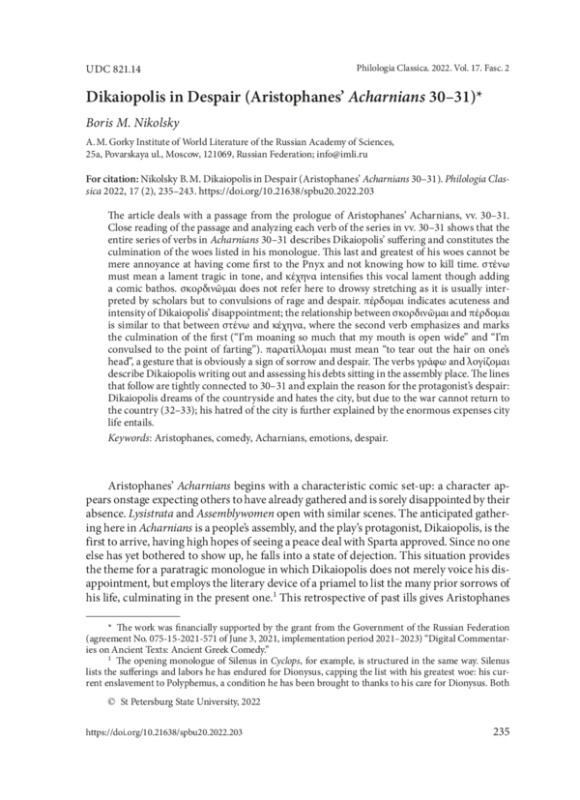
The article deals with a passage from the prologue of Aristophanes’ Acharnians, vv. 30–31. Close reading of the passage and analyzing each verb of the series in vv. 30–31 shows that the entire series of verbs in Acharnians 30–31 describes Dikaiopolis’ suffering and constitutes the culmination of the woes listed in his monologue. This last and greatest of his woes cannot be mere annoyance at having come first to the Pnyx and not knowing how to kill time. στένω must mean a lament tragic in tone, and κέχηνα intensifies this vocal lament though adding a comic bathos. σκορδινῶμαι does not refer here to drowsy stretching as it is usually interpreted by scholars but to convulsions of rage and despair. πέρδομαι indicates acuteness and intensity of Dikaiopolis’ disappointment; the relationship between σκορδινῶμαι and πέρδομαι is similar to that between στένω and κέχηνα, where the second verb emphasizes and marks the culmination of the first (“I’m moaning so much that my mouth is open wide” and “I’m convulsed to the point of farting”). παρατίλλομαι must mean “to tear out the hair on one’s head”, a gesture that is obviously a sign of sorrow and despair. The verbs γράφω and λογίζομαι describe Dikaiopolis writing out and assessing his debts sitting in the assembly place. The lines that follow are tightly connected to 30–31 and explain the reason for the protagonist’s despair: Dikaiopolis dreams of the countryside and hates the city, but due to the war cannot return to the country (32–33); his hatred of the city is further explained by the enormous expenses city life entails.
Предпросмотр статьи
Идентификаторы и классификаторы
- SCI
- Литература
Aristophanes’ Acharnians begins with a characteristic comic set-up: a character appears onstage expecting others to have already gathered and is sorely disappointed by their absence. Lysistrata and Assemblywomen open with similar scenes. The anticipated gathering here in Acharnians is a people’s assembly, and the play’s protagonist, Dikaiopolis, is the first to arrive, having high hopes of seeing a peace deal with Sparta approved. Since no one else has yet bothered to show up, he falls into a state of dejection. This situation provides the theme for a paratragic monologue in which Dikaiopolis does not merely voice his disappointment, but employs the literary device of a priamel to list the many prior sorrows of his life, culminating in the present one
Если у вас возникли вопросы или появились предложения по содержанию статьи, пожалуйста, направляйте их в рамках данной темы.
Список литературы
1. Compton-Engle G. Mock-Tragic Priamels in Aristophanes’ Acharnians and Euripides’ Cyclops. Hermes 2001, 129, 558-561.
2. Graves S. E. (ed.) The Acharnians by Aristophanes. Cambridge, Cambridge University Press, 1905.
3. Knox B. The Heroic Temper. Studies in Sophoclean Tragedy. Berkeley, LA - London, University of California Press, 1963.
4. Leeuwen J. van (ed., comm.) Aristophanes. Acharnenses. Leiden, Sijthoff, 1901.
5. Olson S. D. (ed., comm.) Aristophanes. Acharnians. Oxford, OUP, 2002.
6. Paley F. A. (ed., comm.) The Acharnians of Aristophanes. Cambridge, Deighton, Bell, 1876.
7. Platnauer M. (ed., comm.) Aristophanes. Peace. Oxford, Clarendon Press, 1964.
8. Rennie W. (ed., comm.) The Acharnians of Aristophanes. London, E. Arnold, 1909.
9. Starkie W. J. M. (ed., comm.) The Acharnians of Aristophanes. London, Macmillan, 1909.
10. Platnauer M. (ed., comm.) Aristophanes. Peace. Oxford, Clarendon Press, 1964.
11. Taillardat J. Les images d’Aristophane. Paris, Les Belles Lettres, 21965.
Выпуск
Другие статьи выпуска
Matro of Pitane’s cento of Homeric verses, The Attic Dinner Party contains a puzzling episode in which the narrator throws sea-urchins, which he has apparently already eaten, among the feet of the slaves, where they clatter “where waves were washing the beach”. The slaves then draw out the spines “from the head”. Following Elena Ermolaeva’s comparison of Matro’s lines to the Unswept Floor mosaic, I suggest that his banquet took place in a normal dining room rather than on a beach or in a room with a window facing one. The floor of this room, being a pebble mosaic, could aptly be called a beach from which the slaves were washing the detritus of the meal, a procedure (as we know from Olynthus) the dining rooms of private houses were expressly designed to facilitate. This interpretation entails reading *λύματ ̓… κλύζεσκον for the manuscripts’ κύματ ̓… κλύζεσκε). The scribal alteration I postulate has the effect — unique in this poem, and therefore suspect — of reproducing an entire Homeric line unaltered. Lastly, the phrase “from the head” does not refer to whence the slaves are pulling the sea-urchin’s spines (for that will be from their own feet), but to where they came from in the first place: a sea-urchin’s head
Статья «Максим Горький как толкователь Аристотеля. К теории трагического очищения», написанная крупным московским латинистом А. А. Грушка в 1929 году, незадолго до смерти, заслуживает интереса как документ эпохи, несчастливой для русской науки и культуры в целом. В этом любопытном, довольно пространном, этюде повествуется, в частности, о том, с какой необычайной прозорливостью и художественной силой Горький раскрыл в одном из своих ранних творений — повести «Тоска» — сущность процесса, который Аристотель понимал под катарсисом. Грушка ранее не писал на греческие сюжеты, и время создания статьи было исключительно неподходящим для такого рода дискуссии. Замечая небрежность, с которой он пересказывает, казалось бы, ключевую для своего рассуждения сцену из названного произведения Горького, невольно приходишь к выводу, что Горький, предмет его восхищения в 1900-е годы, в конце 1920-х, когда «пролетарского писателя» восхваляла советская пропаганда, перестал представлять для него какой-либо интерес. Ностальгические мотивы в статье Грушка выдают его истинное настроение. Статья была написана по необходимости и второпях, с многочисленными включениями Lesefrüchte широко образованного автора — чтобы спасти то, что, как он наивно полагал, еще можно было спасти
Переход от силлабического к силлабо-тоническому стиху в русском стихосложении в конце 1730-х — начале 1740-х годов связан с деятельностью трех выдающихся поэтов: Василия Кирилловича Тредиаковского (1703–1769), Михаила Васильевича Ломоносова (1711–1765) и Александра Петровича Сумарокова (1717–1777). Реформа затронула в первую очередь двусложные и трехсложные размеры и подготовила выработку более сложных метров, в том числе силлабо-тонических аналогов для эолийских метров. Сапфический гендекасиллаб из них пользовался наибольшей известностью и распространенностью. Также и сапфическая строфа была весьма популярна в европейских литературах. Она состоит из трех сапфических гендекасиллабов и адония в четвертой строке. Русские поэты-силлабики охотно создавали рифмованные сапфические строфы. В одиннадцатисложниках цезура после пятого слога была обязательна, а ударения во всех четырех строках не были упорядочены. Такие сапфические строфы Тредиаковский включил в свой перевод галантного романа Поля Тальмана «Езда в остров любви» (Paris, 1663; СПб., 1730). В 1735 году Тредиаковский опубликовал «Новый и краткий способ к сложению российских стихов», ставший точкой отсчета для реформы русского стиха. В своем трактате поэт предложил, помимо прочего, и реформированную сапфическую строфу: гендекасиллабы в ней, по его мнению, состояли из шести хореев и должны были иметь три хореические стопы перед обязательной цезурой, причем третья должна была быть каталектической. Все строки оканчивались женскими рифмами. Во втором издании трактата (1752) Тредиаковский пересмотрел свое понимание сапфической строфы. Теперь он призывает видеть в русском сапфическом одиннадцатисложнике четыре хорея, между которыми вклинен дактиль с цезурой после первого слога. Под влиянием «Письма о правилах российского стихотворства» Ломоносова Тредиаковский приходит к убеждению о необходимости альтернанса, а потому считает, что первые два стиха в сапфической строфе должны быть с мужскими рифмами; как следствие они оказываются усечены до десяти слогов. В утраченном «Письме о сафической и горацианской строфах» (1755) Сумароков выразил резкое несогласие с этим воззрением Тредиаковского. Десятисложники в сапфических строфах были для него недопустимы; он был также против регулярной цезуры. Все же метрическую структуру сапфического гендекасиллаба он понимал так же, как и Тредиаковский. В 1755 и 1758 годах Сумароков опубликовал три стихотворения, написанных сапфическими силлабо-тоническими строфами. Часть из них с рифмами, а часть без; но цезура во всех них иррегулярна. В 1762 году Тредиаковский перевел две строфы из «Юбилейного гимна» Горация. Их форма позволяет заключить, что поэт учел мнение своего оппонента и потому отказался от десятисложников в них. Лишь в вопросе о цезуре он остался непреклонен
The article examines an unpublished inscription conserved in the Nerantzia Castle of Kos (Greece). It consists of four elegiac couplets that Coan scholar Stamatios K. Pantelidis (Παντελίδης) composed some time before 1879. It was supposed to be located in the facade of the school founded the year indicated in the inscription. Seemingly, after the earthquake which devastated Kos in the year 1933, it was relocated in the warehouse of the Nerantzia Castle in northern Kos along with many other inscriptions. On the one hand, it provides the possibility of knowing how stonegravers work, to what extent Greeks knew their very own language in its ancient form and the way they dealt when it came to use (then and now) unusual forms of the language. On the other hand, the inscription is relevant to the cultural history of Greece in the last years of Ottoman rule and in the years after it, as Kos was part of the Ottoman Empire until 1912, date in which it passed under Italian rule until 1947, when the isle was incorporated into the Hellenic Republic. Therefore the purpose is to clarify the historical and real circumstances of the inscription, as well as to analyze the compositional process of this dedicatory epigram from the metrical point of view (it contains many deviations from to the classical precepts), style and classical tradition. The inscription has not been previously studied due to its peculiar characteristics. Indeed, it is an epigram written in modern times but in an archaizing Greek (i. e. roughly respecting the rules of classical grammar), so it is not studied by neohellenists given the ancient character of its language, nor by classicists because it was composed in recent times
This article aims to put Latin impersonal passive into the context of covert categories, specifically pluractionality. I try to reanalyse six passages from the Roman grammatical texts, mostly compiled in Heinrich Keil’s Grammatici Latini, in which the meaning of Latin impersonal passives is considered. There are two groups of evidence. The first one (passages from Diomedes, Priscian, and frg. Bobiense de verbo) presents the impersonal passive as a linguistic strategy that shifts focus from an agent to a situation, while the second one (Diomedes and two excerpts of Servius’ commentaries on Virgil) concentrates upon the number of agents. In the last case, a verbal action is considered to be a collective one involving many people, and therefore, in my opinion, falls into the category of pluractionality. Being a diverse phenomenon, the term pluractionality includes participant plurality, which is realised either in a subject or in an object depending on whether the verb is intransitive or transitive. Intransitivity of the Latin impersonal passive forms, as it seems, may imply agent plurality rather than subject plurality, since impersonal passive constructions are subjectless. Furthermore, in my opinion, the evidence provided by Latin grammarians demonstrates a contraposition of the 1 st person singular, 1 st person plural and 3rd person singular passive forms
The piece deals with the interpretation of Prop. 2. 8. 21–24. These verses seem to be problematic and illogical over the years. In the poem, the speaker, deserted by his beloved Cynthia, imagines himself dead and then describes the heroine’s reaction to this disastrous event. Propertius thinks that she will be happy about his death and defile his grave. Then he suddenly turns to Haemon, who commits suicide in despair of the Antigone’s death, and after that threatens Cynthia to kill her. Firstly, it is incorrect to compare the righteous Antigone with the unfaithful Cynthia. Secondly, the decision to kill the beloved is inept. Some scholars transpose the verses in order to avoid the incoherence. Others try to interpret the passage, leaving the lines in their initial order, but they usually think that Propertius compares himself with Haemon and Cynthia with Antigone. The author of the article reconsiders gender roles in this comparison and suggests a new interpretation. There are also some examples from the Catullan and Propertian poetry, which show that the gender-inverted comparisons are widely used in ancient literature and especially in Roman love poetry of the 1st century B. C., in which they, probably, are part of a new literary strategy.
Several ancient authors tell a puzzling story of treason to murder Alexander the Great by presenting him with poison or poisonous water carried in a curious vessel — a hoof of a horse, a mule, or an ass. Porphyry of Tyre, citing Kallimachos and Philo the Paradoxographer, gives us a reason to believe that the mention of hoof-made vessels was a misinterpretation of hornmade chalices, or put otherwise, drinking horns. Presuming that the vessel in question indeed was a drinking horn, we are left with an unusual image — Alexander the Great perished after drinking the poisonous water from the horn of a hornless animal. We can look into the development of this legend and propose its origins by examining mutual features of two distinct traditions — the Greek legend of the river Styx and its lethal streams and the Indo-Iranian tradition of several miraculous features of a unicorn’s horn, attested in Iranian, Indian, and Greek sources. After the survey of relevant sources, we see that the horn from Philo’s story represented a legendary present of Indian rulers intended to save Alexander the Great from harm. Various layers of misapprehension transformed the legendary gift into a device contracted to harm him. This way, the author demonstrates two points: 1) that the story told by Porphyry in Styg. 375F is a part of an Indo-Iranian tradition about unicorns and their miraculous features; and 2) that the legend of Alexander’s poisoning represents a transformed and misinterpreted story of Alexander’s grandest gift.
This paper is an overview — in it I take a critical look at works that have come out in recent years about Antiphon. My primary focus is on four books: two scholarly works on Antiphon, one by Annie Hourcade and another by Michael Gagarin, an edition of the fragments of Antiphon’s treatises with a detailed commentary by Gerard Pendrick, and, finally, a new edition of Antiphon’s speeches prepared by Mervin Dilts and David Murphy. There is still a dispute among scholars about the authorship of the Corpus Antiphonteum. Some (the separatists) consider that there were separate authors for the speeches, on the one hand, and for the treatises, on the other — Antiphon the orator and Antiphon the sophist, respectively. Others (the unitarians) insist that there was a single author for both the speeches and the treatises. In the 19 th and the first half of the 20 th centuries, the separatists had the upper hand, but the situation slowly began to change, and now most scholars — rightly so in my opinion — argue for a single authorship. The separatists are compelled to divide the biographical testimonies of Antiphon between the orator and the sophist. But in the case of a single Antiphon, it turns out there is more than a little information about that person. In this paper, I present a review of scholarly opinion about evidence according to which Antiphon invented τέχνη ἀλυπίας and opened a psychotherapeutic clinic, where he tried to help his patients using verbal therapy. Some scholars call the tradition of the clinic into question. The separatists attribute any evidence about it to Antiphon the sophist. Like other scholars, I uphold the credibility of the clinic. I also take a look at the image of Antiphon presented by Xenophon (Mem. 1, 6.). Many scholars consider Xenophon’s story to be fictitious or reject it outright. The separatists believe that Xenophon calls Antiphon a sophist in the very first sentence of the sixth chapter in order to distinguish him from his namesake, Antiphon the orator. I think Xenophon’s goal is different. Socrates, in conversation with Antiphon during their second meeting, which Xenophon describes later on in the same chapter, likens sophists to πόρνοι (Mem. 1. 6. 13). Obviously, Xenophon calls Antiphon a sophist because he intends that the shameful implications of this comparison be applied first and foremost to him. Hourcade and Gagarin want to show that the author of the treatises and the speeches was one and the same person. Even though Pendrick is a separatist, the parallels he draws between the fragments of the treatises and individual passages in the speeches also, I think, favor the idea of a single Antiphon. I conclude that, thanks to the work of these scholars, Antiphon has, although not yet fully, been put back together again
The article revisits Aristophanes’ Daitales fr. 233 which is often taken as (the only) evidence of Homeric glosses being drilled by Athenian youth as part of their school education in 5th c. BC. The author discusses in detail the context of Aristophanic citation in Galen’s work, the state of the text of the fragment and its modern interpretations. In fact, nothing in the text itself directly suggests that learning glosses was part of the traditional school education in Athens. On the contrary, it can be argued that Aristophanes presented glosses as linguistic innovations and intellectuals studying them as sophists. The parallels between Daitales and Clouds, as well as Plato’s Kratylos and other fifth-century texts must be taken into account when interpreting the dialogue between the Father and his Son in fr. 233. As a conclusion, the author suggests that the characters of Daitales should be interpreted differently: the Old Man in this episode of the play is not opposing the sophistic teachings, but rather using these in his argument as an instrument to demonstrate the Licentious Son his ignorance. The latter is apparently not a follower of the sophists and defends himself with his more practical knowledge of legal terms
The paper deals with the embryological teaching of Empedocles, the ancient Greek philosopher from Acragas, who lived in the 5 th century BC. The article is focused on the mechanisms by which children inherit their parents’ features in the doctrine of Empedocles. The available fragments and evidence on the teachings of early Greek philosophers often provide distorted and sometimes contradictory information. This paper attempts to carefully analyze all the evidence regarding inheritance mechanisms and bring it into an agreement with each other without resorting to abandoning some of the fragments. The most extensive information is provided to us by Censorinus, the 3rd century Roman writer, who in 238 AD wrote the treatise De die natali to congratulate his patron Caerelius on his 49th birthday. The article comments in detail on the testimony of Censorinus (De die natali, 6. 6 = 31 A 81 DK) concerning Empedocles’ views on the inheritance of parental traits by children, as well as the contradictory messages by Aetius (Aët. 5. 11. 1 = A 81) and Aristotle (De gen. an. I, 18, 723a23; IV, 1, 764a1f.; 765a 8 = 31 A 81 DK). The analysis conducted by Erna Lesky in her famous monograph of 1950 was expanded and supplemented in this article. In addition, the study takes into account the evidence of cases where children do not resemble their parents. Empedocles justifies these cases by popular superstitions, which were widespread in Europe up to the 20th century.
In 2015, Jack Davis and Sharon Stocker, while excavating the so-called “Tomb of a warrior with a griffin”, discovered an agate seal with an extraordinarily detailed depiction of a combat scene. It shows a warrior armed with a sword only, bending over his adversary’s shield, grabbing him by the crest of his helmet and using it as leverage to render him absolutely powerless. The article studies the image on the Pylos combat agate as a reflection of an early epic narrative. It is shown that the account of the combat between Menelaus and Paris in the Iliad (3. 369–376) is an elaboration on a traditional epic narrative that was preserved in the text of the Iliad as a rudimentary motif (following Th. Zelinsky’s terminology). The comparison of this narrative with the Pylos combat agate allows us to comment the Homeric episode in a new way, insofar as it preserves the description of the type of helmet that was in use in the 16th–15th centuries BCE. This helmet would have permitted the adversary to turn the helmeted warrior’s head in the way that is depicted on the Pylos combat agate. It is noteworthy that the Homeric account begins with “were it not for…”, negating the version of events that was the basis of the earlier epic narrative. As a result, we are able to reconstruct several fragments of the heroic epos going back to early Mycenaean times, unsurprisingly connected (as already surmised by Ruijgh) with Peloponnesus of the 17th–15th centuries BCE.
Статистика статьи
Статистика просмотров за 2026 год.
Издательство
- Издательство
- СПБГУ
- Регион
- Россия, Санкт-Петербург
- Почтовый адрес
- Россия, 199034, Санкт-Петербург, Университетская наб., д. 7–9
- Юр. адрес
- 199034, г Санкт-Петербург, Василеостровский р-н, Университетская наб, д 7/9
- ФИО
- Кропачев Николай Михайлович (РЕКТОР)
- E-mail адрес
- spbu@spbu.ru
- Контактный телефон
- +7 (812) 3282000
- Сайт
- https://spbu.ru/