
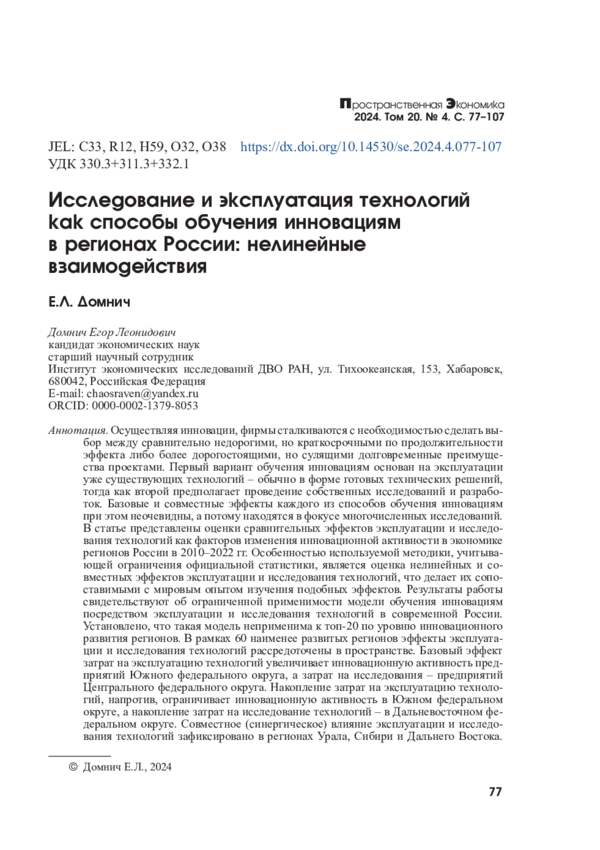
Осуществляя инновации, фирмы сталкиваются с необходимостью сделать выбор между сравнительно недорогими, но краткосрочными по продолжительности эффекта либо более дорогостоящими, но сулящими долговременные преимущества проектами. Первый вариант обучения инновациям основан на эксплуатации уже существующих технологий - обычно в форме готовых технических решений, тогда как второй предполагает проведение собственных исследований и разработок. Базовые и совместные эффекты каждого из способов обучения инновациям при этом неочевидны, а потому находятся в фокусе многочисленных исследований. В статье представлены оценки сравнительных эффектов эксплуатации и исследования технологий как факторов изменения инновационной активности в экономике регионов России в 2010-2022 гг. Особенностью используемой методики, учитывающей ограничения официальной статистики, является оценка нелинейных и совместных эффектов эксплуатации и исследования технологий, что делает их сопоставимыми с мировым опытом изучения подобных эффектов. Результаты работы свидетельствуют об ограниченной применимости модели обучения инновациям посредством эксплуатации и исследования технологий в современной России. Установлено, что такая модель неприменима к топ-20 по уровню инновационного развития регионов. В рамках 60 наименее развитых регионов эффекты эксплуатации и исследования технологий рассредоточены в пространстве. Базовый эффект затрат на эксплуатацию технологий увеличивает инновационную активность предприятий Южного федерального округа, а затрат на исследования - предприятий Центрального федерального округа. Накопление затрат на эксплуатацию технологий, напротив, ограничивает инновационную активность в Южном федеральном округе, а накопление затрат на исследование технологий - в Дальневосточном федеральном округе. Совместное (синергическое) влияние эксплуатации и исследования технологий зафиксировано в регионах Урала, Сибири и Дальнего Востока. Полученные результаты позволяют дополнить мировой опыт изучения процессов обучения инновациям с учетом специфики реализации инновационных процессов в российских регионах.
Идентификаторы и классификаторы
При осуществлении инновационной деятельности любая фирма сталкивается с необходимостью выбора: использовать ли ей уже известные (в рамках фирмы, отрасли или региона) технологии либо сделать ставку на относительно новые технологии, требующие как минимум основательной доработки, а как максимум – полноценного исследования (разумеется, за счет самой фирмы). Первый вариант получил наименование «эксплуатация» (exploitation), тогда как второй – «исследование» (exploration); в сочетании друг с другом они определяют способ или подход к обучению (learning) фирмы инновациям.
Если у вас возникли вопросы или появились предложения по содержанию статьи, пожалуйста, направляйте их в рамках данной темы.
Список литературы
-
Домнич Е.Л. Видовая структура и региональные пропорции затрат на инновационную деятельность в экономике России // Экономические и социальные перемены: факты, тенденции, прогноз. 2024. Т. 17. № 5. С. 133-150. https://dx.doi.org/10.15838/esc.2024.5.95.7. -
Домнич Е.Л. Инновации как фактор изменения производительности предприятий: проблемы измерения и интерпретации // Пространственная экономика. 2022. Т. 18. № 4. С. 93-127. https://dx.doi.org/10.14530/se.2022.4.093-127. -
Домнич Е.Л. Экономические эффекты технологических инноваций в обрабатывающей промышленности России и Дальнего Востока // Пространственная экономика. 2023. Т. 19. № 4. С. 84-116. https://dx.doi.org/10.14530/se.2023.4.084-116. -
Мариев О.С., Нагиева К.М., Симонова В.Л. Управление факторами инновационной активности российских регионов на основе эконометрического моделирования // Управленец. 2020. Т. 11. № 1. С. 57-69. https://dx.doi.org/10.29141/2218-5003-2020-11-1-6. -
Терещенко Д.С. Межрегиональные эффекты инноваций в России: анализ с позиций байесовского подхода // Пространственная экономика. 2024. Т. 20. № 1. С. 125-143. https://dx.doi.org/10.14530/se.2024.1.125-143. -
Atuahene-Gima K., Murray J.Y. Exploratory and Exploitative Learning in New Product Development: A Social Capital Perspective on New Technology Ventures in China // Journal of International Marketing. 2007. Vol. 15. No. 2. Pp. 1-29. https://dx.doi.org/10.1509/jimk.15.2.1. -
Berg J.M. Balancing on the Creative Highwire: Forecasting the Success of Novel Ideas in Organizations // Administrative Science Quarterly. 2016. Vol. 61. No. 3. Pp. 433-468. https://dx.doi.org/10.1177/0001839216642211. -
Brambor T., Clark W., Golder M. Understanding Interaction Models: Improving Empirical Analyses // Political Analysis. 2006. Vol. 14. Issue 1. Pp. 63-82. https://dx.doi.org/10.1093/pan/mpi014. -
Cao Q., Gedajlovic E., Zhang H. Unpacking Organizational Ambidexterity: Dimensions, Contingencies and Synergistic Effects // Organization Science. 2009. Vol. 20. No. 4. Pp. 781-796. https://dx.doi.org/10.1287/orsc.1090.0426. -
Christensen C.M., McDonald R.M., Altman E.J., Palmer J.E. Disruptive Innovation: An Intellectual History and Directions for Future Research // Academy of Management Proceedings. 2018. Vol. 55. No. 7. Pp. 1043-1078. https://dx.doi.org/10.1111/joms.12349. -
Chu C., Li C., Lin C. The Joint Effect of Project-Level Exploratory and Exploitative Learning in New Product Development // European Journal of Marketing. 2011. Vol. 45. No. 4. Pp. 531-550. https://dx.doi.org/10.1108/03090561111111325. -
Echambadi R., Hess J.D. Mean-Centering Does Not Alleviate Collinearity Problems in Moderated Multiple Regression Models // Marketing Science. 2007. Vol. 26. No. 3. Pp. 438-445. https://dx.doi.org/10.1287/mksc.1060.0263. -
Gibson C.B., Birkinshaw J. The Antecedents, Consequences, and Mediating Role of Organizational Ambidexterity // Academy of Management Journal. 2004. Vol. 47. No. 2. Pp. 209-226. -
Greve H.R. Exploration and Exploitation in Product Innovation // Industrial and Corporate Change. 2007. Vol. 16. No. 5. Pp. 945-975. https://dx.doi.org/10.1093/icc/dtm013. -
Harris R.D.F., Tzavalis E. Inference for Unit Roots in Dynamic Panels Where the Time Dimension Is Fixed // Journal of Econometrics. 1999. Vol. 91. No. 2. Pp. 201-226. https://dx.doi.org/10.1016/S0304-4076(98)00076-1. -
Hausman J.A. Specification Tests in Econometrics // Econometrica. 1978. Vol. 46. No. 6. Pp. 1251-1271. https://dx.doi.org/10.2307/1913827. -
He Z., Wong P. Exploration vs. Exploitation: An Empirical Test of the Ambidexterity Hypothesis // Organization Science. 2004. Vol. 15. No. 4. Pp. 481-494. https://dx.doi.org/10.1287/orsc.1040.0078. -
Huber P.J. The Behavior of Maximum Likelihood Estimates Under Nonstandard Conditions // Proceedings of the Fifth Berkeley Symposium on Mathematical Statistics and Probability. Vol. 1. Berkeley: University of California Press, 1967. Pp. 221-233. -
Im K.S., Pesaran M.H., Shin Y. Testing for Unit Roots in Heterogenous Panels // Journal of Econometrics. 2003. Vol. 115. No.1. Рp. 53-74. https://dx.doi.org/10.1016/S0304-4076(03)00092-7. -
Katila R., Ahuja G. Something Old, Something New: A Longitudinal Study of Search Behavior and New Product Introduction // Academy of Management Journal. 2002. Vol. 45. No. 6. Рp. 1183-1194. https://dx.doi.org/10.2307/3069433. -
Lavie D., Rosenkopf L. Balancing Exploration and Exploitation Alliance Formation // Academy of Management Journal. 2007. Vol. 49. No. 4. Рp. 797-818. https://dx.doi.org/10.5465/AMJ.2006.22083085. -
Lavie D., Stettner U., Tushman M.L. Exploration and Exploitation Within and Across Organizations // Academy of Management Annals. 2010. Vol. 4. No. 1. Рp. 109-155. https://dx.doi.org/10.5465/19416521003691287. -
Levin A., Lin C.F., Chu C.J. Unit Root Tests in Panel Data: Asymptotic and Finite-Sample Properties // Journal of Econometrics. 2002. Vol. 108. Issue 1. Pp. 1-24. https://dx.doi.org/10.1016/S0304-4076(01)00098-7. -
Levinthal D.A., March J.G. The Myopia of Learning // Strategic Management Journal. 1993. Vol. 14. Issue S2. Pp. 95-112. https://dx.doi.org/10.1002/smj.4250141009. -
Li P. P. Global Implications of the Indigenous Epistemological System from the East: How to Apply Yin-Yang Balancing to Paradox Management // Cross Cultural & Strategic Management. 2016. Vol. 23. Issue 1. Pp. 42-77. https://dx.doi.org/10.1108/CCSM-10-2015-0137. -
Li P.P., Liu H., Li Y., Wang H. Exploration-Exploitation Duality with Both Tradeoff and Synergy: The Curvilinear Interaction Effects of Learning Modes on Innovation Types // Management and Organization Review. 2023. Vol. 19. Issue 3. Pp. 498-532. https://dx.doi.org/10.1017/mor.2022.49. -
March J.G. Exploration and Exploitation in Organizational Learning // Organization Science. 1991. Vol. 2. No. 1. Pp. 71-87. http://www.jstor.org/stable/2634940. -
Mathias B.D. Exploration, Exploitation, Ambidexterity, and Firm Performance: A Meta-Analysis // Technology, Innovation, Entrepreneurship, and Competitive Strategy: Exploration and Exploitation in Early-Stage Ventures and SMEs / Editor by T. Amburgey, U. Stettner, B. Aharonson. Emerald Publishing Limited, 2014. Pp. 289-317. https://dx.doi.org/10.1108/s1479-067x20140000014009. -
Naumov I.V., Nikulina N.L. Exploring the Innovative Development of Russian Regions: A Spatial Regression Analysis Using the Cobb-Douglas Model // R-Economy. 2023. Vol. 9. No. 2. Pp. 226-247. https://dx.doi.org/10.15826/recon.2023.9.2.014. -
Raisch S., Birkinshaw J., Probst G., Tushman M.L. Organizational Ambidexterity: Balancing Exploitation and Exploration for Sustainable Performance // Organization Science. 2009. Vol. 20. No. 4. Pp. 685-695. https://dx.doi.org/10.1287/orsc.1090.0428. -
Schad J., Lewis M.W., Raisch S., Smith W.K. Paradox Research in Management Science: Looking Back to Move Forward // Academy of Management Annals. 2016. Vol. 10. No. 1. Pp. 5-64. https://dx.doi.org/10.1080/19416520.2016.1162422. -
Siggelkow N., Levinthal D.A. Temporarily Divide to Conquer: Centralized, Decentralized, and Reintegrated Organizational Approaches to Exploration and Adaptation // Organization Science. 2003. Vol. 14. No. 6. Pp. 650-669. https://dx.doi.org/10.1287/orsc.14.6.650.24840. -
Siren C.A., Kohtamaki M., Kuckertz A. Exploration and Exploitation Strategies, Profit Performance, and the Mediating Role of Strategic Learning: Escaping the Exploitation Trap // Strategic Entrepreneurship Journal. 2012. Vol. 6. No.1. pp. 18-41. https://dx.doi.org/10.1002/sej.1126. -
Smith W.K., Lewis M.W. Toward a Theory of Paradox: A Dynamic Equilibrium Model of Organizing // Academy of Management Review. 2011. Vol. 36. No. 2. Pp. 381-403. https://dx.doi.org/10.5465/AMR.2011.59330958. -
White H. A Heteroskedasticity-Consistent Covariance Matrix and a Direct Test for Heteroskedasticity // Econometrica. 1980. No. 48. Pp. 817-830. https://dx.doi.org/10.2307/1912934.
Выпуск
Другие статьи выпуска
С 18 по 28 сентября 2024 г. в Школе экономики и менеджмента Дальневосточного федерального университета в г. Владивостоке состоялась очередная, уже четвертая Международная Тихоокеанская школа-конференция по экспериментальной экономике (МТШК).
В сентябре 2024 г. в г. Сиань (КНР) состоялся форум аналитических центров стран Шанхайской организации сотрудничества (ШОС) «Продвижение устойчивого развития, создание общего дома», организованный Институтом России, Восточной Европы и Центральной Азии Китайской академии общественных наук совместно с Институтом Центральной Азии Шэньсийского педагогического университета (г. Сиань) и Китайским нефтяным университетом (г. Пекин).

С 11 по 22 ноября 2024 г. в Баку (Азербайджан) прошла Рамочная конференция ООН по изменению климата, более известная как COP29. Это первая климатическая конференция ООН на постсоветском пространстве. Выбор Азербайджана в качестве принимающей страны вызвал ряд споров у участников конференции, так как экономика этого государства в значительной степени зависит от ископаемого топлива, оказывая существенную нагрузку на окружающую среду.
Всероссийская научно-практическая конференция с международным участием памяти академика П.А. Минакира «Теория, методы и практика пространственной экономики» проводилась 3–4 декабря 2024 г. в г. Хабаровске. Организаторами выступали Институт экономических исследований ДВО РАН, Дальневосточное отделение РАН и правительство Хабаровского края1. Эта конференция, с одной стороны, является традиционной, так как продолжает ряд ежегодных научных мероприятий, проводимых в ИЭИ ДВО РАН, с другой стороны – выделяется, поскольку посвящена памяти академика П.А. Минакира.
Встающие перед лицом многообразных внешних вызовов задачи ускоренного цифрового развития России требуют решения проблем цифрового неравенства в обозримые сроки. Их решение осложняется, в том числе, весьма значительным разнообразием экономических и инновационных условий различных регионов нашей страны и требует всестороннего его учета. В ходе исследования дано определение понятия цифрового потенциала регионов страны и представлен набор показателей для его оценки. Цель исследования - детализация представлений о цифровом неравенстве регионов России на основе использования понятия их цифрового потенциала. Эта цель достигается путем решения задач раскрытия четырех аспектных цифровых потенциалов (кадрового, технологического, инфраструктурного и коммерческого), позволяющих охарактеризовать интегральный цифровой потенциал регионов страны. Для оценки аспектных и интегрального потенциалов регионов использовались методы прямого рангового сравнения и типологический. Результаты оценки и сравнения регионов по их аспектным и интегральному цифровому потенциалам позволяют прийти к ряду обобщений. В числе лидеров регионы, включающие крупнейшие агломерации, а также ряд регионов нового освоения на Севере, а отстают преимущественно староосвоенные промышленные регионы, а также регионы с высокой долей сельского населения. Лидерство по разным цифровым потенциалам не обязательно совпадает. Но при этом выделяется группа лидеров по интегральному цифровому потенциалу в составе 13 регионов.
В статье приведен анализ особенностей экономического развития Японии. Выявлены проблемы, которые привели к длительному периоду стагнации, не позволяющие выйти на траекторию роста экономики. Так, в условиях глобализации и цифровизации экспортно ориентированная модель экономики с доминирующей ролью государства и жесткой корпоративной структурой не позволяла быстро и адекватно реагировать на новые вызовы глобальной конкурентной среды. Снизилась отдача от капитала и рабочей силы. На рынке труда внутри страны стал наблюдаться дефицит вследствие старения населения, снижения рождаемости, традиций японской семьи (уход женщин с рынка труда после замужества), жесткой миграционной политики и др. Выявлены основные направления реформ последнего десятилетия и их влияние на японскую экономику. Эффективность проведенных реформ оценивается неоднозначно. Роста внутреннего спроса не удалось добиться из-за сохраняющейся высокой нормы накопления и двухэтапного повышения ставки потребительского налога. Однако рынок труда был расширен за счет увеличения занятости женщин и граждан старше 65 лет и небольшого смягчения норм миграционной политики. К тому же произошла либерализация внешнеэкономической политики. Определены стратегии роста японской экономики на современном этапе. Экзогенные шоки последних лет частично нивелировали положительные результаты реформ. Однако такие направления, как смена бизнес-моделей (на формат B2B), переход к безуглеродным технологиям, развитие туристической отрасли, активное использование искусственного интеллекта во всех сферах и другое способствуют росту японской экономики и лежат в основе стратегии экономического развития, реализуемой действующим правительством.
Усложнение глобальных цепочек стоимости, тенденции глобализации и деглобализации, стремление некоторых развивающихся стран к решорингу и ниашорингу, экономические шоки и торговые войны - все это приводит к трансформации торговых потоков и особенно существенно отражается на высокотехнологичных секторах, к которым относится сектор оптического и электронного оборудования. Результаты данной статьи базируются на объединении двух подходов к исследованию торговых потоков между странами: торговли добавленной стоимостью и декомпозиции добавленной стоимости на внутренний и иностранной компонент с использованием метода «затраты-выпуск» и сетевого подхода. Для построения глобальной карты торговых потоков использованы таблицы «затраты-выпуск» ADB MRIO за 2017 и 2022 гг. для 73 стран, в части исследования особенностей участия России в ГЦС использованы таблицы «затраты-выпуск» ADB MRIO за 2000, 2007-2022 гг. для 63 стран. Результатом исследования стало определение структуры и пространственной организации глобальных производственных систем в отрасли оптического и электронного оборудования, определение характеристик и особенностей сети, а также специфики вовлеченности России в глобальные цепочки стоимости в данном секторе. Полученная сетевая модель позволила определить наличие шести кластеров, которые формируют взаимосвязи по принципу «ядро-периферия», а также выявить специфику формирования и развития этих кластеров. Ядра модели составляют три центра мегауровня КНР, США и Республика Корея, вокруг которых сформировались три глобальных кластера и три субъядра, контролируемые главными ядрами, которые значительно выделяются из общей периферии, центрами которых выступают Япония, Германия и Тайвань. Анализ показателей сети в динамике за исследуемый период показал ее следующие особенности: устойчивость и стабильность, формирование по отраслевому, а не географическому признаку, активизацию вовлеченности в ГЦС между ядрами с одной стороны и крупными азиатскими экономиками и небольшими странами Европы с другой. Анализ специфики участия России в системе глобального производства исследуемой отрасли показал преобладание восходящих связей с высоким содержанием в экспорте внутренней добавленной стоимости, наличие сильных взаимосвязей с отечественными предприятиями, высокую локализацию производства и слабую динамику вовлеченности в ГЦС.
Статья посвящена оценке величины и пространственного распределения экономических эффектов, обусловленных введением санкционных ограничений на экспорт российских топливно-энергетических ресурсов. В расчетах использована внутринациональная балансовая модель В. Леонтьева с прозрачной системой предпосылок и сравнительно невысокими требованиями к информационному обеспечению. Проанализированы факторы изменения спроса на российские энергоресурсы на мировых рынках в перспективе до 2030 г. Дана оценка реакции экономики регионов России в последнем году прогнозного периода (2030 г.) на ряд последовательно вводимых экспортных ограничений разного характера - от компромиссных (когда условия торговли остаются относительно благоприятными и сокращение поставок в западном направлении в значительной мере компенсируется активизацией поставок в восточном направлении) до крайних / радикальных (когда активно применяется практика торговых барьеров и санкций, блокирующих потенциал рыночных маневров). Показано, что пространственное распределение потерь от экспортных ограничений является неравномерным и в существенной степени зависит от географии новых рынков сбыта топливно-энергетических ресурсов. С точки зрения нивелирования негативных эффектов экспортных ограничений оценены активно обсуждаемые сейчас направления структурной трансформации ТЭК России: 1) развитие электроэнергетики, 2) создание СПГ производств, 3) модернизация НПЗ и 4) развитие нефтегазохимии. Сделан вывод о том, что имеющиеся предложения позволяют компенсировать возникающие вследствие экспортных ограничений потери национальной экономики, но в общем не меняют инерционной направленности ее динамики.
В статье на основе данных о реальных располагаемых доходах населения и расходах на потребление товаров и услуг для 11 регионах Дальневосточного федерального округа за 2000-2022 гг. оцениваются региональные функции потребления на базе модели коррекции ошибок. Выявляется наличие краткосрочных и долгосрочных зависимостей между динамикой доходов и потреблением населения, важных для генерации мультипликативных эффектов в экономиках соответствующих регионов. Обнаружено, что для 7 субъектов РФ (Республики Бурятия, Забайкальского, Приморского и Хабаровского краев, Амурской и Сахалинской областей, а также Еврейской автономной области) характерно наличие как статистически значимых краткосрочных зависимостей между изменением доходов и изменением потребления, так и долгосрочных равновесных соотношений между доходом и потреблением. Рассчитаны показатели краткосрочных предельных склонностей к потреблению, являющихся основой региональных мультипликаторов автономных расходов. Для Республики Саха (Якутия) выявлена статистически значимая краткосрочная зависимость между доходом и потреблением, но отсутствие долгосрочной взаимосвязи между показателями. Для Камчатского края, Магаданской области и Чукотского автономного округа подтверждено отсутствие как краткосрочных, так и долгосрочных взаимосвязей между доходом и потреблением, а следовательно, отсутствие потенциалов генерации иных мультипликативных эффектов в экономике, кроме тех, что обусловлены сугубо межотраслевыми взаимосвязями.
В работе представлено исследование различий в экономическом развитии муниципальных образований Новосибирской области. На основе данных официальной статистики строятся карты распределения по территории населения, занятости, выручки, рентабельности продаж, доли убыточных предприятий. Сделан вывод о высокой степени концентрации деловой активности вокруг региональной столицы. При этом не все муниципалитеты Новосибирской агломерации являются лидерам по темпам роста и эффективности бизнеса, что ставит вопрос об исчерпании ресурса положительных эффектов агломерационной экономики. Описательные методы дополняются эконометрическим анализом роли пространственных факторов в экономическом развитии территорий. Регрессионные оценки выявили неоднородность влияния внешних рынков, в рамках Новосибирской агломерации доминируют положительные эффекты межрайонных связей, а за ее пределами сильнее сказываются отрицательные последствия межмуниципальной конкуренции. Дальнейшая концентрация экономического потенциала в Новосибирской агломерации без более протяженного транслирования импульсов роста на другие городские и сельские населенные пункты приведет к сдерживанию развития всей территории области. Региональная политика должна включать институты и механизмы перехода от преимущественно конкурентных отношений между муниципальными образованиями к преобладанию кооперативных интересов. Необходимо также создавать условия для формирования новых центров экономического роста в регионе, их роль могут выполнять муниципальные образования с относительно высокой численностью населения, развитой сетью дорог и преимущественно промышленной специализацией деловой активности.
Статистика статьи
Статистика просмотров за 2025 - 2026 год.
Издательство
- Издательство
- ИЭИ ДВО РАН
- Регион
- Россия, Хабаровск
- Почтовый адрес
- 680042, г. Хабаровск, ул. Тихоокеанская, 153.
- Юр. адрес
- 680042, г. Хабаровск, ул. Тихоокеанская, 153.
- ФИО
- Исаев Артём Геннадьевич (Директор)
- E-mail адрес
- st@ecrin.ru
- Контактный телефон
- +7 (421) 2725225
- Сайт
- http:/www.ecrin.ru