
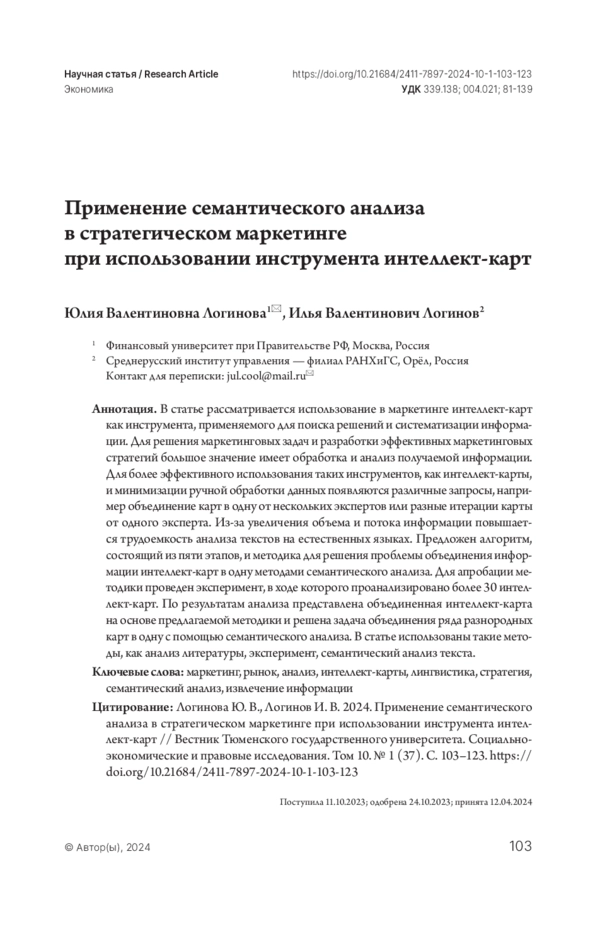
В статье рассматривается использование в маркетинге интеллект-карт как инструмента, применяемого для поиска решений и систематизации информации.
Для решения маркетинговых задач и разработки эффективных маркетинговых стратегий большое значение имеет обработка и анализ получаемой информации.
Для более эффективного использования таких инструментов, как интеллект-карты,
и минимизации ручной обработки данных появляются различные запросы, например объединение карт в одну от нескольких экспертов или разные итерации карты от одного эксперта.
Из-за увеличения объема и потока информации повышается трудоемкость анализа текстов на естественных языках.
Предложен алгоритм, состоящий из пяти этапов, и методика для решения проблемы объединения информации интеллект-карт в одну методами семантического анализа.
Для апробации методики проведен эксперимент, в ходе которого проанализировано более 30 интеллект-карт.
По результатам анализа представлена объединенная интеллект-карта на основе предлагаемой методики и решена задача объединения ряда разнородных карт в одну с помощью семантического анализа.
В статье использованы такие методы, как анализ литературы, эксперимент, семантический анализ текста.
Идентификаторы и классификаторы
Благодаря цифровизации и развитию информационных технологий количество информации в мире постоянно увеличивается, уровень конкуренции становится беспрецедентным, что также отражается и в маркетинге, где увеличиваются объемы
информации о клиентах, партнерах, конкурентах, постоянно изменяются внешние факторы и т. д.
С другой стороны, традиционные подходы к решению маркетинговых
задач становятся не всегда актуальными в настоящее время.
Если у вас возникли вопросы или появились предложения по содержанию статьи, пожалуйста, направляйте их в рамках данной темы.
Список литературы
Алексеева Т. Е., Федосеева Л. Н. 2022. Англоязычные рекламные слоганы автопроизводителей: структурно-семантический анализ // Вестник Воронежского государственного
университета. Серия: Лингвистика и межкультурная коммуникация. № 1. С. 81–87.
Белов С. Д., Зрелова Д. П., Зрелов П. В., Кореньков В. В. 2020. Обзор методов автоматической обработки текстов на естественном языке // Системный анализ в науке и образовании. № 3. С. 8–22.
Ехлаков Ю. П., Малаховская Е. К. 2018. Семантическая сеть формирования содержания
текстового коммуникационного сообщения для продвижения мобильных приложений
на потребительский рынок // Вестник Дагестанского государственного технического
университета. Технические науки. № 45 (1). С. 129–138.
Изакова Н. Б., Елькина К. С. 2021. Матричный метод Росситера — Перси при разработке
коммуникационной стратегии производителя хлебобулочных изделий // e-FORUM.
Том 5. № 2 (15).
Комарова С. Н., Мишурова А. Ю. 2020. Выбор маркетинговой стратегии сервисного
предприятия для обеспечения устойчивого развития // Естественно-гуманитарные
исследования. № 28 (2). С. 119–128.
Кузнецов С. А., Вильнин А. Д. 2021. Сравнение методов оценки семантического сходства
на основе doc2vec и tf-idf // Электронные средства и системы управления: XVII Меж-
дунар. науч.-практ. конф. (17–19 ноября 2021 г.). С. 166–168.
Лепехина Ю. А. 2018. Выбор стратегии стивидорной компании на основе маркетингового
анализа // Экономика устойчивого развития. № 2 (34). С. 200–213.
Любецкий П. Б. 2018. Механизм формирования и реализации маркетинговой стратегии
мясоперерабатывающих предприятий. Горки: БГСХА. 288 с.
Микалко М. 2019. Взлом креатива: как увидеть то, что не видят другие / пер. с англ. А. Ко-
робейникова. М.: Манн, Иванов и Фербер. 4-е изд. 320 с.
Фещенко Л. Г. 2020. Пентаграмма рекламного текста, или комплексная методика анализа
(предтекст, контекст, текст, подтекст, затекст) // Жанры и типы текста в научном и ме-
дийном дискурсе: сб. науч. трудов. Орёл: Орловский гос. ин-т культуры. Вып. 17. С. 21–35.
Шимохин А. В. 2021. Семантический анализ отзывов о поставщиках на основе применения
нейросетевой технологии // Фундаментальные исследования. № 5. С. 117–121.
Шлыков В. А., Гордеева О. А. 2020. Формирование контекстной рекламы на основе анализа
сетевой активности пользователя // Труды международного симпозиума «Надежность
и качество». Том 1. С. 276–280.
Althuizen N., Wierenga B., Chen B. 2016. Managerial decision-making in marketing: matching
the demand and supply side of creativity // Journal of Marketing Behavior. No. 2. Рр. 129–176.
Bagorka M. 2017. Methodological instruments for forming the marketing strategy of agricultural
production ecologization // Baltic Journal of Economic Studies. No. 3. Рр. 7–11.
Beel J., Langer S. 2011. An exploratory analysis of mind maps // Proceedings of the 2011 ACM
Symposium on Document Engineering. https://doi.org/10.1145/2034691.2034709
Chen T., Mohanty R. R., Hoffmann Rodriguez M. А., Krishnamurthy V. 2019. Collaborative
mind-mapping: a study of patterns, strategies, and evolution of maps created by peer-pairs //
Proceedings of the ASME 2019 International Design Engineering Technical Conferences &
Computers and Information in Engineering Conference IDETC/CIE 2019 (August 18–21,
2019, Anaheim, CA, USA). https://doi.org/10.1115/DETC2019-98125
Deerwester S. C., Dumais S. T., Landauer T. K., Furnas G. W., Harshman R. A. 1990. Indexing
by latent semantic analysis // JAsIs. No. 41 (6). Рр. 391–407.
Gabrilovich E., Markovitch S. 2007. Computing semantic relatedness using Wikipedia-based
explicit semantic analysis // IJCAI. No. 7. Рр. 1606–1611.
Ge K., Zhao J.-Q., Zhao Y.-Y. 2022. Gr-gnn: gated recursion-based graph neural network algorithm
// Mathematics. Vol. 10. No. 7. Р. 1171.
Hamilton W., Ying Z., Leskovec J. 2017. Inductive representation learning on large graphs //
Advances in Neural Information Processing Systems. Рp. 1024–1034.
Hassan S., Mihalcea R. 2011. Semantic relatedness using salient semantic analysis // Twenty-Fifth
AAAI Conference on Artificial Intelligence. No. 25. Рр. 884–889.
Hou Z., Liu X., Dong Y., Wang C., Tang J. 2022. Graphmae: self-supervised masked graph
autoencoders // KDD ’22 (August 14–18, 2022, Washington, DC, USA). https://doi.org/
10.48550/arXiv.2205.10803
Kedaj P., Pavlicek J., Hanzlik P. 2014. Effective mind maps in e-learning // Acta Informatica
Pragensia. No. 3. Рр. 239–250.
Koznov D., Larchik E., Pliskin M., Artamonov N. 2011. Mind maps merging in collaborative
work // Programming and Computer Software. No. 37. Рр. 315–321.
Landauer T. K., Laham D., Rehder B., Schreiner M. E. 1997. How well can passage meaning
be derived without using word order? А comparison of latent semantic analysis and humans
// Proceedings of the 19th annual meeting of the Cognitive Science Society, Citeseer.
Рр. 412–417.
Levie R., Monti F., Bresson X., Bronstein M. 2018. Cayleynets: graph convolutional neural
networks with complex rational spectral filters // IEEE Transactions on Signal Processing.
No. 67 (1). Рp. 97–109.
Li Z., Zhao Y., Zhang Y., Zhang Z. 2022. Multi-relational graph attention networks for knowledge
graph completion // Knowledge-Based Systems. No. 251. https://doi.org/10.1016/j.
knosys.2022.109262
Lindholm A. 2001. September 13. 3-way merging algorithm for synchronizing ordered trees —
the 3dm merging and differencing tool for XML: Master’s thesis / Helsinki University of Technology,
Department of Computer Science and Engineering. Finland, Espoo. https://citeseerx.ist.psu.
edu/document?repid=rep1&type=pdf&doi=01233fb5ca6e286edabea4cceb990d7d7b0f5652
Shabani N., Wu J., Beheshti A., Foo J., Hanif A., Shahabikargar M. 2023. A comprehensive survey
on graph summarization with graph neural networks // Journal of IEEE Transactions
on Artificial Intelligence. https://doi.org/10.48550/arXiv.2302.06114
Shalaby W., Zadrozny W. 2017. Mined semantic analysis: а new concept space model for semantic
representation of textual data // IEEE International Conference on Big Data (BIGDATA).
Рр. 2122–2131.
Tarka P., Łobiński M. 2014. Decision making in reference to model of marketing predictive analytics
— theory and practice // Management and Business Administration. Central Europe.
No. 22. Рр. 60–69.
Tomše D., Snoj B. 2014. Marketing communication on social networks: solution in the times
of crisis // Marketing. No. 45. Рр. 131–138.
Veličković P., Cucurull G., Casanova A., Romero A., Lio P., Bengio Y. 2017. Graph attention
networks // ICLR. https://doi.org/10.48550/arXiv.1710.10903
Yang D., Yin Y. 2021. Evaluation of taxonomic and neural embedding methods for calculating
semantic similarity // Natural Language Engineering. No. 1 (29). https://doi.org/10.48550/
arXiv.2209.15197
Zhang C.-Y., Yao Z.-L., Yao H.-Y., Huang F., Chen C. P. 2022. Dynamic representation learning
via recurrent graph neural networks // IEEE Transactions on Systems, Man, and Cybernetics:
Systems. No. 52 (3). Рp. 468–479.
Zhang S., Tong H., J. Xu, R. Maciejewski. 2019. Graph convolutional networks: a comprehensive
review // Computational Social Networks. No. 6 (1). Рp. 1–23.
Выпуск

Другие статьи выпуска
В этой книге, рассуждая с афроцентрических позиций и теоретических подходов, авторы задают универсальные и наиболее важные вопросы нашего времени о мире, социальной безопасности, защите людей и окружающей среды от физического ущерба и необходимых для этого институциональных гарантиях.
Эти вопросы обязательно связаны с гарантиями правосудия. Африканская перспектива важна для того, чтобы преобразовать нашу позицию, основанную на евроцентричном мышлении и концепции »богатого Севера«, в универсальную.
Согласно авторы, для Африки характерны единые континентальные вызовы. До сих пор ни одна из западных держав не смогла предложить долгосрочного решения этих проблем.
Западу не хватает первоначального опыта антиколониальной борьбы и стремления
к независимому развитию Африки.
В статье рассматривается Всероссийская научно-практическая конференция на тему «Сохранение и укрепление традиционных духовно-нравственных ценностей многонационального народа России»
В статье описывается ценностное и прогнозно-стратегическое значение научной юриспруденции

Статья посвящена характеристике динамики налогового бремени российских компаний сферы информационных технологий как ключевого фактора их экономической устойчивости.
Целью исследования является определение региональных особенностей уровня налогового бремени в сфере информационных технологий для выявления лучшей практики с возможностью дальнейшего тиражирования удачного опыта.
Для достижения цели проводится анализ изменения налогового бремени в постковидный период по сравнению с 2019 г.
Особое внимание уделяется динамике налогового бремени в зависимости от масштабов
предприятий.
Результаты исследования показывают, что тенденция снижения налогового бремени в постковидный период не является стабильной для всех регионов.
Было подтверждено, что низкий уровень налогового бремени связан не столько с отраслью ведения деятельности (в частности, со сферой информационных технологий), сколько с региональными особенностями (созданием налоговых преференций на отдельных территориях).
В настоящее время господдержка бизнеса налоговыми способами и методами направлена в большей степени на поддержку тех или иных субъектов федерации, а не отрасли информации и связи.
Наиболее типичный масштаб предприятий сферы информационных технологий, демонстрирующих минимальное налоговое бремя, предполагает выручку от 30 до 120 млн руб. в год.
Подобное масштабирование бизнеса в данной сфере позволяет не только использовать налоговые преференции, установленные действующим российским налоговым законодательством, но и изыскивать ресурсы для организации эффективного налогового планирования.
В данной статье освещены исторические аспекты присоединения Луганской Народной Республики к Российской Федерации.
Авторами рассмотрены особенности применения судами Луганской Народной Республики
уголовного закона Российской Федерации в период интеграции нового субъекта в правовую систему Российской Федерации.
Актуальность исследования обусловлена тем, что в нем раскрывается механизм индивидуализации наказания подсудимых, являющихся участниками специальной
военной операции по защите гражданского населения Донецкой и Луганской Народных
Республик, в том числе реализованный путем назначения условного осуждения.
В статье раскрываются особенности применения судами в качестве смягчающего наказание обстоятельства участие в специальной военной операции.
Исследована складывающаяся практика назначения наказания лицам за совершение криминальных деяний до дня вхождения ЛНР в состав Российской Федерации.
Также изучены вопросы формирования судебной практики применения норм уголовного и международного права при рассмотрении дел о преступлениях, совершенных в отношении мирного населения ЛНР.
Сделано заключение о том, что судами обоснованно и справедливо применяются нормы уголовного кодекса ЛНР, которые улучшают положение осужденных.
Автор полагает, что в условиях проводимой муниципальной реформы в России совершенствование механизмов общественного участия в муниципальном управлении должно стать одним из приоритетных направлений.
Данное обстоятельство актуализирует вопрос о комплексном исследовании релевантного
зарубежного опыта.
В работе впервые в рамках отечественной науки муниципального права исследуется региональное (провинциальное) законодательство Аргентины в части регулирования форм участия населения в осуществлении местного самоуправления.
Научная новизна работы обусловлена комплексным системным исследованием правовых основ обеспечения участия населения в осуществлении местного самоуправления в Аргентине.
В указанной части исследуются нормативные источники, которые ранее в отечественной науке муниципального права исследованы не были.
Актуальность исследования связана с потребностью и своевременностью анализа зарубежного опыта муниципального строительства в контексте реализованной в России конституционной и продолжающейся муниципальной реформы.
Акцент в работе сделан на таких формах участия, как выборы, референдум, отзыв выборных должностных лиц, участие населения в обсуждении различных вопросов посредством использования различных механизмов, создание децентрализованных территориальных образований.
На основе сочетания сравнительно-правового и комплексного методов исследования автор приходит к выводу, что отдельные механизмы вовлечения населения в принятие решений на местном уровне могут быть приняты во внимание в рамках отечественного правопорядка.
В частности, обращается внимание на совершенствование процедуры отзыва выборных должностных лиц, повышение степени участия населения при реформировании территориальных основ организации муниципальной власти, обеспечение участия жите-
лей отдельных населенных пунктах в осуществлении местного самоуправления
при укрупнении муниципальных образований, институционализацию локальных сообществ.
Анализ аргентинского опыта в указанной части может служить
подспорье
Интернет становится всё более значимым для эффективного функционирования экономики и общества.
Однако исследования показали наличие цифрового разрыва, заключающегося в том, что пожилые люди являются неравноправными участниками онлайн-торговли.
Поэтому наше исследование направлено на изучение социальных факторов, которые способствуют или ограничивают поведение пожилых людей при совершении покупок в Интернете, а также предлагается авторская стратификация пожилых пользователей / не пользователей онлайн-сервисов на основе этих социальных факторов. Эмпирическая часть исследования включала опрос с выборкой из 320 пожилых людей, по результатам
которого был проведен корреляционный и кластерный анализ.
Полученные результаты показывают, что наиболее сильным фактором, определяющим адаптивность пожилых людей к онлайн-торговле, является место их жительства (сельская
либо городская местность).
В статье рассматриваются основные тенденции воспроизводства педагогических кадров в системе общего образования России.
На основании анализа теоретико-методологических подходов и ряда эмпирических работ
авторами делается вывод о значимости стабильного восполнения профессиональной структуры, в т. ч. на уровне общего образования, а также наличии ряда факторов, влияющих на его успешность.
К подобным факторам относят территориальные условия, в т. ч. социально-экономические и демографические, динамику уровня образования населения и специфику работы системы образования (например, наличие предпрофильного образования как механизма
рекрутинга потенциальных работников), а также влияние иных групп факторов.
В работе анализируются статистические данные Министерства просвещения Российской Федерации о численности, структуре и динамике движения кадров в организациях, реализующих программы общего образования.
Авторы показывают ряд негативных тенденций, связанных с ростом численности учителей, уволившихся со своего рабочего места, увеличением количества ставок, приходящегося на одного штатного работника образования, а также роста числа ставок, вакантных на начало учебного года.
Описанные тенденции имеют специфику проявления в городских и сельских общеобразовательных организациях, а также с разной степенью интенсивности проявляются в различных предметных областях, усиливая проблемы с подготовкой, в первую очередь, по естественнонаучным предметам.
Статья посвящена анализу роли и места соседского взаимодействия в мессенджерах в части конструирования социального статуса.
Цифровизация повседневности и расширение строительства многоквартирных жилых объектов в российских городах ставят перед исследователями множество вопросов об особенностях протекания социальных процессов и складывания социальной структуры в данных условиях.
Цель статьи — на основании опыта двухлетнего наблюдения и собранного эмпирического материала (более 60 000 сообщений пользователей) показать, как в дискурсе соседских обсуждений современных жилых комплексов Иркутска артикулируется нарратив социального благополучия.
Основным методом исследования является дискурс-анализ, социальный статус жильцов представляется нам «пустым знаком», за наполнение которого «борется» дискурс соседских обсуждений.
Для предобработки текстового массива применялся софт MAXQDA 2020, предобработка производилась с помощью тематического кодирования.
Был выделен ряд кодов, так или иначе связанных с исследуемой проблематикой.
Закодированная совокупность текстов была обобщена в три основных тропа, вокруг которых вращаются обсуждения интересующей нас тематики — финансовая состоятельность членов сообщества, материальные маркеры достатка и образ жителей сопредельных локальностей.
Основным теоретическим ресурсом, используемым в исследовании, послужили идеи П. Бурдьё и «социального конструирования реальности» П. Бергера и Т. Лукмана.
Соседский чат представляется нам механизмом, позволяющим инструментализировать атрибуты социального статуса в текстовых практиках, тем самым кристаллизуя сообщество изнутри.
Основными факторами, детерминирующими самоописание и самовоображение сообществ в качестве носителей высокого социального статуса, выделены благополучие, предзаданное на этапе реализации застройщиками новой недвижимости, и расположение в городском пространстве.
Статистика статьи
Статистика просмотров за 2025 - 2026 год.
Издательство
- Издательство
- ТЮМГУ
- Регион
- Россия, Тюмень
- Почтовый адрес
- 625003, Уральский федеральный округ, Тюменская область, г. Тюмень, ул. Володарского, д. 6
- Юр. адрес
- 625003, Уральский федеральный округ, Тюменская область, г. Тюмень, ул. Володарского, д. 6
- ФИО
- Романчук Иван Сергеевич (РЕКТОР)
- E-mail адрес
- ceo@utmn.ru
- Контактный телефон
- +7 (345) 2597429