Following the first edition of Manuel Álvares’ De institutione grammatica libri tres (Lisbon, 1572), the Portuguese text tradition of the celebrated grammar was completed with the 1573 pupil’s manual. Both the precise number of editions that appeared thereafter and what in a distant future might be developed into a stemma editionum remain unknown. In the context of ongoing bibliographic research, the present article offers an outlook on the beginnings of Alvaresian grammar in late 16th-century Europe by means of a presentation of how the grammars’ national text traditions emerged in Czech, French, German, Italian, Lithuanian, Polish and Spanish editions. Álvares’ grammar started to take on divergent national forms since its first publication for the purposes of the Bavarian Jesuit University of Dillingen, in which the volumes were distributed according to the official syllabus, thus moving beyond the division between teacher’s manual and pupil’s manual made by the author. Even though the more comprehensive ars maior also appeared in German and Italian editions, in the late 16th century the ars minor became particularly important due to its editions in France, Italy and Spain. There also appeared the Czech variant of the ars minor as well as the Lithuanian and Polish partial editions, whose textual constitution seems to correspond to the requirements of the respective syllabi.
Идентификаторы и классификаторы
- SCI
- Литература
The rapid global expansion of the Society of Jesus since its recognition by Pope Paul III in 1540 prompted the establishment of a considerable number of Jesuit schools, colleges and universities, both in the Old and in the New World. Initially, in order to supply the required manuals for teaching Latin at the Coimbra Real Collegio das Artes, in his letter dated 18 October 1564 the second Superior General Diego Laínez (1512–1565) ordered the Portuguese Jesuit Manuel Álvares (1526–1583) to hand over his materials on Latin grammar (Laínez 1917, VIII, 265). Whereas it seems to be commonly known that the first edition of what may be called the ars maior of De institvtione grammatica libri tres was published in Lisbon in September of 1572, the existence of the 1573 first edition of the pupil’s manual classifiable as ars minor could only be proven quite recently (Kemmler 2012, 2015)
Список литературы
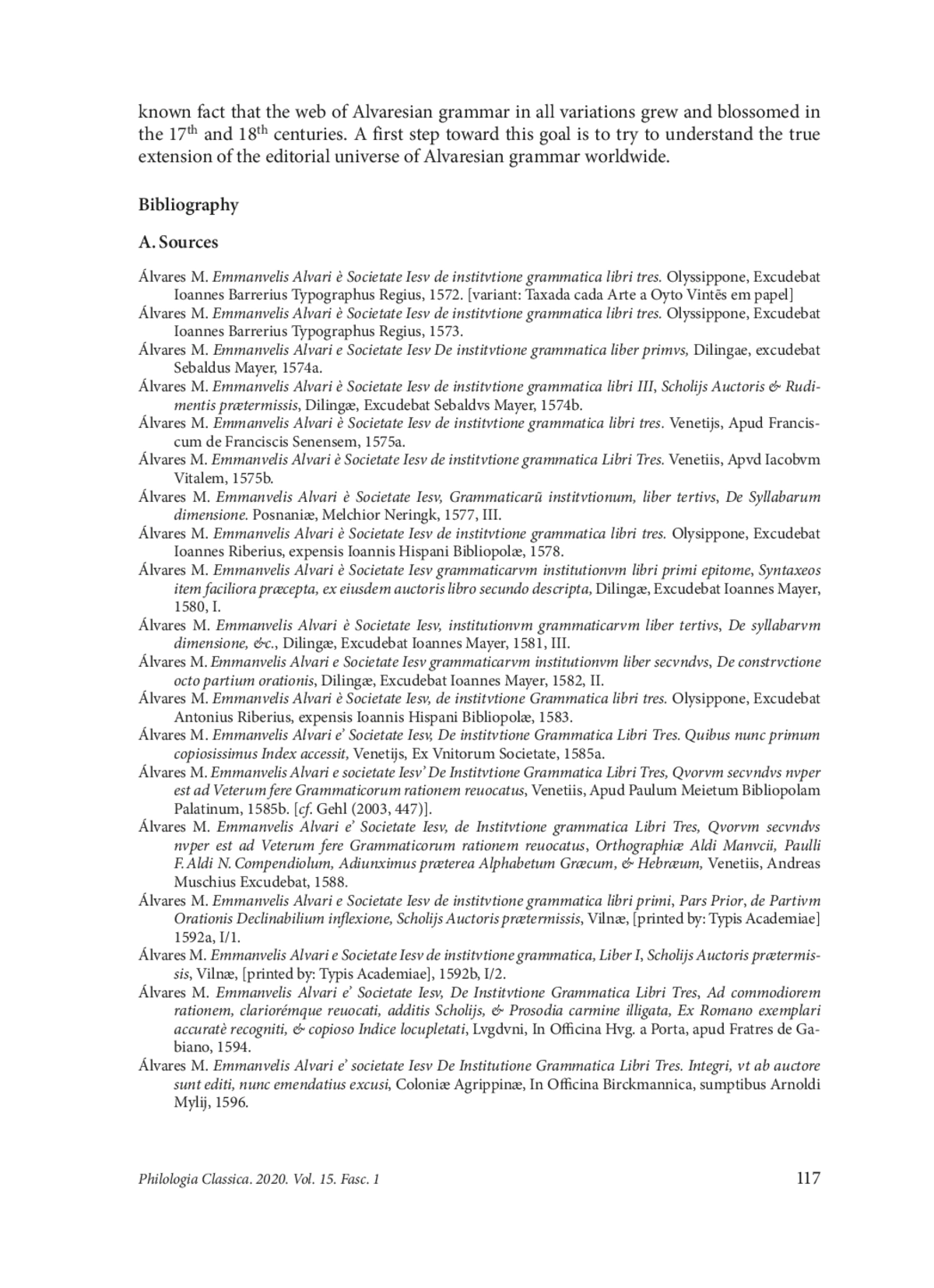
1. Álvares M. Emmanvelis Alvari è Societate Iesv de institvtione grammatica libri tres. Olyssippone, Excudebat Ioannes Barrerius Typographus Regius, 1572. [variant: Taxada cada Arte a Oyto Vintẽs em papel].
2. Álvares M. Emmanvelis Alvari è Societate Iesv de institvtione grammatica libri tres. Olyssippone, Excudebat Ioannes Barrerius Typographus Regius, 1573.
3. Álvares M. Emmanvelis Alvari e Societate Iesv De institvtione grammatica liber primvs, Dilingae, excudebat Sebaldus Mayer, 1574a.
4. Álvares M. Emmanvelis Alvari è Societate Iesv de institvtione grammatica libri III, Scholijs Auctoris & Rudimentis prætermissis, Dilingæ, Excudebat Sebaldvs Mayer, 1574b.
5. Álvares M. Emmanvelis Alvari è Societate Iesv de institvtione grammatica libri tres. Venetijs, Apud Franciscum de Franciscis Senensem, 1575a.
6. Álvares M. Emmanvelis Alvari è Societate Iesv de institvtione grammatica Libri Tres. Venetiis, Apvd Iacobvm Vitalem, 1575b.
7. Álvares M. Emmanvelis Alvari è Societate Iesv, Grammaticarũ institvtionum, liber tertivs, De Syllabarum dimensione. Posnaniæ, Melchior Neringk, 1577, III.
8. Álvares M. Emmanvelis Alvari è Societate Iesv de institvtione grammatica libri tres. Olysippone, Excudebat Ioannes Riberius, expensis Ioannis Hispani Bibliopolæ, 1578.
9. Álvares M. Emmanvelis Alvari è Societate Iesv grammaticarvm institutionvm libri primi epitome, Syntaxeos item faciliora præcepta, ex eiusdem auctoris libro secundo descripta, Dilingæ, Excudebat Ioannes Mayer, 1580, I.
10. Álvares M. Emmanvelis Alvari è Societate Iesv, institutionvm grammaticarvm liber tertivs, De syllabarvm dimensione, &c., Dilingæ, Excudebat Ioannes Mayer, 1581, III.
11. Álvares M. Emmanvelis Alvari e Societate Iesv grammaticarvm institutionvm liber secvndvs, De constrvctione octo partium orationis, Dilingæ, Excudebat Ioannes Mayer, 1582, II.
12. Álvares M. Emmanvelis Alvari è Societate Iesv, de institvtione Grammatica libri tres. Olysippone, Excudebat Antonius Riberius, expensis Ioannis Hispani Bibliopolæ, 1583.
13. Álvares M. Emmanvelis Alvari e’ Societate Iesv, De institvtione Grammatica Libri Tres. Quibus nunc primum copiosissimus Index accessit, Venetijs, Ex Vnitorum Societate, 1585a.
14. Álvares M. Emmanvelis Alvari e societate Iesv’ De Institvtione Grammatica Libri Tres, Qvorvm secvndvs nvper est ad Veterum fere Grammaticorum rationem reuocatus, Venetiis, Apud Paulum Meietum Bibliopolam Palatinum, 1585b. [cf. Gehl (2003, 447)].
15. Álvares M. Emmanvelis Alvari e’ Societate Iesv, de Institvtione grammatica Libri Tres, Qvorvm secvndvs nvper est ad Veterum fere Grammaticorum rationem reuocatus, Orthographiæ Aldi Manvcii, Paulli F. Aldi N. Compendiolum, Adiunximus præterea Alphabetum Græcum, & Hebræum, Venetiis, Andreas Muschius Excudebat, 1588.
16. Álvares M. Emmanvelis Alvari e Societate Iesv de institvtione grammatica libri primi, Pars Prior, de Partivm Orationis Declinabilium inflexione, Scholijs Auctoris prætermissis, Vilnæ, [printed by: Typis Academiae] 1592a, I/1.
17. Álvares M. Emmanvelis Alvari e Societate Iesv de institvtione grammatica, Liber I, Scholijs Auctoris prætermissis, Vilnæ, [printed by: Typis Academiae], 1592b, I/2.
18. Álvares M. Emmanvelis Alvari e’ Societate Iesv, De Institvtione Grammatica Libri Tres, Ad commodiorem rationem, clariorémque reuocati, additis Scholijs, & Prosodia carmine illigata, Ex Romano exemplari accuratè recogniti, & copioso Indice locupletati, Lvgdvni, In Officina Hvg. a Porta, apud Fratres de Gabiano, 1594.
19. Álvares M. Emmanvelis Alvari e’ societate Iesv De Institutione Grammatica Libri Tres. Integri, vt ab auctore sunt editi, nunc emendatius excusi, Coloniæ Agrippinæ, In Officina Birckmannica, sumptibus Arnoldi Mylij, 1596.
20. Álvares M. Emmanvelis Alvari, e’ Societate Iesv, De Institvtione grammatica libri III, Locvpletati, et scholiis nuper aucti, ac recogniti, Pragæ, Ex Typographia VVenceslai Marini, 1598a, I.
21. Álvares M. Emmanvelis Alvari, e’ Societate Iesv, De Institvtione grammatica librum secvndvm, introductio, Pragæ, Excudebat VVenceslaus Marinus, 1598b; II/1.
22. Álvares M. Emmanvelis Alvari, e’ Societate Iesv, De Institvtione grammatica liber secvndvs, De Constrvctione Octo Partium Orationis, Pragæ, Excudebat VVenceslaus Marinus, 1598c, II/2.
23. Álvares M. Emmanvelis Alvari, e’ Societate Iesv, De Institvtione grammatica liber tertivs, de syllabarvm dimensione, Pragæ, Excudebat VVenceslaus Marinus, 1598d, III.
24. Álvares M. Emmanvelis Alvari, e Societate Iesv, De Institvtione Grammatica Libri Tres, Ad commodiorem rationem, clariorémque reuocati, additis Scholijs, & Prosodia carmine illigata, Ex Romano exemplari accuratè recogniti, & copioso Indice locupletati, Lvgdvni, Apvd Ioannem Pillehotte, 1598b, I.
25. Álvares M. Emmanvelis Alvari, e Societate Iesv, De Institvtione Grammatica, Liber secundus, qvi est, De Constructione octo partium Orationis, ad veterum ferè Grammaticorum rationem reuocatus, Editio Qvinta, Ex Auctoris Commentario emmendatior, Lvgdvni, APVD Ioannem Pillehotte, 1598b, II.
26. Álvares M. Emmanvelis Alvari, e Societate Iesv De Institutione Grammatica Liber tertius, De Syllabarum Dimensione, Editio qvarta, Lvgdvni, Apvd Ioannem Pillehotte, 1598b, III.
27. Álvares M. Emmanvelis Alvari e’ Societate Iesv, De Institutione Grammatica Libri Tres, Ad commodiorem rationem, clariorémque reuocati, additis Scholijs, & Prosodia carmine illigata, Ex Romano exemplari accuratè recogniti, & copioso Indice locupletati, Lvgdvni, Apvd Abraham Cloqvemin, 1598c, I.
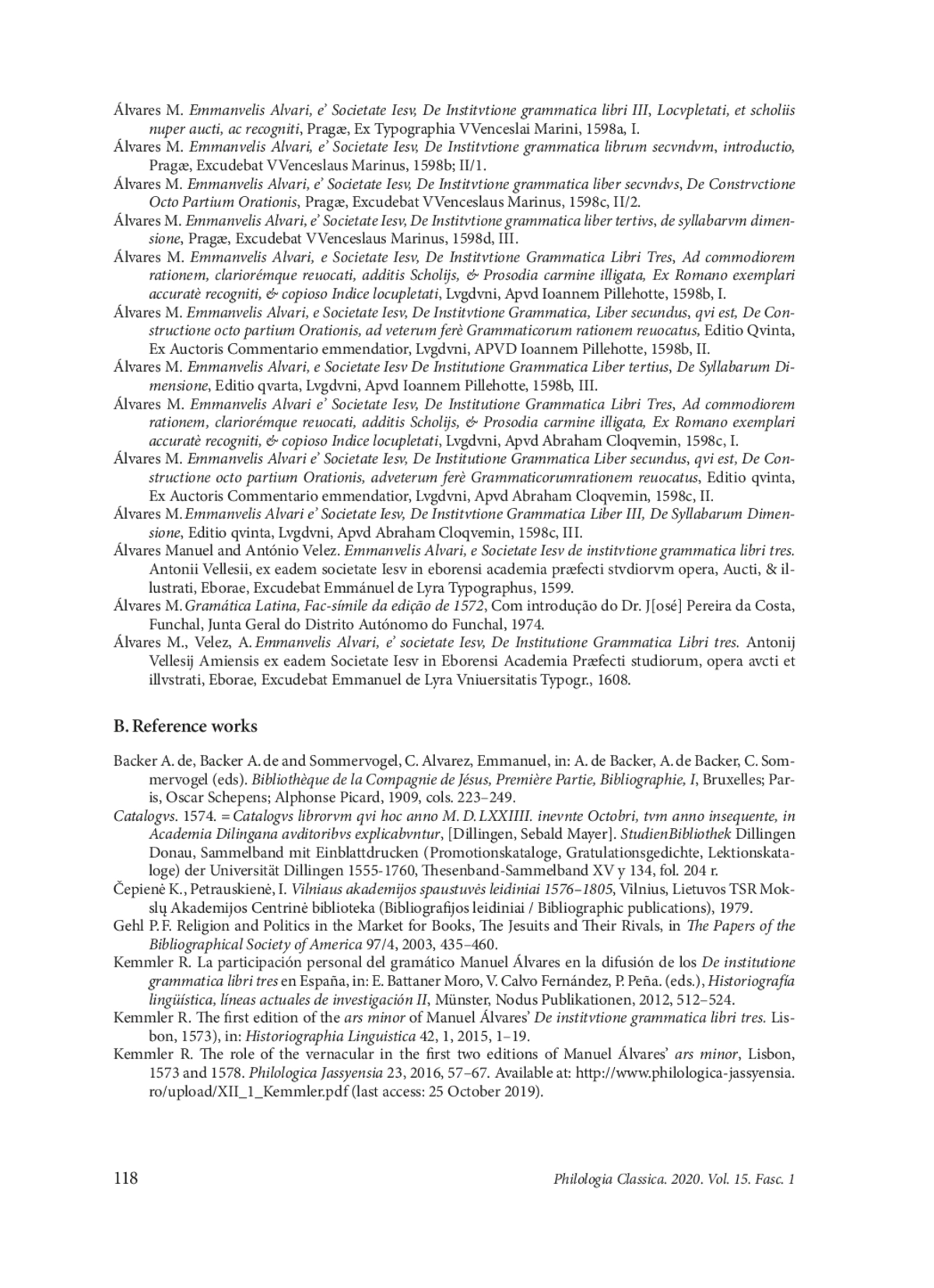
28. Álvares M. Emmanvelis Alvari e’ Societate Iesv, De Institutione Grammatica Liber secundus, qvi est, De Constructione octo partium Orationis, adveterum ferè Grammaticorumrationem reuocatus, Editio qvinta, Ex Auctoris Commentario emmendatior, Lvgdvni, Apvd Abraham Cloqvemin, 1598c, II.
29. Álvares M. Emmanvelis Alvari e’ Societate Iesv, De Institvtione Grammatica Liber III, De Syllabarum Dimensione, Editio qvinta, Lvgdvni, Apvd Abraham Cloqvemin, 1598c, III.
30. Álvares Manuel and António Velez. Emmanvelis Alvari, e Societate Iesv de institvtione grammatica libri tres. Antonii Vellesii, ex eadem societate Iesv in eborensi academia præfecti stvdiorvm opera, Aucti, & illustrati, Eborae, Excudebat Emmánuel de Lyra Typographus, 1599.
31. Álvares M. Gramática Latina, Fac-símile da edição de 1572, Com introdução do Dr. J[os.] Pereira da Costa, Funchal, Junta Geral do Distrito Autónomo do Funchal, 1974.
32. Álvares M., Velez, A. Emmanvelis Alvari, e’ societate Iesv, De Institutione Grammatica Libri tres. Antonij Vellesij Amiensis ex eadem Societate Iesv in Eborensi Academia Præfecti studiorum, opera avcti et illvstrati, Eborae, Excudebat Emmanuel de Lyra Vniuersitatis Typogr., 1608.
33. Backer A. de, Backer A. de and Sommervogel, C. Alvarez, Emmanuel, in: A. de Backer, A. de Backer, C. Sommervogel (eds). Bibliothèque de la Compagnie de Jésus, Première Partie, Bibliographie, I, Bruxelles; Paris, Oscar Schepens; Alphonse Picard, 1909, cols. 223-249.
34. Catalogvs. 1574. = Catalogvs librorvm qvi hoc anno M. D. LXXIIII. inevnte Octobri, tvm anno insequente, in Academia Dilingana avditoribvs explicabvntur, [Dillingen, Sebald Mayer]. StudienBibliothek Dillingen Donau, Sammelband mit Einblattdrucken (Promotionskataloge, Gratulationsgedichte, Lektionskataloge) der Universität Dillingen 1555-1760, Thesenband-Sammelband XV y 134, fol. 204 r.
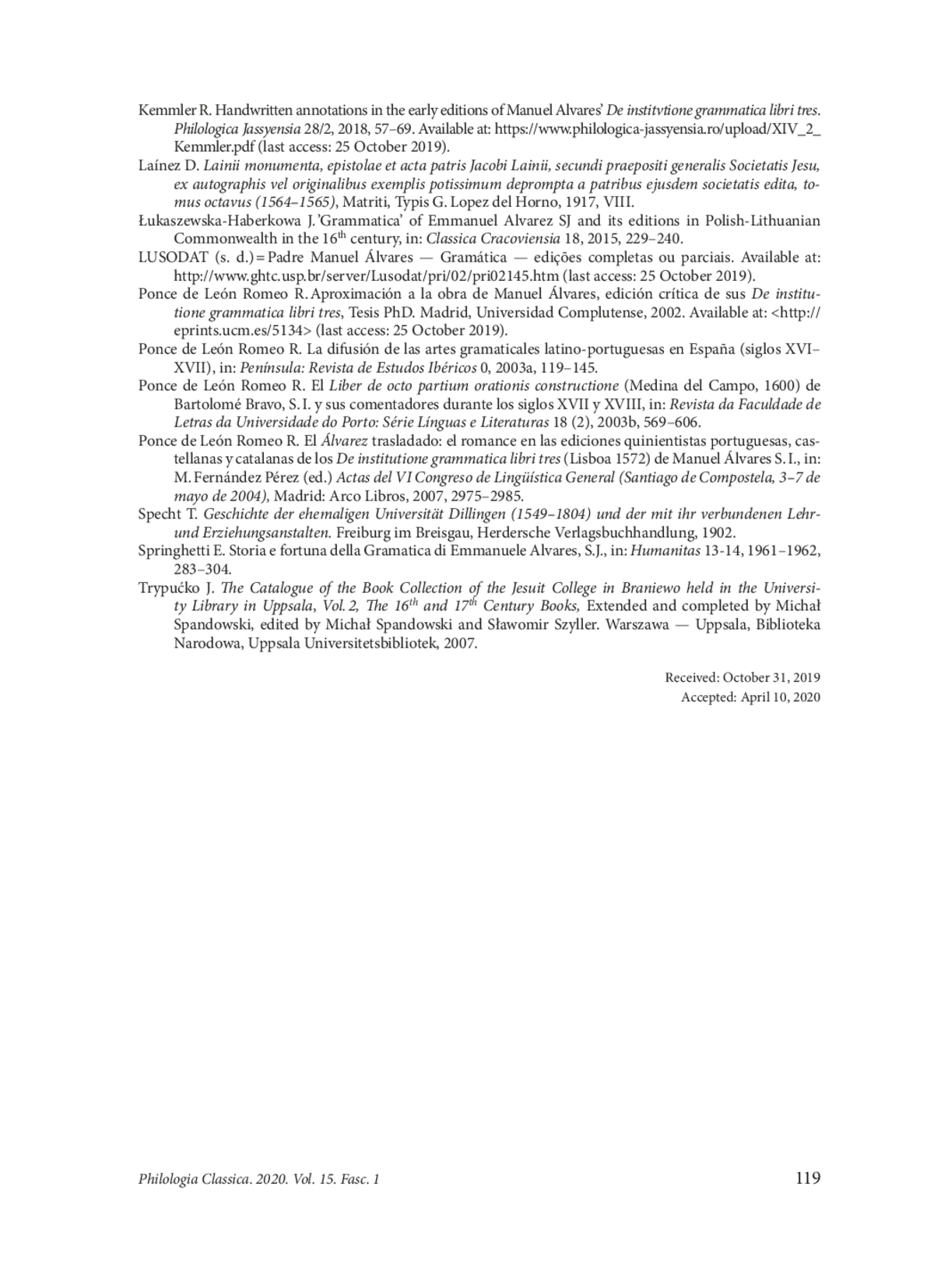
35. Čepienė K., Petrauskienė, I. Vilniaus akademijos spaustuvės leidiniai 1576-1805, Vilnius, Lietuvos TSR Mokslų Akademijos Centrinė biblioteka (Bibliografijos leidiniai / Bibliographic publications), 1979.
36. Gehl P. F. Religion and Politics in the Market for Books, The Jesuits and Their Rivals, in The Papers of the Bibliographical Society of America 97/4, 2003, 435-460.
37. Kemmler R. La participación personal del gramático Manuel Álvares en la difusión de los De institutione grammatica libri tres en España, in: E. Battaner Moro, V. Calvo Fernández, P. Peña. (eds.), Historiografía lingüística, líneas actuales de investigación II, Münster, Nodus Publikationen, 2012, 512-524.
38. Kemmler R. The first edition of the ars minor of Manuel Álvares’ De institvtione grammatica libri tres. Lisbon, 1573), in: Historiographia Linguistica 42, 1, 2015, 1-19.
39. Kemmler R. The role of the vernacular in the first two editions of Manuel Álvares’ ars minor, Lisbon, 1573 and 1578. Philologica Jassyensia 23, 2016, 57-67. Available at: http://www.philologica-jassyensia.ro/upload/XII_1_Kemmler.pdf (last access: 25 October 2019).
40. Kemmler R. Handwritten annotations in the early editions of Manuel Alvares’ De institvtione grammatica libri tres. Philologica Jassyensia 28/2, 2018, 57-69. Available at: https://www.philologica-jassyensia.ro/upload/XIV_2_Kemmler.pdf (last access: 25 October 2019).
41. Laínez D. Lainii monumenta, epistolae et acta patris Jacobi Lainii, secundi praepositi generalis Societatis Jesu, ex autographis vel originalibus exemplis potissimum deprompta a patribus ejusdem societatis edita, tomus octavus (1564-1565), Matriti, Typis G. Lopez del Horno, 1917, VIII.
42. Łukaszewska-Haberkowa J. ‘Grammatica’ of Emmanuel Alvarez SJ and its editions in Polish-Lithuanian Commonwealth in the 16th century, in: Classica Cracoviensia 18, 2015, 229-240.
43. LUSODAT (s. d.) = Padre Manuel Álvares - Gramática - edições completas ou parciais. Available at: http://www.ghtc.usp.br/server/Lusodat/pri/02/pri02145.htm (last access: 25 October 2019).
44. Ponce de León Romeo R. Aproximación a la obra de Manuel Álvares, edición crítica de sus De institutione grammatica libri tres, Tesis PhD. Madrid, Universidad Complutense, 2002. Available at: (last access: 25 October 2019).
45. Ponce de León Romeo R. La difusión de las artes gramaticales latino-portuguesas en España (siglos XVI-XVII), in: Península: Revista de Estudos Ibéricos 0, 2003a, 119-145.
46. Ponce de León Romeo R. El Liber de octo partium orationis constructione (Medina del Campo, 1600) de Bartolom. Bravo, S. I. y sus comentadores durante los siglos XVII y XVIII, in: Revista da Faculdade de Letras da Universidade do Porto: Série Línguas e Literaturas 18 (2), 2003b, 569-606.
47. Ponce de León Romeo R. El Álvarez trasladado: el romance en las ediciones quinientistas portuguesas, castellanas y catalanas de los De institutione grammatica libri tres (Lisboa 1572) de Manuel Álvares S. I., in: M. Fernández Pérez (ed.) Actas del VI Congreso de Lingüística General (Santiago de Compostela, 3-7 de mayo de 2004), Madrid: Arco Libros, 2007, 2975-2985.
48. Specht T. Geschichte der ehemaligen Universität Dillingen (1549-1804) und der mit ihr verbundenen Lehrund Erziehungsanstalten. Freiburg im Breisgau, Herdersche Verlagsbuchhandlung, 1902.
49. Springhetti E. Storia e fortuna della Gramatica di Emmanuele Alvares, S.J., in: Humanitas 13-14, 1961-1962, 283-304.
50. Trypućko J. The Catalogue of the Book Collection of the Jesuit College in Braniewo held in the University Library in Uppsala, Vol. 2, The 16th and 17th Century Books, Extended and completed by Michał Spandowski, edited by Michał Spandowski and Sławomir Szyller. Warszawa - Uppsala, Biblioteka Narodowa, Uppsala Universitetsbibliotek, 2007.

Выпуск
Другие статьи выпуска
Justin the Philosopher, a second-century Christian author, discusses the cult of Mithras in his works First Apology on behalf of the Christians and Dialogue with Trypho the Jew. Justin’s portrayal of Mithraic customs is traditionally interpreted in the light of his conception of imitatio diabolica, as the ἀρχή of pagan myths and beliefs. To illustrate the theory of diabolical imitation, Justin touches upon several features of Mithraic rituals and provides us with a few indications of Mithraic ethical teachings. Two curious accounts of Mithraic cave shrines in Justin’s Dialogue with Trypho the Jew (Justin. Dial. 70, 1–3; 78, 6) have not been closely examined by previous researchers and require our special attention. Justin draws a parallel between the Mithraic cave shrines and the prophecy of Isaiah (Isa. 33, 13–16), focusing on the prophet’s words concerning a cave and a cliff as he finds them analogous to Mithraic sanctums. Remarkably, Justin never refers to Mithraic temples as caves, but only as places, called so by Mithraists. He does not claim that the devil has taught Mithraists to perform rituals in caves, but insists that he has taught them to name their sanctuaries caves. Justin’s wording exposes his effort to accentuate the difference between the object (a shrine) and its name (cave). This indicates that Justin believed that Mithraists did not use natural caves as their sanctuaries, despite his knowledge of other aspects of this cult
One of the most famous academic conflicts in 17 th century Sweden was a quarrel between Johannes Schefferus and Olof Verelius in the 1670s concerning the original position of the city of Uppsala and its heathen temple, mentioned by Adam of Bremen. After a series of publications with mutual attacks Verelius published in 1678 a document entitled Annotationes ex scriptis Karoli Episcopi Arosiensis excerptae, pretending to go back to a lost medieval source. Schefferus answered with an analysis of the document, proving it to be a forgery. Despite Schefferus’ brilliant and convincing philological investigation, Annotationes have often been regarded as a genuine medieval source, especially after the publication of a monograph by the Swedish historian Kjell Kumlien in 1967. Recently, several historical and philological surveys have opposed Kumlien’s views, providing additional arguments in favour of Schefferus’ claims. This article aims at adding one more: an odd juncture in the text of Annotationes — ‘opus trium deorum’ that is to be understood as ‘a temple of three gods’ — can be explained by an ambition of the forger to imitate Adam of Bremen, whose text belonged to the central ones in the controversy.
В статье исследуются восточнославянские (русские и украинские) переводы фрагментов из поэм Гомера, входивших в исторические и политические сочинения М. Стрыйковского, А. Ф. Моджевского, Юста Липсия и др., переводившихся в Киеве, Москве и Санкт-Петербурге с начала XVII до середины XVIII вв. Особый интерес представляют переводы, выполнявшиеся в той или иной стихотворной форме. Выбор переводчиками именно стихотворной формы для перевода позволяет лучше понять пути адаптации русской культурой относительно новой для нее стихотворной формы. Тщательное изучение контекста появления стихотворных переводов из Гомера в составе обширных прозаических трудов позволяет увидеть мотивы, руководившие переводчиками (Гомер предстает автором древнейших свидетельств по истории славян; учителем политической риторики, моделью интеллектуала в конструируемых отношениях интеллектуала и государства). Восточнославянские культуры имели опыт стихотворной передачи текстов Гомера и филологического интереса к ним (во всяком случае — интереса, требующего обращения к альтернативным изданиям и греческому тексту) задолго до того, как фрагментарный стихотворный перевод из Гомера, выполненный М. В. Ломоносовым, был в 1748 г. опубликован в Петербурге. Впервые публикуются стихотворные переводы из Гомера, содержащиеся в московском переводе Хроники Мацея Стрыйковского (1660-1670-е) и «Увещаниях и прикладах политических» (Monita et exempla politica) Юста Липсия, переведенных в Киеве, Петербурге и Москве в 1712-1722 гг. Публикация текста сопровождается существенными уточнениями истории текста памятников.
The perfect tense in Greek which is used to denote a state of affairs in the present as resulting from a past action does not find an exact equivalent in the system of Latin tenses: when faced with the need to express this idea a Latin speaker could either focus on the expression of the state by using the present tense (whereby the connection with the past was not expressed and would only be inferred), or use the perfect, in which case the effect of the past action on the present was not directly expressed and could only be deduced (the so-called resultative perfect). The article analyses Latin speakers’ attitude to this difference between Greek and Latin verbal systems, in particular, on the basis of the evidence collected from Roman epistolography when the letter-writer felt that the idea he wished to express could most aptly be rendered by a Greek perfect and switched to the Greek solely for that perfect form. The corpus of texts used for this study included the letters of Cicero to Atticus and his Epistulae ad Familiares, the Letters of Pliny the Younger, Seneca’s Letters to Lucilius, excerpts of Augustus’ letters preserved by Suetonius, and M. Cornelius Fronto’s correspondence with Marcus Aurelius
This paper aims to revise the status quaestionis of the title of a play by Seneca preserved in two commonly recognised variants — Phoenissae and Thebais — and two less well-known variants — Phoenissa and Antigona. It has been generally accepted that only the title Phoenissae is correct, and that this title was modelled on Euripides’ drama of the name. This view, however, can hardly be deemed plausible, considering the substantial differences between Seneca’s and Euripides’ Phoenissae. Moreover, it has been widely held that there is no analogy for the title Thebais in the dramatic tradition but that it has equivalents in epic texts, which has led to the conclusion that Thebais is an ill-chosen interpolation. The other variants of the title have not been discussed at all. In this article we scrutinise previously disregarded sources and argue that all the play’s titles may have originated in Classical Antiquity and may be regarded as synonyms. We also demonstrate that the interpretation of the title Phoenissae as referring to a Chorus of Tyrian maidens is purely speculative, since the links between Seneca’s and Euripides’ Phoenissae cannot be unequivocally defined. We posit that the Romans may have understood both the title of Euripides’ play and of its probable imitation written by Accius as alluding to the heroines, Jocasta and Antigone. The examples found in Statius’ verse may be used as evidence that the adjective Phoenissus was understood by the educated Roman public as Thebanus. In the final part of the paper, we analyse the dramatic action of Phoenissae, which leads us to the conclusion that the interpretation of the title as a metonymic term describing Jocasta and Antigone is accurate
The article investigates an early theological justification of the radical detachment from society expressed in a saying by the famous Egyptian hermit Arsenius the Great (4 th‒5 th century) who avoided contacts not only with lay people, but even with his fellow monks in the desert of Sketis. This justification is to be seen in connection with the phenomenon of monastic secluded life which suddenly emerged in the second part of the 3 rd century, in sharp contrast with traditional views of the catholic Christians of the 1 st‒3 rd centuries on the way of life suitable for the followers of Christ. In this article, the radical break with this early paradigm is called the “revolution of the solitaries”. Arsenius, who lived about eighty years after the first monks in Egypt started to be recognized as a distinct phenomenon in public space, does not necessarily draw on the oldest layers of the traditions justifying and explaining the religious motivation for being alone. Nevertheless, his statement is one of the first pieces of theological reflection on the subject transmitted in full which opens a number of intriguing possibilities for further research on this widely neglected field. The article provides the historical context of Arsenius’ justification which includes criticism of the anachoretic monasticism in the pagan and Christian communities. Some critics of the secluded life consider it as contrary to the Jewish and pagan wisdom as well as to the revelation of Christ, a statement making Arsenius’ apology most precarious. Of special inrerest is that Arsenius, when staying away remaining secluded from all kinds of people, was to a certain degree guided by the example of Socrates
New Testament scholars have long argued that in Acts 17:16–34 Luke depicts Paul in such a way as to evoke Socrates’ modus philosophandi and to echo his trial and apology. While this argument can be based on sufficiently clear philological indications, there are other, comparatively vague and more general Socratic reminiscences in Luke-Acts, e. g. in the Gethsemane episode which shows that for the Lukan Jesus death is not a terrifying prospect. This study reads Luke’s portrayal of the apostle Peter through the lens of the exemplum Socratis as presented by Greek and Roman intellectuals in the first and early second centuries CE, including Dio Chrysostom, Epictetus, Plutarch, and Seneca. The author argues that the humble origins of Peter, his non-academic profession, his poverty, his lack of formal education, and his unbreakable commitment to obey God and to spread the Christian message in spite of the threat of judges are reminiscent of major elements of the reception of Socrates in the period that Luke-Acts was probably composed (c. 80–100 CE). Highlighting the subtle Socratic components in Luke’s depiction of Peter not only helps to shed new light on Peter’s alleged lack of education (Acts 4:13). It also helps to understand, firstly, how the literary depiction of early Christian teaching figures is shaped by roughly contemporaneous philosophical discourses, and secondly, that Peter’s literary image, although it presents a totally different type of teaching figure than Paul, serves in its own way to exemplify the compatibility of the Christian religion with particular strands of ancient philosophy.
Heraclides of Pontus, a versatile philosopher whose work still remains largely unexplored, wrote several pieces on Homer including “Solutions of the Homeric problems”, to which some of the extant fragments are attributed. One of these (F. 171 Wehrli = 99 Schütrumpf) concerns the Iliad and the Odyssey being discrepant in the number of the cities on Crete: the Catalogue of Ships refers to the island as ἑκατόμπολιν (Il. 2.649) while Odysseus in his ‘Cretan Lies’ states that people dwell ninety great cities on Crete (Od. 19.174). To explain this inconsistency, Heraclides tells a dramatic story about Idomeneus which he probably made up himself, being an eminent author of dialogues and even tragedies (provided that the relevant testimonies are reliable) with an interest in mythology. His version of Idomeneus’ homecoming was not supported by contemporary historians, and, although later picked up by some poets and scholars, did not end up as a part of the commonplace Idomeneus tradition as we know it today
The paper analyzes Ch. 24 of the 11th book of Aelian’s De natura animalium devoted to the so-called sea-leopard (πάρδαλις) and the oxyrrhynchus fish, both living in the Red Sea. Aelian compares the body colour of the sea-leopard to the mountain leopard, i. e. the snow leopard or the ounce (Panthera uncia Schreber, 1775). This comparison clearly demonstrates that the sealeopard is to be identified with the sand tiger shark or the spotted ragged-tooth shark (Carcharias taurus Rafinesque, 1810). This fish usually resides and hunts in the depths of the sea, but also swims to the coast and sometimes attacks the swimming people. The attacks of sand tiger sharks must have taken place in ancient times, so the fish was easily recognizable not only by the Greeks but also by the inhabitants of the Red Sea’s seashore. The Greek ichthyonym ὀξύ(ρ)ρυγχος refers to five different species of fish, but Aelian uses it to denote an oriental kind of shark existing in the Red Sea (NA 11, 24). The oxyrrhynchus shark has an elongated mouth, golden eyes and white eyelids, i. e. nictitating membranes, typical of sharks belonging to the order Carcharhiniformes. Its tail is oblong in shape and its fins are black and white. There are also pale and green parts of its body. On the basis of Aelian’s description it is possible to suggest that the unknown fish should be identified with the bignose shark (Carcharhinus altimus S. Springer, 1950).
An attempt to interpret the famous ancient musical composition known as ὄρθιος νόμος requires an analysis of all available evidence connecting ὄρθιος with sounds. The most extensive description of this nome (Dio 1. 1) ascribes it a military (or generally stimulating) character. This conforms with a number of passages, where an ὄρθιος sound ‘makes one stand up’ to help, or to fight, i. e. it stimulates dynamic activity. Perhaps, then, this was the initial meaning of the adjective, from which it eventually morphed to mean ‘sonorous’ or ‘piercing’. It seems that a sound could be made piercing and pervasive both by its volume and by its pitch, therefore ὄρθιος as a quality of sound frequently correlates with ‘loud’ and ‘high’. Nevertheless, a common interpretation that equates ὄρθιος with ὀξύς is unwary: the conventional metaphor in ancient Greek concerning a sound’s pitch is ὀξύς — βαρύς (‘sharp’ — ‘heavy’), whereas the spatial metaphor of vertical (‘high’ — ‘low’) is not reliably attested. Another characteristic of sound that our sources correlate with ὄρθιος is ‘strained’ (ἔντονος, ἀνάτασιν ἔχων, ἀνατεταμένος), which in its turn likely indicates loudness (but does not literally translate as either ‘high’ or ‘swift’) and physical effort on behalf of the performers, or else the ethos of a musical piece, which transmitted tension to the audience
This article discusses an intriguing text in Stobaeus’ Ecl. 1.25.3i about the sun’s movement as a spiral on a cylinder. The author offers an interpretation of this text and argue that it is about Empedocles’ conception of the solar trajectory during the year. After a preliminary attempt, an interlude is inserted on some strange theories, ascribed to Empedocles, about the two hemispheres of the heaven and two suns. Two of the more reliable theories attributed to Empedocles that are relevant in the context of this paper, namely the tilting and the eggshape of the heaven, as well as the problems of the size of the sun and the shape of the earth, are discussed in successive sections. This allows the author to illustrate some of his ideas on Presocratic flat earth cosmology. Prior to offering a visualization of the cosmos according to Empedocles, Bollack’s earlier attempt is subjected to a critical examination. In two additional sections of the article, the author claims that, according to Empedocles, the moon must move on a cylinder as well and that the image of the cylinder for movements of the sun and moon dates back to Anaximander
Издательство
- Издательство
- СПБГУ
- Регион
- Россия, Санкт-Петербург
- Почтовый адрес
- Россия, 199034, Санкт-Петербург, Университетская наб., д. 7–9
- Юр. адрес
- 199034, г Санкт-Петербург, Василеостровский р-н, Университетская наб, д 7/9
- ФИО
- Кропачев Николай Михайлович (РЕКТОР)
- E-mail адрес
- spbu@spbu.ru
- Контактный телефон
- +7 (812) 3282000
- Сайт
- https://spbu.ru/