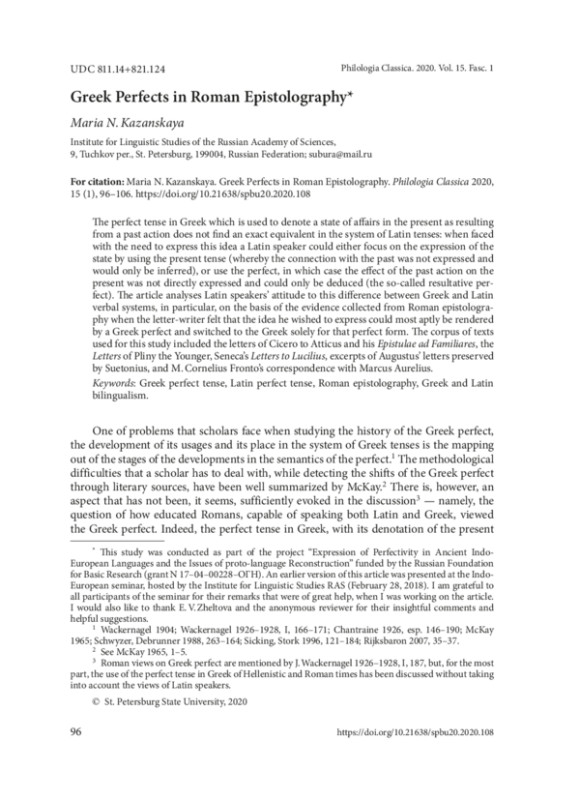
The perfect tense in Greek which is used to denote a state of affairs in the present as resulting from a past action does not find an exact equivalent in the system of Latin tenses: when faced with the need to express this idea a Latin speaker could either focus on the expression of the state by using the present tense (whereby the connection with the past was not expressed and would only be inferred), or use the perfect, in which case the effect of the past action on the present was not directly expressed and could only be deduced (the so-called resultative perfect). The article analyses Latin speakers’ attitude to this difference between Greek and Latin verbal systems, in particular, on the basis of the evidence collected from Roman epistolography when the letter-writer felt that the idea he wished to express could most aptly be rendered by a Greek perfect and switched to the Greek solely for that perfect form. The corpus of texts used for this study included the letters of Cicero to Atticus and his Epistulae ad Familiares, the Letters of Pliny the Younger, Seneca’s Letters to Lucilius, excerpts of Augustus’ letters preserved by Suetonius, and M. Cornelius Fronto’s correspondence with Marcus Aurelius
Предпросмотр статьи



Идентификаторы и классификаторы
- SCI
- Литература
Если у вас возникли вопросы или появились предложения по содержанию статьи, пожалуйста, направляйте их в рамках данной темы.