
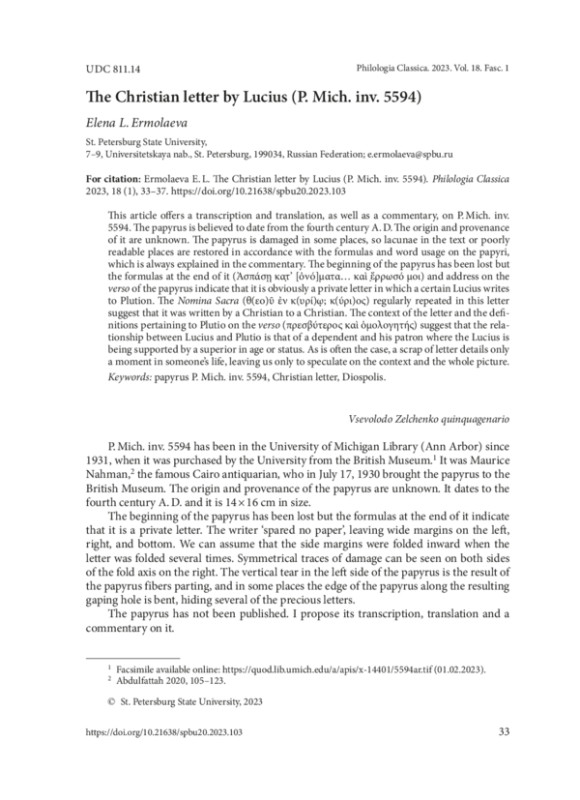
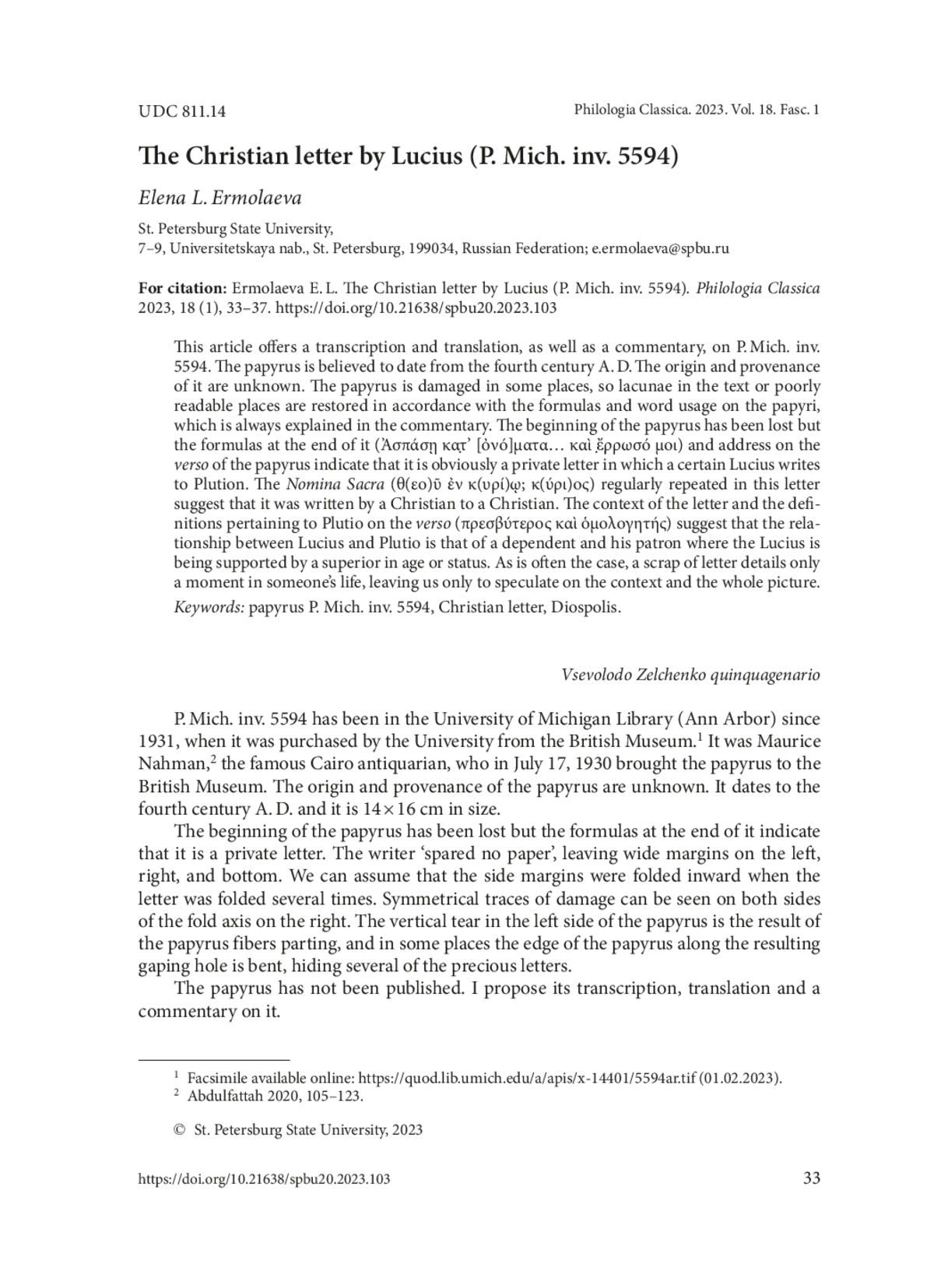
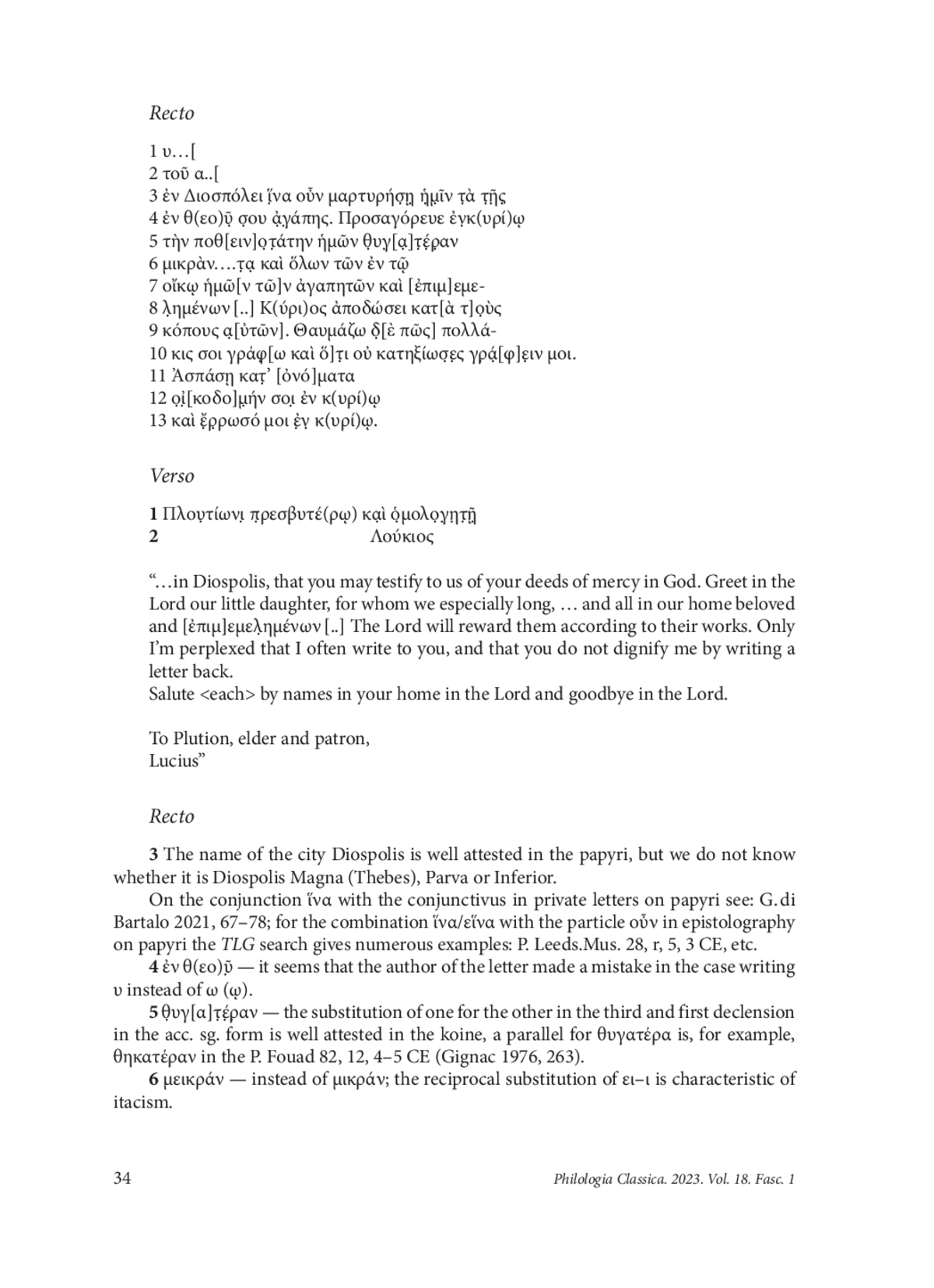
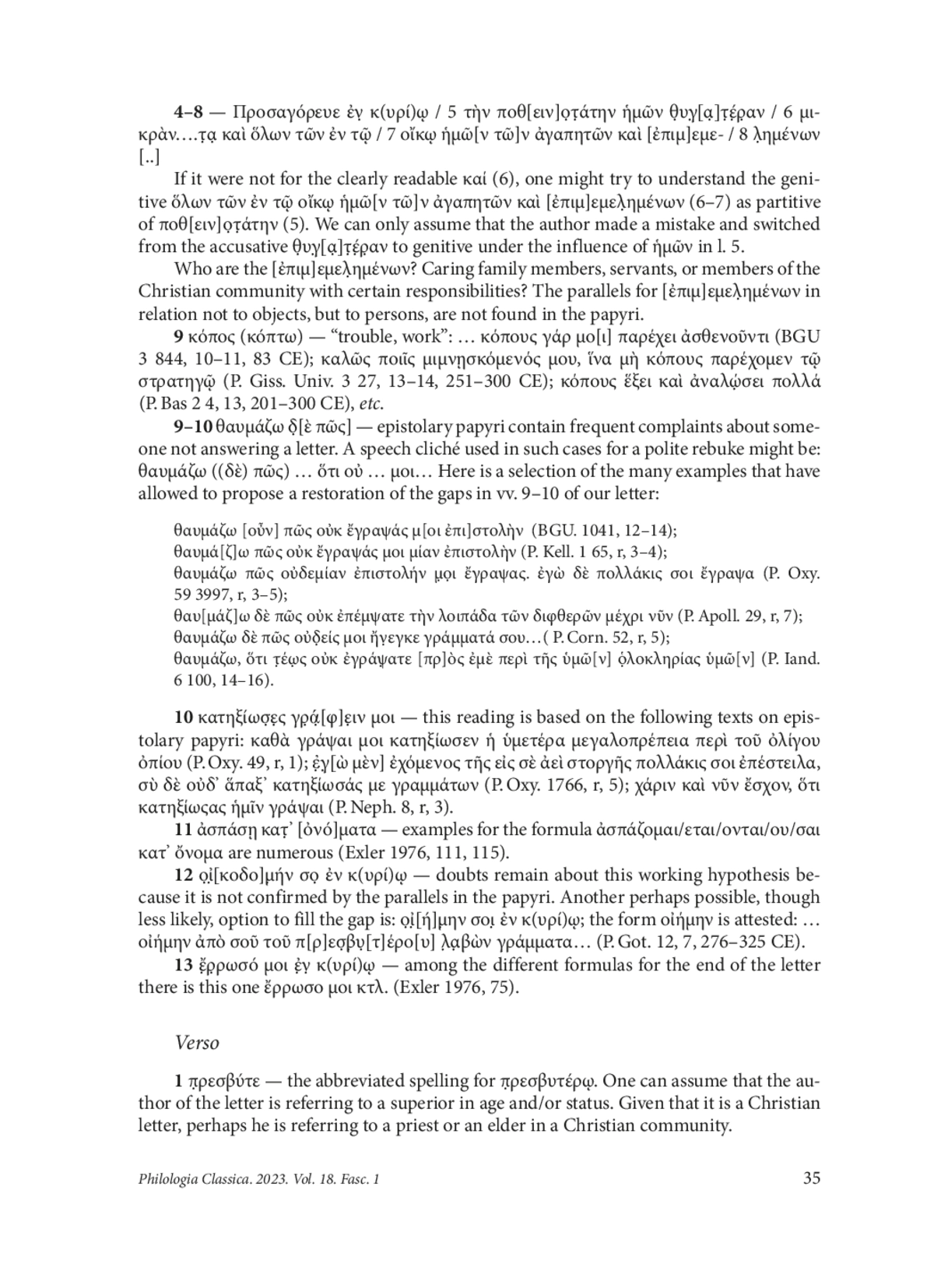
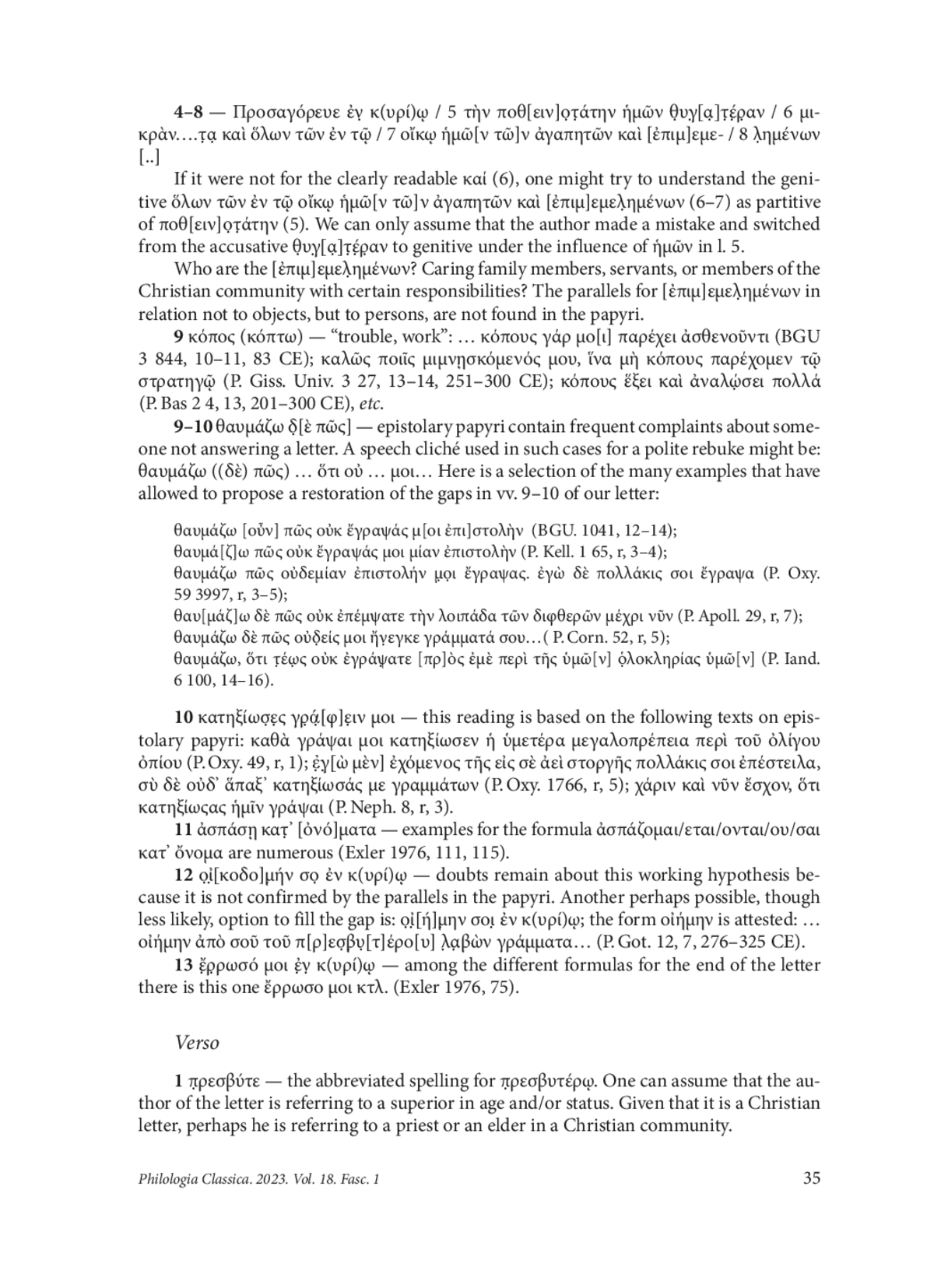
This article offers a transcription and translation, as well as a commentary, on P. Mich. inv. 5594. The papyrus is believed to date from the fourth century A. D. The origin and provenance of it are unknown. The papyrus is damaged in some places, so lacunae in the text or poorly readable places are restored in accordance with the formulas and word usage on the papyri, which is always explained in the commentary. The beginning of the papyrus has been lost but the formulas at the end of it (Ἀσπάσῃ κατ̣ ’ [ὀνό]ματα… καὶ ἔ̣ρ̣ρωσό μοι) and address on the verso of the papyrus indicate that it is obviously a private letter in which a certain Lucius writes to Plution. The Nomina Sacra (θ(εο)ῦ ἐν κ(υρί)ῳ; κ(ύρι)ος) regularly repeated in this letter suggest that it was written by a Christian to a Christian. The context of the letter and the definitions pertaining to Plutio on the verso (πρεσβύτερος καὶ ὁμολογητής) suggest that the relationship between Lucius and Plutio is that of a dependent and his patron where the Lucius is being supported by a superior in age or status. As is often the case, a scrap of letter details only a moment in someone’s life, leaving us only to speculate on the context and the whole picture
Предпросмотр статьи

Идентификаторы и классификаторы
- SCI
- Языкознание
P. Mich. inv. 5594 has been in the University of Michigan Library (Ann Arbor) since 1931, when it was purchased by the University from the British Museum.1 It was Maurice Nahman,2 the famous Cairo antiquarian, who in July 17, 1930 brought the papyrus to the British Museum. The origin and provenance of the papyrus are unknown. It dates to the fourth century A. D. and it is 14 × 16 cm in size
Если у вас возникли вопросы или появились предложения по содержанию статьи, пожалуйста, направляйте их в рамках данной темы.
Список литературы
1. Abdulfattah I. R. A Forgotten Man Maurice Nahman, an Antiquarian-Tastemaker. In: J. Kamrin et al. (eds) Guardian of Ancient Egypt. Studies in Honor of Zani Hawass. Prague, Charles University, Faculty of Art, 2020, 105-123.
2. Di Bartalo G. Studien zur griechischen Syntax dokumentarischer Papyri der römischen Zeit. Papyrologia Coloniensia. Vol. XLIV. Leiden, Brill, 2021.
3. Diggle J. (ed.-in-chief) The Cambridge Greek Lexicon. Cambridge - New York, Cambridge University Press, 2021.
4. Exler F. X. J. The Form of the Ancient Greek Letter of the Epistolary Papyri (3rd BC - 3rd AD). Chicago, Ares Publishers, 1976.
5. Gignac F. A Grammar of the Greek Papyri of the Roman and Byzantine Periods: Phonology. Milano, Instituto Editoriale Cisalpino, La Goliardica, 1976.
6. Harrauer H. Handbuch der griechischen Paläographie. Textband. Stuttgart, Anton Hiersemann Verlag, 2010.
7. Salomons R. P. Papyri Bodleianae I. Amsterdam, J. C. Gieben, 1996.
Выпуск
Другие статьи выпуска
This article offers a linguistic commentary on the verse Verg. Aen. 9. 427 me, me, adsum qui feci, in me conuertite ferrum, in which the personal pronoun in the accusative needs interpretation. Since the time of Servius and Donatus, the opinions of commentators have been divided. Servius and his followers believe that the pronoun in the accusative is a direct complement that depends on an implied (omitted) verb like interficite, occidite, or petite, and consider this place as a rhetorical figure of aposiopesis. Donatus, on the other hand, argues that the accusative me, me is independent, while discontinuous intonation with which the whole verse must be uttered emphasizes the extreme degree of despair of Nisus, who cannot prevent the death of his beloved friend Euryalus. A review of the commentaries on the Aeneid shows that there are slightly more supporters of Donatus’ hypothesis than that of Servius’, but all of their reasoning is intuitive and does not explain why it is the syntactically independent accusative that gives the agitated sounding to Nisus’ last words. The author of the article applies the pragmatic approach to the interpretation of this place, analyzing similar examples of “non-syntactic” use of the accusative and considering both traditional and modern views on this phenomenon. As a result, the author comes to the conclusion that the verse under consideration corresponds to what in modern linguistics is called “cleft construction”. Such constructions exist in different languages and serve to express the focus of contrast. At the end of the study, the author attempts to answer the question of why Latin employs the accusative as a tool to express intense emotions
История классической филологии в СССР в годы Великой Отечественной войны в науке еще не получила должного освещения. Несмотря на бытовые и материальные трудности, разрыв коммуникаций, недоступность литературы, занятия наукой и подготовка молодых кадров продолжались. В статье на основании разрозненных архивных данных и источников личного происхождения определяются способы адаптации сотрудников эвакуированной в Саратов кафедры классической филологии ЛГУ к условиям военного времени в вопросах организации учебного процесса и научного творчества (1942–1944). Кадровый состав подразделения, включавший пять человек во главе с И. М. Тронским, позволял осуществлять преподавание латинского языка и античной литературы на историческом и филологическом факультетах, а также готовить небольшое количество студентов-«классиков» по сохранившимся в Саратове дореволюционным пособиям. Научные же разработки сотрудников кафедры шли вразрез с общей факультетской темой — «Литература и война». Названия докладов И. М. Тронского, Я. М. Боровского, Г. А. Стратановского свидетельствуют о стремлении продолжать, насколько позволял книжный фонд, начатые до войны темы либо разрабатывать сюжеты рецепции античного наследия. Под руководством И. М. Тронского в начале 1944 г. Т. Н. Чикалина защитила вполне традиционную для специальности диссертацию, посвященную синтаксису Законов XII таблиц. О желании не прерывать подлинно научные филологические исследования, быть в фарватере мировой науки говорит и выбранная в 1944 г. кафедральная тема — «Лукреций» — в честь памятной даты 2000-летия со дня смерти поэта
Предлагаемая работа представляет собой публикацию латинской переписки двух видных филологов-классиков конца XIX — начала XX в. Ф. Е. Корша и Г. Э. Зенгера, представляющей интерес как для истории классического образования в России, так и для истории филологических исследований. Латинская переписка, будучи не столь объемной частью всей академической корреспонденции двух авторов, по большей части хранится в Архиве Российской академии наук (Москва), отдельные письма также представлены в РГБ и РНБ. Публикация включает письма личного характера, а также письма с обсуждением текстологических проблем различных произведений античной литературы. Обсуждаются общие вопросы филологической науки и античной культуры, равно как и некоторые моменты, связанные с профессиональной деятельностью. Особое место занимают письма, содержащие разбор конъектур к стихотворному ответу императора Адриана поэту Флору, а также к «Энеиде» Вергилия и произведениям Горация. Отдельным достоинством переписки являются стихи: оба ученых стоят в ряду лучших представителей отечественной латинской поэзии. Для латиноязычных писем выбиралась бумага меньшего — карточного — размера. Все материалы публикуются впервые. К каждому письму предлагаются небольшие подстрочные комментарии, позволяющие получить более полное представление как об особенностях переписки, так и о тех персоналиях и проблемах, которые в них упоминаются
Установление источников «Бородина» — задача со многими неизвестными, едва ли посильная даже современной филологии. Тем не менее о нескольких слагаемых шедевра мы знаем: школьный этюд «Le champ de Borodino» 1829 г. и сочиненное годом или двумя позднее «Поле Бородина» в какой-то степени позволяют определить, между какими альтернативами Лермонтов выбирал. Например, франкоязычный прозаический текст рисует ночь перед боем в обоих станах, тогда как автор ювенильных стихов сосредоточен на русском. Историчность очевидным образом конфликтует с лиризмом. Преодолеть конфликт, то есть выступить историком битвы, оставаясь в костюме ее героя, получится лучше, если изображать действия, предполагаемые в данной сюжетной ситуации. Кроме мемуаров, среди которых явные пересечения с текстами Лермонтова обнаруживают записки Ф. Н. Глинки и Н. Н. Любенкова, поэт обращается к литературным моделям. В числе последних — «Илиада» в переводе Гнедича, который вышел в 1829 г. и живо обсуждался литераторами и учеными, в частности учителем Лермонтова А. Ф. Мерзляковым. Дополняя замеченную исследователями параллель с Ил. 11, 523, можем добавить к перечню искомых источников контрастное описание троянского и ахейского лагерей, увиденных глазами Агамемнона (10, 11–16), тем более что сочинитель «Le champ de Borodino» описывает поведение французов почти в тех же выражениях, что и Гомер — троянцев
The Byzantine Empire had a long tradition of educational practices, including schedography. It became popular in the 10th century and continued to be cultivated until the 19th century, with a peak in the 13th century. In the late 19th century, scholars began to take an interest in the relevant texts. In the mid-20th century, there were attempts to study these texts as a curious kind of paraliterary production. Currently, in the 21st century, there have been editions of different schedographical collections. Schedographical texts are a very specific kind of written documents and do not fit well with the usual editorial practices. They were written to be read aloud, intended to teach, not to entertain, and generally, they do not have the aesthetic value of a literary text. Finally, these texts appear in collections of very different origins. In many cases we do not know their original context, which makes them difficult to be interpreted. In this article, 23 schedographical texts from manuscript Vat. Pal. Gr. 92 are published. This manuscript consists of 239 ff. and it was copied in the last decades of the 13th century in southern Italy. The manuscript contains more than 425 schedae. In contrast to other paratexts used in schools, the manuscript includes glosses with forms of popular Greek, such as, e. g., the use of σπίτι for “house”. A complete edition of the manuscript will certainly reveal more expressions similar to this one. 29 remaining unpublished texts will be published in the second part. The humorous phrase that heads this article, ὦ μωρῆς παιδίον, is the schedographical resolution of the phrase ὀμμ’ ὀρεῖς (glossed as ἐγείρεις) παιδίον, included in one of the schedae published here for the first time.
The author discusses the newly found Greek inscriptions from Lasica, from the basilica on Machkhomeri Hill near Khobi dated to the 6 th c. CE, with three Greek words and expressions having non-standard meanings. The only possible interpretation of the expression ἔχετε ἐν παραθέκῃ (sic) that comes to mind is “to have or keep as a pledge, to have or keep entrusted” i. e. the martyrs must keep the soul of the founder Gorgonios, which he entrusted to them as a pledge of his own salvation. The standard meanings of the term κατοίκησις as “settling” or “dwelling, abode” do not correspond to the context of the list of the benefactors either as an act or as a locus, as well as the early Byzantine meaning “government, administration”. It should mean here a burial, which could be understood as a new dwelling of the body or even a shrine for the relics (probably one of the Forty Martyrs), which appeared in Machkhomeri in connection with the rebuilding of the basilica and which was placed in the martyrium in the eastern end of the southern aisle. Finally, the term συνοδία by its origin meant a “companionship on a journey”, and later became a terminus technicus for caravan; new, Byzantine meanings of this word are “Christian fellowship company of the faithful, local congregation”, “gathering, assembly for worship”, “community of religious”. But here it is an “association of lay people around an institution or an influential person, probably functioning as a group of pilgrims”
This paper concerns the issue of the length of vowel e in the final -eus of the Latin medical terminological adjectives of coccygeus type. These adjectives are not associated with ancient Latin nouns and do not have a digraphic combination in the Greek prototype at the junction of the noun base and the adjective suffix: anconeus, coccygeus, laryngeus, phalangeus, pharyngeus. The lexemes were created by anatomists between the 16th and 18th centuries, mostly by Jean Riolan the Younger, James Douglas, William Cheselden, Christian H. T. Schreger. The spelling of these words with the final -æus in the work by Douglas in 1707 was a failed (and faulty) attempt to unify the spelling of Latin medical adjectives with a final -eus. The next try belonged to Cheselden (1713): he writes these lexemes with the final -eus. The artificial origin, the presence of two variants of the spelling (-æus and -eus) and of an identical in spelling Latin morpheme (-ĕus), and the simplification of spelling of Latin medical terms are the reasons why different variants of the appearance of the Latin adjectives of coccygeus type exist: with finals -aeus, -ēus, -ĕus. At the same time, an original Latinized Greek adjective existed — coccygius (from κοκκύγιος, used by Pausanias). The author suggests changing the nomenclature spelling of the adjectives of coccygeus type, bringing them in line with the historical “living” appearance: anconius, coccygius, laryngius, phalangius, and pharyngius. Until this change is carried out, it is recommended to consider ⟨e⟩ in the final -eus as a short vowel stressing the antepenultimate syllable
The article discusses the origins of four Neo-Latin animal names, denoting a beetle, a bird, a fish and a mollusk, coined by the Greek scholar Theodore Gaza in the third quarter of the fifteenth century: two neologisms of form, or proper neologisms, gal(l)eruca and gallinago, and two neologisms of sense, cernua ‘inclined forwards, head foremost’ and patella ‘plate, pan’. These words, still valid in today’s zoological nomenclature, were first introduced in Gaza’s Latin version of Aristotle’s Historia animalium, where they stood, respectively, for μηλολόνθη, σκολόπαξ/ἀσκαλώπας, ὀρφώς/ὀρφός and λεπάς. Apparently, they owe their existence to Gaza’s acquaintance with Italian dialectal vocabulary, as can be deduced from two sixteenthcentury sources: Agostino Nifo’s commentary to Aristotle’s zoological writings and Ippolito Salviani’s encyclopedic work on aquatic animals. Gaza’s galleruca must have originated from the Lombard galeruca ‘rose chafer’ (the identification of μηλολόνθη with the latter probably due to the hapax legomenon χρυσομηλολόνθιον, Ar. Vesp. 1341), gallinago from the Emilian gallinazza ‘woodcock’ (since the only known characteristic of σκολόπαξ/ἀσκαλώπας is that it is similar to a hen, Arist. Hist. an. 617b24), cernua from the Calabrian cerna/cernia (identified with ὀρφώς/ὀρφός either due to Gaza’s use of a bilingual glossary or due to his own experience in the Calabrian bilingual milieu) and patella from the Calabrian or Roman patella ‘pan; limpet’ (perhaps identified with λεπάς because Gaza kept in mind the name of a vessel, λεπαστή/ λεπάστη, considered deriving from λεπάς by Eustathius). All the said dialects correspond to the Italian regions where Gaza spent parts of his life
Macrobius Ambrosius Theodosius, in his Saturnalia, draws upon the Platonic archetype in making overt allusions to the Symposium and yet follows Athenaeus, whose work he seems to know thoroughly, albeit does not acknowledge its influence openly. Besides the Greek paradigms, Macrobius used Roman models, i. e., Cicero’s dialogues, to infuse his literary banquet with Roman flavour. The author of Saturnalia was severely criticised, especially by representatives of the Quellenforschung movement in the second half of the 19 th century, for allegedly being a poor plagiarist. His compilatory method is described in this article, and two other plausible Macrobius’ sources are proposed: Juvenal’s Satires and Seneca the Younger’s On Tranquility of the Mind. In Roman History Ammianus Marcellinus depicted the people inhabiting Rome of his times as degenerate parasites hostile to any form of intellectual activity who fritter away time on vulgar entertainment and obsessively overfeed themselves. Many scenes of so-called sober merriment shared by the prominent Roman personages of the IV c. AD were, in all probability, introduced to Saturnalia to counterbalance Ammianus Marcellinus’ harsh criticism of Roman morals. Macrobius’s familiarity with both Juvenal and Seneca manifests itself in the list of similes, yet, as the author of the present article proposes, there are passages in the oeuvre of both writers that may have instilled the vision of frugality typical of Romans in Macrobius’s mind, so that he may have used images borrowed from both earlier writers to Saturnalia
This paper offers an analysis of similar and parallel developing projects of creating a true philosophy by the disciples and followers of Origen and Plotinus. Two texts permeated by the eulogy of the scholarch are analysed: Gregory the Wonderworker’s The Address of Thanksgiving to Origen and the Life of Plotinus by Porphyry. Gregory was a student of Origen, while Porphyry attended his school long enough to become familiar with the doctrine, teaching methods and personality of the scholarch. The author establishes the structural, thematic and lexical similarity of both texts. The text by Gregory the Wonderworker, chronologically earlier, was a pushing away point for Porphyry in creating an image of the ideal scholarch in the person of Plotinus. This is confirmed by the structural and lexical contrast in the portrayal of Plotinus in Vita Plotini and Origen in the passage preserved by Proclus (Procl. In Tim. I.63. 29–33). In particular, the negative image of Origen in Vita Plotini 13. 10–17 is echoed by the figure of Thaumasius, dissatisfied with the protracted dispute between Plotinus and Porphyry, which rarely draws the scholars’ attention. Nowhere else mentioned, Thaumasius appears as a marginal figure: either he himself was interested in general statements and wanted to hear Plotinus speaking in the manner of a set treatise (trans. Armstrong), or he wanted Plotinus to “faire une conférence suivie et propre à être écrite” (trans. Bréhier). The author hypothesises that it is not a proper name but a nickname. The author suggests that Thaumasius is not an accidental participant in a specific episode of the Neoplatonists’ school life but the philosophical rival of the Neoplatonists, theologian Origen, ironically presented in an unattractive manner. Thus, the deliberately constructed episode with Plotinus and Thaumasius is a polemical jab at Origen’s followers, who put forward a programme of philosophical renovation alternative to the Platonic, and the very depiction of Plotinus as a ‘divine man’ (θεῖος ἀνήρ) responds to the image of Origen painted by his followers. The supposed allusions in Vita Plotini 13. 5–17 testify to the openness of the Roman Neoplatonic school to the already-formed Christian version of philosophy. For this reason, Porphyry chose to portray a situation in which Plotinus showed attention and patience in interpreting difficult philosophical questions for three days. In contrast, Origen, in a similar situation, showed impatience and irritability
This paper examines the form διεπρήστευσε, obelized in the editions of Herodotus. There have been two ways of interpreting the form: some scholars have taken it to refer to an act of speech, while others have sought here a verb of motion. Both groups of scholars proposed a variety of conjectures, some of them addenda lexicis and none of them commanding immediate acceptance. After a review of various solutions that have been proposed to-date, this paper argues in favor of retaining the reading of the paradosis and analyzing (-)πρηστεύω as a verb of quick motion. The verb is argued to be an Ionic colloquialism (or even Herodotus’ own Augenblicksbildung), derived from the root of πίμπρημι in its original meaning ‘to blow’ (of which ‘to burn’ is a secondary development) via an agent noun πρηστήρ / *πρήστης, cf. μνηστεύω ‘woo’: μνηστήρ ‘suitor’ or δυναστεύω ‘hold power’: δυνάστης ‘person with power’. The proposed translation ‘blasted, dashed’ is supported by typological parallels for the semantic development ‘to blow’ → ‘to move (impetuously)’, such as Old English blǽstan ‘to blow; to move impetuously’ or Russian dut’ ‘to blow; to dash, to rush’. Interestingly, Hittite (parip) parāi-, the cognate of Gk. πίμπρημι, may show the same semantic development: ‘to blow’, ‘to ignite fire by blowing’ > ‘to move swiftly’.
Статистика статьи
Статистика просмотров за 2026 год.
Издательство
- Издательство
- СПБГУ
- Регион
- Россия, Санкт-Петербург
- Почтовый адрес
- Россия, 199034, Санкт-Петербург, Университетская наб., д. 7–9
- Юр. адрес
- 199034, г Санкт-Петербург, Василеостровский р-н, Университетская наб, д 7/9
- ФИО
- Кропачев Николай Михайлович (РЕКТОР)
- E-mail адрес
- spbu@spbu.ru
- Контактный телефон
- +7 (812) 3282000
- Сайт
- https://spbu.ru/