
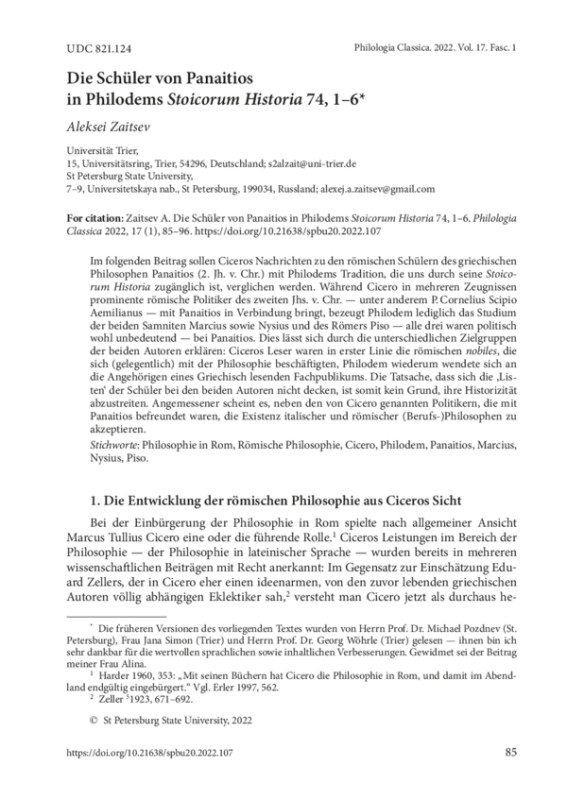
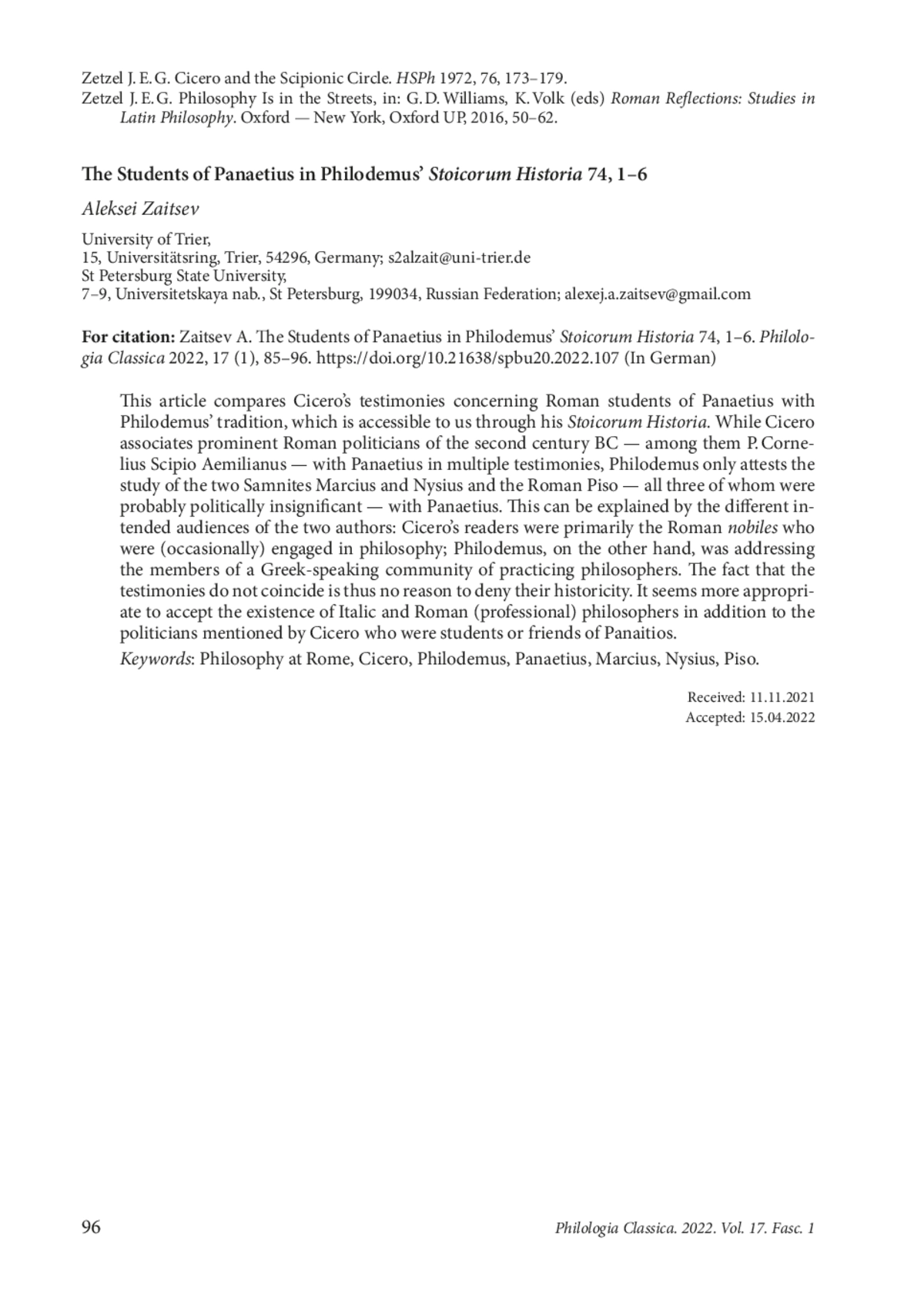
Im folgenden Beitrag sollen Ciceros Nachrichten zu den römischen Schülern des griechischen Philosophen Panaitios (2. Jh. v. Chr.) mit Philodems Tradition, die uns durch seine Stoicorum Historia zugänglich ist, verglichen werden. Während Cicero in mehreren Zeugnissen prominente römische Politiker des zweiten Jhs. v. Chr. — unter anderem P. Cornelius Scipio Aemilianus — mit Panaitios in Verbindung bringt, bezeugt Philodem lediglich das Studium der beiden Samniten Marcius sowie Nysius und des Römers Piso — alle drei waren politisch wohl unbedeutend — bei Panaitios. Dies lässt sich durch die unterschiedlichen Zielgruppen der beiden Autoren erklären: Ciceros Leser waren in erster Linie die römischen nobiles, die sich (gelegentlich) mit der Philosophie beschäftigten, Philodem wiederum wendete sich an die Angehörigen eines Griechisch lesenden Fachpublikums. Die Tatsache, dass sich die, Listen‘ der Schüler bei den beiden Autoren nicht decken, ist somit kein Grund, ihre Historizität abzustreiten. Angemessener scheint es, neben den von Cicero genannten Politikern, die mit Panaitios befreundet waren, die Existenz italischer und römischer (Berufs-)Philosophen zu akzeptieren.
Предпросмотр статьи


Идентификаторы и классификаторы
- SCI
- Языкознание
Bei der Einbürgerung der Philosophie in Rom spielte nach allgemeiner Ansicht Marcus Tullius Cicero eine oder die führende Rolle.1 Ciceros Leistungen im Bereich der Philosophie — der Philosophie in lateinischer Sprache — wurden bereits in mehreren wissenschaftlichen Beiträgen mit Recht anerkannt: Im Gegensatz zur Einschätzung Eduard Zellers, der in Cicero eher einen ideenarmen, von den zuvor lebenden griechischen Autoren völlig abhängigen Eklektiker sah, 2 versteht man Cicero jetzt als durchaus
Если у вас возникли вопросы или появились предложения по содержанию статьи, пожалуйста, направляйте их в рамках данной темы.
Список литературы
1. Abel K. Die kulturelle Mission des Panaitios. A&A 1971, 17, 119-143.
2. Alesse F. (ed.) Panezio di Rodi: Testimonianze. Napoli, Bibliopolis, 1997.
3. Alesse F. Filosofia stoica e classe dirigente romana nel II secolo a.C.: Panezio, Blossio, gli Scipioni, in: P. Vesperini (ed.) Philosophari: Usages romains des savoirs grecs sous la République et sous l’Empire. Paris, Classiques Garnier, 2017, 77-88.
4. Armstrong D. Introduction, in: D. Armstrong, J. Fish, P. A. Johnston, M. B. Skinner (eds) Vergil, Philodemus, and the Augustans. Austin, University of Texas Press, 2004, 1-22.
5. Armstrong D., Fish J., Johnston P. A., Skinner M. B. (eds) Vergil, Philodemus, and the Augustans. Austin, University of Texas Press, 2004.
6. Astin A. E. Diodorus and the Date of the Embassy to the East of Scipio Aemilianus. CPh 1959, 54 (4), 221-227.
7. Astin A. E. Scipio Aemilianus. Oxford, Clarendon Press, 1967.
8. Auricchio F. L., Indelli G., Del Mastro G. / Goulet R. (Übers.) Philodème de Gadara P 142, in: Dictionnaire des philosophes antiques 2012, V, 334-359.
9. Balsdon J. P. V. D. Romans and Aliens. London, Duckworth, 1979.
10. Beck H., Walter U. Die frühen römischen Historiker, Bd. 1: Von Fabius Pictor bis Cn. Gellius. Darmstadt, WBG, 2001.
11. Bernhardy G. Grundriss der römischen Literatur. Halle, C. A. Schwetschke und Sohn, 21850.
12. Blank D. Philodemus. Stanford Encyclopedia of Philosophy, 2019: https://plato.stanford.edu/entries/philodemus/(08.04.2022).
13. Brown R. M. A Study of the Scipionic Circle. Scottdale, Mennonite Press, 1934.
14. Capasso M. Who Lived in the Villa of the Papyri at Herculaneum - A Settled Question? in: M. Zarmakoupi (ed.) The Villa of the Papyri at Herculaneum. Berlin - New York, de Gruyter, 2010, 89-113.
15. Castner C. J. Prosopography of Roman Epicureans from the Second Century B. C. to the Second Century A. D. Frankfurt am Main - Bern - New York - Paris, Lang, 1988.
16. Comparetti D. Papiro ercolanese inedito. Rivista di filologia e di istruzione classica 1875, 3, 449-555.
17. Dorandi T. (ed.) Filodemo: Storia dei filosofi. La Stoà da Zenone a Panezio (PHerc. 1018). Leiden - New York - Köln, Brill, 1994.
18. Dorandi T. Chronology, in: K. Algra, J. Barnes, J. Mansfeld, M. Schofield (eds) The Cambridge History of Hellenistic Philosophy. Cambridge, Cambridge UP, 1999, 31-54.
19. Drecoll C. Die Karneadesgesandtschaft und ihre Auswirkungen in Rom: Bemerkungen zur Darstellung der Karneadesgesandtschaft in den Quellen. Hermes 2004, 132 (1), 82-91.
20. Elvers K.-L. Calpurnius, in: DNP 1997, 2, 941.
21. Erler M. Philodem aus Gadara, in: H. Flashar (Hrsg.) Die Philosophie der Antike. Bd. 4: Die Hellenistische Philosophie. Basel, Schwabe, 1994, 289-362.
22. Erler M. Römische Philosophie, in: F. Graf (Hrsg.) Einleitung in die lateinische Philologie. Wiesbaden, Springer, 1997, 537-598.
23. Erskine A. The Hellenistic Stoa: Political Thought and Action. London, Duckworth, 1990.
24. Ferrary J.-L. Philhellénisme et Impérialisme: aspects idéologiques de la conquête romaine du monde hellénistique, de la seconde guerre de Macédoine à la guerre contre Mithridate. Rome, École française de Rome, 1988.
25. Flashar H. Hellenistische Philosophie. Wien, Passagen Verlag, 2020.
26. Fleischer K. Die Papyri Herkulaneums im Digitalen Zeitalter. Berlin - Boston, de Gruyter, 2022.
27. Forsythe G. A Philological Note on the Scipionic Circle. AJPh 1991, 112 (3), 363-364.
28. Garbarino G. Roma e la filosofia greca dalle origini alla fine del II secolo a.C.: I. Introduzione e testi; II. Commento e indici. Turin, Paravia, 1973.
29. Gawlick G., Görler W. Cicero, in: H. Flashar (Hrsg.) Die Philosophie der Antike. Bd. 4: Die Hellenistische Philosophie. Basel, Schwabe, 1994, 991-1168.
30. Gehrke H.-J. Römischer mos und griechische Ethik. Überlegungen zum Zusammenhang von Akkulturation und politischer Ordnung im Hellenismus. HZ 1994, 258 (3), 593-622.
31. Gigante M. Filodemo in Italia. Florenz, Felice Le Monnier, 1990.
32. Griffin M. T. Philosophical Badinage in Cicero’s Letters to his Friends, in: J. G. F. Powell (ed.) Cicero the Philosopher: Twelve Papers. Oxford, Clarendon Press, 1995, 325-346.
33. Gruen E. S. Culture and National Identity in Republican Rome. New York, Cornell UP, 1992.
34. Haake M. Der Philosoph in der Stadt: Untersuchungen zur öffentlichen Rede über Philosophen und Philosophie in den hellenistischen Poleis. München, C. H. Beck, 2007.
35. Harder R. Die Einbürgerung der Philosophie in Rom, in: W. Marg (Hrsg.) Richard Harder: Kleine Schriften. München, C. H. Beck, 1960 [1929], 330-353.
36. Kurczyk S. Cicero und die Inszenierung der eigenen Vergangenheit: Autobiographisches Schreiben in der späten Römischen Republik. Köln - Weimar - Wien, Böhlau, 2006.
37. Mattingly H. B. Scipio Aemilianus’ Eastern Embassy - the Rhodian Evidence. Aclass 1996, 39, 67-71.
38. Mattingly H. B. Scipio Aemilianus’ Eastern Embassy. CQ 1986, 36 (2), 491-495.
39. Maurach G. Geschichte der römischen Philosophie: Eine Einführung. Darmstadt, WBG, 32006.
40. Mommsen Th. Römische Geschichte. Bd. 2: Von der Schlacht von Pydna bis auf Sullas Tod. Berlin, Weidmannsche Buchhandlung, 81889.
41. Münzer F. Marcius 46, in: RE 1930, XIV, 2, 1552-1554.
42. Philippson R. Philodemos 5, in: RE 1938, XIX, 2, 2444-2482.
43. Pohlenz M. Panaitios 5, in: RE 1949, XVIII, 3, 418-440.
44. Powell J. G. F. (ed.) Cicero the Philosopher: Twelve Papers. Oxford, Clarendon Press, 1995.
45. Powell J. G. F. The Embassy of the Three Philosophers to Rome in 155 B. C., in: Chr. Kremmydas, K. Tempest (eds) Hellenistic Oratory: Continuity and Change. Oxford, Oxford UP, 2013, 219-247.
46. Rawson E. Intellectual Life in the Late Roman Republic. Baltimore, John Hopkins UP, 1985.
47. Rawson E. Roman Rulers and the Philosophic Adviser, in: M Griffin, J. Barnes (eds) Philosophia Togata: Essays on Philosophy and Roman Society. Oxford, Clarendon Press, 1989, 233-257.
48. Sider D. The Epigrams of Philodemos: Introduction, Text, and Commentary. Oxford, Oxford UP, 1997.
49. Steinmetz P. Panaitios aus Rhodos und seine Schüler, in: H. Flashar (Hrsg.) Die Philosophie der Antike. Bd. 4: Die Hellenistische Philosophie. Basel, Schwabe, 1994, 646-669.
50. Strasburger H. Der ‘Scipionenkreis’. Hermes 1966, 94 (1), 60-72.
51. Suerbaum W. (Hrsg.) Handbuch der lateinischen Literatur der Antike. Bd. 1: Die archaische Literatur: Von den Anfängen bis Sullas Tod. Die vorliterarische Periode und die Zeit von 240 bis 78 v. Chr. München, C. H. Beck, 2002.
52. Thrams P. Hellenistische Philosophen in politischer Funktion. Hamburg, Kovač, 2001.
53. Van Straaten M. (ed.) Panaetii Rhodii fragmenta. Leiden, Brill, 1962.
54. Van Straaten M. Panétius: sa vie, ses écrits et sa doctrine avec une édition des fragments. Amsterdam, H. J. -Paris, 1946.
55. Vesperini P. La philosophia et ses pratiques d’Ennius à Cicéron. Rome, École française de Rome, 2012.
56. Volk K. The Roman Republic of Letters: Scholarship, Philosophy, and Politics in the Age of Cicero and Caesar. Princeton - Oxford, Princeton UP, 2021.
57. Von Albrecht M. Geschichte der römischen Literatur: von Andronicus bis Boethius; mit Berücksichtigung ihrer Bedeutung für die Neuzeit, Bd. 1. Bern, Francke, 1992.
58. Zaitsev A. Philosophischer Kulturaustausch: Die Kontakte der Römer mit den griechischen Philosophen vom dritten bis zum ersten Jh. v. Chr. Diss. phil. Trier, Universität Trier, 2022.
59. Zeller E., Wellmann E. (Hrsg.) Die Philosophie der Griechen in ihrer geschichtlichen Entwicklung, Tl. 3, Abt. 1. Leipzig, O. R. Reisland, 1923 [1909].
60. Zetzel J. E. G. Cicero and the Scipionic Circle. HSPh 1972, 76, 173-179.
61. Zetzel J. E. G. Philosophy Is in the Streets, in: G. D. Williams, K. Volk (eds) Roman Reflections: Studies in Latin Philosophy. Oxford - New York, Oxford UP, 2016, 50-62.
Выпуск

Другие статьи выпуска
The following analysis concerns Pliny’s excursus on mazzard (sweet cherry) cultivation in Rome in the Book 15 of the Historia naturalis. Pliny links their introduction and spread to the conquests of the Roman army under the command of illustrious general and bon vivant L. Licinius Lucullus. The confrontation of Pliny’s narrative with other sources, as well as with the findings of contemporary researchers, indicate that Lucullus could not have been the first discoverer of the mazzard and the chronological information Pliny gives should be treated with special caution. Most relevantly, Athenaeus of Naucratis invoked the same tradition, according to which Lucullus was also the author of the name of the mazzard (Greek κεράσια, Latin cerasia), to mock the tendency of the Romans to attribute Greek achievements to themselves. Pliny’s embellished argument, however, aligns perfectly with his Romanocentric and imperialist world picture. As an eminent historian, naturalist and official of the Roman Empire, he used certain passages in his immense encyclopaedia as a departure point to present idealistically the successes of the Roman army and its culture-forming role. In this context, Pliny’s description of the discovery and spread of mazzard cultivation serves as another illustration of the genius of the Romans and the power of their empire
The present paper is the first attempt at a bio-bibliography of Jan Luňák (1847–1935), the peripatetic classicist who roamed the Austro-Hungarian, German, and Russian empires before founding the classical seminar at the University of Ljubljana, in 1919, in what was then the Kingdom of Serbs, Croats, and Slovenians. Luňák studied in Prague and Leipzig and then moved to St Petersburg to earn his master’s in classical philology from Dorpat (now Tartu) and his doctorate in Greek literature from Kazan. In 1890 he became extraordinarius in Moscow, and in 1892 ordinarius in Odessa, from where he retired in 1907. Known primarily for his Quaestiones Sapphicae, he was forced to launch a second career in 1919, after World War I and then the October Revolution permanently separated him from his family and deprived him of his pension. He served as contractual professor of classical philology in Ljubljana until 1930 when he finally returned to Prague. Based on both published and archival material, the paper provides a historical context for his academic career (which had its roots in the Russian Philological Seminary in Leipzig, where Luňák was recommended by Friedrich Ritschl). It thus attempts to understand the somewhat disparate aspects of his complex scholarly itinerary. Apart from providing his comprehensive bibliography, the study hopes to serve as a stimulus for other primary sources to surface in the future
В статье анализируется период в истории кафедры классической филологии Ленинградского университета с 1938 по 1946 гг., за исключением военного времени (1942– 1944 гг.), когда кафедра находилась в эвакуации в Саратове. Привлечена делопроизводственная документация из архивных фондов (Центральный государственный архив г. Санкт-Петербурга и Объединенный архив СПбГУ) и мемуарные свидетельства (главным образом О. М. Фрейденберг). Анализ учебного плана кафедры, введенного в 1938 г., позволил сделать вывод о комплексной историко-филологической подготовке студентов отделения, уходящей корнями еще в дореволюционное время. Установлено, что политика заведующей кафедрой О. М. Фрейденберг по продвижению молодых кадров на кафедру (с передачей им учебных курсов, не всегда рационально обоснованной, на основном отделении) способствовала созданию конфликтной ситуации, которая вылилась в публичное обсуждение в мае 1946 г. на ученом совете возглавляемого ею подразделения. Это заседание не следует относить к разряду идеологических кампаний: оно имело под собой основание в виде профессиональных разногласий. Скандальность же защит Б. Л. Галеркиной и Н. В. Вулих была обусловлена не столько личностными мотивами, сколько научными различиями во взглядах на задачи классической филологии между О. М. Фрейденберг и представителями «старой» школы. Сами же диссертации оказались наспех выполненными, причиной чему явилась материальная сторона
В статье рассматривается история преподавания классических языков в первые годы с момента образования Главных народных училищ в Российской империи в правление Екатерины II. В качестве примера берется Тобольское Главное народное училище в период с 1789 по 1810 г., в которое были направлены выпускники Учительской семинарии Санкт-Петербурга. Дана характеристика реформы среднего образования при Екатерине II, краткая информация о реформах классического образования в XIX в. и их вопло - щении в Западной Сибири. Также анализируются учебники, переведенные с австрийских и заново написанные для Главных народных училищ. Подробно рассматривается Устав народных училищ в части практических и методических рекомендаций учителю иностранных языков (латинский и немецкий). Приводится анализ методических принципов учебника по латинскому языку Я. А. Коменского, адаптированного для преподавания латыни в Главных народных училищах. Рассматриваются основные тематические блоки и методические особенности подачи материала, приводятся примеры текстов учебника. Публикация ставит перед собой цель рассмотреть истоки развития российского классического образования как общественного института с точки зрения практического воплощения и методического анализа, а также произвести обзор организационных составляющих преподавания в Тобольском Главном народном училище. Исследуются конкретно-исторические условия работы учителей, особенности преподавания древних языков в сибирской столице. Материал свидетельствует о далеко не безупречном характере воплощения образовательных реформ 1780-х гг. в условиях Сибири. В то же время нельзя не признать, что реформы заложили необходимую основу для формирования систематического среднего образования в России и переходу к системе классических гимназий, имеющих связь и преемство с университетами европейской части России, что положительно сказалось на культурном и экономическом развитии Западной Сибири в XIX — начале XX в

В статье исследуются неопубликованные примеры прогимнасм на древнегреческом и латинском языках, созданные первыми учениками Софрония Лихуда во время прохождения ими курса греческой и латинской риторики в конце XVII века в Москве. Сборники с этими текстами сохранились в трех кодексах из Отдела рукописей Российской национальной библиотеки. Они посвящены проработке целого ряда риторических упражнений из классического греческого позднеантичного пособия Афтония Антиохийского: этопее, энкомию, псогосу, хрии, общему месту, опровержению и подтверждению. Как и в поздневизантийских сборниках прогимнасм, ни одна из рукописных тетрадей первых учеников Лихудов не включала упражнения на басню, экфрасис, тезис и введение закона; однако все они, за исключением введения закона, изучались в сокращенной форме в рамках других прогимнасм. Темы упражнений, которые предлагал Софроний Лихуд, в основном были христианского характера: плач Иосифа, предательство Иуды, похвала Рождеству, святым и мученикам, богословские дебаты и многое другое. Информация, сохранившаяся на полях рукописей, позволила идентифицировать имена авторов (Николай Семенов Головин, Алексей Кириллов, Федор Поликарпов и Федор Герасимов, Федот Агеев, Иосиф Афанасьев, Петр Постников, Палладий Рогов, греки Анастасий и иеродиакон Дионисий), а также определить необходимые элементы выполняемого упражнения. Исходя из полученного материала, мы можем заключить, что Софроний Лихуд, сочетая на своих уроках лучшие элементы как византийской, так и латинской иезуитской риторической подготовки, придерживался традиций современных ему греческих школ
This paper sheds new light on two Greek texts accompanying Aeschylus’ Prometheus Vinctus, in the fifteenth-century manuscript Q No. 2 of the Library of the Russian Academy of Sciences in Saint Petersburg. The first text is a didactic poem on iambic versification, allegedly composed by Michael Psellos, and the other one is a mixture of book epigrams related to the subject of the Prometheus Vinctus. August Nauck studied the manuscript and published these texts. All further mentions of the manuscript depend on Nauck’s readings, which nobody seems to question. In the latest edition of Psellos, prepared by Westerink, the manuscript from St Petersburg has not been taken into account, albeit the editor mentions Nauck’s publication. As for the epigrams, they have been published several times, also without taking that manuscript into account. A new study of the codex shows that Nauck’s edition contains several minor misreadings, therefore, I propose a new edition, based on the St Petersburg manuscript, as well as other manuscripts bearing same or similar verses, which were, apparently, unknown to him. Analyzing the epigrams on Prometheus, I compare our manuscript with others which contain the same verses (usually in different order). I try to explain some of the mistakes in these texts and correct them, as well as to compare them with other readings.
In her critical edition of the Passio Nazarii, Celsi, Geruasii et Protasii (BHL 6043), a text dated to the 6th or 7th century AD and probably translated from Greek, Cecile Lanéry introduces several conjectural changes aimed at language standardization. The author of the present article takes issue with several of her conjectures and suggests that in each case the transmitted text actually stands criticism and should probably be left unchanged. At 2.3, the transmitted alapas is not to be changed to alapis with percutio, since percutio with both the accusative of direct object and the accusative of a word meaning “blow” is several times reliably attested in the Vetus Latina, and in one of these instances the word used for “blow” is actually alapa. At 5.1, et in the expression uocans Nazarium et dixit ei should not be deleted, since there are numerous parallels for this syntax in Late Latin. At 8.2, in carcerem is to be retained as a possible way to describe position in Late Latin, whether confusion of expressions denoting position and direction or hypercorrect graphic -m is at issue. At 12.1, the form imperatori is to be retained as a possible orthographic variant for the ablative in Late Latin
Der Aufsatz beschäftigt sich mit drei Passagen aus Asconius’ Kommentar zu den Reden Ciceros. Im ersten der behandelten Fragmente berichtet Asconius, dass Ciceros Tochter Tullia im Wochenbett im Haus ihres Ehemannes P. Lentulus verstorben sei. Diese Darstellung steht im Gegensatz zur in der Forschung fast allgemein akzeptierten, wenngleich auf indirekte Quellenzeugnisse gestützten, Meinung, dass Tullia auf Ciceros tuskulanischer Villa verschieden sei, nachdem sie einen Sohn im Haus ihres Vaters in Rom geboren habe. Asconius’ Zeugnis wird der Nachricht Plutarchs (Cic. 41, 7–8) gegenübergestellt, in der die gleiche Version überliefert ist. Der Verfasser gelangt zur Schlussfolgerung, dass der Darstellung der beiden Autoren eine gemeinsame Quelle zugrunde liegt, nämlich die von Tiro verfasste Biographie Ciceros, in der nur der Geburtsort des Kindes Tullias, aber nicht der Todesort seiner Mutter angegeben wurde. Gestützt auf diese Information, kamen Asconius und Plutarch unabhängig voneinander zum folgerichtigen, aber irrtümlichen Schluss, dass Tullia im Haus ihres ehemaligen Ehemannes verstorben sei. In der zweiten Passage erwähnt Asconius, dass M. Licinius Crassus im Richterkollegium im Majestätsprozess des C. Cornelius im Jahre 65 saß. Im selben Jahre bekleidete Crassus die Zensur. Allerdings waren die amtierenden Magistrate von den Geschworenen ausgeschlossen. Da der Corneliusprozess in den späten Frühling oder die erste Hälfte des Sommers datiert werden kann, ist zu vermuten, dass Crassus zu diesem Zeitpunkt das Amt aufgab. Im dritten Teil des Aufsatzes wird Asconius’ Bericht über den Mord an Lucretius Afella untersucht. Nach Asconius wurde Afella von einem gewissen L. Bellienus ermordet, während Plutarch berichtet, dass Afella von einem der Zenturionen Sullas erschlagen worden sei. Der Verfasser kommt zum Schluss, dass diese zwei Menschen identisch sind, obwohl ihre mögliche Identität in der Forschung üblicherweise in Zweifel gezogen wird
The article concerns the semantic nuances of the verb faxo in the Plautus’ language. The vast majority of the occurrences demonstrate causative semantics, but there are a few cases where such a meaning can hardly be seen. De Melo singled out the two occurrences in which faxo can be treated as either an adverb similar to forsitan or a parenthetical expression with the meaning “I assume.” The author of the article has found some more examples of the non-causative use of faxo and tried to find out which of De Melo’s suggestions is preferable. On the grounds of the grammaticalization principles suggested by Hopper and Heine, there has been traced the stages of grammaticalization of faxo in the language of Roman comedy, with particular attention to the broader context. It is demonstrated that the causative meaning which transpires in many examples tends to emerge in the “bridging contexts” of grammaticalization, while the transition to the semantics under consideration occurs at the following stage, i. e. in the “switch context”. Having analyzed all the occurrences of faxo against the broader contexts and comparative data from other languages, the author concludes that the rare sigmatic future faxo had over time become a semi-grammaticalized marker of the speaker’s stance, which allowed both evidential (inferential) and modal-epistemic interpretation
The Greek grammarian and lexicographer, Hesychius of Alexandria (5 th–6th c. CE) included a Pamphylian gloss: βουρικυπάρισσος ἡ ἄμπελος. Περγαῖοι in his dictionary of rare and dialectal words. Based on a microphilological and lexical analysis, I suggest that the Greek text should be read as follows: βουρίꞏ κυπάρισσος ἢ ἄμπελος. Περγαῖοι (“bourí: cypress or grapevine. Citizens of Perge”). The Pamphylian gloss in question represents two different borrowings of terms originating in the Near East. The first item βουρίꞏ κυπάρισσος (‘cypress’) seems to have been borrowed from Akkadian burāšu(m) ‘a kind of conifer tree; juniper or cypress’ with a Lycian intermediary (Akk. burāšu → Luw. *burašiš > Lyc. *burehi > *burhi → Pamph. βουρί), whereas the second one βουρίꞏ […] ἄμπελος (‘grapevine’) reflects a separate loanword from an Anatolian source, cf. Hitt. and Luw. muriš c. ‘a grapevine, a vine, a cluster or bunch of grapes or other fruit’. The Pamphylian dialect of Ancient Greek represents an extraordinary idiom, which was used in the neighbourhood of numerous Anatolian languages such as Lycian, Milyan, Sidetic, Pisidian and Cilician. It is therefore not surprising that the Pamphylian Greeks borrowed a number of cultural terms for plants from an Anatolian Indo-European source, as well as from Akkadian or other West Semitic languages via Luwian and Lycian. Additionally, other possible Anatolian borrowings into Ancient Greek (e. g. Gk. dial. βωληνή ‘a type of grapevine’, μῶλαξ ‘id.’ vs. Hittite maḫlaš c. ‘grapevine, Vitis vinifera L.’) are mentioned and reviewed
It is a well-known fact that tmesis (independent use of the preverb from its verb) as a linguistic phenomenon was progressively eliminated from Ancient Greek, so that only residual usage is attested in the language of the Classical age. However, one verb, ἀναδραμεῖν, retained tmetic usage with the particle τε intervening between the preverb and the verb, ἀνά τε ἔδραμε, until late Antiquity (Appian, Eunapius). It is significant that this construction (on par with the non tmetic form ἀνέδραμε) was used in prose, which suggests that it was part of actual linguistic usus. The article examines the reasons behind the unique longevity of this tmesis. Following an overview of the occurrences of ἀνά τε ἔδραμεν in Herodotus, Appian and Eunapius, and the comparison of the use of the tmetic and non tmetic forms, the elements of the construction are discussed. It is shown that the survival of ἀνά τε ἔδραμεν must have been influenced by the semantic development of the verb (the root no longer denotes actual running, but springing to one’s feet or rapid growth), as well as the capacity of the preverb ἀνα- to appear independently of its verb (the deontic ἄνα). Finally, a possible shift in meaning of τε (as invariable part of the expression) is discussed. While it is impossible to pinpoint one single factor that determined the singular longevity of the tmesis ἀνά τε ἔδραμε in Greek, a combination of factors seems to have contributed to its survival
In this paper, I demonstrate that the early Stoics adhered to a normative theory that may be called intentionalist: the moral significance of any action is not determined by its material content, but by the virtuous or vicious disposition of the agent’s soul and the intentions arising from this disposition. Since according to Stoics all people are divided into virtuous sages and vicious non-sages, all the actions of the former are morally right (κατορθώματα), whereas those of the latter are morally wrong (ἁμαρτήματα), even if they are materially identical. On the other hand, some statements in the Stoic fragments can rather be characterized as deontological: in this case, certain materially defined types of action (stealing, lying, adultery, etc.) seem to be presented as morally wrong in themselves. The paper’s central thesis is that such statements do not contradict the basic Stoic intentionalism but can be interpreted as consistent with it. Such an interpretation becomes possible under two conditions: firstly, if one takes into account how exactly the notions of κατόρθωμα and ἁμάρτημα relate to the Stoic notions of appropriate and inappropriate action (καθῆκον and παρὰ τὸ καθῆκον), and, secondly, if one examines the Stoic position on the moral status of lying, which is very revealing in this respect
Ancient authors did not leave us any description of ancient interpreters, and neither their usual functions nor possible social positions are known to us. Although this can be partially restored from written sources, the whole picture remains in the shadows. We are not aware of the ways in which people became interpreters in Antiquity, whether such a profession actually existed, and to what extent it is possible to apply the modern understanding of interpreters to ancient times. Finally, there are many dark corners in our understanding of historical specifics: the functions, social status and ethnic origin of interpreters obviously varied in different cultures and time frames. The use of a word or an expression defining the interpreter is another issue, for Greek ἑρμηνεύς, a traditional lexeme in dictionaries of Ancient Greek (LSJ, GE, DELG, GEW, EDG, Woodhouse), does not, in fact, always denote someone related to this line of work. In Xenophon’s Anabasis a person named Pigres is described as ἑρμηνεύς and one of the companions of Cyrus the Younger in his belligerent attempt to overthrow Artaxerxes II. Pigres is usually understood as an interpreter (Gehman, Lendle, Rochette, Wiotte-Franz, Stoneman etc.), but is there a solid basis for such understanding? What do we know about him? What does Xenophon tell us about his responsibilities? The study shows that Pigres’ identity should be understood in relation to the usage of the word ἑρμηνεύς in V–ΙV BCE and to the sociocultural context of Asia Minor under the rule of the Achaemenid dynasty

This article analyses the role of the prophet Teiresias in the Bacchae of Euripides in the particular context of sophistic influence. It views the originality of the prophet’s depiction as reflective of Euripides’ creative self-consciousness within an agonistic genre that relied on the malleability of ancient myth, particularly towards the end of tragedy’s “golden era”. Our particular aim is to present the prophet independently of the Sophoсlean background against which Teiresias is often viewed, and as a more complex figure than a (not especially satisfactory) radicalization of his earlier incarnations. The prophet in Bacchae is a liminal figure poised between tragedy and comedy, man and god, male and female, tradition and innovation. As such he parallels many of the “doublings” characteristic of Dionysus himself. The analysis re-examines the extent and nature of the comedy in the early Teiresias–Cadmus–Pentheus scene (170–369) in the context of the most recent scholarship. It then offers a close examination of the so-called sophistic speech by the prophet (266–327) within the framework of contemporary attitudes to sophism and how this has unfairly influenced scholarly perception of Teiresias’s authority as a dramatic character. The argument aims to establish Teiresias’s incarnation as both fifth-century intellectual and representative of traditional values. He thus reflects the tension between old and new in the integration of Dionysiac religion in mythical Thebes
Статистика статьи
Статистика просмотров за 2026 год.
Издательство
- Издательство
- СПБГУ
- Регион
- Россия, Санкт-Петербург
- Почтовый адрес
- Россия, 199034, Санкт-Петербург, Университетская наб., д. 7–9
- Юр. адрес
- 199034, г Санкт-Петербург, Василеостровский р-н, Университетская наб, д 7/9
- ФИО
- Кропачев Николай Михайлович (РЕКТОР)
- E-mail адрес
- spbu@spbu.ru
- Контактный телефон
- +7 (812) 3282000
- Сайт
- https://spbu.ru/