

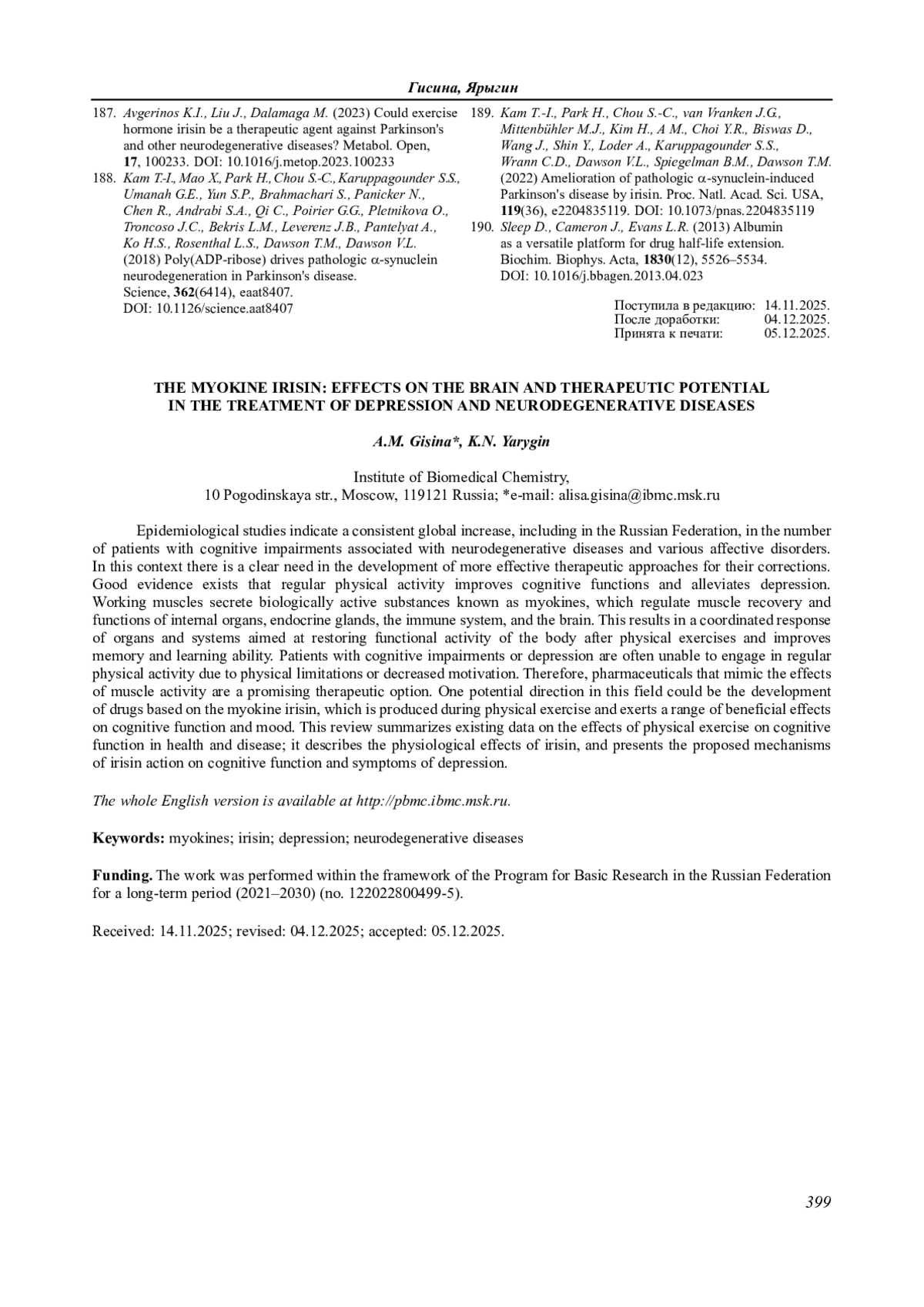
Эпидемиологические исследования показывают, что во всём мире, в том числе в РФ, наблюдается устойчивый рост числа пациентов с когнитивными нарушениями, связанными с нейродегенеративными заболеваниями и различными аффективными расстройствами. В связи с этим существует запрос на разработку более действенных терапевтических подходов к их коррекции. Установлено, что регулярная физическая нагрузка способствует улучшению когнитивных функций и подавляет симптомы депрессии. Работающие мышцы секретируют биологически активные вещества — миокины, регулирующие восстановление самих мышц, а также регулирующие функции внутренних органов, желёз внутренней секреции, иммунной системы и мозга. Результатом является скоординированный ответ органов и систем, направленный на восстановление функциональной активности организма после физической нагрузки. В частности, улучшается память и способность к обучению. Пациенты с когнитивными нарушениями или депрессией часто не способны вовлечься в регулярную физическую активность из-за физических ограничений или ослабления мотивации. В связи с этим фармацевтические препараты, имитирующие эффекты мышечной активности, являются перспективной терапевтической опцией. Одним из направлений может стать создание препаратов на основе миокина иризина, который вырабатывается во время физической нагрузки и оказывает целый ряд благотворных эффектов на когнитивные функции и настроение. В этом обзоре представлены данные по влиянию физической нагрузки на когнитивные функции в норме и при патологии, описано физиологическое действие иризина, представлены предполагаемые механизмы действия иризина на когнитивные функции и симптомы депрессии.
Предпросмотр статьи

Идентификаторы и классификаторы
- SCI
- Биология
Деменция и депрессия входят в число важнейших проблем гериатрии. Деменция характеризуется приобретёнными когнитивными нарушениями, приводящими к заметному ухудшению способности пациента к обучению, работе, общению и, в конце концов, к нарушению способности поддерживать нормальный образ жизни [1]. По этиологии и патогенезу можно выделить две категории деменций: 1) наблюдающиеся при нейродегенеративных заболеваниях — болезни Альцгеймера, деменции с тельцами Леви, болезни Паркинсона и лобно-височной долевой дегенерации; 2) возникающие при иных, не нейродегенеративных патологиях, таких как гидроцефалия, черепно-мозговая травма, инфекции, иммунные нарушения, опухоли, отравления и метаболические заболевания [1]. В 2017 году глобальная оценка численности пациентов с диагнозом деменция составляла приблизительно 50 миллионов человек, и ожидалось, что каждые 20 лет их численность будет удваиваться [2]. Поддержание когнитивных функций у стареющего населения является важной задачей, поскольку деменция напрямую влияет на качество жизни пожилых людей и создаёт значительную нагрузку на общество, семьи и систему здравоохранения. Депрессия является ещё более распространённым серьёзным ментальным заболеванием, которое касается почти 300 миллионов людей по всему миру [3] и также является одной из главных причин временной нетрудоспособности с невыходом на работу [4].
Если у вас возникли вопросы или появились предложения по содержанию статьи, пожалуйста, направляйте их в рамках данной темы.
Список литературы
1. Gale S.A., Acar D., Daffner K.R. (2018) Dementia. Am. J. Med., 131(10), 1161-1169. DOI: 10.1016/j.amjmed.2018.01.022
2. López-Lluch G., Rattan S.I.S. (2015) Facing challenges in an ageing world. Biogerontology, 16(5), 567-568. DOI: 10.1007/s10522-015-9597-5
3. Herrman H., Kieling C., McGorry P., Horton R., Sargent J., Patel V. (2019) Reducing the global burden of depression: a Lancet-World Psychiatric Association Commission. Lancet, 393(10189), e42-e43. DOI: 10.1016/S0140-6736(18)32408-5
4. Friedrich M.J. (2017) Depression is the leading cause of disability around the world. JAMA, 317(15), 1517. DOI: 10.1001/jama.2017.3826
5. Richmond-Rakerd L.S., d’Souza S., Milne B.J., Caspi A., Moffitt T.E. (2022) Longitudinal associations of mental disorders with dementia: 30-year analysis of 1.7 million New Zealand citizens. JAMA Psychiatry, 79(4), 333-340. DOI: 10.1001/jamapsychiatry.2021.4377
6. Singh-Manoux A., Dugravot A., Fournier A., Abell J., Ebmeier K., Kivimäki M., Sabia S. (2017) Trajectories of depressive symptoms before diagnosis of dementia: a 28-year follow-up study. JAMA Psychiatry, 74(7), 712-718. DOI: 10.1001/jamapsychiatry.2017.0660
7. Dafsari F.S., Jessen F. (2020) Depression - an underrecognized target for prevention of dementia in Alzheimer’s disease. Transl. Psychiatry, 10(1), 160. DOI: 10.1038/s41398-020-0839-1
8. Lorenzetti V., Allen N.B., Fornito A., Yücel M. (2009) Structural brain abnormalities in major depressive disorder: a selective review of recent MRI studies. J. Affect. Disord., 117(1-2), 1-17. DOI: 10.1016/j.jad.2008.11.021
9. Cotter D., Mackay D., Chana G., Beasley C., Landau S., Everall I.P. (2002) Reduced neuronal size and glial cell density in area 9 of the dorsolateral prefrontal cortex in subjects with major depressive disorder. Cereb. Cortex, 12(4), 386-394. DOI: 10.1093/cercor/12.4.386
10. Duman R.S., Shinohara R., Fogaça M.V., Hare B. (2019) Neurobiology of rapid acting antidepressants: convergent effects on GluA1-synaptic function. Mol. Psychiatry, 24(12), 1816-1832. DOI: 10.1038/s41380-019-0400-x
11. Kang H.J., Voleti B., Hajszan T., Rajkowska G., Stockmeier C.A., Licznerski P., Lepack A., Majik M.S., Jeong L.S., Banasr M., Son H., Duman R.S. (2012) Decreased expression of synapse-related genes and loss of synapses in major depressive disorder. Nat. Med., 18(9), 1413-1417. DOI: 10.1038/nm.2886
12. Peng T.-C., Chen W.-L., Wu L.-W., Chang Y.-W., Kao T.-W. (2020) Sarcopenia and cognitive impairment: a systematic review and meta-analysis. Clin. Nutr., 39(9), 2695-2701. DOI: 10.1016/j.clnu.2019.12.014
13. Sugimoto T., Ono R., Murata S., Saji N., Matsui Y., Niida S., Toba K., Sakurai T. (2016) Prevalence and associated factors of sarcopenia in elderly subjects with amnestic mild cognitive impairment or Alzheimer disease. Curr. Alzheimer Res., 13(6), 718-726. DOI: 10.2174/1567205013666160211124828
14. Tyndall A.V., Clark C.M., Anderson T.J., Hogan D.B., Hill M.D., Longman R.S., Poulin M.J. (2018) Protective effects of exercise on cognition and brain health in older adults. Exerc. Sport Sci. Rev., 46(4), 215-223. DOI: 10.1249/JES.0000000000000161
15. Cassilhas R.C., Tufik S., de Mello M.T. (2015) Physical exercise, neuroplasticity, spatial learning and memory. Cell. Mol. Life Sci., 73(5), 975-983. DOI: 10.1007/s00018-015-2102-0
16. de Sousa R.A.L., Rocha-Dias I., de Oliveira L.R.S., Improta-Caria A.C., Monteiro-Junior R.S., Cassilhas R.C. (2021) Molecular mechanisms of physical exercise on depression in the elderly: a systematic review. Mol. Biol. Rep., 48(4), 3853-3862. DOI: 10.1007/s11033-021-06330-z
17. Wong-Goodrich S.J.E., Pfau M.L., Flores C.T., Fraser J.A., Williams C.L., Jones L.W. (2010) Voluntary running prevents progressive memory decline and increases adult hippocampal neurogenesis and growth factor expression after whole-brain irradiation. Cancer Res., 70(22), 9329-9338. DOI: 10.1158/0008-5472.CAN-10-1854
18. Pietropaolo S., Sun Y., Li R., Brana C., Feldon J., Yee B.K. (2008) The impact of voluntary exercise on mental health in rodents: a neuroplasticity perspective. Behav. Brain Res., 192(1), 42-60. DOI: 10.1016/j.bbr.2008.03.014
19. Heissel A., Heinen D., Brokmeier L.L., Skarabis N., Kangas M., Vancampfort D., Stubbs B., Firth J., Ward P.B., Rosenbaum S., Hallgren M., Schuch F. (2023) Exercise as medicine for depressive symptoms? A systematic review and meta-analysis with meta-regression. Br. J. Sports Med., 57(16), 1049-1057. DOI: 10.1136/bjsports-2022-106282
20. Noetel M., Sanders T., Gallardo-Gómez D., Taylor P., del Pozo Cruz B., van den Hoek D., Smith J.J., Mahoney J., Spathis J., Moresi M., Pagano R., Pagano L., Vasconcellos R., Arnott H., Varley B., Parker P., Biddle S., Lonsdale C. (2024) Effect of exercise for depression: systematic review and network meta-analysis of randomised controlled trials. BMJ, 384, e075847. DOI: 10.1136/bmj-2023-075847
21. Hu M.X., Turner D., Generaal E., Bos D., Ikram M.K., Ikram M.A., Cuijpers P., Penninx B.W.J.H. (2020) Exercise interventions for the prevention of depression: a systematic review of meta-analyses. BMC Public Health, 20(1), 1255. DOI: 10.1186/s12889-020-09323-y
22. Singh B., Bennett H., Miatke A., Dumuid D., Curtis R., Ferguson T., Brinsley J., Szeto K., Eglitis E., Zhou M., Simpson C.E.M., Petersen J.M., Firth J., Maher C.A. (2025) Systematic umbrella review and meta-meta-analysis: effectiveness of physical activity in improving depression and anxiety in children and adolescents. J. Am. Acad. Child Adolesc. Psychiatry, S0890-8567(25)00208-4. Epub ahead of print. DOI: 10.1016/j.jaac.2025.04.007
23. Hamer M., Chida Y. (2009) Physical activity and risk of neurodegenerative disease: a systematic review of prospective evidence. Psychol. Med., 39(1), 3-11. DOI: 10.1017/S0033291708003681
24. Nichol K.E., Poon W.W., Parachikova A.I., Cribbs D.H., Glabe C.G., Cotman C.W. (2008) Exercise alters the immune profile in Tg2576 Alzheimer mice toward a response coincident with improved cognitive performance and decreased amyloid. J. Neuroinflammation, 5, 13. DOI: 10.1186/1742-2094-5-13
25. Little H.C., Tan S.Y., Cali F.M., Rodriguez S., Lei X., Wolfe A., Hug C., Wong G.W. (2018) Multiplex quantification identifies novel exercise-regulated myokines/cytokines in plasma and in glycolytic and oxidative skeletal muscle. Mol. Cell. Proteomics, 17(8), 1546-1563. DOI: 10.1074/mcp.RA118.000794
26. Eaton M., Granata C., Barry J., Safdar A., Bishop D., Little J.P. (2018) Impact of a single bout of high-intensity interval exercise and short-term interval training on interleukin-6, FNDC5, and METRNL mRNA expression in human skeletal muscle. J. Sport Health Sci., 7(2), 191-196. DOI: 10.1016/j.jshs.2017.01.003
27. Cai L., Tan M., Tan W., Zeng X., Wan N., Wong S.H.-S., O’Reilly J., Sun F., Yang J., Chen Y. (2019) Associations of circulating irisin concentrations with cardiometabolic risk factors among children vary by physical activity or sedentary time levels. Front. Endocrinol., 10, 549. DOI: 10.3389/fendo.2019.00549
28. Bettariga F., Taaffe D.R., Galvão D.A., Lopez P., Bishop C., Markarian A.M., Natalucci V., Kim J.-S., Newton R.U. (2024) Exercise training mode effects on myokine expression in healthy adults: a systematic review with meta-analysis. J. Sport Health Sci., 13(6), 764-779. DOI: 10.1016/j.jshs.2024.04.005
29. Cordingley D.M., Anderson J.E., Cornish S.M. (2023) Myokine response to blood-flow restricted resistance exercise in younger and older males in an untrained and resistance-trained state: a pilot study. J. Sci. Sport Exerc., 5, 203-217. DOI: 10.1007/s42978-022-00164-2
30. Vints W.A.J., Šeikinaitė J., Gökçe E., Kušleikienė S., Šarkinaite M., Valatkeviciene K., Česnaitienė V.J., Verbunt J., Levin O., Masiulis N (2024) Resistance exercise effects on hippocampus subfield volumes and biomarkers of neuroplasticity and neuroinflammation in older adults with low and high risk of mild cognitive impairment: a randomized controlled trial. GeroScience, 46(4), 3971-3991. DOI: 10.1007/s11357-024-01110-6
31. Morishita S., Tsubaki A., Nakamura M., Nashimoto S., Fu J.B., Onishi H. (2019) Rating of perceived exertion on resistance training in elderly subjects. Expert Rev. Cardiovasc. Ther., 17(2), 135-142. DOI: 10.1080/14779072.2019.1561278
32. Kim Y.-P., Kim H.-B., Jang M.-H., Lim B.-V., Kim Y.-J., Kim H., Kim S.-S., Kim E.-H., Kim C.-J. (2003) Magnitude- and time-dependence of the effect of treadmill exercise on cell proliferation in the dentate gyrus of rats. Int. J. Sports Med., 24(2), 114-117. DOI: 10.1055/s-2003-38202
33. Blumenthal J.A., Babyak M.A., Doraiswamy P.M., Watkins L., Hoffman B.M., Barbour K.A., Herman S., Craighead W.E., Brosse A.L., Waugh R., Hinderliter A., Sherwood A. (2007) Exercise and pharmacotherapy in the treatment of major depressive disorder. Psychosom. Med., 69(7), 587-596. DOI: 10.1097/PSY.0b013e318148c19a
34. Lee J., Gierc M., Vila-Rodriguez F., Puterman E., Faulkner G. (2021) Efficacy of exercise combined with standard treatment for depression compared to standard treatment alone: a systematic review and meta-analysis of randomized controlled trials. J. Affect. Disord., 295, 1494-1511. DOI: 10.1016/j.jad.2021.09.043
35. Mammen G., Faulkner G. (2013) Physical activity and the prevention of depression: a systematic review of prospective studies. Am. J. Prev. Med., 45(5), 649-657. DOI: 10.1016/j.amepre.2013.08.001
36. Pearce M., Garcia L., Abbas A., Strain T., Schuch F.B., Golubic R., Kelly P., Khan S., Utukuri M., Laird Y., Mok A., Smith A., Tainio M., Brage S., Woodcock J. (2022) Association between physical activity and risk of depression: a systematic review and meta-analysis. JAMA Psychiatry, 79(6), 550-559. DOI: 10.1001/jamapsychiatry.2022.0609
37. Cunha M.P., Oliveira Á., Pazini F.L., Machado D.G., Bettio L.E.B., Budni J., Aguiar A.S., Martins D.F., Santos A.R.S., Rodrigues A.L.S. (2013) The antidepressantlike effect of physical activity on a voluntary running wheel. Med. Sci. Sports Exerc., 45(5), 851-859. DOI: 10.1249/MSS.0b013e31827b23e6
38. Lin T.-W., Kuo Y.-M. (2013) Exercise benefits brain function: the monoamine connection. Brain Sci., 3(1), 39-53. DOI: 10.3390/brainsci3010039
39. Euteneuer F., Dannehl K., del Rey A., Engler H., Schedlowski M., Rief W. (2017) Immunological effects of behavioral activation with exercise in major depression: an exploratory randomized controlled trial. Transl. Psychiatry, 7(5), e1132. DOI: 10.1038/tp.2017.76
40. Sigwalt A.R., Budde H., Helmich I., Glaser V., Ghisoni K., Lanza S., Cadore E.L., Lhullier F.L.R., de Bem A.F., Hohl A., de Matos F.J., de Oliveira P.A., Prediger R.D., Guglielmo L.G., Latini A. (2011) Molecular aspects involved in swimming exercise training reducing anhedonia in a rat model of depression. Neuroscience, 192, 661-674. DOI: 10.1016/j.neuroscience.2011.05.075
41. Luca M., Luca A. (2019) Oxidative stress-related endothelial damage in vascular depression and vascular cognitive impairment: beneficial effects of aerobic physical exercise. Oxid. Med. Cell. Longev., 2019, 8067045. DOI: 10.1155/2019/8067045
42. Brocardo P.S., Boehme F., Patten A., Cox A., Gil-Mohapel J., Christie B.R. (2012) Anxiety- and depression-like behaviors are accompanied by an increase in oxidative stress in a rat model of fetal alcohol spectrum disorders: protective effects of voluntary physical exercise. Neuropharmacology, 62(4), 1607-1618. DOI: 10.1016/j.neuropharm.2011.10.006
43. Liang X., Tang J., Qi Y.-Q., Luo Y.-M., Yang C.-M., Dou X.-Y., Jiang L., Xiao Q., Zhang L., Chao F.-L., Zhou C.-N., Tang Y. (2022) Exercise more efficiently regulates the maturation of newborn neurons and synaptic plasticity than fluoxetine in a CUS-induced depression mouse model. Exp. Neurol., 354, 114103. DOI: 10.1016/j.expneurol.2022.114103
44. Liang X., Tang J., Chao F.-L., Zhang Y., Chen L.-M., Wang F.-F., Tan C.-X., Luo Y.-M., Xiao Q., Zhang L., Qi Y.-Q., Jiang L., Huang C.-X., Gao Y., Tang Y. (2019) Exercise improves depressive symptoms by increasing the number of excitatory synapses in the hippocampus of CUS-induced depression model rats. Behav. Brain Res., 374, 112115. DOI: 10.1016/j.bbr.2019.112115
45. Micheli L., Ceccarelli M., d’Andrea G., Tirone F. (2018) Depression and adult neurogenesis: positive effects of the antidepressant fluoxetine and of physical exercise. Brain Res. Bull., 143, 181-193. DOI: 10.1016/j.brainresbull.2018.09.002
46. Steib K., Schäffner I., Jagasia R., Ebert B., Lie D.C. (2014) Mitochondria modify exercise-induced development of stem cell-derived neurons in the adult brain. J. Neurosci., 34(19), 6624-6633. DOI: 10.1523/JNEUROSCI.4972-13.2014
47. Meyer J.D., Koltyn K.F., Stegner A.J., Kim J.-S., Cook D.B. (2016) Relationships between serum BDNF and the antidepressant effect of acute exercise in depressed women. Psychoneuroendocrinology, 74, 286-294. DOI: 10.1016/j.psyneuen.2016.09.022
48. Baj G., d’Alessandro V., Musazzi L., Mallei A., Sartori C.R., Sciancalepore M., Tardito D., Langone F., Popoli M., Tongiorgi E. (2012) Physical exercise and antidepressants enhance BDNF targeting in hippocampal CA3 dendrites: further evidence of a spatial code for BDNF splice variants. Neuropsychopharmacology, 37(7), 1600-1611. DOI: 10.1038/npp.2012.5
49. Teufel A., Malik N., Mukhopadhyay M., Westphal H. (2002) Frcp1 and Frcp2, two novel fibronectin type III repeat containing genes. Gene, 297(1-2), 79-83. DOI: 10.1016/s0378-1119(02)00828-4
50. Boström P., Wu J., Jedrychowski M.P., Korde A., Ye L., Lo J.C., Rasbach K.A., Boström E.A., Choi J.H., Long J.Z., Kajimura S., Zingaretti M.C., Vind B.F., Tu H., Cinti S., Højlund K., Gygi S.P., Spiegelman B.M. (2012) A PGC1-α-dependent myokine that drives brown-fat-like development of white fat and thermogenesis. Nature, 481(7382), 463-468. DOI: 10.1038/nature10777
51. Nie Y., Dai B., Guo X., Liu D. (2020) Cleavage of FNDC5 and insights into its maturation process. Mol. Cell. Endocrinol., 510, 110840. DOI: 10.1016/j.mce.2020.110840
52. Schumacher M.A., Chinnam N., Ohashi T., Shah R.S., Erickson H.P. (2013) The structure of irisin reveals a novel intersubunit β-sheet fibronectin type III (FNIII) dimer: implications for receptor activation. J. Biol. Chem., 288(47), 33738-33744. DOI: 10.1074/jbc.M113.516641
53. Huh J.Y., Panagiotou G., Mougios V., Brinkoetter M., Vamvini M.T., Schneider B.E., Mantzoros C.S. (2012) FNDC5 and irisin in humans: I. Predictors of circulating concentrations in serum and plasma and II. mRNA expression and circulating concentrations in response to weight loss and exercise. Metabolism, 61(12), 1725-1738. DOI: 10.1016/j.metabol.2012.09.002
54. Wojtaszewski J.F.P., Nielsen P., Hansen B.F., Richter E.A., Kiens B. (2000) Isoform-specific and exercise intensitydependent activation of 5′-AMP-activated protein kinase in human skeletal muscle. J. Physiol., 528(Pt 1), 221-226. DOI: 10.1111/j.1469-7793.2000.t01-1-00221.x
55. Witczak C.A., Sharoff C.G., Goodyear L.J. (2008) AMP-activated protein kinase in skeletal muscle: from structure and localization to its role as a master regulator of cellular metabolism. Cell. Mol. Life Sci., 65(23), 3737-3755. DOI: 10.1007/s00018-008-8244-6
56. Liang H., Ward W.F. (2006) PGC-1α: a key regulator of energy metabolism. Adv. Physiol. Educ., 30(4), 145-151. DOI: 10.1152/advan.00052.2006
57. Dun S.L., Lyu R.-M., Chen Y.-H., Chang J.-K., Luo J.J., Dun N.J. (2013) Irisin-immunoreactivity in neural and non-neural cells of the rodent. Neuroscience, 240, 155-162. DOI: 10.1016/j.neuroscience.2013.02.050
58. Aydin S., Kuloglu T., Aydin S., Kalayci M., Yilmaz M., Cakmak T., Albayrak S., Gungor S., Colakoglu N., Ozercan I.H. (2014) A comprehensive immunohistochemical examination of the distribution of the fat-burning protein irisin in biological tissues. Peptides, 61, 130-136. DOI: 10.1016/j.peptides.2014.09.014
59. Ruan Q., Huang Y., Yang L., Ruan J., Gu W., Zhang X., Zhang Y., Zhang W., Yu Z. (2019) The effects of both age and sex on irisin levels in paired plasma and cerebrospinal fluid in healthy humans. Peptides, 113, 41-51. DOI: 10.1016/j.peptides.2019.01.004
60. Zhao R. (2022) Irisin at the crossroads of inter-organ communications: challenge and implications. Front. Endocrinol., 13, 989135. DOI: 10.3389/fendo.2022.989135
61. Jedrychowski M.P., Wrann C.D., Paulo J.A., Gerber K.K., Szpyt J., Robinson M.M., Nair K.S., Gygi S.P., Spiegelman B.M. (2015) Detection and quantitation of circulating human irisin by tandem mass spectrometry. Cell Metab., 22(4), 734-740. DOI: 10.1016/j.cmet.2015.08.001
62. Ruan Q., Zhang L., Ruan J., Zhang X., Chen J., Ma C., Yu Z. (2018) Detection and quantitation of irisin in human cerebrospinal fluid by tandem mass spectrometry. Peptides, 103, 60-64. DOI: 10.1016/j.peptides.2018.03.013
63. Roca-Rivada A., Castelao C., Senin L.L., Landrove M.O., Baltar J., Belén Crujeiras A., Seoane L.M., Casanueva F.F., Pardo M. (2013) FNDC5/irisin is not only a myokine but also an adipokine. PLOS One, 8(4), e60563. DOI: 10.1371/journal.pone.0060563
64. Islam M.R., Valaris S., Young M.F., Haley E.B., Luo R., Bond S.F., Mazuera S., Kitchen R.R., Caldarone B.J., Bettio L.E.B., Christie B.R., Schmider A.B., Soberman R.J., Besnard A., Jedrychowski M.P., Kim H., Tu H., Kim E., Choi S.H., Tanzi R.E., Spiegelman B.M., Wrann C.D. (2021) Exercise hormone irisin is a critical regulator of cognitive function. Nat. Metab., 3(8), 1058-1070. DOI: 10.1038/s42255-021-00438-z
65. Lee J.M., Sim T.H., Kim S.H., Choi Y.J., Lee J.H., Yeo S.G., Kim Y.-J. (2025) Exercise-induced FNDC5/irisin ameliorates cognitive impairment in aged mice, associated with antioxidant and neurotrophic responses. Antioxidants, 14(10), 1239. DOI: 10.3390/antiox14101239
66. Wang Y., Tian M., Tan J., Pei X., Lu C., Xin Y., Deng S., Zhao F., Gao Y., Gong Y. (2022) Irisin ameliorates neuroinflammation and neuronal apoptosis through integrin αVβ5/AMPK signaling pathway after intracerebral hemorrhage in mice. J. Neuroinflammation, 19, 82. DOI: 10.1186/s12974-022-02438-6
67. Lee P., Linderman J.D., Smith S., Brychta R.J., Wang J., Idelson C., Perron R.M., Werner C.D., Phan G.Q., Kammula U.S., Kebebew E., Pacak K., Chen K.Y., Celi F.S. (2014) Irisin and FGF21 are cold-induced endocrine activators of brown fat function in humans. Cell Metab., 19(2), 302-309. DOI: 10.1016/j.cmet.2013.12.017
68. Waseem R., Shamsi A., Mohammad T., Hassan M.I., Kazim S.N., Chaudhary A.A., Rudayni H.A., Al-Zharani M., Ahmad F., Islam A. (2022) FNDC5/irisin: physiology and pathophysiology. Molecules, 27(3), 1118. DOI: 10.3390/molecules27031118
69. Pang M., Yang J., Rao J., Wang H., Zhang J., Wang S., Chen X., Dong X. (2018) Time-dependent changes in increased levels of plasma irisin and muscle PGC-1α and FNDC5 after exercise in mice. Tohoku J. Exp. Med., 244(2), 93-103. DOI: 10.1620/tjem.244.93
70. Babaei A., Nourshahi M., Fani M., Entezari Z., Jameie S.B., Haghparast A. (2021) The effectiveness of continuous and interval exercise preconditioning against chronic unpredictable stress: involvement of hippocampal PGC-1α/FNDC5/BDNF pathway. J. Psychiatr. Res., 136, 173-183. DOI: 10.1016/j.jpsychires.2021.02.006
71. Brenmoehl J., Albrecht E., Komolka K., Schering L., Langhammer M., Hoeflich A., Maak S. (2014) Irisin is elevated in skeletal muscle and serum of mice immediately after acute exercise. Int. J. Biol. Sci., 10(3), 338-349. DOI: 10.7150/ijbs.7972
72. Norheim F., Langleite T.M., Hjorth M., Holen T., Kielland A., Stadheim H.K., Gulseth H.L., Birkeland K.I., Jensen J., Drevon C.A. (2014) The effects of acute and chronic exercise on PGC-1α, irisin and browning of subcutaneous adipose tissue in humans. FEBS J., 281(3), 739-749. DOI: 10.1111/febs.12619
73. Flori L., Testai L., Calderone V. (2021) The “irisin system”: from biological roles to pharmacological and nutraceutical perspectives. Life Sci., 267, 118954. DOI: 10.1016/j.lfs.2020.118954
74. Yen C.-H., Chang P.-S., Chang Y.-H., Lin P.-T. (2022) Identification of coenzyme Q10 and skeletal muscle protein biomarkers as potential factors to assist in the diagnosis of sarcopenia. Antioxidants, 11(4), 725. DOI: 10.3390/antiox11040725
75. Kim H.-J., So B., Choi M., Kang D., Song W. (2015) Resistance exercise training increases the expression of irisin concomitant with improvement of muscle function in aging mice and humans. Exp. Gerontol., 70, 11-17. DOI: 10.1016/j.exger.2015.07.006
76. Tsou Y.-H., Wang B., Ho W., Hu B., Tang P., Sweet S., Zhang X.-Q., Xu X. (2019) Nanotechnology-mediated drug delivery for the treatment of obesity and its related comorbidities. Adv. Healthc. Mater., 8(12), e1801184. DOI: 10.1002/adhm.201801184
77. Pardo M., Crujeiras A.B., Amil M., Aguera Z., Jiménez-Murcia S., Baños R., Botella C., de la Torre R., Estivill X., Fagundo A.B., Fernández-Real J.M., Fernández-García J.C., Fruhbeck G., Gómez-Ambrosi J., Rodríguez R., Tinahones F.J., Fernández-Aranda F., Casanueva F.F. (2014) Association of irisin with fat mass, resting energy expenditure, and daily activity in conditions of extreme body mass index. Int. J. Endocrinol., 2014, 857270. DOI: 10.1155/2014/857270
78. Hecksteden A., Wegmann M., Steffen A., Kraushaar J., Morsch A., Ruppenthal S., Kaestner L., Meyer T. (2013) Irisin and exercise training in humans - results from a randomized controlled training trial. BMC Med., 11, 235. DOI: 10.1186/1741-7015-11-235
79. Tsuchiya Y., Ando D., Takamatsu K., Goto K. (2015) Resistance exercise induces a greater irisin response than endurance exercise. Metabolism, 64(9), 1042-1050. DOI: 10.1016/j.metabol.2015.05.010
80. He Z., Tian Y., Valenzuela P.L., Huang C., Zhao J., Hong P., He Z., Yin S., Lucia A. (2018) Myokine response to high-intensity interval vs. resistance exercise: an individual approach. Front. Physiol., 9, 1735. DOI: 10.3389/fphys.2018.01735
81. Ruas J.L., White J.P., Rao R.R., Kleiner S., Brannan K.T., Harrison B.C., Greene N.P., Wu J., Estall J.L., Irving B.A., Lanza I.R., Rasbach K.A., Okutsu M., Nair K.S., Yan Z., Leinwand L.A., Spiegelman B.M. (2012) A PGC-1α isoform induced by resistance training regulates skeletal muscle hypertrophy. Cell, 151(6), 1319-1331. DOI: 10.1016/j.cell.2012.10.050
82. Siteneski A., Cunha M.P., Lieberknecht V., Pazini F.L., Gruhn K., Brocardo P.S., Rodrigues A.L.S. (2018) Central irisin administration affords antidepressant-like effect and modulates neuroplasticity-related genes in the hippocampus and prefrontal cortex of mice. Prog. Neuropsychopharmacol. Biol. Psychiatry, 84(Pt A), 294-303. DOI: 10.1016/j.pnpbp.2018.03.004
83. Pignataro P., Dicarlo M., Zerlotin R., Storlino G., Oranger A., Sanesi L., Lovero R., Buccoliero C., Mori G., Colaianni G., Colucci S., Grano M. (2022) Antidepressant effect of intermittent long-term systemic administration of irisin in mice. Int. J. Mol. Sci., 23(14), 7596. DOI: 10.3390/ijms23147596
84. Bilek F., Cetisli-Korkmaz N., Ercan Z., Deniz G., Demir C.F. (2022) Aerobic exercise increases irisin serum levels and improves depression and fatigue in patients with relapsing remitting multiple sclerosis: a randomized controlled trial. Mult. Scler. Relat. Disord., 61, 103742. DOI: 10.1016/j.msard.2022.103742
85. Tu W.-J., Qiu H.-C., Liu Q., Li X., Zhao J.-Z., Zeng X. (2018) Decreased level of irisin, a skeletal muscle cell-derived myokine, is associated with post-stroke depression in the ischemic stroke population. J. Neuroinflammation, 15, 133. DOI: 10.1186/s12974-018-1177-6
86. Yardimci A., Ertugrul N.U., Ozgen A., Ozbeg G., Ozdede M.R., Ercan E.C., Canpolat S. (2023) Effects of chronic irisin treatment on brain monoamine levels in the hypothalamic and subcortical nuclei of adult male and female rats: an HPLC-ECD study. Neurosci. Lett., 806, 137245. DOI: 10.1016/j.neulet.2023.137245
87. Clelland C.D., Choi M., Romberg C., Clemenson G.D., Fragniere A., Tyers P., Jessberger S., Saksida L.M., Barker R.A., Gage F.H., Bussey TJ. (2009) A functional role for adult hippocampal neurogenesis in spatial pattern separation. Science, 325(5937), 210-213. DOI: 10.1126/science.1173215
88. Anacker C., Luna V.M., Stevens G.S., Millette A., Shores R., Jimenez J.C., Chen B., Hen R. (2018) Hippocampal neurogenesis confers stress resilience by inhibiting the ventral dentate gyrus. Nature, 559(7712), 98-102. DOI: 10.1038/s41586-018-0262-4
89. Tapia-Rojas C., Aranguiz F., Varela-Nallar L., Inestrosa N.C. (2016) Voluntary running attenuates memory loss, decreases neuropathological changes and induces neurogenesis in a mouse model of Alzheimer’s disease. Brain Pathol., 26(1), 62-74. DOI: 10.1111/bpa.12255
90. Moreno-Jiménez E.P., Flor-García M., Terreros-Roncal J., Rábano A., Cafini F., Pallas-Bazarra N., Ávila J., Llorens-Martín M. (2019) Adult hippocampal neurogenesis is abundant in neurologically healthy subjects and drops sharply in patients with Alzheimer’s disease. Nat. Med., 25(4), 554-560. DOI: 10.1038/s41591-019-0375-9
91. McAvoy K.M., Scobie K.N., Berger S., Russo C., Guo N., Decharatanachart P., Vega-Ramirez H., Miake-Lye S., Whalen M., Nelson M., Bergami M., Bartsch D., Hen R., Berninger B., Sahay A. (2016) Modulating neuronal competition dynamics in the dentate gyrus to rejuvenate aging memory circuits. Neuron, 91(6), 1356-1373. DOI: 10.1016/j.neuron.2016.08.009
92. Oakley H., Cole S.L., Logan S., Maus E., Shao P., Craft J., Guillozet-Bongaarts A., Ohno M., Disterhoft J., van Eldik L., Berry R., Vassar R. (2006) Intraneuronal beta-amyloid aggregates, neurodegeneration, and neuron loss in transgenic mice with five familial Alzheimer’s disease mutations: potential factors in amyloid plaque formation. J. Neurosci., 26(40), 10129-10140. DOI: 10.1523/JNEUROSCI.1202-06.2006
93. Hashemi M.-S., Ghaedi K., Salamian A., Karbalaie K., Emadi-Baygi M., Tanhaei S., Nasr-Esfahani M.H., Baharvand H. (2013) Fndc5 knockdown significantly decreased neural differentiation rate of mouse embryonic stem cells. Neuroscience, 231, 296-304. DOI: 10.1016/j.neuroscience.2012.11.041
94. Forouzanfar M., Rabiee F., Ghaedi K., Beheshti S., Tanhaei S., Shoaraye Nejati A., Jodeiri Farshbaf M., Baharvand H., Nasr-Esfahani M.H. (2015) Fndc5 overexpression facilitated neural differentiation of mouse embryonic stem cells. Cell Biol. Int., 39(5), 629-637. DOI: 10.1002/cbin.10427
95. Ebadi R., Rabiee F., Kordi-Tamandani D.M., Nasr-Esfahani M.H., Ghaedi K. (2021) Fndc5 knockdown significantly decreased the expression of neurotrophins and their respective receptors during neural differentiation of mouse embryonic stem cells. Human Cell, 34(3), 847-861. DOI: 10.1007/s13577-021-00517-z
96. Lourenco M.V., Frozza R.L., de Freitas G.B., Zhang H., Kincheski G.C., Ribeiro F.C., Gonçalves R.A., Clarke J.R., Beckman D., Staniszewski A., Berman H., Guerra L.A., Forny-Germano L., Meier S., Wilcock D.M., de Souza J.M., Alves-Leon S., Prado V.F., Prado M.A.M., Abisambra J.F., Tovar-Moll F., Mattos P., Arancio O., Ferreira S.T., de Felice F.G. (2019) Exercise-linked FNDC5/irisin rescues synaptic plasticity and memory defects in Alzheimer’s models. Nat. Med., 25(1), 165-175. DOI: 10.1038/s41591-018-0275-4
97. Lourenco M.V., de Freitas G.B., Raony H., Ferreira S.T., de Felice F.G. (2022) Irisin stimulates protective signaling pathways in rat hippocampal neurons. Front. Cell. Neurosci., 16, 953991. DOI: 10.3389/fncel.2022.953991
98. Chen K., Wang K., Wang T. (2022) Protective effect of irisin against Alzheimer’s disease. Front. Psychiatry, 13, 967683. DOI: 10.3389/fpsyt.2022.967683
99. Lourenco M.V., Ribeiro F.C., Sudo F.K., Drummond C., Assunção N., Vanderborght B., Tovar-Moll F., Mattos P., de Felice F.G., Ferreira S.T. (2020) Cerebrospinal fluid irisin correlates with amyloid-β, BDNF, and cognition in Alzheimer’s disease. Alzheimers Dement. (Amsterdam), 12, e12034. DOI: 10.1002/dad2.12034
100. Gonçalves R.A., Sudo F.K., Lourenco M.V., Drummond C., Assunção N., Vanderborght B., Ferreira D.D.P., Ribeiro F.C., Pamplona F.A., Tovar-Moll F., Mattos P., Ferreira S.T., de Felice F.G. (2023) Cerebrospinal fluid irisin and lipoxin A4 are reduced in elderly Brazilian individuals with depression: insight into shared mechanisms between depression and dementia. Alzheimers Dement., 19(6), 2595-2604. DOI: 10.1002/alz.12893
101. Otte C., Gold S.M., Penninx B.W., Pariante C.M., Etkin A., Fava M., Mohr D.C., Schatzberg A.F. (2016) Major depressive disorder. Nat. Rev. Dis. Primers, 2, 16065. DOI: 10.1038/nrdp.2016.65
102. Schuch F.B., Vancampfort D., Firth J., Rosenbaum S., Ward P.B., Silva E.S., Hallgren M., Ponce de Leon A., Dunn A.L., Deslandes A.C., Fleck M.P., Carvalho A.F., Stubbs B. (2018) Physical activity and incident depression: a meta-analysis of prospective cohort studies. Am. J. Psychiatry, 175(7), 631-648. DOI: 10.1176/appi.ajp.2018.17111194
103. Pignataro P., Dicarlo M., Suriano C., Sanesi L., Zerlotin R., Storlino G., Oranger A., Zecca C., dell’Abate M.T., Mori G., Grano M., Colucci S., Colaianni G. (2023) Once-daily subcutaneous irisin administration mitigates depression- and anxiety-like behavior in young mice. Int. J. Mol. Sci., 24(7), 6715. DOI: 10.3390/ijms24076715
104. Hou Z., Zhang J., Yu K., Song F. (2020) Irisin ameliorates the postoperative depressive-like behavior by reducing the surface expression of epidermal growth factor receptor in mice. Neurochem. Int., 135, 104705. DOI: 10.1016/j.neuint.2020.104705
105. Wang S., Pan J. (2016) Irisin ameliorates depressive-like behaviors in rats by regulating energy metabolism. Biochem. Biophys. Res. Commun., 474(1), 22-28. DOI: 10.1016/j.bbrc.2016.04.047
106. Ernst J., Hock A., Henning A., Seifritz E., Boeker H., Grimm S. (2017) Increased pregenual anterior cingulate glucose and lactate concentrations in major depressive disorder. Mol. Psychiatry, 22(1), 113-119. DOI: 10.1038/mp.2016.73
107. Chan K.L., Cathomas F., Russo S.J. (2019) Central and peripheral inflammation link metabolic syndrome and major depressive disorder. Physiology (Bethesda), 34(2), 123-133. DOI: 10.1152/physiol.00047.2018
108. Qin Y., Jiang X., Li W., Li J., Tian T., Zang G., Fang L., Zhou C., Xu B., Gong X., Huang C., Yang X., Bai M., Fan L., Xie P. (2019) Chronic mild stress leads to aberrant glucose energy metabolism in depressed Macaca fascicularis models. Psychoneuroendocrinology, 107, 59-69. DOI: 10.1016/j.psyneuen.2019.05.007
109. Liu L., Zhou X., Zhang Y., Pu J., Yang L., Yuan S., Zhao L., Zhou C., Zhang H., Xie P. (2018) Hippocampal metabolic differences implicate distinctions between physical and psychological stress in four rat models of depression. Transl. Psychiatry, 8(1), 4. DOI: 10.1038/s41398-017-0018-1
110. Chen G., Yang D., Yang Y., Li J., Cheng K., Tang G., Zhang R., Zhou J., Li W., Liu Z., Fan S., Xie P. (2015) Amino acid metabolic dysfunction revealed in the prefrontal cortex of a rat model of depression. Behav. Brain Res., 278, 286-292. DOI: 10.1016/j.bbr.2014.05.027
111. Luo Y., Qiao X., Ma Y., Deng H., Xu C.C., Xu L. (2020) Disordered metabolism in mice lacking irisin. Sci. Rep., 10, 17368. DOI: 10.1038/s41598-020-74588-7
112. Xiong X.-Q., Chen D., Sun H.-J., Ding L., Wang J.-J., Chen Q., Li Y.-H., Zhou Y.-B., Han Y., Zhang F., Gao X.-Y., Kang Y.-M., Zhu G.-Q. (2015) FNDC5 overexpression and irisin ameliorate glucose/lipid metabolic derangements and enhance lipolysis in obesity. Biochim. Biophys. Acta, 1852(9), 1867-1875. DOI: 10.1016/j.bbadis.2015.06.017
113. Moreno-Navarrete J.M., Ortega F., Serrano M., Guerra E., Pardo G., Tinahones F., Ricart W., Fernández-Real J.M. (2013) Irisin is expressed and produced by human muscle and adipose tissue in association with obesity and insulin resistance. J. Clin. Endocrinol. Metab., 98(4), E769-E778. DOI: 10.1210/jc.2012-2749
114. Zhang W., Chang L., Zhang C., Zhang R., Li Z., Chai B., Li J., Chen E., Mulholland M. (2015) Irisin: a myokine with locomotor activity. Neurosci. Lett., 595, 7-11. DOI: 10.1016/j.neulet.2015.03.069
115. Kleinridders A., Cai W., Cappellucci L., Ghazarian A., Collins W.R., Vienberg S.G., Pothos E.N., Kahn C.R. (2015) Insulin resistance in brain alters dopamine turnover and causes behavioral disorders. Proc. Natl. Acad. Sci. USA, 112(11), 3463-3468. DOI: 10.1073/pnas.1500877112
116. Kimbrell T.A., Ketter T.A., George M.S., Little J.T., Benson B.E., Willis M.W., Herscovitch P., Post R.M. (2002) Regional cerebral glucose utilization in patients with a range of severities of unipolar depression. Biol. Psychiatry, 51(3), 237-252. DOI: 10.1016/s0006-3223(01)01216-1
117. Xin C., Liu J., Zhang J., Zhu D., Wang H., Xiong L., Lee Y., Ye J., Lian K., Xu C., Zhang L., Wang Q., Liu Y., Tao L. (2016) Irisin improves fatty acid oxidation and glucose utilization in type 2 diabetes by regulating the AMPK signaling pathway. Int. J. Obes., 40(3), 443-451. DOI: 10.1038/ijo.2015.199
118. Lee H.J., Lee J.O., Kim N., Kim J.K., Kim H.I., Lee Y.W., Kim S.J., Choi J.-I., Oh Y., Kim J.H., Suyeon-Hwang, Park S.H., Kim H.S. (2015) Irisin, a novel myokine, regulates glucose uptake in skeletal muscle cells via AMPK. Mol. Endocrinol., 29(6), 873-881. DOI: 10.1210/me.2014-1353
119. Zhang Y., Li R., Meng Y., Li S., Donelan W., Zhao Y., Qi L., Zhang M., Wang X., Cui T., Yang L.-J., Tang D. (2014) Irisin stimulates browning of white adipocytes through mitogen-activated protein kinase p38 MAP kinase and ERK MAP kinase signaling. Diabetes, 63(2), 514-525. DOI: 10.2337/db13-1106
120. Cao X., Li L.-P., Wang Q., Wu Q., Hu H.-H., Zhang M., Fang Y.-Y., Zhang J., Li S.-J., Xiong W.-C., Yan H.-C., Gao Y.-B., Liu J.-H., Li X.-W., Sun L.-R., Zeng Y.-N., Zhu X.-H., Gao T.-M. (2013) Astrocyte-derived ATP modulates depressive-like behaviors. Nat. Med., 19(6), 773-777. DOI: 10.1038/nm.3162
121. Rabiee F., Lachinani L., Ghaedi S., Nasr-Esfahani M.H., Megraw T.L., Ghaedi K. (2020) New insights into the cellular activities of Fndc5/irisin and its signaling pathways. Cell Biosci., 10, 51. DOI: 10.1186/s13578-020-00413-3
122. Ribeiro D., Petrigna L., Pereira F.C., Muscella A., Bianco A., Tavares P. (2021) The impact of physical exercise on the circulating levels of BDNF and NT 4/5: a review. Int. J. Mol. Sci., 22(16), 8814. DOI: 10.3390/ijms22168814
123. Mousavi K., Jasmin B.J. (2006) BDNF is expressed in skeletal muscle satellite cells and inhibits myogenic differentiation. J. Neurosci., 26(21), 5739-5749. DOI: 10.1523/JNEUROSCI.5398-05.2006
124. Aguado F., Carmona M.A., Pozas E., Aguiló A., Martínez-Guijarro F.J., Alcantara S., Borrell V., Yuste R., Ibañez C.F., Soriano E. (2003) BDNF regulates spontaneous correlated activity at early developmental stages by increasing synaptogenesis and expression of the K+/Cl- co-transporter KCC2. Development, 130(7), 1267-1280. DOI: 10.1242/dev.00351
125. Marlatt M.W., Potter M.C., Lucassen P.J., van Praag H. (2012) Running throughout middle-age improves memory function, hippocampal neurogenesis, and BDNF levels in female C57BL/6J mice. Dev. Neurobiol., 72(6), 943-952. DOI: 10.1002/dneu.22009
126. Tsai S.-F., Ku N.-W., Wang T.-F., Yang Y.-H., Shih Y.-H., Wu S.-Y., Lee C.-W., Yu M., Yang T.-T., Kuo Y.-M. (2018) Long-term moderate exercise rescues age-related decline in hippocampal neuronal complexity and memory. Gerontology, 64(6), 551-561. DOI: 10.1159/000488589
127. Sheldrick A., Camara S., Ilieva M., Riederer P., Michel T.M. (2017) Brain-derived neurotrophic factor (BDNF) and neurotrophin 3 (NT3) levels in post-mortem brain tissue from patients with depression compared to healthy individuals - a proof of concept study. Eur. Psychiatry, 46, 65-71. DOI: 10.1016/j.eurpsy.2017.06.009
128. Zavvari F., Nahavandi A. (2020) Fluoxetine increases hippocampal neural survival by improving axonal transport in stress-induced model of depression male rats. Physiol. Behav., 227, 113140. DOI: 10.1016/j.physbeh.2020.113140
129. Björkholm C., Monteggia L.M. (2016) BDNF - a key transducer of antidepressant effects. Neuropharmacology, 102, 72-79. DOI: 10.1016/j.neuropharm.2015.10.034
130. Wrann C.D., White J.P., Salogiannnis J., Laznik-Bogoslavski D., Wu J., Ma D., Lin J.D., Greenberg M.E., Spiegelman B.M. (2013) Exercise induces hippocampal BDNF through a PGC-1α/FNDC5 pathway. Cell Metab., 18(5), 649-659. DOI: 10.1016/j.cmet.2013.09.008
131. Kim M.-H., Leem Y.-H. (2019) The effects of peripherallysubacute treatment with irisin on hippocampal dendritogenesis and astrocyte-secreted factors. J. Exerc. Nutr. Biochem., 23(4), 32-35. DOI: 10.20463/jenb.2019.0029
132. Wu L., Zhang T., Chen K., Lu C., Liu X.F., Zhou J.L., Huang Y.K., Yan H., Chen Y., Zhang C.J., Li J.F., Shi S.Q., Ren P., Huang X. (2021) Rapid antidepressant-like effect of Fructus Aurantii depends on cAMP-response element binding protein/brain-derived neurotrophic facto by mediating synaptic transmission. Phytother. Res., 35(1), 404-414. DOI: 10.1002/ptr.6812
133. Cai M.-Y., Yang Z., Huang X.-J., Li J., Bao W.-Y., Hurilebagen, Wulanqiqige, Wuyunsiriguleng, Cui J.-W., Ma L.-Q. (2022) Mongolian medicine Areca Thirteen Pill (GY-13) improved depressive syndrome via upregulating cAMP/PKA/CREB/BDNF signaling pathway. J. Ethnopharmacol., 293, 115310. DOI: 10.1016/j.jep.2022.115310
134. Ieraci A., Madaio A.I., Mallei A., Lee F.S., Popoli M. (2016) Brain-derived neurotrophic factor Val66Met human polymorphism impairs the beneficial exerciseinduced neurobiological changes in mice. Neuropsychopharmacology, 41(13), 3070-3079. DOI: 10.1038/npp.2016.120
135. Tu W.-J., Qiu H.-C., Cao J.-L., Liu Q., Zeng X.-W., Zhao J.-Z. (2018) Decreased concentration of irisin is associated with poor functional outcome in ischemic stroke. Neurotherapeutics, 15(4), 1158-1167. DOI: 10.1007/s13311-018-0651-2
136. Zhang F., Hou G., Hou G., Wang C., Shi B., Zheng Y. (2021) Serum irisin as a potential biomarker for cognitive decline in vascular dementia. Front. Neurol., 12, 755046. DOI: 10.3389/fneur.2021.755046
137. Jin Z., Guo P., Li X., Ke J., Wang Y., Wu H. (2019) Neuroprotective effects of irisin against cerebral ischemia/reperfusion injury via Notch signaling pathway. Biomed. Pharmacother., 120, 109452. DOI: 10.1016/j.biopha.2019.109452
138. Song D., Chen X., Zhou N., Yuan Y., Geng S., Zhang C., Zhao Z., Wang X., Bao X., Lan X., Zhang X. (2023) Low-intensity pulsed ultrasound triggers a beneficial neuromodulation in dementia mice with chronic cerebral hypoperfusion via activation of hippocampal Fndc5/irisin signaling. J. Transl. Med., 21, 139. DOI: 10.1186/s12967-022-03824-7
139. Asadi Y., Gorjipour F., Behrouzifar S., Vakili A. (2018) Irisin peptide protects brain against ischemic injury through reducing apoptosis and enhancing BDNF in a rodent model of stroke. Neurochem. Res., 43(8), 1549-1560. DOI: 10.1007/s11064-018-2569-9
140. Li D.-J., Li Y.-H., Yuan H.-B., Qu L.-F., Wang P. (2017) The novel exercise-induced hormone irisin protects against neuronal injury via activation of the Akt and ERK1/2 signaling pathways and contributes to the neuroprotection of physical exercise in cerebral ischemia. Metabolism, 68, 31-42. DOI: 10.1016/j.metabol.2016.12.003
141. Haapakoski R., Mathieu J., Ebmeier K.P., Alenius H., Kivimäki M. (2015) Cumulative meta-analysis of interleukins 6 and 1β, tumour necrosis factor α and C-reactive protein in patients with major depressive disorder. Brain Behav. Immun., 49, 206-215. DOI: 10.1016/j.bbi.2015.06.001
142. Pandey G.N., Rizavi H.S., Zhang H., Bhaumik R., Ren X. (2018) Abnormal protein and mRNA expression of inflammatory cytokines in the prefrontal cortex of depressed individuals who died by suicide. J. Psychiatry Neurosci., 43(6), 376-385. DOI: 10.1503/jpn.170192
143. Lu Y., Ho C.S., Liu X., Chua A.N., Wang W., McIntyre R.S., Ho R.C. (2017) Chronic administration of fluoxetine and pro-inflammatory cytokine change in a rat model of depression. PLOS One, 12(10), e0186700. DOI: 10.1371/journal.pone.0186700
144. Franklin T.C., Xu C., Duman R.S. (2018) Depression and sterile inflammation: essential role of danger associated molecular patterns. Brain Behav. Immun., 72, 2-13. DOI: 10.1016/j.bbi.2017.10.025
145. Xiao X., Zhang H., Ning W., Yang Z., Wang Y., Zhang T. (2022) Knockdown of FSTL1 inhibits microglia activation and alleviates depressive-like symptoms through modulating TLR4/MyD88/NF-κB pathway in CUMS mice. Exp. Neurol., 353, 114060. DOI: 10.1016/j.expneurol.2022.114060
146. Askari H., Rajani S.F., Poorebrahim M., Haghi-Aminjan H., Raeis-Abdollahi E., Abdollahi M. (2018) A glance at the therapeutic potential of irisin against diseases involving inflammation, oxidative stress, and apoptosis: an introductory review. Pharmacol. Res., 129, 44-55. DOI: 10.1016/j.phrs.2018.01.012
147. Jiang X., Shen Z., Chen J., Wang C., Gao Z., Yu S., Yu X., Chen L., Xu L., Chen Z., Ni W. (2020) Irisin protects against motor dysfunction of rats with spinal cord injury via adenosine 5′-monophosphate (AMP)-activated protein kinase-nuclear factor kappa-B pathway. Front. Pharmacol., 11, 582484. DOI: 10.3389/fphar.2020.582484
148. Wang K., Li H., Wang H., Wang J.-H., Song F., Sun Y. (2018) Irisin exerts neuroprotective effects on cultured neurons by regulating astrocytes. Mediators Inflamm., 2018, 9070341. DOI: 10.1155/2018/9070341
149. Peng J., Deng X., Huang W., Yu J.-H., Wang J.-X., Wang J.-P., Yang S.-B., Liu X., Wang L., Zhang Y., Zhou X.-Y., Yang H., He Y.-Z., Xu F.-Y. (2017) Irisin protects against neuronal injury induced by oxygen-glucose deprivation in part depends on the inhibition of ROS-NLRP3 inflammatory signaling pathway. Mol. Immunol., 91, 185-194. DOI: 10.1016/j.molimm.2017.09.014
150. Yu Q., Li G., Ding Q., Tao L., Li J., Sun L., Sun X., Yang Y. (2020) Irisin protects brain against ischemia/reperfusion injury through suppressing TLR4/MyD88 pathway. Cerebrovasc.Dis., 49(4), 346-354. DOI: 10.1159/000505961
151. Duan H., Jing L., Xiang J., Ju C., Wu Z., Liu J., Ma X., Chen X., Liu Z., Feng J., Yan X. (2022) CD146 associates with Gp130 to control a macrophage pro-inflammatory program that regulates the metabolic response to obesity. Adv. Sci. (Weinheim), 9(13), e2103719. DOI: 10.1002/advs.202103719
152. van den Bossche J., Baardman J., Otto N.A., van der Velden S., Neele A.E., van den Berg S.M., Luque-Martin R., Chen H.-J., Boshuizen M.C.S., Ahmed M., Hoeksema M.A., de Vos A.F., de Winther M.P. (2016) Mitochondrial dysfunction prevents repolarization of inflammatory macrophages. Cell Rep., 17(3), 684-696. DOI: 10.1016/j.celrep.2016.09.008
153. Xiong X.-Q., Geng Z., Zhou B., Zhang F., Han Y., Zhou Y.-B., Wang J.-J., Gao X.-Y., Chen Q., Li Y.-H., Kang Y.-M., Zhu G.-Q. (2018) FNDC5 attenuates adipose tissue inflammation and insulin resistance via AMPK-mediated macrophage polarization in obesity. Metabolism, 83, 31-41. DOI: 10.1016/j.metabol.2018.01.013
154. Dong J., Dong Y., Dong Y., Chen F., Mitch W.E., Zhang L. (2016) Inhibition of myostatin in mice improves insulin sensitivity via irisin-mediated cross talk between muscle and adipose tissues. Int. J. Obes., 40(3), 434-442. DOI: 10.1038/ijo.2015.200
155. Madhu L.N., Somayaji Y., Shetty A.K. (2022) Promise of irisin to attenuate cognitive dysfunction in aging and Alzheimer’s disease. Ageing Res. Rev., 78, 101637. DOI: 10.1016/j.arr.2022.101637
156. Mazur-Bialy A.I., Pocheć E., Zarawski M. (2017) Anti-inflammatory properties of irisin, mediator of physical activity, are connected with TLR4/MyD88 signaling pathway activation. Int. J. Mol. Sci., 18(4), 701. DOI: 10.3390/ijms18040701
157. Pandya C.D., Howell K.R., Pillai A. (2013) Antioxidants as potential therapeutics for neuropsychiatric disorders. Prog. Neuropsychopharmacol. Biol. Psychiatry, 46, 214-223. DOI: 10.1016/j.pnpbp.2012.10.017
158. Zuo C., Cao H., Song Y., Gu Z., Huang Y., Yang Y., Miao J., Zhu L., Chen J., Jiang Y., Wang F. (2022) Nrf2: an all-rounder in depression. Redox Biol., 58, 102522. DOI: 10.1016/j.redox.2022.102522
159. Bhatt S., Nagappa A.N., Patil C.R. (2020) Role of oxidative stress in depression. Drug Discov. Today, 25(7), 1270-1276. DOI: 10.1016/j.drudis.2020.05.001
160. Palta P., Samuel L.J., Miller E.R. 3rd, Szanton S.L. (2014) Depression and oxidative stress: results from a meta-analysis of observational studies. Psychosom. Med., 76(1), 12-19. DOI: 10.1097/PSY.0000000000000009
161. Liu T., Zhong S., Liao X., Chen J., He T., Lai S., Jia Y. (2015) A meta-analysis of oxidative stress markers in depression. PLOS One, 10(10), e0138904. DOI: 10.1371/journal.pone.0138904
162. Eren I., Naziroğlu M., Demirdaş A. (2007) Protective effects of lamotrigine, aripiprazole and escitalopram on depressioninduced oxidative stress in rat brain. Neurochem. Res., 32(7), 1188-1195. DOI: 10.1007/s11064-007-9289-x
163. Juszczyk G., Mikulska J., Kasperek K., Pietrzak D., Mrozek W., Herbet M. (2021) Chronic stress and oxidative stress as common factors of the pathogenesis of depression and Alzheimer’s disease: the role of antioxidants in prevention and treatment. Antioxidants, 10(9), 1439. DOI: 10.3390/antiox10091439
164. Wang D., Zhai X., Chen P., Yang M., Zhao J., Dong J., Liu H. (2014) Hippocampal UCP2 is essential for cognition and resistance to anxiety but not required for the benefits of exercise. Neuroscience, 277, 36-44. DOI: 10.1016/j.neuroscience.2014.06.060
165. Du R.-H., Wu F.-F., Lu M., Shu X.-D., Ding J.-H., Wu G., Hu G. (2016) Uncoupling protein 2 modulation of the NLRP3 inflammasome in astrocytes and its implications in depression. Redox Biol., 9, 178-187. DOI: 10.1016/j.redox.2016.08.006
166. Yu J., Cheng Y., Cui Y., Zhai Y., Zhang W., Zhang M., Xin W., Liang J., Pan X., Wang Q., Sun H. (2022) Anti-seizure and neuronal protective effects of irisin in kainic acid-induced chronic epilepsy model with spontaneous seizures. Neurosci. Bull., 38(11), 1347-1364. DOI: 10.1007/s12264-022-00914-w
167. Cheng Y., Cui Y., Zhai Y., Xin W., Yu Y., Liang J., Li S., Sun H. (2021) Neuroprotective effects of exogenous irisin in kainic acid-induced status epilepticus. Front. Cell. Neurosci., 15, 738533. DOI: 10.3389/fncel.2021.738533
168. Guo P., Jin Z., Wang J., Sang A., Wu H. (2021) Irisin rescues blood-brain barrier permeability following traumatic brain injury and contributes to the neuroprotection of exercise in traumatic brain injury. Oxid. Med. Cell. Longev., 2021, 1118981. DOI: 10.1155/2021/1118981
169. Kuro-o M., Matsumura Y., Aizawa H., Kawaguchi H., Suga T., Utsugi T., Ohyama Y., Kurabayashi M., Kaname T., Kume E. (1997) Mutation of the mouse klotho gene leads to a syndrome resembling ageing. Nature, 390(6655), 45-51. DOI: 10.1038/36285
170. Zhao Y., Zeng C.-Y., Li X.-H., Yang T.-T., Kuang X., Du J.-R. (2020) Klotho overexpression improves amyloid-β clearance and cognition in the APP/PS1 mouse model of Alzheimer’s disease. Aging Cell, 19(10), e13239. DOI: 10.1111/acel.13239
171. Dubal D.B., Zhu L., Sanchez P.E., Worden K., Broestl L., Johnson E., Ho K., Yu G.-Q., Kim D., Betourne A., Kuro-o M., Masliah E., Abraham C.R., Mucke L. (2015) Life extension factor klotho prevents mortality and enhances cognition in hAPP transgenic mice. J. Neurosci., 35(6), 2358-2371. DOI: 10.1523/JNEUROSCI.5791-12.2015
172. Semba R.D., Moghekar A.R., Hu J., Sun K., Turner R., Ferrucci L., O’Brien R. (2014) Klotho in the cerebrospinal fluid of adults with and without Alzheimer’s disease. Neurosci. Lett., 558, 37-40. DOI: 10.1016/j.neulet.2013.10.058
173. Erickson C.M., Schultz S.A., Oh J.M., Darst B.F., Ma Y., Norton D., Betthauser T., Gallagher C.L., Carlsson C.M., Bendlin B.B., Asthana S., Hermann B.P., Sager M.A., Blennow K., Zetterberg H., Engelman C.D., Christian B.T., Johnson S.C., Dubal D.B., Okonkwo O.C. (2019) KLOTHO heterozygosity attenuates APOE4-related amyloid burden in preclinical AD. Neurology, 92(16), e1878-e1889. DOI: 10.1212/WNL.0000000000007323
174. Jin Z., Zhang Z., Ke J., Wang Y., Wu H. (2021) Exercise-linked irisin prevents mortality and enhances cognition in a mice model of cerebral ischemia by regulating klotho expression. Oxid. Med. Cell. Longev., 2021, 1697070. DOI: 10.1155/2021/1697070
175. Zarbakhsh S., Safari M., Aldaghi M.R., Sameni H.R., Ghahari L., Khaleghi Lagmouj Y., Rahimi Jaberi K., Parsaie H. (2019) Irisin protects the substantia nigra dopaminergic neurons in the rat model of Parkinson’s disease. Iran. J. Basic Med. Sci., 22(7), 722-728. DOI: 10.22038/ijbms.2019.33444.7987
176. Zhang X., Xu S., Hu Y., Liu Q., Liu C., Chai H., Luo Y., Jin L., Li S. (2023) Irisin exhibits neuroprotection by preventing mitochondrial damage in Parkinson’s disease. NPJ Parkinsons Dis., 9, 13. DOI: 10.1038/s41531-023-00453-9
177. Schneider A.L.C., Huie J.R., Boscardin W.J., Nelson L., Barber J.K., Yaffe K., Diaz-Arrastia R., Ferguson A.R., Kramer J., Jain S., Temkin N., Yuh E., Manley G.T., Gardner R.C. (2022) Cognitive outcome 1 year after mild traumatic brain injury: results from the TRACK-TBI study. Neurology, 98(12), e1248-e1261. DOI: 10.1212/WNL.0000000000200041
178. Delaplain P.T., Albertson S., Grigorian A., Williams B., Smith M., Inaba K., Lekawa M., Nahmias J. (2020) Early cognitive impairment is common after intracranial hemorrhage with mild traumatic brain injury. J. Trauma Acute Care Surg., 89(1), 215-221. DOI: 10.1097/TA.0000000000002641
179. Keys M.E., Delaplain P., Kirby K.A., Boudreau K.I., Rosenbaum K., Inaba K., Lekawa M., Nahmias J. (2021) Early cognitive impairment is common in pediatric patients following mild traumatic brain injury. J. Trauma Acute Care Surg., 91(5), 861-866. DOI: 10.1097/TA.0000000000003266
180. Hagberg H., Mallard C., Rousset C.I., Thornton C. (2014) Mitochondria: hub of injury responses in the developing brain. Lancet Neurol., 13(2), 217-232. DOI: 10.1016/S1474-4422(13)70261-8
181. Chou S.H.-Y., Lan J., Esposito E., Ning M., Balaj L., Ji X., Lo E.H., Hayakawa K. (2017) Extracellular mitochondria in cerebrospinal fluid and neurological recovery after subarachnoid hemorrhage. Stroke, 48(8), 2231-2237. DOI: 10.1161/STROKEAHA.117.017758
182. Fan J., Zhu Q., Wu Z., Ding J., Qin S., Liu H., Miao P. (2020) Protective effects of irisin on hypoxia-reoxygenation injury in hyperglycemia-treated cardiomyocytes: role of AMPK pathway and mitochondrial protection. J. Cell. Physiol., 235(2), 1165-1174. DOI: 10.1002/jcp.29030
183. Bi J., Zhang J., Ren Y., Du Z., Li Q., Wang Y., Wei S., Yang L., Zhang J., Liu C., Lv Y., Wu R. (2019) Irisin alleviates liver ischemia-reperfusion injury by inhibiting excessive mitochondrial fission, promoting mitochondrial biogenesis and decreasing oxidative stress. Redox Biol., 20, 296-306. DOI: 10.1016/j.redox.2018.10.019
184. Chen K., Xu Z., Liu Y., Wang Z., Li Y., Xu X., Chen C., Xia T., Liao Q., Yao Y., Zeng C., He D., Yang Y., Tan T., Yi J., Zhou J., Zhu H., Ma J., Zeng C. (2017) Irisin protects mitochondria function during pulmonary ischemia/reperfusion injury. Sci. Transl. Med., 9(418), eaao6298. DOI: 10.1126/scitranslmed.aao6298
185. Tsukita K., Sakamaki-Tsukita H., Takahashi R. (2022) Long-term effect of regular physical activity and exercise habits in patients with early Parkinson disease. Neurology, 98(8), e859-e871. DOI: 10.1212/WNL.0000000000013218
186. Johansson M.E., Cameron I.G.M., van der Kolk N.M., de Vries N.M., Klimars E., Toni I., Bloem B.R., Helmich R.C. (2022) Aerobic exercise alters brain function and structure in Parkinson’s disease: a randomized controlled trial. Ann. Neurol., 91(2), 203-216. DOI: 10.1002/ana.26291
187. Avgerinos K.I., Liu J., Dalamaga M. (2023) Could exercise hormone irisin be a therapeutic agent against Parkinson’s and other neurodegenerative diseases? Metabol. Open, 17, 100233. DOI: 10.1016/j.metop.2023.100233
188. Kam T.-I., Mao X., Park H., Chou S.-C., Karuppagounder S.S., Umanah G.E., Yun S.P., Brahmachari S., Panicker N., Chen R., Andrabi S.A., Qi C., Poirier G.G., Pletnikova O., Troncoso J.C., Bekris L.M., Leverenz J.B., Pantelyat A., Ko H.S., Rosenthal L.S., Dawson T.M., Dawson V.L. (2018) Poly(ADP-ribose) drives pathologic α-synuclein neurodegeneration in Parkinson’s disease. Science, 362(6414), eaat8407. DOI: 10.1126/science.aat8407
189. Kam T.-I., Park H., Chou S.-C., van Vranken J.G., Mittenbühler M.J., Kim H., A M., Choi Y.R., Biswas D., Wang J., Shin Y., Loder A., Karuppagounder S.S., Wrann C.D., Dawson V.L., Spiegelman B.M., Dawson T.M. (2022) Amelioration of pathologic α-synuclein-induced Parkinson’s disease by irisin. Proc. Natl. Acad. Sci. USA, 119(36), e2204835119. DOI: 10.1073/pnas.2204835119
190. Sleep D., Cameron J., Evans L.R. (2013) Albumin as a versatile platform for drug half-life extension. Biochim. Biophys. Acta, 1830(12), 5526-5534.
Выпуск
Другие статьи выпуска
Использование in silico подходов для оценки потенциальных нежелательных реакций новых фармацевтических субстанций позволяет уменьшить риски, а также финансовые и временные затраты, связанные с разработкой лекарственных средств. С помощью разработанного нами ранее метода выявления химических мотивов, ассоциированных с определёнными типами нежелательной биологической активности, мы оценили “off-target” токсичность клинически исследуемых фармацевтических субстанций, чтобы оценить потенциальные риски их дальнейшего исследования и использования в клинической практике. Для этого созданы структурные фрагменты, высокоспецифичные для ингибиторов рецептора эпидермального фактора роста и дипептидилпептидазы 4 — двух молекулярных мишеней, ассоциированных с широким спектром нежелательных реакций. Проведён поиск соединений, содержащих созданные фрагменты, среди 12070 записей базы данных PubChem, содержащих информацию о проведении клинических испытаний. Показано, что пять соединений, исследуемых в фазах I и II, могут обладать неблагоприятным соотношением “польза-риск”, возникающим из-за потенциального ингибирования одного из двух анализируемых ферментов. Применение подобных аналитических стратегий на ранних доклинических этапах разработки может значительно снизить совокупные финансовые и временные затраты, способствуя ускоренному выводу на рынок более безопасных и доступных лекарственных средств.
Сепсис-ассоциированная энцефалопатия (САЭ) представляет собой острую дисфункцию головного мозга, которая возникает при отсутствии первичного очага инфекции в центральной нервной системе. Целью нашей работы было проведение пилотного нецелевого метаболомного исследования плазмы крови пациентов с САЭ для выявления метаболических изменений, потенциально связанных с патологическим состоянием, и формирования гипотез для дальнейшего изучения патогенеза, поиска перспективных биомаркеров и оценки тяжести состояния септического пациента. Метаболомное профилирование осуществлялось методом ВЭЖХ-МС-ВР с последующим статистическим анализом полученных данных. В результате слепого рандомизированного контролируемого клинического исследования выявлено существенное различие в метаболических профилях основной и контрольной групп. Функциональный анализ позволил обнаружить метаболические пути, наиболее затронутые патологическими процессами у пациентов с САЭ: метаболизм ацилкарнитинов, лизофосфатидилхолинов, таурина, биосинтез фолата и метаболизм лекарственных препаратов — субстрата цитохрома Р450. У больных с САЭ с нарушением сознания в виде делирия и комы отмечено снижение уровня длинноцепочечных ацилкарнитинов и содержания лизофосфатидилхолинов. Метаболомные профили пациентов с САЭ значимо различались в группе умерших и выживших пациентов: концентрации серосодержащих аминокислот в группе умерших были значительно ниже, чем в группе выживших. В нашем исследовании установлены 64 кандидата в биомаркеры, которые потенциально могут быть использованы для прогнозирования исходов сепсиса, что требует дальнейшего изучения с использованием расширенной и независимой когорты пациентов.
Пролекарственные бифармакофорные конъюгаты на основе пиридоксина и наиболее мощного из всех известных НПВС анальгетика кеторолака in vivo проявляют сопоставимую с кеторолаком анальгетическую активность, но при этом обладают значительно более высокой безопасностью и пролонгированностью действия. В настоящей работе in vitro исследованы антиоксидантные и протекторные свойства двух пролекарственных бифармакофорных конъюгатов на основе пиридоксина и кеторолака, их ингибирующая активность в отношении циклооксигеназы (ЦОГ), а также внутриклеточная проницаемость на модели клеток кишечника линии Сасо-2. Показано, что данные соединения ингибируют ЦОГ-1 и ЦОГ-2 на уровне кеторолака со значениями IC50 в интервале от 12,0 мкМ до 34,7 мкМ. Они оказывают выраженное протекторное действие в условиях теплового и химического воздействия мочевины и лимонной кислоты в отношении альбумина и могут проникать в клетки посредством пассивной диффузии.
Ионы меди (Cu2+) в концентрации 25–50 мкМ стимулируют вызванную липополисахаридом (ЛПС) продукцию оксида азота (NO) в культурах глиальных клеток, полученных из коры головного мозга крыс и содержащих как астроциты, так и клетки микроглии. Более высокая концентрация Cu2+ (100 мкМ) при стимуляции ЛПС не вызывала достоверного повышения NO в среде инкубации, а при 200 мкМ Cu2+ происходило снижение этого параметра по сравнению с ЛПС. Ионы Cu2+ в этих концентрациях снижали жизнеспособность культивируемых клеток. Видимо, снижение жизнеспособности клеток не связано с накоплением нитритов, так как добавление в среду культивирования даже 100 мкМ нитрита натрия не снижало выживаемость клеток и не влияло на цитотоксичность Cu2+. Исследование клеток микроглии (маркер IBA1) показало, что в культурах, обработанных ЛПС, микроглия имела преимущественно распластанную амебоидную морфологию, характерную для активированной микроглии. Кроме того, под действием ЛПС происходило увеличение площади профильного поля тела клеток и периметра. В концентрации 25 мкМ ионы Cu2+ не влияли на морфологические изменения клеток микроглии, связанные с воспалительным фенотипом. Нельзя исключать, что усиление ионами меди продукции NO, вызванной ЛПС, опосредовано астроцитами.
Фактор некроза опухоли-α (TNFα) — ключевой провоспалительный цитокин, повышение уровня которого наблюдается при воспалительных заболеваниях верхних дыхательных путей. В работе исследовано дозо- и времязависимое влияние TNFα (1–100 нг/мл, 6–48 ч) на линию клеток RPMI 2650 — модели назального эпителия. Кратковременное воздействие (6 ч) вызывало активацию NF-κB и повышение уровня белков межклеточных контактов E-кадгерина и ZO-1 без существенного влияния на жизнеспособность. Продолжительная экспозиция (24–48 ч) приводила к увеличению уровня про-IL-1β, активации апоптоза и снижению жизнеспособности клеток. При этом отмечалось снижение уровня белков межклеточных контактов. Таким образом, при кратковременном воздействии TNFα может оказывать защитное действие, повышая плотность межклеточных контактов, а при увеличении длительности экспозиции он запускает процессы апоптоза и снижает плотность межклеточных контактов, что может способствовать повышению проницаемости клеточного слоя.
Мультиформная глиобластома (ГБМ) — наиболее агрессивная первичная опухоль головного мозга, характеризующаяся крайне неблагоприятным прогнозом. Трудности в диагностике и мониторинге данного заболевания создают необходимость поиска минимально инвазивных подходов, среди которых перспективным направлением считается жидкостная биопсия. Данный обзор посвящен анализу результатов современных исследований, направленных на поиск циркулирующих белковых биомаркеров ГБМ в плазме и сыворотке крови. В качестве биомаркеров рассматриваются свободно циркулирующие белки плазмы крови и белки, находящиеся в составе внеклеточных везикул (ВнВ). В обзоре обобщены результаты работ, использующих для поиска белковых биомаркеров как иммунохимические методы, так и масс-спектрометрические подходы, а также представлен перечень выявленных потенциальных диагностических и прогностических биомаркеров. Анализ представленных в литературе работ показывает, что протеомный анализ, сосредоточенный на фракции ВнВ плазмы крови, существенно расширяет возможности поиска биомаркеров для неинвазивной диагностики и мониторинга ГБМ.
Статистика статьи
Статистика просмотров за 2026 год.
Издательство
- Издательство
- ИБМХ
- Регион
- Россия, Москва
- Почтовый адрес
- 119121, Россия, г. Москва, ул. Погодинская, д. 10, стр.8
- Юр. адрес
- 119121, Россия, г. Москва, ул. Погодинская, д. 10, стр.8
- ФИО
- Пономаренко Елена Александровна (Директор)
- E-mail адрес
- dir@ibmc.msk.ru
- Контактный телефон
- +7 (499) 2466980