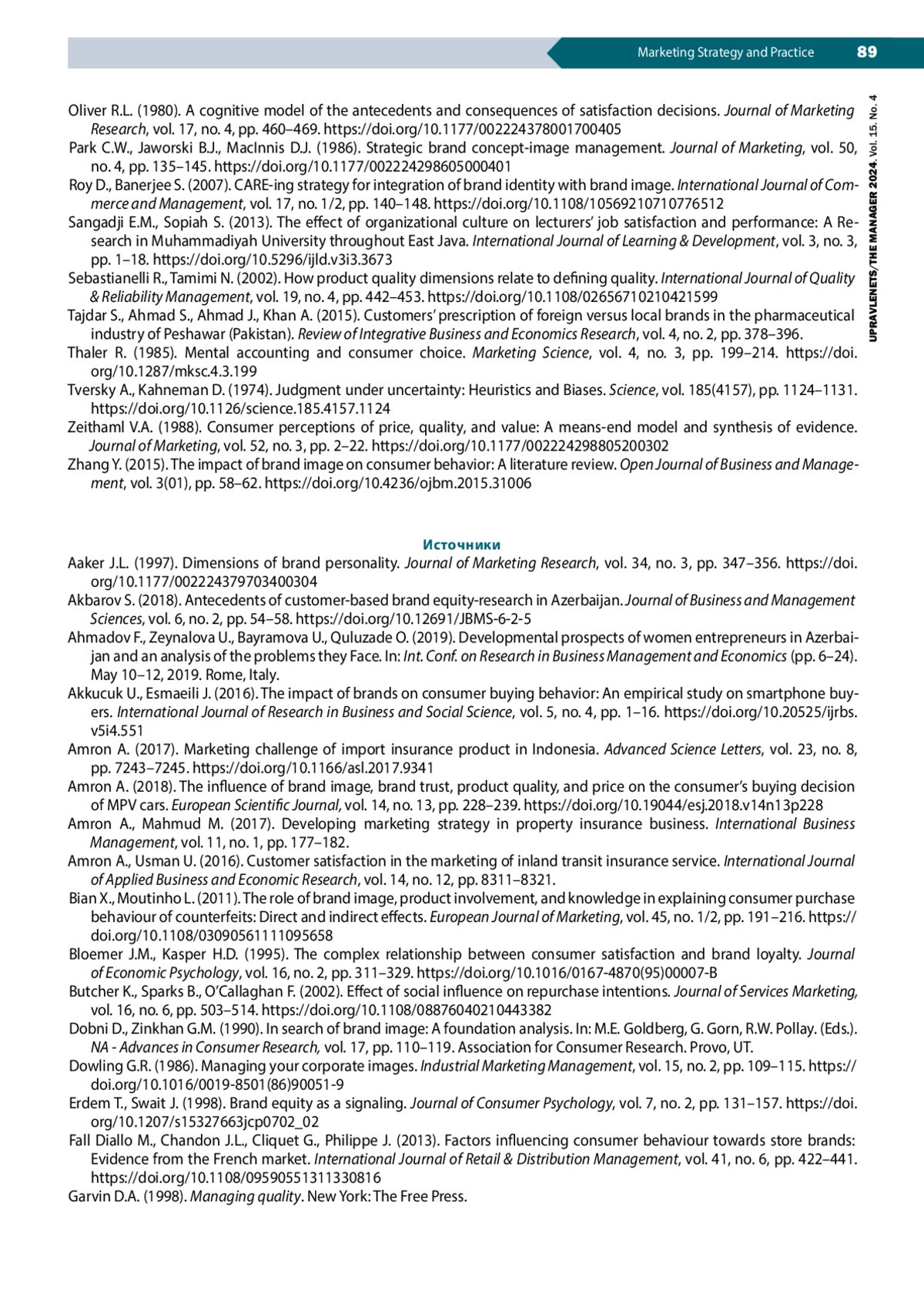
1. Aaker J.L. (1997). Dimensions of brand personality. Journal of Marketing Research, vol. 34, no. 3, pp. 347-356. DOI: 10.1177/002224379703400304 EDN: CORYRP
2. Akbarov S. (2018). Antecedents of customer-based brand equity-research in Azerbaijan. Journal of Business and Management Sciences, vol. 6, no. 2, pp. 54-58. DOI: 10.12691/JBMS-6-2-5
3. Ahmadov F., Zeynalova U., Bayramova U., Quluzade O. (2019). Developmental prospects of women entrepreneurs in Azerbaijan and an analysis of the problems they Face. In: Int. Conf. on Research in Business Management and Economics (pp. 6-24). May 10-12, 2019. Rome, Italy.
4. Akkucuk U., Esmaeili J. (2016). The impact of brands on consumer buying behavior: An empirical study on smartphone buyers. International Journal of Research in Business and Social Science, vol. 5, no. 4, pp. 1-16. DOI: 10.20525/ijrbs.v5i4.551
5. Amron A. (2017). Marketing challenge of import insurance product in Indonesia. Advanced Science Letters, vol. 23, no. 8, pp. 7243-7245. DOI: 10.1166/asl.2017.9341
6. Amron A. (2018). The influence of brand image, brand trust, product quality, and price on the consumer’s buying decision of MPV cars. European Scientific Journal, vol. 14, no. 13, pp. 228-239. DOI: 10.19044/esj.2018.v14n13p228
7. Amron A., Mahmud M. (2017). Developing marketing strategy in property insurance business. International Business Management, vol. 11, no. 1, pp. 177-182.
8. Amron A., Usman U. (2016). Customer satisfaction in the marketing of inland transit insurance service. International Journal of Applied Business and Economic Research, vol. 14, no. 12, pp. 8311-8321.
9. Bian X., Moutinho L. (2011). The role of brand image, product involvement, and knowledge in explaining consumer purchase behaviour of counterfeits: Direct and indirect effects. European Journal of Marketing, vol. 45, no. 1/2, pp. 191-216. DOI: 10.1108/03090561111095658
10. Bloemer J.M., Kasper H.D. (1995). The complex relationship between consumer satisfaction and brand loyalty. Journal of Economic Psychology, vol. 16, no. 2, pp. 311-329. DOI: 10.1016/0167-4870(95)00007-B
11. Butcher K., Sparks B., O’Callaghan F. (2002). Effect of social influence on repurchase intentions. Journal of Services Marketing, vol. 16, no. 6, pp. 503-514. DOI: 10.1108/08876040210443382 EDN: EAPNGT
12. Dobni D., Zinkhan G.M. (1990). In search of brand image: A foundation analysis. In: M.E. Goldberg, G. Gorn, R.W. Pollay. (Eds.). NA - Advances in Consumer Research, vol. 17, pp. 110-119. Association for Consumer Research. Provo, UT.
13. Dowling G.R. (1986). Managing your corporate images. Industrial Marketing Management, vol. 15, no. 2, pp. 109-115. DOI: 10.1016/0019-8501(86)90051-9
14. Erdem T., Swait J. (1998). Brand equity as a signaling. Journal of Consumer Psychology, vol. 7, no. 2, pp. 131-157. DOI: 10.1207/s15327663jcp0702_02
15. Fall Diallo M., Chandon J.L., Cliquet G., Philippe J. (2013). Factors influencing consumer behaviour towards store brands: Evidence from the French market. International Journal of Retail & Distribution Management, vol. 41, no. 6, pp. 422-441. DOI: 10.1108/09590551311330816
16. Garvin D.A. (1998). Managing quality. New York: The Free Press.
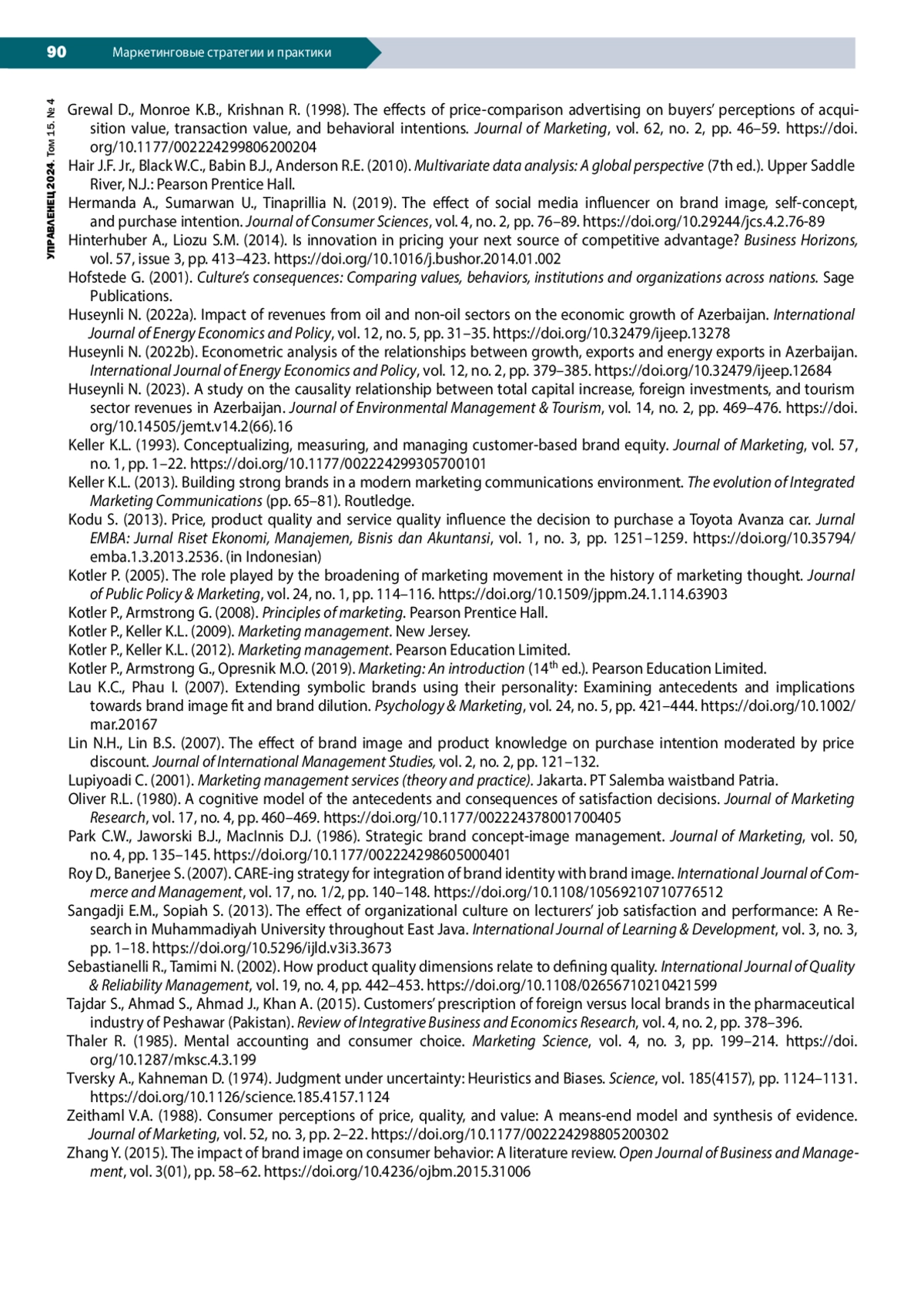
17. Grewal D., Monroe K.B., Krishnan R. (1998). The effects of price-comparison advertising on buyers’ perceptions of acquisition value, transaction value, and behavioral intentions. Journal of Marketing, vol. 62, no. 2, pp. 46-59. DOI: 10.1177/002224299806200204 EDN: ENZWDP
18. Hair J.F. Jr., Black W.C., Babin B.J., Anderson R.E. (2010). Multivariate data analysis: A global perspective (7th ed.). Upper Saddle River, N.J.: Pearson Prentice Hall.
19. Hermanda A., Sumarwan U., Tinaprillia N. (2019). The effect of social media influencer on brand image, self-concept, and purchase intention. Journal of Consumer Sciences, vol. 4, no. 2, pp. 76-89. DOI: 10.29244/jcs.4.2.76-89
20. Hinterhuber A., Liozu S.M. (2014). Is innovation in pricing your next source of competitive advantage? Business Horizons, vol. 57, issue 3, pp. 413-423. DOI: 10.1016/j.bushor.2014.01.002
21. Hofstede G. (2001). Culture’s consequences: Comparing values, behaviors, institutions and organizations across nations. Sage Publications.
22. Huseynli N. (2022a). Impact of revenues from oil and non-oil sectors on the economic growth of Azerbaijan. International Journal of Energy Economics and Policy, vol. 12, no. 5, pp. 31-35. DOI: 10.32479/ijeep.13278 EDN: WYGXZY
23. Huseynli N. (2022b). Econometric analysis of the relationships between growth, exports and energy exports in Azerbaijan.
24. International Journal of Energy Economics and Policy, vol. 12, no. 2, pp. 379-385. DOI: 10.32479/ijeep.12684
25. Huseynli N. (2023). A study on the causality relationship between total capital increase, foreign investments, and tourism sector revenues in Azerbaijan. Journal of Environmental Management & Tourism, vol. 14, no. 2, pp. 469-476. DOI: 10.14505/jemt.v14.2(66).16 EDN: MXLCVS
26. Keller K.L. (1993). Conceptualizing, measuring, and managing customer-based brand equity. Journal of Marketing, vol. 57, no. 1, pp. 1-22. DOI: 10.1177/002224299305700101 EDN: BNWBAR
27. Keller K.L. (2013). Building strong brands in a modern marketing communications environment. The evolution of Integrated Marketing Communications (pp. 65-81). Routledge.
28. Kodu S. (2013). Price, product quality and service quality influence the decision to purchase a Toyota Avanza car. Jurnal EMBA: Jurnal Riset Ekonomi, Manajemen, Bisnis dan Akuntansi, vol. 1, no. 3, pp. 1251-1259. 10.35794/emba.1.3.2013.2536. (in Indonesian). DOI: 10.35794/emba.1.3.2013.2536.(inIndonesian)
29. Kotler P. (2005). The role played by the broadening of marketing movement in the history of marketing thought. Journal of Public Policy & Marketing, vol. 24, no. 1, pp. 114-116. DOI: 10.1509/jppm.24.1.114.63903
30. Kotler P., Armstrong G. (2008). Principles of marketing. Pearson Prentice Hall. Kotler P., Keller K.L. (2009). Marketing management. New Jersey.
31. Kotler P., Keller K.L. (2012). Marketing management. Pearson Education Limited.
32. Kotler P., Armstrong G., Opresnik M.O. (2019). Marketing: An introduction (14th ed.). Pearson Education Limited.
33. Lau K.C., Phau I. (2007). Extending symbolic brands using their personality: Examining antecedents and implications towards brand image fit and brand dilution. Psychology & Marketing, vol. 24, no. 5, pp. 421-444. DOI: 10.1002/mar.20167
34. Lin N.H., Lin B.S. (2007). The effect of brand image and product knowledge on purchase intention moderated by price discount. Journal of International Management Studies, vol. 2, no. 2, pp. 121-132.
35. Lupiyoadi C. (2001). Marketing management services (theory and practice). Jakarta. PT Salemba waistband Patria.
36. Oliver R.L. (1980). A cognitive model of the antecedents and consequences of satisfaction decisions. Journal of Marketing Research, vol. 17, no. 4, pp. 460-469. DOI: 10.1177/002224378001700405
37. Park C.W., Jaworski B.J., MacInnis D.J. (1986). Strategic brand concept-image management. Journal of Marketing, vol. 50, no. 4, pp. 135-145. DOI: 10.1177/002224298605000401
38. Roy D., Banerjee S. (2007). CARE-ing strategy for integration of brand identity with brand image. International Journal of Commerce and Management, vol. 17, no. 1/2, pp. 140-148. DOI: 10.1108/10569210710776512
39. Sangadji E.M., Sopiah S. (2013). The effect of organizational culture on lecturers’ job satisfaction and performance: A Research in Muhammadiyah University throughout East Java. International Journal of Learning & Development, vol. 3, no. 3, pp. 1-18. DOI: 10.5296/ijld.v3i3.3673
40. Sebastianelli R., Tamimi N. (2002). How product quality dimensions relate to defining quality. International Journal of Quality & Reliability Management, vol. 19, no. 4, pp. 442-453. DOI: 10.1108/02656710210421599 EDN: EAOYHD
41. Tajdar S., Ahmad S., Ahmad J., Khan A. (2015). Customers’ prescription of foreign versus local brands in the pharmaceutical industry of Peshawar (Pakistan). Review of Integrative Business and Economics Research, vol. 4, no. 2, pp. 378-396.
42. Thaler R. (1985). Mental accounting and consumer choice. Marketing Science, vol. 4, no. 3, pp. 199-214. DOI: 10.1287/mksc.4.3.199
43. Tversky A., Kahneman D. (1974). Judgment under uncertainty: Heuristics and Biases. Science, vol. 185(4157), pp. 1124-1131. DOI: 10.1126/science.185.4157.1124
44. Zeithaml V.A. (1988). Consumer perceptions of price, quality, and value: A means-end model and synthesis of evidence. Journal of Marketing, vol. 52, no. 3, pp. 2-22. DOI: 10.1177/002224298805200302
45. Zhang Y. (2015). The impact of brand image on consumer behavior: A literature review. Open Journal of Business and Management, vol. 3(01), pp. 58-62. DOI: 10.4236/ojbm.2015.31006