
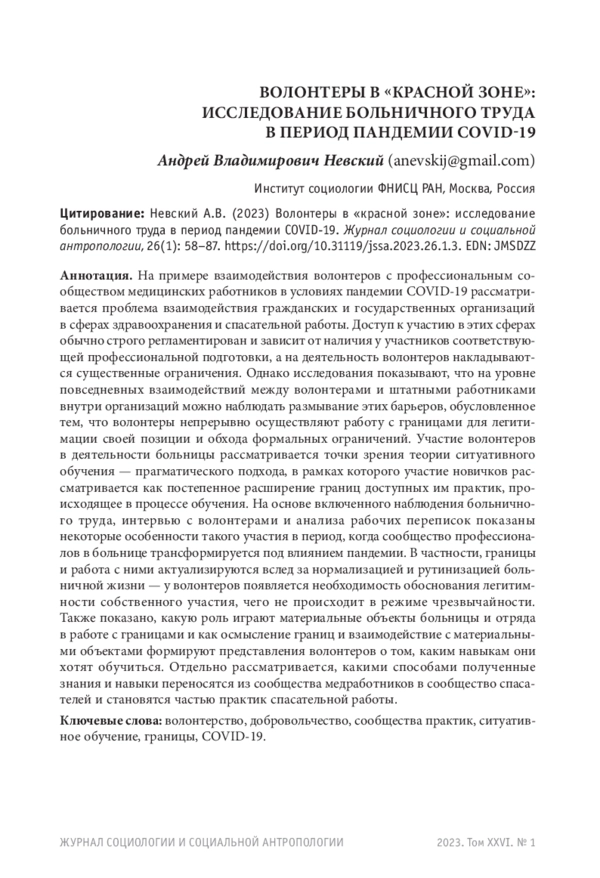
На примере взаимодействия волонтеров с профессиональным сообществом медицинских работников в условиях пандемии COVID-19 рассматривается проблема взаимодействия гражданских и государственных организаций в сферах здравоохранения и спасательной работы. Доступ к участию в этих сферах обычно строго регламентирован и зависит от наличия у участников соответствующей профессиональной подготовки, а на деятельность волонтеров накладываются существенные ограничения. Однако исследования показывают, что на уровне повседневных взаимодействий между волонтерами и штатными работниками внутри организаций можно наблюдать размывание этих барьеров, обусловленное тем, что волонтеры непрерывно осуществляют работу с границами для легитимации своей позиции и обхода формальных ограничений. Участие волонтеров в деятельности больницы рассматривается точки зрения теории ситуативного обучения - прагматического подхода, в рамках которого участие новичков рассматривается как постепенное расширение границ доступных им практик, происходящее в процессе обучения. На основе включенного наблюдения больничного труда, интервью с волонтерами и анализа рабочих переписок показаны некоторые особенности такого участия в период, когда сообщество профессионалов в больнице трансформируется под влиянием пандемии. В частности, границы и работа с ними актуализируются вслед за нормализацией и рутинизацией больничной жизни - у волонтеров появляется необходимость обоснования легитимности собственного участия, чего не происходит в режиме чрезвычайности. Также показано, какую роль играют материальные объекты больницы и отряда в работе с границами и как осмысление границ и взаимодействие с материальными объектами формируют представления волонтеров о том, каким навыкам они хотят обучиться. Отдельно рассматривается, какими способами полученные знания и навыки переносятся из сообщества медработников в сообщество спасателей и становятся частью практик спасательной работы.
Идентификаторы и классификаторы
Рассматриваемый случай является одним из этапов длительного этнографического исследования волонтерского поисково-спасательного отряда, действующего в одном из регионов России (далее — отряд). Отряд представляет собой некоммерческую организацию, насчитывающую около двухсот активных членов, и некоторое количество волонтеров, привлекаемых для проведения отдельных спасательных работ. Спектр таких работ достаточно широк.
Если у вас возникли вопросы или появились предложения по содержанию статьи, пожалуйста, направляйте их в рамках данной темы.
Список литературы
- Вятчина М.В. (2022) О больничной этнографии и возрастающем пациентском неравенстве. Антропологический форум, 52: 27-31.
- Клепикова А.А. (2011) Добровольцы благотворительной организации в государственном учреждении для людей с тяжелой инвалидностью: конструкты волонтерства и профессионализма. Журнал исследований социальной политики, 9(3): 391-416. EDN: OIVULF
- Невский А.В. (2018) Добровольные спасатели в системе ликвидации ЧС в России: к вопросу о взаимодействии гражданских организаций и государства. Власть и элиты, 5: 562-589. EDN: PMIKVI
- Allen D. (1997) The nursing-medical boundary: a negotiated order? Sociology of Health and Illness, 19(4): 498-520.
- Alvesson M. (2002) Understanding organizational culture. L.; Thousand Oaks, CA: Sage.
- Anderson J., Reder L.M., Simon H.A. (1996) Situated learning and education. Educational Researcher, 25(4): 5-11. EDN: JROWEN
- Anderson L. (2006) Analytic Autoethnography. Journal of Contemporary Ethnography, 35(4): 373-395. EDN: JNEBXT
- Barnley S. (1986) Technology as an Occasion for Structuring: Evidence from Observations of CT Scanners and the Social Order of Radiology Departments. Administrative Science Quarterly, 31(1): 78-108.
- Beer D. (2017) The social power of algorithms. Information, Communication & Society, 20(1): 1-13.
-
Brooks J., Gurgulis I., Cook H. Rethinking Situated Learning: Participation and Communities of Practice in the UK Fire and Rescue Service. Work, Employment and Society,00(0): 1-17. -
Brown J. S., Duguid P. (1991) Organizational Learning and Communitiesof-Practice: Toward a Unified View of Working, Learning, and Innovation. Organization Science, 1(2): 47-56. -
Cobb P., Bowers J. (1999) Cognitive and Situated Learning Perspectives in Theory and Practice. Educational Researcher, 28(2): 4-15. EDN: JRPADF -
Collin K. Sintonen T., Paloniemi S., Auvinen T. (2011) Work, power and learning in a risk filled occupation. Management Learning, 42(3): 301-318. -
Contu A. (2014) On boundaries and difference: Communities of practice and power relations in creative work. Management Learning, 45(3): 289-316. -
Contu A., Willmott H. (2003) Re-Embedding Situatedness: The Importance of Power Relations in Learning Theory. Organization Science, 14(3): 283-296. EDN: DWIXTR -
Cook N., Yanow D. (1993) Culture and Organizational Learning. Journal of Management Inquiry, 4(2): 372-390. -
Cox A. (2005) What are communities of practice? A comparative review of four seminal works. Journal of Information Science, 31(6): 527-540. EDN: JNNGTJ -
Creswell J. W., Poth C. (2018) Qualitative Inquiry and Research Design. Choosing Among Five Approaches. Fourth Edition. L.; Thousand Oaks, CA: Sage. -
Dagyaran I. et al. (2021) Like Soldiers on the Front. A Qualitative Study Understanding the Frontline Healthcare Professionals' Experience of Treating and Caring for Patients with COVID-19. BMC Health Services Research, 21: 1-10. -
DiMaggio P., Powell W. (1983) The Iron Cage Revisited: Institutional Isomorphism and Collective Rationality in Organizational Fields. American Sociological Review, 48(2): 147-160. -
Duguid F., Mündel K., Schugurensky D. (2013) Volunteer Work and Informal Learning: A Conceptual Discussion. In: Duguid, F., Mündel K., Schugurensky D. (eds.) Volunteer Work, Informal Learning and Social Action. Rotterdam: Sense Publishers: 17-36. -
Fox J. (2006) "Notice How You Feel": An Alternative to Detached Concern Among Hospice Volunteers. Qualitative Health Research, 16(7): 944-961. -
Fox S. (2000) Communities of Practice, Foucault and Actor-Network Theory. Journal of Management Studies, 37(6): 853-868. EDN: EQBOKH -
Goodwin D., Pope C., Mort M., Smith A. (2005) Access, boundaries and their effects: legitimate participation in anaesthesia. Sociology of Health and Illness, 27(6): 855-71. -
Handley K., A Sturdy A., Fincham R., Clark T. (2006) Within and Beyond Communities of Practice: Making Sense of Learning Through Participation, Identity and Practice. Journal of Management Studies, 43(3): 641-653. -
Hustinx L., Handy F., Cnaan R., Brudney J., Pessi A., Yamauchi N. (2010) Social and Cultural Origins of Motivations to Volunteer: A Comparison of University Students in Six Countries.International Sociology, 25(3): 349-82. -
Hustinx L., Lammertyn F. (2003) Collective and Reflexive Styles of Volunteering. Voluntas: International Journal of Voluntary and Nonprofit Organizations, 14(2): 167-87. EDN: EQNOEB -
Johnston T., Acker J. (2016) Using a sociological approach to answering questions about paramedic professionalism and identity. Australasian Journal of Paramedicine 13(1): 1-8. -
Kulmala M. (2011) Russian State and Civil Society in Interaction: An Ethnographic Approach. Laboratorium, 3(1): 51-83. EDN: NXVMSH -
Lamont, M., Molnar V. (2002) The Study of Boundaries in the Social Sciences. Annual Review of Sociology, 28: 167-95. EDN: HEYMQL -
Lave J., Wenger E. (1991) Situated Learning. Legitimate Peripheral Participation. Cambridge: Cambridge University Press. -
March J. G., Olsen J. P. (1975) The Uncertainty of the Past: Organizational Learning Under Ambiguity. European Journal of Political Research, 3(2): 1947-1971. -
Mauss M. (1973) Techniques of the body. Economy and Society, 2(1): 70-88. -
Mellow M. (2007) Hospital Volunteers and Carework. Canadian Review of Sociology, 44(4): 451-467. -
Nicolini D. (2012) Practice Theory, Work and Organization. Oxford: Oxford University Press. -
Peterson A. L. (2014) A case for the use of autoethnography in nursing research. Journal of Advanced Nursing, 71(1): 226-233. -
Roberts J. (2006) Limits to Communities of Practice. Journal of Management Studies, 43(3): 623-639. -
Romano Jr., N., Donovan C., Chen H., Nunamaker Jr. J. (2003) A Methodology for Analyzing Web-Based Qualitative Data. Journal of Management Information Systems, 19(4): 213-246. EDN: DVTLJT -
Roose J. (2016) Social Movements and Neo-Institutionalism: A Fruitful Merger? In: Roose J. Dietz H. (eds.) Social Theory and Social Movements. Mutual Inspirations. Wiesbaden: Springer VS: 113-135. -
Scott W.R. (2014) Institutions and Organizations: Ideas, Interests and Identities. 4th edition. N.Y.: Sage. -
Serrano Velarde K. (2020) Informal learning in formal organizations: The case of volunteer learning in the hospital. Current Sociology, 68(4): 572-591. EDN: WAKTRX -
Smith E. (2003). Ethos, Habitus and Situation for Learning: an ecology. British Journal of Sociology of Education, 24(4): 463-470. -
Star S. L. (2010) This is Not a Boundary Object: Reflections on the Origin of a Concept. Science, Technology, & Human Values, 35(5): 601-617. -
Star S., Griesemer J. (1989) Institutional Ecology, ‘Translations' and Boundary Objects: Amateurs and Professionals in Berkeley's Museum of Vertebrate Zoology, 1907-39. Social Studies of Science, 19(3): 387-420. EDN: JPZJHT -
Stein L.I. (1967) The doctor-nurse game. Archives of General Psychiatry, 16: 699-703. -
Wenger E. (1998) Communities of Practice: Learning, Meaning, and Identity. Cambridge: Cambridge University Press. -
Wenger-Trayner E., Wenger-Trayner B. (2015) Learning in a Landscape of Practice: A Framework. In: Wenger-Trayner E., Fenton-O'Creevy M., Hutchinson S., Kubiak C. Wenger-Trayner B. (eds). Learning in Landscapes of Practice: Boundaries, Identity, and Knowledgeability in Practice-Based Learning. N.Y.: Routledge: 13-29. -
Wilson J., Musick M. (1997) Who Cares? Toward an Integrated Theory of Volunteer Work. American Sociological Review, 62(5): 694-713. EDN: HEZFOJ
Выпуск
Другие статьи выпуска
Книга не из последних новинок, но заслуживает внимания социологов. Для описания отношений Китая с западным миром широко используется теория «обмана». Суть ее состоит в том, что, несмотря на обильные инвестиции Запада, Китай как был, так и остался самобытной страной со своими ценностями и малопонятной западному человеку духовной культурой. Особенно это проявляется в положении женщины, которая дома может быть полновластной хозяйкой (при условии, что она доказала способность к материнству), но занимает скромное место в публичном пространстве.
В Социологическом институте РАН — филиале ФНИСЦ РАН 18 ноября 2022 г. состоялась конференция «Продленная взрослость / отложенное старение во времена постковида и неопределенности». Уникальной ее особенностью стала концентрация исследований на заявленной теме, а также вокруг трансформаций политики активного долголетия, развития региональных политик, интеграции пожилых людей в различные виды активностей и социальную жизнь.
Практики стихийного туризма остаются белым пятном в современных исследованиях рекреации. В то же время пригородные лесные массивы являются точкой притяжения, рекреационным магнитом для жителей больших городов, ориентированных на пассивный стихийный туризм. Данная работа направлена на исследование поведенческого аспекта формирования ценности места обитателей туристических стоянок как основы для возникновения у них чувства места. Описан механизм преобразования унифицированного лесного ландшафта в уникальное (ценное) место через конструирование и воспроизводство практик пользования туристическими стоянками и прав собственности на них. Информационную базу составили материалы кейс-стади, реализованного в течение летних полевых сезонов 2021 и 2022 гг. на территории Караканского бора Новосибирской области. В ходе экспедиции выборочно исследовано 30 км береговой линии Обского водохранилища, сплошное обследование реализовано на 12 км непрерывной береговой линии северной части Караканского бора. Выявлены туристические сообщества, береговой стаж которых насчитывает 30-40 лет и которые включают в себя уже третье поколение отдыхающих. Предложена типология туристов по степени их укорененности, «врастания» в ландшафт, т.е. длительности и регулярности пребывания, а также степени преобразования этого ландшафта. Рассмотрены практики выбора и освоения места, определяющие, как место становится своим, как оно удерживается и затем передается следующим пользователям. Несмотря на неформальный характер отношений собственности и необходимость постоянного их подтверждения, основные компоненты права собственности (право изменять форму и содержание блага и право передавать другим лицам) осуществляются подавляющим большинством пользователей. При всей вариативности практик места экологические практики являются неоспоримым основанием для присвоения пространства туристической стоянки. Отсутствие мусора - видимый и социально поддерживаемый индикатор реализации практик благоустройства, т.е. вложения в место, инвестиций в его рекреационный потенциал.
Анализируется социальная активность и участие пожилых людей в контексте активного долголетия. Исследовательская задача состояла в реконструкции репертуара социальной активности/участия современных пожилых россиян и тех смыслов, которые они вкладывают в эту активность, и ответе на вопрос о том, как эта активность вписывается в концепцию активного старения (долголетия). В анализе мы делали акцент на практиках и приписываемых им значениях и смыслах среди двух возрастных групп информантов. Полученные результаты сопоставляли с индексом активного долголетия (ИАД) как наиболее популярным инструментом для определения активности пожилых. Эмпирическую базу составили 28 глубинных интервью с людьми старше 60 лет. Данные нашего исследования демонстрируют гораздо более богатый репертуар социальной активности и участия пожилых, нежели тот, который предполагается учитывать в рамках ИАД. При этом существенных различий в формах активности между работающими и неработающими пожилыми в возрасте 60-75 лет не обнаружено. На репертуар активности влияет возраст - после 75 форм активности становится меньше, и она дрейфует в сторону приватной жизни (семья, забота о внуках и родственниках) и дачных забот, оставляя ностальгию взамен утраченных возможностей. Пожилые 75+ не стараются вернуть прежние активности, а, наоборот, стремятся к рутинизированной повседневности и вовлечению в семейные дела, а также к повседневным делам и хобби, которые позволяют чувствовать вовлеченность в социальную жизнь. Отсрочка старения в группе 60+ связана с сохранением активности на уровне среднего возраста и замещением утраченных активностей в случае окончания трудовой деятельности. Предписанность и формализованность способов оценки активности (в частности, ИАД) не учитывает реально существующий широкий репертуар социальной активности и участия пожилых, а также не позволяет реконструировать индивидуальные смыслы и значения активности и связать это с общей удовлетворенностью жизнью.
Проблема активизации потенциала молодежи в развитии территорий, перехода ее скрытых ресурсов (возможностей) в актуальное состояние движущей силы социальных преобразований на региональном уровне представляет особую актуальность в общественном и научном дискурсе. С позиции деятельностно-активистской парадигмы молодежь рассматривается как значимый субъект территориального развития посредством ее вовлеченности в разнообразные практики гражданского участия. Цель - выявление возможностей и ограничений гражданского участия молодежи в развитии территорий. Определено, что в российском обществе создается благоприятная институциональная среда гражданского участия молодежи, однако отмечаются проблемы в реализации молодежной политики в части активизации молодежного ресурса как на национальном, так и на региональном уровне. На основе методологии количественной социологии (авторами разработан инструментарий социологического опроса, который апробирован на территории Вологодской области в 2021 г., N=1900) выявлено, что молодежь в большей степени, чем население региона в целом, демонстрирует готовность к участию, но реже включена в реальные практики общественно полезной деятельности. Получен вывод, что как политическое (при вертикальном взаимодействии с властью), так и социальное участие молодежи (в пространстве повседневности) реализуется в первую очередь в неформальных (одномоментных или спонтанных) практиках. Определено, что демотивирующие причины вовлеченности молодежи в практики гражданского участия в региональном пространстве отличаются разнообразием - от институциональных до социальных и психологических. На примере МБУ «Молодежный центр “ГОР.СОМ35”» (г. Вологда), показано, что молодежный центр - это комплексная структура или новая модель «общественно-государственного партнерства», создающая условия для развития гражданского участия молодежи в регионе. Представленные материалы могут лечь в основу социологической диагностики уровня, потенциала, барьеров вовлеченности молодежи в общественно полезную деятельность с целью дальнейшего развития приоритетов молодежной региональной политики, эффективного выстраивания работы молодежных организаций.
Соседство понимается как социальное явление, где пространственная близость имеет принципиальное значение, однако в современных исследованиях феномена акцент, скорее, делается на качестве соседских связей, в то время как пространство и время соседских коммуникаций нередко уходят на второй план. В фокусе статьи - современное российское соседство в пространственно-временной перспективе. Исследование фокусировалось на анализе микроуровня явления - на соседских практиках и рутинных взаимодействиях, и с этой целью введено понятие «соседствование». Основные исследовательские вопросы - где и когда происходят взаимодействия соседей в современных российских мегаполисах и как пространство и время проявляют себя в соседстве? Эта точка входа позволяет увидеть многослойность и процессуальность явления, а также зафиксировать значимые характеристики современного соседства, среди которых дистанцированность, мимолетность и краткосрочность, ситуативность, управляемость и др. Пространство соседствования рассматривается с точки зрения мест взаимодействия соседей между собой, границ и масштабов. Время в соседстве анализируется через множественность темпоральностей и ритмов соседства, стаж проживания, а также флуктуации соседских отношений. Исследование позволило выявить места соседских коммуникаций, зафиксировать множественность и значение границ в соседстве. Вводятся понятия дальнего и ближнего соседства, которые связаны не столько с дистанцией и масштабами, сколько с качеством соседских связей. Дальнее соседство базируется на локальной идентичности и классовой близости, а ближнее - на общей / поделенной материальности и совместности. Важнейшая социальная дифференциация в соседстве определяется стажем проживания и разделением на «старичков» и «новичков». Интенсивность соседствования и изменения соседских сценариев изменяются с течением времени. Статья основана на исследовании, которое проводилось в 2018-2019 гг. в Санкт-Петербурге. Основными материалами стали лейтмотивные интервью с жителями города об их опыте быть соседями (всего 17 интервью), дневники общения с соседями (12 дневников) и автоэтнографии.
Положившая начало обширному исследовательскому полю эмоционального труда книга А.Р. Хокшилд «Управляемое сердце» теперь переведена на русский язык, но многие важнейшие аспекты книги еще ждут осмысления. К одному из таких аспектов относится вопрос о том, как связаны отчуждение и эмоциональный труд. Хокшилд рассматривает отчужденность работника от своих чувств и своего Я в процессе выполнения эмоционального труда в сервисной сфере. Целью статьи выступает не только анализ использования Хокшилд концепции отчуждения, но и прежде всего поиск ответа на вопрос, почему это понятие сохраняет свою актуальность для современных исследователей эмоционального труда. С точки зрения автора статьи, Хокшилд использует марксистское понятие отчуждения, чтобы придать интеракционистскому подходу к управлению эмоциями критический потенциал и связать трудовые процессы на микроуровне и, в частности, субъективный опыт работника с макропроцессами и структурами. Это позволяет Хокшилд и ее последователям анализировать неравенство, ролевые напряжения, конфликты и психологические проблемы работников. Марксистский стиль рассуждений Хокшилд важен для характеристики обширной классовой прослойки - работников сферы обслуживания, использование эмоциональности которых служит максимизации экономической прибыли. Однако, как показали исследователи эмоционального труда, не все виды управления эмоциями могут быть отчуждающими и иметь негативные социальные и психологические последствия. Таким образом, понятие эмоционального труда является амбивалентным в смысле своих последствий, но остается эвристическим для исследования трудовых отношений и в новых социальных реалиях, в контексте пандемии и цифровизации общества.
Мотивация трудовой деятельности представляет собой сложно-организованную систему, которая не сводится к отношению актора к конкретной работе в конкретной организации. В ней синхронизируются отношение к труду как целенаправленной деятельности, отношение к своей профессии, отношение актора к конкретной работе. Различные уровни обобщения, восхождение от конкретно-видового к общеродовому (генерализация) отношению к труду, находясь в тесном взаимодействии, в то же время обладают автономностью и относительной независимостью. Основные теоретические идеи прошли эмпирическое тестирование в процессе регрессионного анализа данных, собранных в результате онлайн-опроса. Они свидетельствуют, что в условиях перехода от индустриального к постиндустриальному обществу роль ведущих факторов успешной трудовой деятельности постепенно приобретают приверженность профессии и ориентированность работника на самореализацию и профессиональное развитие.
Статья посвящена социально-эпистемологическому исследованию понятия цивилизации. Логика развития данного понятия реконструируется с учетом взаимообратимой зависимости между ростом методологического сознания науки и изменением культурно-исторического контекста реализации соответствующих социальных идей, культурных универсалий. Показано, что генезис рассматриваемого понятия является следствием эволюции идей, которые не просто выражают соответствующие теоретико-методологические, социокультурные преобразования,но и сами влияют на развитие культуры и общества. Большой интерес для автора представляет обусловленность различных моделей цивилизационного анализа, во-первых, принципами научной рациональности и, во-вторых, вырастающими на основе подобных принципов (в условиях доминирования научной картины мира) парадигмами социального мышления и деятельности. Это позволяет делать социально-эпистемологические выводы о современных возможностях и перспективах развития цивилизационного подхода с учетом преобладающих сегодня тенденций развития методологической культуры мышления, с одной стороны, и реалий культурно-исторического процесса - с другой.
Статистика статьи
Статистика просмотров за 2025 - 2026 год.
Издательство
- Издательство
- ФНИСЦ РАН
- Регион
- Россия, Москва
- Почтовый адрес
- 117218, г. Москва, ул. Кржижановского, д. 24/35, к. 5
- Юр. адрес
- 117218, г. Москва, ул. Кржижановского, д. 24/35, к. 5
- ФИО
- Черныш Михаил Федорович (Директор)
- E-mail адрес
- fnisc@fnisc.ru
- Контактный телефон
- +8 (499) 1250079
- Сайт
- https://www.fnisc.ru