

A technique for transforming pixel images to form a new type of structures – named filamentous, or thread-like, by the author – possessing the property of revealing significant features of the transformed objects, has been developed. A program in Python using the OpenCV computer vision module and the Numpy data array module, allowing for efficient processing of original pixel images and visualization of filamentous mappings formed on their basis, has also been developed. Both the principles of the developed method and the main actions performed during the execution of the program code are described. The created program is distinguished by ease of use and the ability to adjust the thread placement step. Based on the results of experiments on processing a large number of heterogeneous images and analyzing the obtained results, conclusions have been drawn and recommendations have been given regarding the prospects for applying filamentous structures in various fields of science and art. Particular attention is paid to the transformation of fractal images widespread in nature. The potential convenience of using the developed thread-like structures for improving the procedures of recognizing fuzzy images (including those using neural networks), for example, obtained from satellites, is also considered.
The following goals were set within the scientific work: to create a method, an
algorithm and a program for compression of raster (pixel) graphic information using special
mathematical methods, or affine transformations. The main task was to provide a high degree of image compression with a minimum deterioration of image quality. An original method for replacing a large number of pixel blocks in the source image by a relatively small number of the most suitable specially created domain blocks was developed. Affine transformation consists in moving any domain block from a set to any part of the image, while ensuring maximum similarity of source and domain blocks.
To implement the method, an algorithm and a program in the modern and popular Python language have been developed. We have considered the example of image transformation in grayscale of 256x256 pixels using domain blocks created from 4x4 pixel image areas. The result is an image visually indistinguishable from the original image, which requires only 0.3125 of the original information to describe. Calculations were also performed with a smaller number of domain blocks.
The developed method and program proved a high degree of compression of bitmap images with preservation of their quality. It is possible to further improve the described algorithm and the program presented on the author’s site by simultaneous application of different types of affine transformations.
It is shown that the same method can be used not only for image processing, but also for the detection of similarity (fractal properties) in any flow of information.
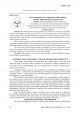
The three-dimensional representation of the solution for the ordinary differential equations system (ODE) describing convective flow is a Lorentz attractor. This system of equations is the basic deterministic system with which the development of chaos theory began. In order to derive the characteristics of this complex system, the development of a modern accessible and easy to use software product is necessary.
The aim of the work was to create a program for investigating the Lorentz attractor in Python using special command libraries. Particular attention is paid to ways of solving the system of ordinary differential equations by different numerical methods and to the clarity of the presented results.
The code blocks of the developed software are described; it is used to calculate the Lorentz attractor by varying the numerical methods for solving the ordinary differential equations and system parameters. Conclusions are drawn from the results of the calculation.