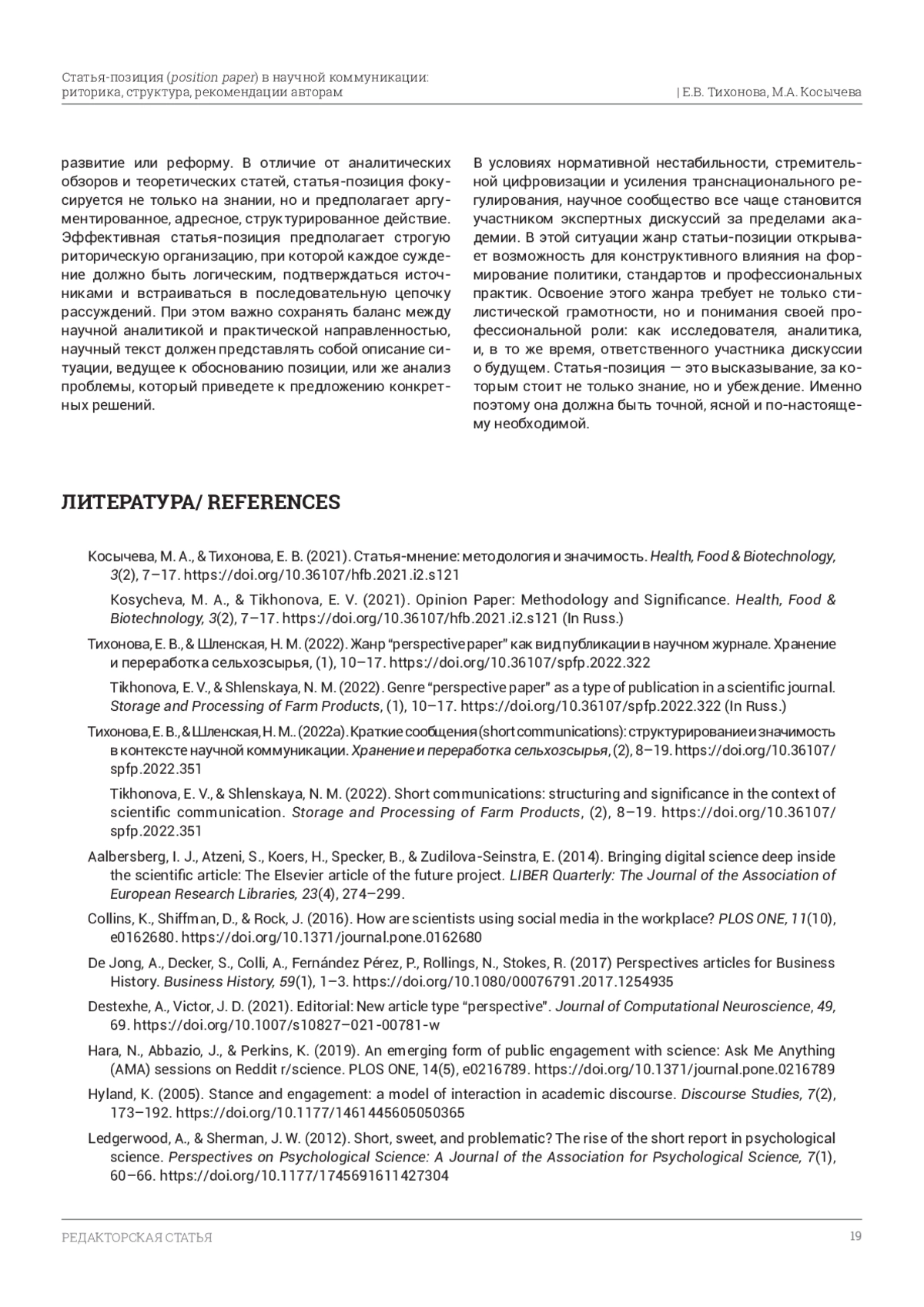
1. Косычева, М. А., & Тихонова, Е. В. (2021). Статья-мнение: методология и значимость. Health, Food & Biotechnology, 3(2), 7-17. DOI: 10.36107/hfb.2021.i2.s121 EDN: YVHSIG
2. Тихонова, Е. В., & Шленская, Н. М. (2022). Жанр “perspective paper” как вид публикации в научном журнале. Хранение и переработка сельхозсырья, (1), 10-17. DOI: 10.36107/spfp.2022.322 EDN: JFUDMD
3. Тихонова, Е. В., & Шленская, Н. М.. (2022a). Краткие сообщения (short communications): структурирование и значимость в контексте научной коммуникации. Хранение и переработка сельхозсырья, (2), 8-19. DOI: 10.36107/spfp.2022.351 EDN: PFNCXA
4. Aalbersberg, I. J., Atzeni, S., Koers, H., Specker, B., & Zudilova-Seinstra, E. (2014). Bringing digital science deep inside the scientific article: The Elsevier article of the future project. LIBER Quarterly: The Journal of the Association of European Research Libraries, 23(4), 274-299.
5. Collins, K., Shiffman, D., & Rock, J. (2016). How are scientists using social media in the workplace? PLOS ONE, 11(10), e0162680. DOI: 10.1371/journal.pone.0162680
6. De Jong, A., Decker, S., Colli, A., Fernández Pérez, P., Rollings, N., Stokes, R. (2017) Perspectives articles for Business History. Business History, 59(1), 1-3. DOI: 10.1080/00076791.2017.1254935
7. Destexhe, A., Victor, J. D. (2021). Editorial: New article type “perspective”. Journal of Computational Neuroscience, 49, 69. DOI: 10.1007/s10827-021-00781-w EDN: TFGZOT
8. Hyland, K. (2005). Stance and engagement: a model of interaction in academic discourse. Discourse Studies, 7(2), 173-192. DOI: 10.1177/1461445605050365
9. Ledgerwood, A., & Sherman, J. W. (2012). Short, sweet, and problematic? The rise of the short report in psychological science. Perspectives on Psychological Science: A Journal of the Association for Psychological Science, 7(1), 60-66. DOI: 10.1177/1745691611427304
10. Mukherjee, B. (2010). Changing scenario of scholarly communication: Journals, e-journals and open access journals. Scholarly Communication in Library and Information Services, 1-37. DOI: 10.1016/b978-1-84334-626-5.50001-x
11. National Model United Nations (NMUN) (2021). Position paper guide.
12. Osman, W. (2018). Hyland’s model of argument in ESL writers essay. In 15th Asia TEFL and 64th TEFLIN International Conference on English Language Teaching (pp. 1-15).
13. Pérez-Llantada, C. (2021). Genres and languages in science communication: The multiple dimensions of the sciencepolicy interface. Language & Communication, 78, 65-76. DOI: 10.1016/j.langcom.2021.02.004 EDN: MYNDGU
14. Piwowar, H. (2013). Value all research products. Nature, 493(7431), 159-159. DOI: 10.1038/493159a
15. Söderström, B. (2013). Perspective articles and special issues in AMBIO. AMBIO, 42, 1-2. DOI: 10.1007/s13280-012-0364-4
16. Swales, J. M. (1990). Genre analysis: English in academic and research settings. Cambridge: Cambridge University Press.
17. Swales, J. M. (2004). Research genres: Explorations and applications. Cambridge University Press.
18. Toulmin, S. (2003). The Uses of Argument (Updated ed.). Cambridge University Press.
19. Hara, N., Abbazio, J., & Perkins, K. (2019). An emerging form of public engagement with science: Ask Me Anything (AMA) sessions on Reddit r/science. PLOS ONE, 14(5), e0216789. DOI: 10.1371/journal.pone.0216789