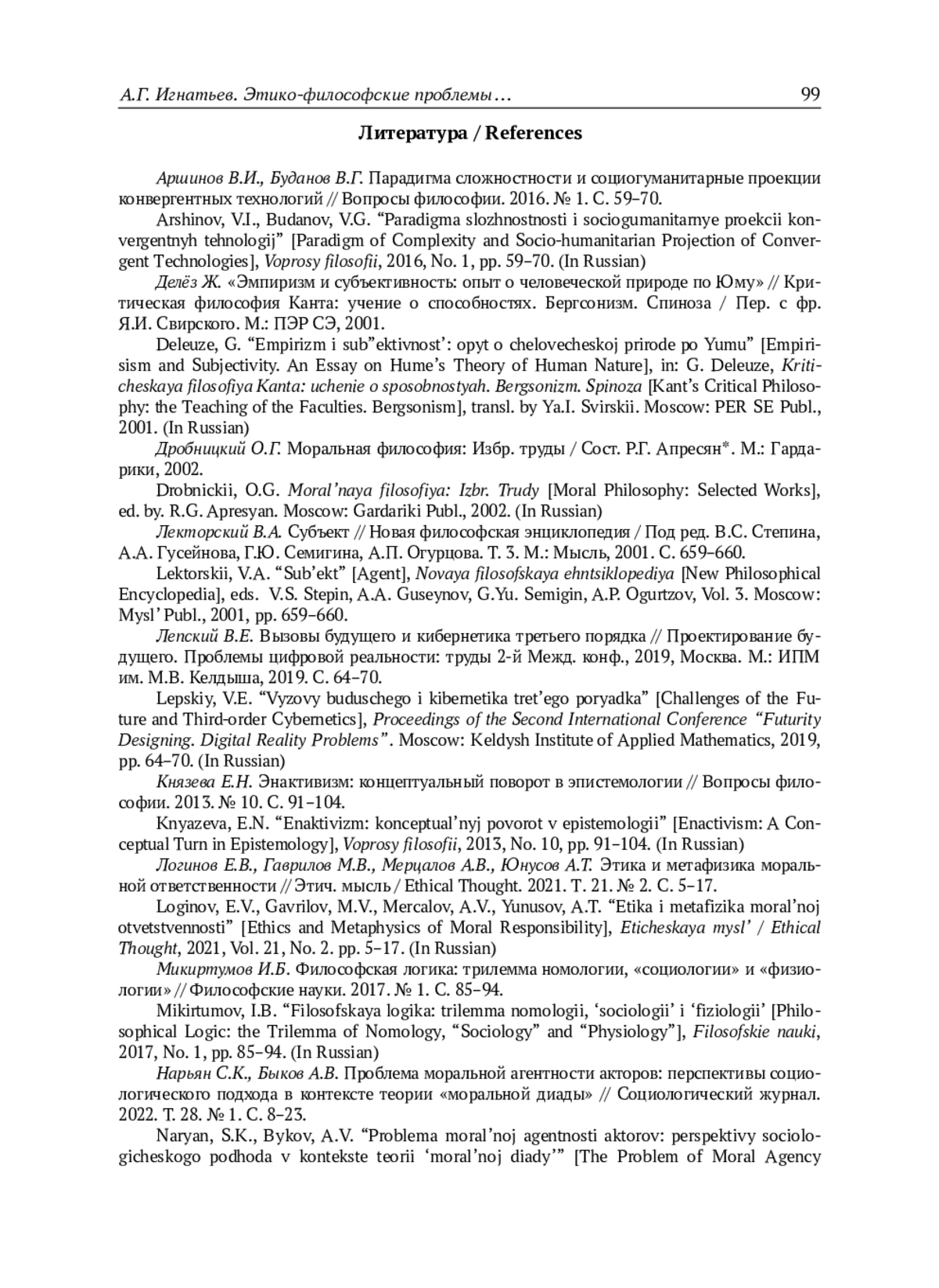
1. Аршинов В.И., Буданов В.Г. Парадигма сложностности и социогуманитарные проекции конвергентных технологий // Вопросы философии. 2016. № 1. C. 59-70.
2. Arshinov, V.I., Budanov, V.G. “Paradigma slozhnostnosti i sociogumanitarnye proekcii kon-vergentnyh tehnologij” [Paradigm of Complexity and Socio-humanitarian Projection of Conver-gent Technologies], Voprosy filosofii, 2016, No. 1, pp. 59-70. (In Russian). EDN: VSASIT
3. Делёз Ж. “Эмпиризм и субъективность: опыт о человеческой природе по Юму” // Кри-тическая философия Канта: учение о способностях. Бергсонизм. Спиноза / Пер. с фр. Я.И. Свирского. М.: ПЭР СЭ, 2001.
4. Deleuze, G. “Empirizm i sub”ektivnost’: opyt o chelovecheskoj prirode po Yumu“ [Empiri-sism and Subjectivity. An Essay on Hume’s Theory of Human Nature], in: G. Deleuze, Kriti-cheskaya filosofiya Kanta: uchenie o sposobnostyah. Bergsonizm. Spinoza [Kant’s Critical Philoso-phy: the Teaching of the Faculties. Bergsonism], transl. by Ya.I. Svirskii. Moscow: PER SE Publ., 2001. (In Russian).
5. Дробницкий О.Г. Моральная философия: Избр. труды / Сост. Р.Г. Апресян*. М.: Гарда-рики, 2002.
6. Drobnickii, O.G. Moral’naya filosofiya: Izbr. Trudy [Moral Philosophy: Selected Works], ed. by. R.G. Apresyan. Moscow: Gardariki Publ., 2002. (In Russian).
7. Лекторский В.А. Субъект // Новая философская энциклопедия / Под ред. В.С. Степина, А.А. Гусейнова, Г.Ю. Семигина, А.П. Огурцова. Т. 3. М.: Мысль, 2001. С. 659-660.
8. Lektorskii, V.A. “Sub’ekt” [Agent], Novaya filosofskaya ehntsiklopediya [New Philosophical Encyclopedia], eds. V.S. Stepin, A.A. Guseynov, G.Yu. Semigin, A.P. Ogurtzov, Vol. 3. Moscow: Mysl’ Publ., 2001, pp. 659-660.
9. Лепский В.Е. Вызовы будущего и кибернетика третьего порядка // Проектирование бу-дущего. Проблемы цифровой реальности: труды 2-й Межд. конф., 2019, Москва. М.: ИПМ им. М.В. Келдыша, 2019. С. 64-70.
10. Lepskiy, V.E. “Vyzovy buduschego i kibernetika tret’ego poryadka” [Challenges of the Fu-ture and Third-order Cybernetics], Proceedings of the Second International Conference “Futurity Designing. Digital Reality Problems”. Moscow: Keldysh Institute of Applied Mathematics, 2019, pp. 64-70. (In Russian).
11. Князева Е.Н. Энактивизм: концептуальный поворот в эпистемологии // Вопросы фило-софии. 2013. № 10. С. 91-104.
12. Knyazeva, E.N. “Enaktivizm: konceptual’nyj povorot v epistemologii” [Enactivism: A Con-ceptual Turn in Epistemology], Voprosy filosofii, 2013, No. 10, pp. 91-104. (In Russian). EDN: REIGYZ
13. Логинов Е.В., Гаврилов М.В., Мерцалов А.В., Юнусов А.Т. Этика и метафизика мораль-ной ответственности // Этич. мысль / Ethical Thought. 2021. Т. 21. № 2. С. 5-17.
14. Loginov, E.V., Gavrilov, M.V., Mercalov, A.V., Yunusov, A.T. “Etika i metafizika moral’noj otvetstvennosti” [Ethics and Metaphysics of Moral Responsibility], Eticheskaya mysl’ / Ethical Thought, 2021, Vol. 21, Nо. 2. pp. 5-17. (In Russian).
15. Микиртумов И.Б. Философская логика: трилемма номологии, “социологии” и “физио-логии” // Философские науки. 2017. № 1. С. 85-94.
16. Mikirtumov, I.B. “Filosofskaya logika: trilemma nomologii, ‘sociologii’ i ‘fiziologii’ [Philo-sophical Logic: the Trilemma of Nomology, “Sociology” and “Physiology”], Filosofskie nauki, 2017, No. 1, pp. 85-94. (In Russian). EDN: YJBUEB
17. Нарьян С.К., Быков А.В. Проблема моральной агентности акторов: перспективы социо-логического подхода в контексте теории “моральной диады” // Социологический журнал. 2022. Т. 28. № 1. С. 8-23.
18. Naryan, S.K., Bykov, A.V. “Problema moral’noj agentnosti aktorov: perspektivy sociolo-gicheskogo podhoda v kontekste teorii ‘moral’noj diady’” [The Problem of Moral Agency of Actors: Perspectives of Sociological Approach in the Context of ‘Moral Dyad’ Theory], Socio-logicheskij zhurnal, 2022, Vol. 28, No. 1, pp. 8-23. (In Russian).
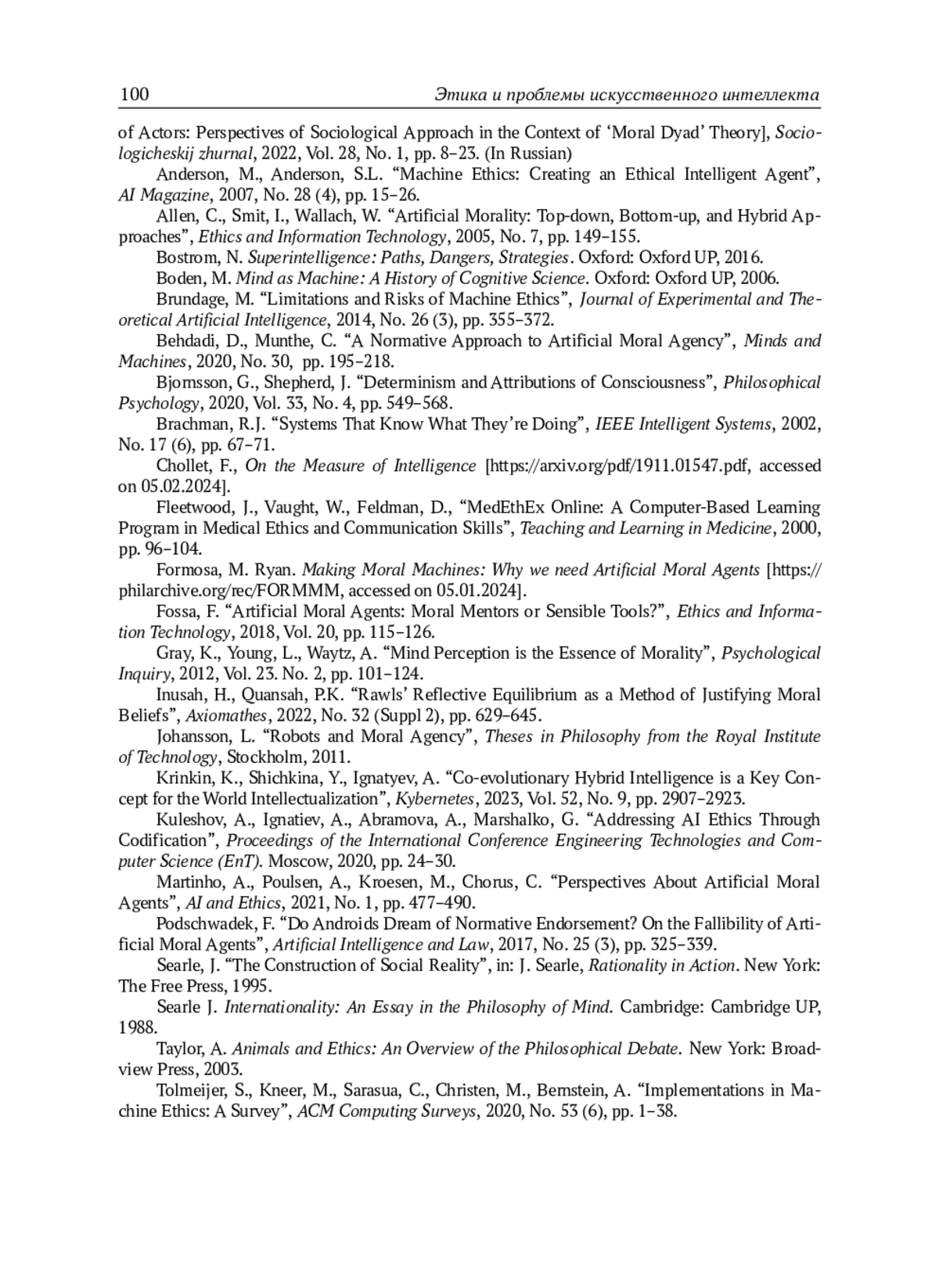
19. Anderson, M., Anderson, S.L. “Machine Ethics: Creating an Ethical Intelligent Agent”, AI Magazine, 2007, No. 28 (4), pp. 15-26.
20. Allen, С., Smit, I., Wallach, W. “Artificial Morality: Top-down, Bottom-up, and Hybrid Ap-proaches”, Ethics and Information Technology, 2005, No. 7, pp. 149-155.
21. Bostrom, N. Superintelligence: Paths, Dangers, Strategies. Oxford: Oxford UP, 2016.
22. Boden, M. Mind as Machine: A History of Cognitive Science. Oxford: Oxford UP, 2006.
23. Brundage, M. “Limitations and Risks of Machine Ethics”, Journal of Experimental and The-oretical Artificial Intelligence, 2014, No. 26 (3), pp. 355-372.
24. Behdadi, D., Munthe, C. “A Normative Approach to Artificial Moral Agency”, Minds and Machines, 2020, No. 30, pp. 195-218.
25. Bjornsson, G., Shepherd, J. “Determinism and Attributions of Consciousness”, Philosophical Psychology, 2020, Vol. 33, No. 4, pp. 549-568.
26. Brachman, R.J. “Systems That Know What They’re Doing”, IEEE Intelligent Systems, 2002, No. 17 (6), pp. 67-71.
27. Chollet, F., On the Measure of Intelligence [https://arxiv.org/pdf/1911.01547.pdf, accessed on 05.02.2024].
28. Fleetwood, J., Vaught, W., Feldman, D., “MedEthEx Online: A Computer-Based Learning Program in Medical Ethics and Communication Skills”, Teaching and Learning in Medicine, 2000, pp. 96-104.
29. Formosa, M. Ryan. Making Moral Machines: Why we need Artificial Moral Agents [https://philarchive.org/rec/FORMMM, accessed on 05.01.2024].
30. Fossa, F. “Artificial Moral Agents: Moral Mentors or Sensible Tools?”, Ethics and Informa-tion Technology, 2018, Vol. 20, pp. 115-126.
31. Gray, K., Young, L., Waytz, A. “Mind Perception is the Essence of Morality”, Psychological Inquiry, 2012, Vol. 23. No. 2, pp. 101-124.
32. Inusah, H., Quansah, P.K. “Rawls’ Reflective Equilibrium as a Method of Justifying Moral Beliefs”, Axiomathes, 2022, No. 32 (Suppl 2), pp. 629-645.
33. Johansson, L. “Robots and Moral Agency”, Theses in Philosophy from the Royal Institute of Technology, Stockholm, 2011.
34. Krinkin, K., Shichkina, Y., Ignatyev, A. “Co-evolutionary Hybrid Intelligence is a Key Con-cept for the World Intellectualization”, Kybernetes, 2023, Vol. 52, No. 9, pp. 2907-2923.
35. Kuleshov, A., Ignatiev, A., Abramova, A., Marshalko, G. “Addressing AI Ethics Through Codification”, Proceedings of the International Conference Engineering Technologies and Com-puter Science (EnT). Moscow, 2020, pp. 24-30.
36. Martinho, A., Poulsen, A., Kroesen, M., Chorus, C. “Perspectives About Artificial Moral Agents”, AI and Ethics, 2021, No. 1, pp. 477-490.
37. Podschwadek, F. “Do Androids Dream of Normative Endorsement? On the Fallibility of Arti-ficial Moral Agents”, Artificial Intelligence and Law, 2017, No. 25 (3), pp. 325-339.
38. Searle, J. “The Construction of Social Reality”, in: J. Searle, Rationality in Action. New York: The Free Press, 1995.
39. Searle J. Internationality: An Essay in the Philosophy of Mind. Cambridge: Cambridge UP, 1988.
40. Taylor, A. Animals and Ethics: An Overview of the Philosophical Debate. New York: Broad-view Press, 2003.
41. Tolmeijer, S., Kneer, M., Sarasua, C., Christen, M., Bernstein, A. “Implementations in Ma-chine Ethics: A Survey”, ACM Computing Surveys, 2020, No. 53 (6), pp. 1-38.