Хотя развитие технологии получения генетически модифицированных организмов может принести пользу людям, безопасность генетически модифицированных продуктов питания остается в центре внимания ученых. Если генетически модифицированные продукты питания, введенные в оборот, нарушают право потребителей на охрану здоровья, потребитель может потребовать возмещения ущерба в соответствии с положениями Гражданского кодекса и Закона о безопасности пищевых продуктов Китая. Если продавец данного продукта нарушает право потребителя на получение информации и право выбора, потребитель может потребовать расторжения договора купли-продажи ГМ-продуктов питания, а также возмещения убытков в соответствии с положениями Гражданского кодекса Китая и с Законом о защите прав и интересов потребителей. Если был причинен ущерб здоровью в результате употребления генетически модифицированных продуктов питания, пострадавшая сторона может потребовать возмещения ущерба в соответствии с Гражданским кодексом Китая. В случае если нанесенный ущерб был несущественным, пострадавшая сторона все равно может потребовать компенсацию затрат (например, расходы на медицинское обследование, транспортные расходы, потерянный заработок из-за пропущенной работы). Независимо от того, был ли нанесен существенный ущерб физическому здоровью, пострадавшая сторона также может потребовать компенсацию за моральный ущерб в зависимости от обстоятельств. Целью статьи является рассмотрение гражданской ответственности, возникающей в связи с генетически модифицированными продуктами питания, в соответствии с китайским законодательством на основе анализа конкретных случаев.
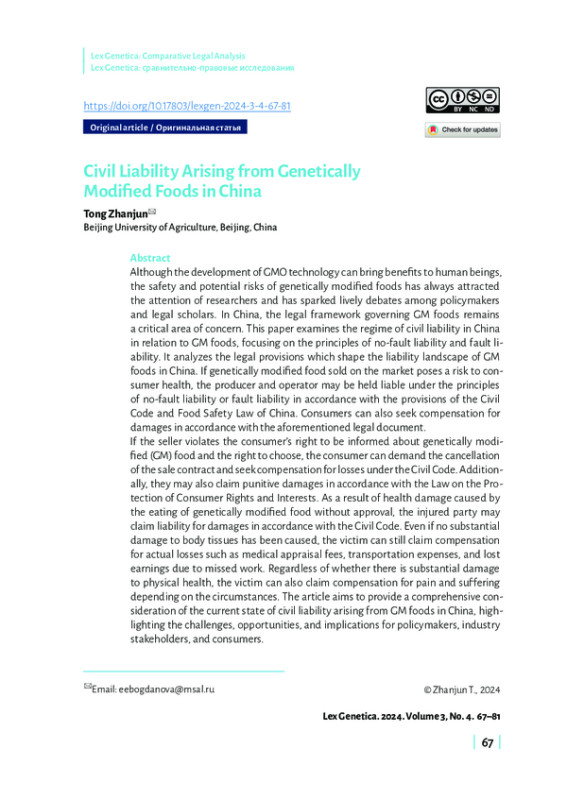
Although the development of GMO technology can bring benefits to human beings, the safety and potential risks of genetically modified foods has always attracted the attention of researchers and has sparked lively debates among policymakers and legal scholars. In China, the legal framework governing GM foods remains a critical area of concern. This paper examines the regime of civil liability in China in relation to GM foods, focusing on the principles of no-fault liability and fault liability. It analyzes the legal provisions which shape the liability landscape of GM foods in China. If genetically modified food sold on the market poses a risk to consumer health, the producer and operator may be held liable under the principles of no-fault liability or fault liability in accordance with the provisions of the Civil Code and Food Safety Law of China. Consumers can also seek compensation for damages in accordance with the aforementioned legal document. If the seller violates the consumer’s right to be informed about genetically modified (GM) food and the right to choose, the consumer can demand the cancellation of the sale contract and seek compensation for losses under the Civil Code. Additionally, they may also claim punitive damages in accordance with the Law on the Protection of Consumer Rights and Interests. As a result of health damage caused by the eating of genetically modified food without approval, the injured party may claim liability for damages in accordance with the Civil Code. Even if no substantial damage to body tissues has been caused, the victim can still claim compensation for actual losses such as medical appraisal fees, transportation expenses, and lost earnings due to missed work. Regardless of whether there is substantial damage to physical health, the victim can also claim compensation for pain and suffering depending on the circumstances. The article aims to provide a comprehensive consideration of the current state of civil liability arising from GM foods in China, highlighting the challenges, opportunities, and implications for policymakers, industry stakeholders, and consumers.
Предпросмотр статьи




Идентификаторы и классификаторы
- SCI
- Право
- Префикс DOI
- 10.17803/lexgen-2024-3-4-67-81
Если у вас возникли вопросы или появились предложения по содержанию статьи, пожалуйста, направляйте их в рамках данной темы.