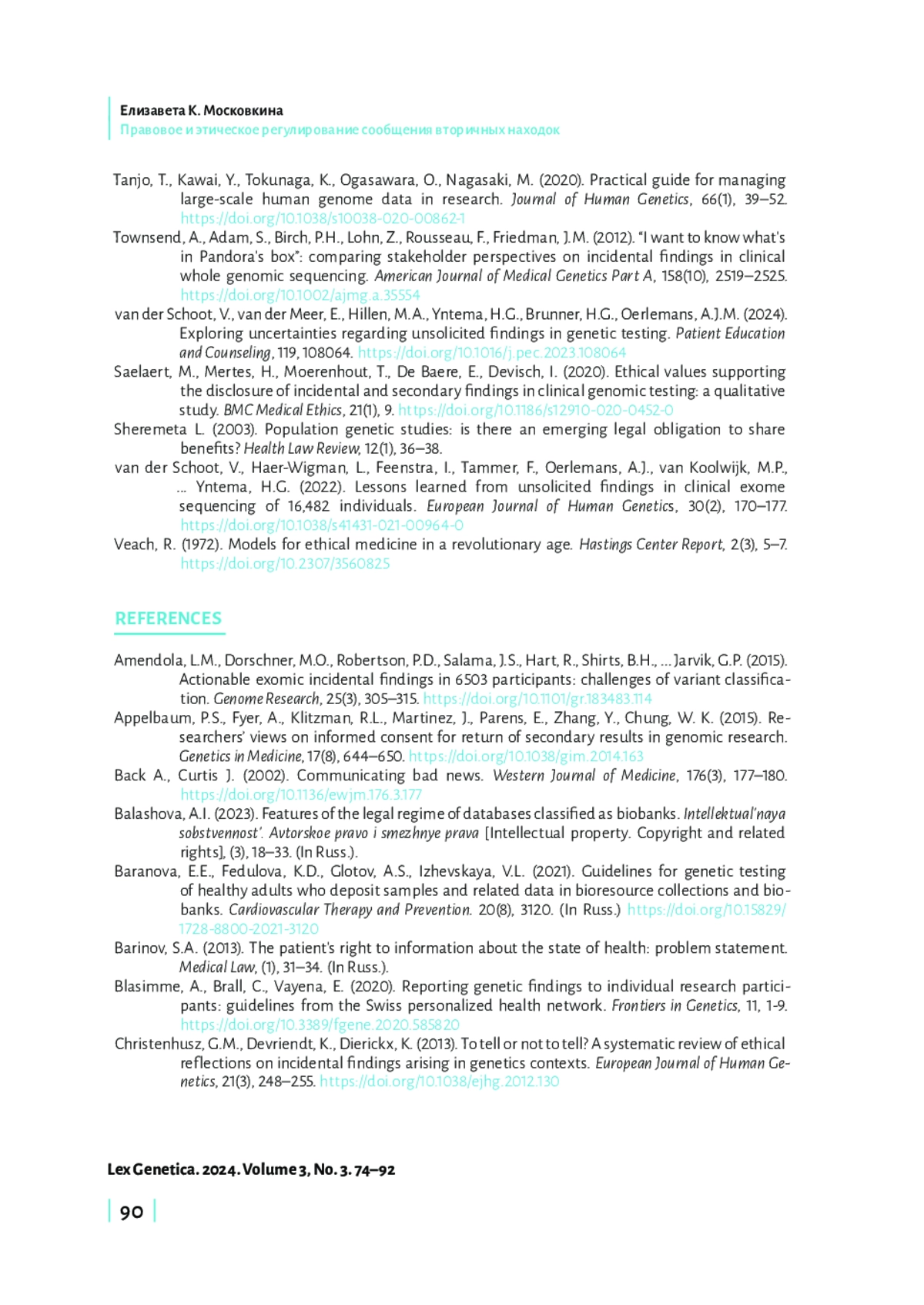
1. Балашова, А.И. (2023). Особенности правового режима баз данных, отнесенных к биобанкам. Интеллектуальная собственность. Авторское право и смежные права, (3), 18-33.
2. Баранова, Е.Е., Федулова, К.Д., Глотов, А.С., Ижевская, В.Л. (2021). Рекомендации по генетическому тестированию взрослых здоровых лиц, депонирующих свои образцы и информацию в биоресурсные коллекции и биобанки. Кардиоваскулярная терапия и профилактика, 20(8), 3120. https://doi.org/10.15829/1728-8800-2021-3120
3. Баринов, С.А. (2013). Право пациента на информацию о состоянии здоровья: постановка проблемы. Медицинское право, (1), 31-34.
4. Демикова, Н.С., Баранова, Е.Е. (2022) Показания к полногеномному секвенированию у больных с подозрением на наследственные редкие заболевания. Москва: ФГБОУ ДПО РМАНПО Минздрава России.
5. Иванов, Н.Г. (2023). Уголовная ответственность медицинского работника за причинение вреда человеку при несоблюдении клинических рекомендаций. Медицинское право, (2), 2-6.
6. Кубышкин, А.В. (2023) Особенности метода правового регулирования геномных исследований в информационном обществе. Право и цифровая экономика, (2), 43-55.
7. Московкина, Е.К. (2023). Конфиденциальность пациента и права родственников в генетических исследованиях. Lex Genetica, 2(2), 53-73. https://doi.org/10.17803/lexgen-2023-2-2-53-73
8. Пестрикова, А.А. (2020) Формирование этико-правовых способов контроля за научными исследованиями в области развития и использования генетических технологий. Актуальные проблемы российского права, (10), 157-167. https://doi.org/10.17803/1994-1471.2020.119.10.157-167
9. Сухих, Г.Т., Трофимов, Д.Ю., Шубина, Е., Дегтярев, Д.Н., Масленников, Д.Н., Мукосей, И.С., … Кубышкин А.В. (2024). Методические рекомендации «Применение высокопроизводительного секвенирования и молекулярного кариотипирования на микроматрицах в пренатальный период». Акушерство и гинекология, (3), 25-43. https://doi.org/10.18565/aig.2024.52
10. Amendola, L.M., Dorschner, M.O., Robertson, P.D., Salama, J.S., Hart, R., Shirts, B.H., ... Jarvik, G.P. (2015). Actionable exomic incidental findings in 6503 participants: challenges of variant classification. Genome Research, 25(3), 305-315. https://doi.org/10.1101/gr.183483.114
11. Appelbaum, P.S., Fyer, A., Klitzman, R.L., Martinez, J., Parens, E., Zhang, Y., Chung, W.K. (2015). Researchers’ views on informed consent for return of secondary results in genomic research. Genetics in Medicine, 17(8), 644-650. https://doi.org/10.1038/gim.2014.163
12. Back A., Curtis J. (2002). Communicating bad news. Western Journal of Medicine, 176(3), 177-180. https://doi.org/10.1136/ewjm.176.3.177
13. Blasimme, A., Brall, C., Vayena, E. (2020). Reporting genetic findings to individual research participants: guidelines from the Swiss personalized health network. Frontiers in Genetics, 11, 1-9. https://doi.org/10.3389/fgene.2020.585820
14. Christenhusz, G.M., Devriendt, K., Dierickx, K. (2013). To tell or not to tell? A systematic review of ethical reflections on incidental findings arising in genetics contexts. European Journal of Human Genetics, 21(3), 248-255. https://doi.org/10.1038/ejhg.2012.130
15. Emanuel, E.J., Emanuel, L. (1992). Four models of the physician-patient relationship. JAMA, 267(16), 2221-2226. https://doi.org/10.1001/jama.1992.03480160079038
16. Hayes, R.B (2011). Distinguishing the Ethics of Clinical Research and Clinical Care. Insight: the Newsletter of the Rhode Island Psychological Association: Ethics Corner, Winter. Available at: http://hdl.handle.net/20.500.14038/44795
17. Jarvik, G.P., Amendola, L.M., Berg, J.S., Brothers, K., Clayton, E.W., Chung, W., ... Burke, W. (2014). Return of genomic results to research participants: the floor, the ceiling, and the choices in between. The American Journal of Human Genetics, 94(6), 818-826. https://doi.org/10.1016/j.ajhg.2014.04.009
18. Jelsig, A.M., Qvist, N., Brusgaard, K., Ousager, L.B. (2015). Research participants in NGS studies want to know about incidental findings. European Journal of Human Genetics, 23(10), 1423-1426. https://doi.org/10.1038/ejhg.2014.298
19. Koplin, J.J., Savulescu, J., Vears, D.F. (2020). Why genomics researchers are sometimes morally required to hunt for secondary findings. BMC Medical Ethics, 21, 1-11. https://doi.org/10.1186/s12910-020-0449-8
20. Miller, D.T., Lee, K., Abul-Husn, N.S., Amendola, L.M., Brothers, K., Chung, W.K., ... ACMG Secondary Findings Working Group. (2022). ACMG SF v3. 1 list for reporting of secondary findings in clinical exome and genome sequencing: A policy statement of the American College of Medical Genetics and Genomics (ACMG). Genetics in Medicine, 24(7), 1407-1414. https://doi.org/10.1016/j.gim.2023.100866
21. Mitchell, C., Ploem, C., Chico, V., Ormondroyd, E., Hall, A., Wallace, S., … Kaye, J. (2017). Exploring the potential duty of care in clinical genomics under UK law. Medical Law International, 17(3), 158-182. https://doi.org/10.1177/0968533217721966
22. Monden K., Gentry L., Cox T. (2016). Delivering bad news to patients. Baylor University Medical Center Proceedings, 29(1), 101-102. https://doi.org/10.1080/08998280.2016.11929380
23. Muller S., van Thiel G., Mostert M., van Delden J. (2023). Dynamic consent, communication and return of results in large-scale health data reuse: Survey of public preferences. Digital Health, 9. https://doi.org/10.1177/20552076231190997
24. Murphy, J., Scott, J., Kaufman, D., Geller, G., LeRoy, L., Hudson, K. (2008). Public expectations for return of results from large-cohort genetic research. The American Journal of Bioethics, 8(11), 36-43. https://doi.org/10.1080/15265160802513093
25. Tan, N., Amendola, L.M., O’Daniel, J.M., Burt, A., Horike-Pyne, M.J., Boshe, L., ... Jarvik, G.P. (2017). Is “incidental finding” the best term?: a study of patients’ preferences. Genetics in Medicine, 19(2), 176-181. https://doi.org/10.1038/gim.2016.96
26. Tanjo, T., Kawai, Y., Tokunaga, K., Ogasawara, O., Nagasaki, M. (2020). Practical guide for managing large-scale human genome data in research. Journal of Human Genetics, 66(1), 39-52. https://doi.org/10.1038/s10038-020-00862-1
27. Townsend, A., Adam, S., Birch, P.H., Lohn, Z., Rousseau, F., Friedman, J.M. (2012). “I want to know what’s in Pandora’s box”: comparing stakeholder perspectives on incidental findings in clinical whole genomic sequencing. American Journal of Medical Genetics Part A, 158(10), 2519-2525. https://doi.org/10.1002/ajmg.a.35554
28. van der Schoot, V., van der Meer, E., Hillen, M.A., Yntema, H.G., Brunner, H.G., Oerlemans, A.J.M. (2024). Exploring uncertainties regarding unsolicited findings in genetic testing. Patient Education and Counseling, 119, 108064. https://doi.org/10.1016/j.pec.2023.108064
29. Saelaert, M., Mertes, H., Moerenhout, T., De Baere, E., Devisch, I. (2020). Ethical values supporting the disclosure of incidental and secondary findings in clinical genomic testing: a qualitative study. BMC Medical Ethics, 21(1), 9. https://doi.org/10.1186/s12910-020-0452-0
30. Sheremeta L. (2003). Population genetic studies: is there an emerging legal obligation to share benefits? Health Law Review, 12(1), 36-38.
31. van der Schoot, V., Haer-Wigman, L., Feenstra, I., Tammer, F., Oerlemans, A.J., van Koolwijk, M.P., ... Yntema, H.G. (2022). Lessons learned from unsolicited findings in clinical exome sequencing of 16,482 individuals. European Journal of Human Genetics, 30(2), 170-177. https://doi.org/10.1038/s41431-021-00964-0
32. Veach, R. (1972). Models for ethical medicine in a revolutionary age. Hastings Center Report, 2(3), 5-7. https://doi.org/10.2307/3560825