

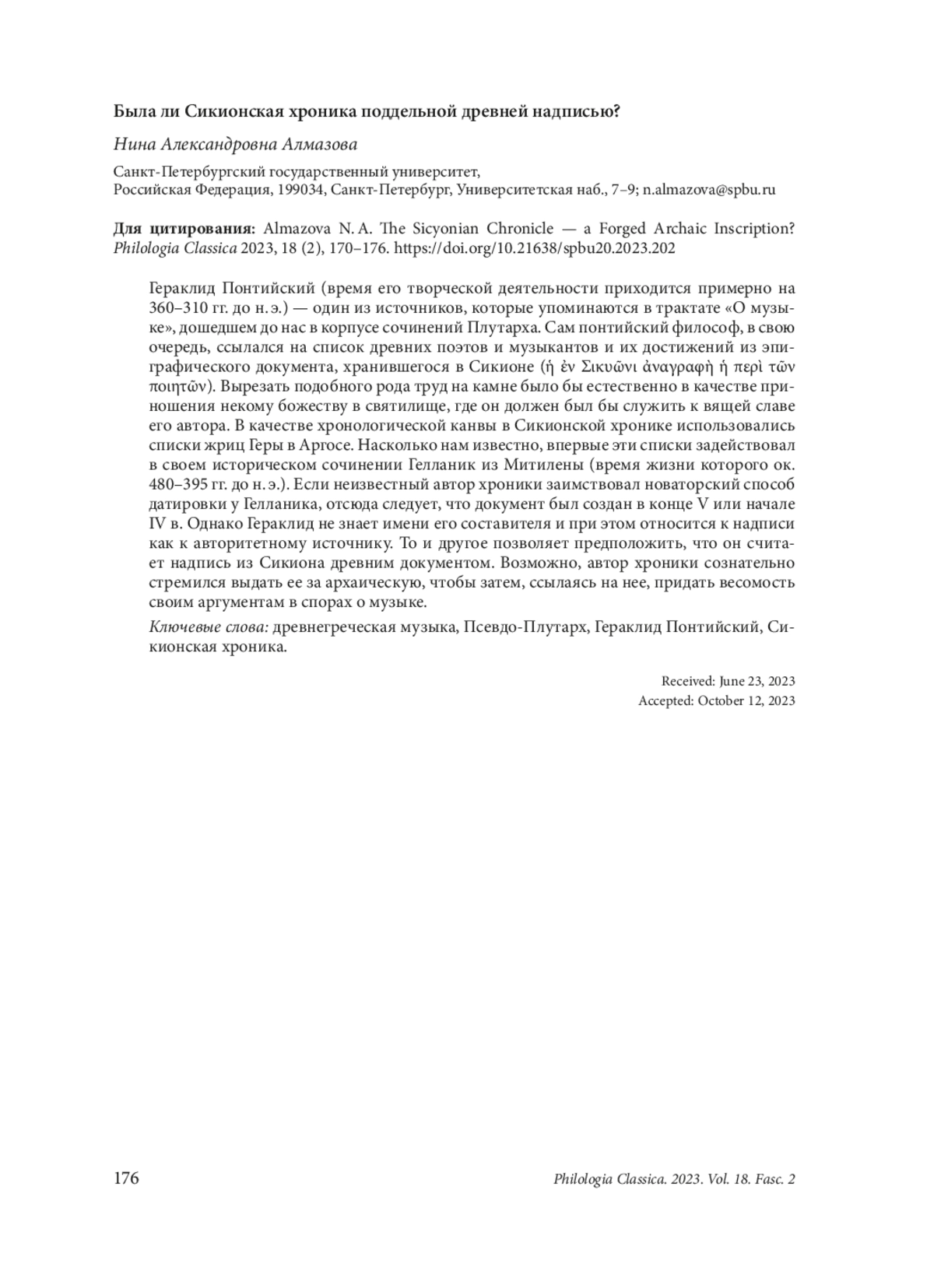
Heraclides of Pontus (active ca 360–310 BC) is one of the sources used in Ps.-Plutarch’s De musica. In his turn, the Pontic philosopher is known to have quoted a list of ancient poets and musicians and their achievements from an epigraphical document preserved in Sicyon. Incising such a work in stone would be natural as a dedication to some divinity in a sanctuary, where it would promote the fame of the historian who composed it. The system of dating used in the Sicyonian chronicle was based on the records of Hera’s priestesses held in Argos. As far as we know, this approach was first applied by Hellanicus of Mytilene (ca 480–395 BC). If the unknown author of the chronicle borrowed his method of dating from Hellanicus, this implies that the document was created in the late fifth or early fourth century BC. Nevertheless, for Heraclides this inscription was, on the one hand, anonymous, and on the other, authoritative. Both these peculiarities lead us to assume that he believed the Sicyonian chronicle to be an archaic document. Perhaps the author forged it to pass for an ancient inscription, in order to quote from, and thus give weight to his arguments in discussions on music.
Предпросмотр статьи

Идентификаторы и классификаторы
- SCI
- Литература
Modern views on the history of ancient Greek music are significantly influenced by the only treatise dealing with this topic that came down to us from Antiquity: Ps.- Plutarch’s Περὶ μουσικῆς. It is in this work that the exposition of musical achievements (beginning from the point at which it seems to become historical rather than mythological) is largely based on certain pieces called nomes (νόμοι). In particular, it records lists of the first nomes attributed to the authors of the seventh century BC: Terpander is said to have composed the citharodic nomes named Βοιώτιος, Αἰόλιος, Τροχαῖος, ̓Οξύς, Κηπίων, Τερπάνδρειος, Τετραοίδιος; Clonas, the aulodic nomes Ἀπόθετος, Ἔλεγοι
Если у вас возникли вопросы или появились предложения по содержанию статьи, пожалуйста, направляйте их в рамках данной темы.
Список литературы
1. Almazova N. On the meaning of αὐλῳδία, αὐλῳδός. Hyperboreus 2008, 14 (2), 5-34.
2. Almazova N. Alexander Polyhistor and Glaucus of Rhegium as Sources of Pseudo-Plutarch’s Treatise De musica I-II. Hyperboreus 2021, 27 (2), 266-290.
3. Barker A. Greek Musical Writings. Vol. I. Cambridge, Cambridge University Press, 1984.
4. Barker A. The Science of Harmonics in Classical Greece. Cambridge, Cambridge University Press, 2007.
5. Barker A. Heraclides and Musical History, in: W. W. Fortenbaugh, E. Pender (eds). Heraclides Ponticus: Discussion. (Rutgers University Studies in Classical Humanities XV.) New Brunswick, Transaction Publishers, 2009, 273-298.
6. Barker A. Ancient Greek Writers on their Musical Past. Studies in Greek Musical Historiography. Pisa - Roma, Fabrizio Serra editore, 2014.
7. Chaniotis A. Historie und Historiker in den griechischen Inschriften. Epigraphische Beiträge zur griechischen Historiographie. Stuttgart, Steiner, 1988.
8. Christensen P. Olympic Victor Lists and Ancient Greek History. Cambridge, Cambridge University Press, 2007.
9. Däbritz R. Heraclides 45. RE 1912, 8, 472-491.
10. Diels H. Olympionikenliste aus Oxyrhynchos. Hermes 1901, 36, 72-80.
11. Franklin J. C. The Lesbian Singers: Towards a Reconstruction of Hellanicus’ Carnean Victors, in: D. Castaldo, F. Giannachi, A. Manieri (eds). Poesia, musica e agoni nella Grecia antica. Galatina, Congedo, 2012, 720-763.
12. Gottschalk H. B. Heraclides of Pontus. Oxford, Clarendon Press, 1980.
13. Griffin S. Sicyon. Oxford, Clarendon Press, 1982.
14. Guarducci M. Epigrafia greca. I. Caratteri e storia della disciplina. La scrittura greca dalle origini all’età imperiale. Roma, Istituto poligrafico dello stato, 1967.
15. Guarducci M. Epigrafia greca. III. Epigrafi di carattere private. Roma, Istituto poligrafico dello stato, 1974.
16. Jacoby F. Das Marmor Parium. Hildesheim, Weidmann, 2008 [1904].
17. Jacoby F. Hellanikos 7. RE 1912, 8, 104-153.
18. Jacoby F. Die Fragmente der griechischen Historiker IId. Berlin, Weidmann, 1930.
19. Jacoby F. Atthis: The Local Chronicles of Ancient Athens. Oxford, Clarendon Press, 1949.
20. Jacoby F. Die Fragmente der griechischen Historiker IIIb. Leiden, Brill, 1955.
21. Kleingünther A. ΠΡΏΤΟΣ ΕΥΡΕΤΗΣ. Untersuchungen zur Geschichte einer Fragestellung. Philologus: Supplbd. 26, Heft 1. Leipzig, Dieterich, 1934.
22. Lasserre F. (ed.) Plutarque. De la musique. Texte traduction commentaire précécés d’uneétude sur l’éducation musicale dans la Grèce antique. Olten - Lausanne, Urs Graf, 1954.
23. Lucarini C. M. Herakleides Pontikos und die ps.-plutarchische Schrift Περὶ μουσικῆς. Hyperboreus 2020, 26 (1), 71-87. EDN: ATOKNB
24. Möller A. The Beginning of Chronography: Helanicus’ Hiereiai, in: N. Luraghi (ed.) The Historian’s Craft in the Age of Herodotus. Oxford, Oxford University Press, 2001, 241-262.
25. Pfister F. Die Lokalhistorie von Sikyon bei Menaichmos, Pausanias und den Chronographen. RhM 1913, 68, 529-537.
26. Rohde E. De Julii Pollucis in apparatu scaenico enarrando fontibus. Lipsiae, Engelmann, 1870.
27. Wehrli F. Die Schule des Aristoteles: Texte und Kommentar. VII. Herakleides Pontikos. Basel - Stuttgart, Schwabe, 1969.
28. Weil H., Reinach Th. (ed.) Plutarque. De la Musique. Édition critique et explicative. Paris, Leroux, 1900.
29. Westphal R. (Hg.) Πλουτάρχου Περὶ μουσικῆς. Plutarch über die Musik. Breslau, Leuckart, 1865.
30. Ziegler K., Pohlenz M. (eds). Plutarchus. Moralia VI, 3. Lipsiae, Teubner, 21959.
31. Almazova N. On the meaning of αὐλῳδία, αὐλῳδός. Hyperboreus 2008, 14 (2), 5-34.
32. Almazova N. Alexander Polyhistor and Glaucus of Rhegium as Sources of Pseudo-Plutarch’s Treatise De musica I-II. Hyperboreus 2021, 27 (2), 266-290.
33. Barker A. Greek Musical Writings. Vol. I. Cambridge, Cambridge University Press, 1984.
34. Barker A. The Science of Harmonics in Classical Greece. Cambridge, Cambridge University Press, 2007.
35. Barker A. Heraclides and Musical History, in: W. W. Fortenbaugh, E. Pender (eds). Heraclides Ponticus: Discussion. (Rutgers University Studies in Classical Humanities XV.) New Brunswick, Transaction Publishers, 2009, 273-298.
36. Barker A. Ancient Greek Writers on their Musical Past. Studies in Greek Musical Historiography. Pisa - Roma, Fabrizio Serra editore, 2014.
37. Chaniotis A. Historie und Historiker in den griechischen Inschriften. Epigraphische Beiträge zur griechischen Historiographie. Stuttgart, Steiner, 1988.
38. Christensen P. Olympic Victor Lists and Ancient Greek History. Cambridge, Cambridge University Press, 2007.
39. Däbritz R. Heraclides 45. RE 1912, 8, 472-491.
40. Diels H. Olympionikenliste aus Oxyrhynchos. Hermes 1901, 36, 72-80.
41. Franklin J. C. The Lesbian Singers: Towards a Reconstruction of Hellanicus’ Carnean Victors, in: D. Castaldo, F. Giannachi, A. Manieri (eds). Poesia, musica e agoni nella Grecia antica. Galatina, Congedo, 2012, 720-763.
42. Gottschalk H. B. Heraclides of Pontus. Oxford, Clarendon Press, 1980.
43. Griffin S. Sicyon. Oxford, Clarendon Press, 1982.
44. Guarducci M. Epigrafia greca. I. Caratteri e storia della disciplina. La scrittura greca dalle origini all’età imperiale. Roma, Istituto poligrafico dello stato, 1967.
45. Guarducci M. Epigrafia greca. III. Epigrafi di carattere private. Roma, Istituto poligrafico dello stato, 1974.
46. Jacoby F. Das Marmor Parium. Hildesheim, Weidmann, 2008 [1904].
47. Jacoby F. Hellanikos 7. RE 1912, 8, 104-153.
48. Jacoby F. Die Fragmente der griechischen Historiker IId. Berlin, Weidmann, 1930.
49. Jacoby F. Atthis: The Local Chronicles of Ancient Athens. Oxford, Clarendon Press, 1949.
50. Jacoby F. Die Fragmente der griechischen Historiker IIIb. Leiden, Brill, 1955.
51. Kleingünther A. ΠΡΏΤΟΣ ΕΥΡΕΤΗΣ. Untersuchungen zur Geschichte einer Fragestellung. Philologus: Supplbd. 26, Heft 1. Leipzig, Dieterich, 1934.
52. Lasserre F. (ed.) Plutarque. De la musique. Texte traduction commentaire précécés d’uneétude sur l’éducation musicale dans la Grèce antique. Olten - Lausanne, Urs Graf, 1954.
53. Lucarini C. M. Herakleides Pontikos und die ps.-plutarchische Schrift Περὶ μουσικῆς. Hyperboreus 2020, 26 (1), 71-87. EDN: ATOKNB
54. Möller A. The Beginning of Chronography: Helanicus’ Hiereiai, in: N. Luraghi (ed.) The Historian’s Craft in the Age of Herodotus. Oxford, Oxford University Press, 2001, 241-262.
55. Pfister F. Die Lokalhistorie von Sikyon bei Menaichmos, Pausanias und den Chronographen. RhM 1913, 68, 529-537.
56. Rohde E. De Julii Pollucis in apparatu scaenico enarrando fontibus. Lipsiae, Engelmann, 1870.
57. Wehrli F. Die Schule des Aristoteles: Texte und Kommentar. VII. Herakleides Pontikos. Basel - Stuttgart, Schwabe, 1969.
58. Weil H., Reinach Th. (ed.) Plutarque. De la Musique. Édition critique et explicative. Paris, Leroux, 1900.
59. Westphal R. (Hg.) Πλουτάρχου Περὶ μουσικῆς. Plutarch über die Musik. Breslau, Leuckart, 1865.
60. Ziegler K., Pohlenz M. (eds). Plutarchus. Moralia VI, 3. Lipsiae, Teubner, 21959.
Выпуск

Другие статьи выпуска
This piece is a fresh take on the crux philologorum in Sappho fr. 96,8, an extended moon simile, where Aeolic σελάννα, a commonplace of Sapphic poetry, easily restituted ex coniectura by W. Schubart in his editio princeps of PBerol. 9722 in 1902, was ousted by an unmetrical, if poetic, μήνα. The author offers an overview of the past and most recent scholarly effort along with an attempt (albeit a speculative one) to approach the issue of the irrational ratio corruptelae from the part of the resonant adjective βροδοδάκτυλος, an altogether uncommon epithet of the moon, paying close attention to the fact that the intruding word is disyllabic. The dactylic feel of the weighty adjective βροδοδάκτυλος is deemed at some point to have prevailed in a scribe’s dictation interne to the result that ἠώς could have landed in the text proper, or could have found its way there gradually from an intrusive marginal gloss left by a learned scribe unable to keep the Homeric clausula ῥοδοδάκτυλος ἠώς to himself. At some point another, no less learned scribe, attentive to the context of the simile, picked up μήνα, not σελήνη, as his remedy of choice, sticking to the number of syllables in the now resident ἠώς
Статья посвящена русскому филологу-классику, педагогу и переводчику немецкого происхождения Карлу Фридриху (Карлу Викторовичу) Гроссгейнриху и его трудам по переложению поэм Гесиода «Теогония» и «Труды и дни» для учащихся. Приводятся краткие сведения о методике преподавания Гроссгейнрихом иностранных языков и об открытом им методе использования адаптированных текстов для чтения древнегреческой эпической поэзии. Подробно анализируется греческий текст поэм Гесиода в автографах Гроссгейнриха по рукописям Российской государственной библиотеки: РГБ. Ф. 201. No 30 и 31. Устанавливается, что рукописи содержат адаптированный греческий текст, предназначенный для учащихся. Раскрываются способы редактирования текста, с помощью которых формы гомеровского диалекта заменяются на аттические. Устанавливается источник латинского перевода поэм Гесиода в автографах Гроссгейнриха. Проводится сравнение адаптированного греческого текста с изданиями поэм Гесиода, анализируются разночтения. Приводятся сведения о занесении А. С. Норовым рукописей Гроссгейнриха в неизданную часть каталога его библиотеки. Устанавливается значение рукописей Гроссгейнриха как дара министру народного просвещения А. С. Норову в свете полемики о необходимости классического образования в России в XIX в. В Приложениях приводятся: (1) отрывок из «Теогонии» по рукописи РГБ. Ф. 201. No 30, (2) примеры редакторских замен Гроссгейнриха в тексте поэм Гесиода, (3) перевод оды Горация, переделанной Гроссгейнрихом для посвящения А. С. Норову, и (4) сопроводи - тельное письмо К. Ф. Гроссгейнриха к А. С. Норову на французском языке от 10 апреля 1857 г. с переводом на русский язык
Modern Greek identity is heavily based on the idea of the continuity of Greek culture and the Greek language. Most specialists in Modern Greek regard Ancient Greek and Modern Greek as different stages of the same language despite multiple differences and innovations at all levels. During the 19 th century, a number of European classical philologists tried to find Ancient Greek features in Modern Greek dialects. As a result, they have singled out Tsakonian as the sole dialect which descends directly from Ancient Doric Laconian but not from Hellenistic Koiné as the rest of the modern dialects. Nevertheless, it is important to point out that Tsakonian is not the only Modern Greek variety with some unique peculiarities inherited from Ancient Greek. This contribution analyzes the phenomena of the Ancient Greek origin in vocabulary, phonetics, morphology and syntax in Modern Greek dialects. The research is focused on those archaisms which exist in the dialects but are absent from Standard Modern Greek. The data was mostly collected by the author of this paper and his colleagues between 2000 and 2023. The analysis demonstrates that the majority of unique peculiarities of the Ancient Greek origin are found in Pontic and Tsakonian, although most varieties of Modern Greek have some archaisms. However, the quantity of archaisms is not a consistent indicator of the antiquity of the dialect since the history of Modern Greek dialects is still terra incognita and there is no good explanation why some dialects keep their archaisms better than the others.
Hannah Arendt, one of the most significant political and philosophical intellectuals of the 20th century, frequently brought up the issue of power. In The Human Condition, to distinguish power from force, strength, and, particularly, violence, she pointed out that the word ‘power’ had been derived from the Aristotelian conception of δύναμις. Since Arendt had written about power as the capacity to act together in the political realm, her understanding of the term δύναμις was credited to Aristotle. In order to make the distinction between power and its extremity, that is, violence, in Arendt’s theory more comprehendible, it is crucial to examine the Aristotelian conception of the term δύναμις and its original definitions, which are mostly found in Metaphysics. This paper aims to provide a philosophical analysis of δύναμις in Aristotle to clarify Arendt’s notion of power as well as her theory of action. In the first part of the article, the author discusses the word δύναμις which had a variety of meanings in antiquity including power, potentiality, potency, capacity, possibility, and force. Unlike common meanings, Aristotle used the word δύναμις in its relation to the term ἐνέργεια, which were usually translated as ‘potentiality’ and ‘actuality’. Aristotle defined δύναμις as the principle of change, that is, the power or capacity to act and be affected, which reveals itself when it achieves its fulfilment, or ἐνέργεια. In the second part, the author demonstrates that Arendt’s concept of power is based on the Aristotelian δύναμις as the power to act together, which cannot be stored up and exists only in its actualization. The author concludes by saying that power in the Aristotelian sense cannot be substituted for violence but instead manifests itself in the ability to be a political human being
В статье впервые публикуется и комментируется греческое стихотворение русского поэта-символиста Вячеслава Ивановича Иванова, написанное 2 сентября 1893 г. в Риме. Авторская подпись под стихотворением содержит указание на жанр плача («трена»): сочетание ямбического триметра с авторским заголовком «трен» можно найти у Григория Назианзина среди Carmina de se ipso. Несмотря на греческий метр и лексику, заимствованную частично из эпической поэзии, тематически Иванов ориентируется главным образом на русскую романтическую традицию, избирая ключевой темой тоску по «милому северу», который противопоставлен югу, олицетворяющему земной рай. Другие романтические мотивы — изгнанничество и зависть к свободным птицам. Отсылки к античной мифологии выражены в образах сада Гесперид и страны гипербореев: если сад Гесперид, в поэзии Иванова концептуально связанный не с западом, а с югом, — это идиллическое пространство, метафорически обозначающее Италию, то Гиперборея традиционно ассоциирована с Россией. Белокрылые птицы, стремящиеся в гиперборейский дом, которым завидует лирический герой, — очевидно, лебеди, и таким образом в стихотворении имплицитно возникает метапоэтическая тема, развиваемая Ивановым в контексте гиперборейского мифа в более поздних стихотворениях. И жанр, и тема изгнанничества указывают также на влияние овидиевских «Tristia»: годом ранее Иванов пишет элегическим дистихом послание к А. М. Дмитриевскому «Laeta», в котором признает Рим своим новым домом, а вместо тоски по родине здесь присутствует другой традиционный мотив — тоска по другу
The Portrait of a Lady attributed to Correggio (St Petersburg, State Hermitage, inv. no. 5555) was witnessed as signed with the Latin pseudonym Antonius Laetus. The inscription was still legible in the 70s, and the analysis of parallels confirms authenticity of the painting while also indicating the time of its creation — most likely in the winter 1518–1519. The identification of the sitter as Ginevra Rangoni accepted by the majority should not be disputed. The idea expressed by Riccardo Finzi more than half a century ago can moreover be supported by new arguments: not only the scapular and the Franciscan knot, but also the laurel, ivy, myrtle, the general expression of the widow bride, the full cup of charming wit as a cure for the bitterness of losses, and the reference to Helen of Troy — all this perfectly fits in with Ginevra’s life circumstances. Contrary to the authoritative opinion of Claudio Franzoni, the inscription on the cup cannot be reduced to a single word: besides νηπενθές it includes ἄχολο[ν], explaining the uncommon epithet, a hapax, and [ἐπίληθον ἁπά]ντων, marking the end of verse Od. 4. 221. Correggio reflected on the feast scene in Menelaus’ palace, visualized it in his creative imagination, and the viewer should turn to it to understand the artist’s intention. Its central character, Helen, appears to act very differently in the two stories told at its end. She sympathizes with the Achaeans, longs for the husband she left behind, and at the same time wants to destroy the warriors hidden in the belly of the wooden horse, among them this deserted husband of hers. Abnormal details of the second story aroused suspicion; it might well have been an interpolation originally belonging to Iliupersis or Little Iliad. However, to Correggio’s mind the text was, of course, authentic, and he perceived the contradictory behavior of Helen as truly homeric. Inspired by Homer, he thus created an ethically ambivalent female image, feasible in its duality.
This second part concludes the publication of previously unpublished texts, a project initiated in the preceding issue of this journal, featuring 30 new schedographical texts. Once again, the objective is to provide new valuable material for the comprehensive study of Byzantine culture and the teaching and learning practice of Ancient Greek during the East Roman Empire. Schedography, a distinct form of educational text practiced in the Byzantine Empire from the 10th century until its end and even beyond (continuing in use until the 19th century), reached its peak in the 13th century. This unique kind of pedagogical texts has gained scholarly attention in contemporary academia. However, despite this interest, it remains a complex field of study due to its unique characteristics. These texts, specifically crafted to be read aloud in educational settings, pose challenges for modern readers as they markedly deviate from contemporary silent reading practices. Furthermore, their lack of clear original context, coupled with their educational intent rather than aesthetic value, complicates the process of interpretation and understanding. Schedography stands as a literary and educational enigma that continues to be a focal point of research in the 21st century. Critically edited collections, such as the one presented in this study (published in two parts), are indispensable for further rigorous scholarly analysis
The article aims to analyze the use of the term concessivus/concessiva ‘concessive’ in Latin grammatical texts which make up Corpus Grammaticorum Latinorum and Digital Library of late antique Latin texts, and to consider the concessive meaning as a grammatical category. A number of grammatical sources (Probus, Ars of Diomedes, Victorini sive Palaemoni Ars, Ars of Cledonius, Explanationes) place the category of concessivity among the verbal categories, namely modus ‘mood’, while in others this term is not mentioned. The text of Diomedes is also notable for the fact that concessivity is included in the concept of species, a term that includes heterogeneous grammatical phenomena among Roman grammarians. At the same time, the grammarian identifies not one meaning of concession, but two, which are defined by the terms — species concessiva (describes situations that are undesirable for the speaker in the present and future) and species affirmativa (describes situations that did not actually happen). All the three terms in the title of this paper correspond to coniunctivus concessivus and indicate the same grammatical form — perfect subjunctive, e. g. feceris ‘even if you did’. In modern linguistics, the meaning of concession is expressed not only by the perfect subjunctive, but also by the present subjunctive, and, thus, does not have a unique formal expression, as in ancient linguistics. I suppose that concession in the Latin language falls under the scope of covert grammatical category, whereas concession, as it was presented in Roman grammars, can be treated as an overt one
The most common word accepted in Mithraic historiography to refer to places of worship is “Mithraeum”. The historical sources, however, offer us a multitude of terms that diverge from this expression which could be evoking different realities and could be referring to other kind of cultic spaces. In this paper, we have collected all the mentions supported in the epigraphy and literary sources, to have a complete vision of all these terms. With these testimonies, we have revised the previous interpretations related to the use of these different names. The variety of them has little to do with location or period. Still, we propose that this terminological variation is related to the consideration that ancient Mithra’s followers had with the moment when they erected the cultic space. It is possible to connect the choice of the word “spelaeum” or “templum” with the first idea they had of what must be an “original Mithraic cave” if we consider the meaning of the verbs used by the dedicators in their inscriptions. The validity of this interpretation will allow for a better understanding of the symbolic universe in which the followers of Mithra moved, instead of the common acceptance of the modern word “mithraeum”
This paper presents a new hypothesis concerning the prologues of Seneca’s Hercules Furens, Agamemnon, and Thyestes. It provides an interpretive alternative to the controversies associated with the current reading tradition, which places superhuman and protatic characters speaking in the opening acts of these plays on the same level of fictional reality as other heroes, or subordinates them to figurative construction. According to the proposed hypothesis, the specific nature of these three scenes may be the result of applying the convention known, with little variation, from several other dramas in which the ghosts disturb the sleeping. The argumentation emphasises the paradigmatic nature of these opening scenes, which end with a formula setting them at the close of the night. It also points to the fact that in the light of the new assumptions, these prologues — redundant in their expository and anticipatory function — play an important role in structuring the dramatic action. Moreover, in the context of the events that follow them, their content can be explained in terms of the dream theory known from the rationalising philosophical discourses of antiquity. Finally, proposed reading of these scenes is based on the assumption of continuity between the discursive and poetic activity of the author
According to the author of the article, Mithridates VI Eupator’s letter to the Parthian monarch Arsaces in Sallust’s Historiae does not reproduce the genuine document from the personal archives of the Pontic king as some researchers believe. The opinion that Sallust criticized Roman politics under Mithridates’mask is rejected; many scholars consider this letter to be a condemnation of deep moral decline of the Roman society. On the contrary, the Roman writer attributes to the Pontic king the weak and vulnerable arguments based on the false facts (at least from the Roman point of view) to discredit his (and not only his) criticism of Roman foreign policy. He calls the Romans “strangers without a homeland, without parents”, but it is naturally that Romans themselves did not think in this way. The author objects to E. Adler, who believes that most of Sallust’s readers did not know history well enough to mark the distortions of facts in Mithridates’ letter. There is every reason to believe that Sallust was counting on an educated public that would be able to appreciate these distortions and their meaning. The author thinks that Mithridates’ argumentation looks like a parody of the anti-Roman propaganda and it might have been perceived as such by Sallust’s readers.
The purpose of this paper is to analyse the distribution of the ancient Greek negatives οὐ and μή in rhetorical questions, particularly in those which are equivalent to an assertive speech act. Traditionally, their use in this context has been described after the answer that usually follows the question without any further explanation: οὐ favours a positive answer, while μή favours a negative one. However, this rule does not always hold true. A theoretical framework that may explain their distribution is nonveridicality. Nonveridicality is applied to those operators that do not presuppose their proposition to be true or false. In fact, the use of μή with the indicative mood in this type of rhetorical question can be explained as characteristic of a nonveridical operator. Thus, μή is used in confirmative questions to signal that the proposition goes against the speaker’s expectations without implying its falsity. In turn, οὐ would be the general negative, so it can appear both in questions with reversed polarity and in confirmative questions whose proposition conforms to the speaker’s expectations. It must be noted that the study includes the use of οὐ and μή combined with other particles such as ἆρα, ἦ, or οὖν, since they exhibit the same properties in those cases
This article discusses the extract from Galen’s treatise “Protrepticus” which contains a description of the goddess Tyche. In the extract, Galen contrasts Hermes (a male master of the arts) and Tyche (a capricious and irrational woman). The fragment is considered in the context of the entire treatise (“Protrepticus” was intended as a polemical statement against the empirical school and their method) and its purpose (exhortation to the study of arts). G. Kaibel has previously shown that many details in the description of Tyche coincide with similar descriptions in the treatise “Tabula Cebetis’’. As a result, the scholar came to the conclusion that Galen and the author of “Tabula’’ relied on the same source. The fragment from the poem by Pacuvius provides additional evidence. However, in addition to the similarities in the description, it is worth considering the differences that appear in Galen’s treatise. For example, Galen replaces the term μανία (μαινομένη in “Tabula Cebetis’’) with the term ἄνοια, depriving it of medical connotations. The translators, apparently, did not attach any importance to this replacement, and therefore we have different translations of the term ἄνοια: folie, mancanza di senno, inanity. Since the replacement of the term μανία is not commented on in the editions and the existing translations demonstrate different interpretations, the author of the article provides an additional commentary, including a comparison of “Protrepticus” with other texts of Galen and the works of Plato, and also draws attention to the parallel passage from Pacuvius
The purpose of the following paper is to identify what kind of mythical creature Aeschylus’ γρυπαίετος (‘griffin–eagle’) that caused such a scandal for ‘Euripides’ in Aristophanes’ Frogs 928–930 (= Aesch. fr. inc. fab. 422 R.) was. The term has usually been interpreted in three ways: (a) as a poetic form of ‘eagle’; (b) as a poetic form of ‘griffin’; (c) as ‘eagle of the griffin species’. The testimony of Aristophanes’ Frogs and vase-painting suggests that it may have been an idiosyncratic, archaic type of griffin, called by modern specialists ‘griffin-bird’ and characterised by having two legs, not four, and the body of a bird, not a lion. This fantastic creature appeared quite frequently on Archaic black-figure vases in Athens, but had completely disappeared by the end of the 6 th century BC. As a result, its appearance would be unknown to Aristophanes’ public, making the term γρυπαίετος impossible to make out (Ra. 930). Thus, the following paper suggests that Aeschylus’ γρυπαίετος (‘griffin-eagle’) is a fabulous composite beast made up of griffin and eagle parts, as its name suggests: a griffin head (with an open hooked beak, long pointed ears, a protuberance or horn over the eyes, and a curl or plume falling down one side of the neck) crowning an eagle body (two-legged, feathered, with wings and talons).
The mythopoetic parable of ‘Gigantomachia over being’ in Plato’s Sophist 246a4 ff. is neither a theoretical construction ad hoc of some general trends, nor a reference to a single contemporary debate, e. g., between Plato’s Academy and atomists in 4 th century BC. The controversy on the nature of being is described as a real battle on epic scale (ἄπλετος μάχη) between two camps, as a debate about fundamental problem of philosophy, that has always existed (ἀεὶ συνέστηκεν) and is still going on. In favor of the identification of the two camps primarily with the Ionian and Italian traditions in the pre-Platonic philosophy speaks the juxtaposition of the ‘Ionian and Italian Muses’ (Ἰάδες καὶ Σικελικαὶ Μοῦσαι) in the preceding context Soph. 242de. The ‘unreformed giants’ are the Ionian physikoi from Anaximander to Democritus, while their ‘divine’ adversaries, who reduce being (ousia) to immaterial forms, are the Pythagoreans, Eleatics and Platonists, as well as Socrates, who dismisses the Ionian περὶ φύσεως ἱστορία in Plato’s Phaedo and who upholds the theory of ideas in the Republic and Phaedrus. The ‘improved’ giants of the second generation are metaphysical dualists like Anaxagoras and Empedocles who admit incorporeal causes like Mind and Love alongside with matter, as well as Heraclitus, the Ionian Sophists and Antisthenes who combined ontological naturalism with teaching arete. The general scheme of the development of theories of archai in Aristotle’s Metaphysics is very similar: from those who recognized only material causes to those who admitted incorporeal moving cause (Anaxagoras and Empedocles).
Статистика статьи
Статистика просмотров за 2026 год.
Издательство
- Издательство
- СПБГУ
- Регион
- Россия, Санкт-Петербург
- Почтовый адрес
- Россия, 199034, Санкт-Петербург, Университетская наб., д. 7–9
- Юр. адрес
- 199034, г Санкт-Петербург, Василеостровский р-н, Университетская наб, д 7/9
- ФИО
- Кропачев Николай Михайлович (РЕКТОР)
- E-mail адрес
- spbu@spbu.ru
- Контактный телефон
- +7 (812) 3282000
- Сайт
- https://spbu.ru/