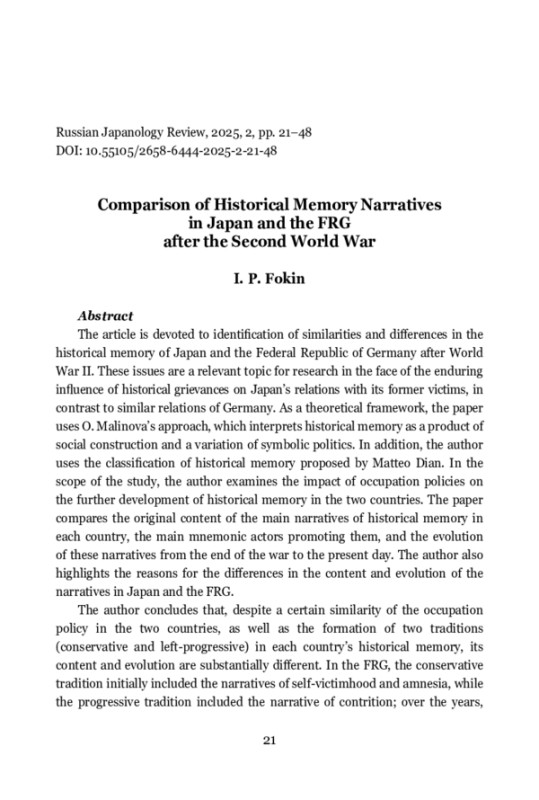
The article is devoted to identi¿cation of similarities and diɣerences in the historical memory of Japan and the Federal Republic of Germany after World War II. These issues are a relevant topic for research in the face of the enduring inÀuence of historical grievances on Japan’s relations with its former victims, in contrast to similar relations of Germany. As a theoretical framework, the paper uses O. Malinova’s approach, which interprets historical memory as a product of social construction and a variation of symbolic politics. In addition, the author uses the classi¿cation of historical memory proposed by Matteo Dian. In the scope of the study, the author examines the impact of occupation policies on the further development of historical memory in the two countries. The paper compares the original content of the main narratives of historical memory in each country, the main mnemonic actors promoting them, and the evolution of these narratives from the end of the war to the present day. The author also highlights the reasons for the diɣerences in the content and evolution of the narratives in Japan and the FRG. The author concludes that, despite a certain similarity of the occupation policy in the two countries, as well as the formation of two traditions (conservative and left-progressive) in each country’s historical memory, its content and evolution are substantially diɣerent. In the FRG, the conservative tradition initially included the narratives of self-victimhood and amnesia, while the progressive tradition included the narrative of contrition; over the years however, the traditions have evolved from polarization to a consensus around contrition and elements of self-victimhood. In Japan, the conservative tradition initially included glori¿cation of the past in addition to self-victimhood, i. e., it was more revisionist, while the progressive tradition focused on self-victimhood rather than contrition. Over time, the traditions in Japan shifted from a consensus around self-victimhood to a sharp polarization: progressives moved to a contrition narrative, while revisionists gained ground among conservatives
Предпросмотр статьи
Идентификаторы и классификаторы
- SCI
- История
Если у вас возникли вопросы или появились предложения по содержанию статьи, пожалуйста, направляйте их в рамках данной темы.