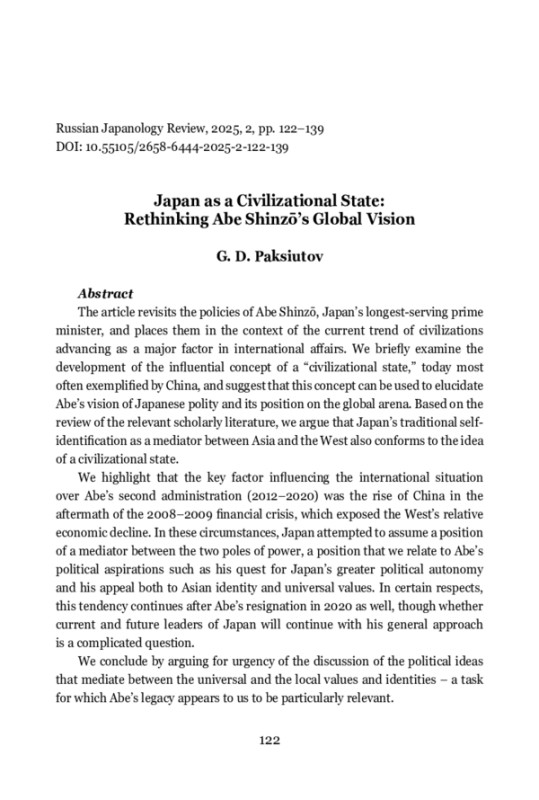
The article revisits the policies of Abe ShinzŮ, Japan’s longest-serving prime minister, and places them in the context of the current trend of civilizations advancing as a major factor in international aɣairs. We brieÀy examine the development of the inÀuential concept of a “civilizational state,” today most often exempli¿ed by China, and suggest that this concept can be used to elucidate Abe’s vision of Japanese polity and its position on the global arena. Based on the review of the relevant scholarly literature, we argue that Japan’s traditional selfidenti¿cation as a mediator between Asia and the West also conforms to the idea of a civilizational state. We highlight that the key factor inÀuencing the international situation over Abe’s second administration (2012–2020) was the rise of China in the aftermath of the 2008–2009 ¿nancial crisis, which exposed the West’s relative economic decline. In these circumstances, Japan attempted to assume a position of a mediator between the two poles of power, a position that we relate to Abe’s political aspirations such as his quest for Japan’s greater political autonomy and his appeal both to Asian identity and universal values. In certain respects, this tendency continues after Abe’s resignation in 2020 as well, though whether current and future leaders of Japan will continue with his general approach is a complicated question. We conclude by arguing for urgency of the discussion of the political ideas that mediate between the universal and the local values and identities – a task for which Abe’s legacy appears to us to be particularly relevant.
Предпросмотр статьи
Идентификаторы и классификаторы
- SCI
- Политология
- УДК
- 32. Политика
Если у вас возникли вопросы или появились предложения по содержанию статьи, пожалуйста, направляйте их в рамках данной темы.