This study examines the strategic role of sake as an instrument of cultural diplomacy within the framework of trade relations between Japan and Europe, using a theoretical approach that combines the concepts of soft power, gastrodiplomacy, and nation branding. Sake, as a traditional Japanese fermented beverage rooted in the spiritual and social practices of society, has undergone a reorientation of its function from domestic consumption to a symbol of national cultural identity promoted internationally. Through the Cool Japan policy, the Japanese government actively positions sake as a key element in public diplomacy, linking cultural heritage with export trade strategies. The implementation of the EU-Japan Economic Partnership Agreement (EPA) since 2018, which includes geographical indication (GI) protection, provides additional legitimacy for the authenticity of sake in the European market. Promotional strategies involving culinary festivals, cross-industry collaborations, and product narratives emphasizing aesthetic value, origins, and traditional production techniques have successfully enhanced European public perception of sake and, more broadly, of Japan. Export data shows signi¿cant growth, with France, the United Kingdom, and Germany contributing the most, indicating the success of this approach in expanding market penetration. However, this dynamic is not without criticism, including the commodi¿cation of cultural values, exclusion of small producers, and the risk of reducing the spiritual meaning of sake in a commercialized context.
Therefore, this study emphasizes the importance of cultural diplomacy that not only highlights visual appeal and market narratives but also commits to preserving values and the participation of local cultural communities. In conclusion, sake diplomacy offers an intriguing model for the integration of culture and economy in international relations, demonstrating that cultural products can serve as an effective means to build cross-national relations rooted in empathy, experience, and appreciation for the uniqueness of traditions
Идентификаторы и классификаторы
- SCI
- Социология
Over the past two decades, the dynamics of international relations have undergone signi¿cant shifts, where diplomatic instruments are no longer dominated by military power or heavy industry trade alone, but also rely on culture-based soft power. [Nye 2004]. One rapidly growing form of cultural diplomacy is gastrodiplomacy, which involves introducing national cuisine to the international stage as part of public diplomacy strategies [Rockower 2012]. This phenomenon has gained momentum with the rise of global mobility, international tourism, and cross-border cultural exchange, enabling cuisine to serve as a means of building positive perceptions of its country of origin. East Asian countries, including Japan, have been pioneers in leveraging the power of cuisine as a diplomatic tool to expand cultural inÀuence while opening up trade opportunities [Strugar 2015].
Список литературы
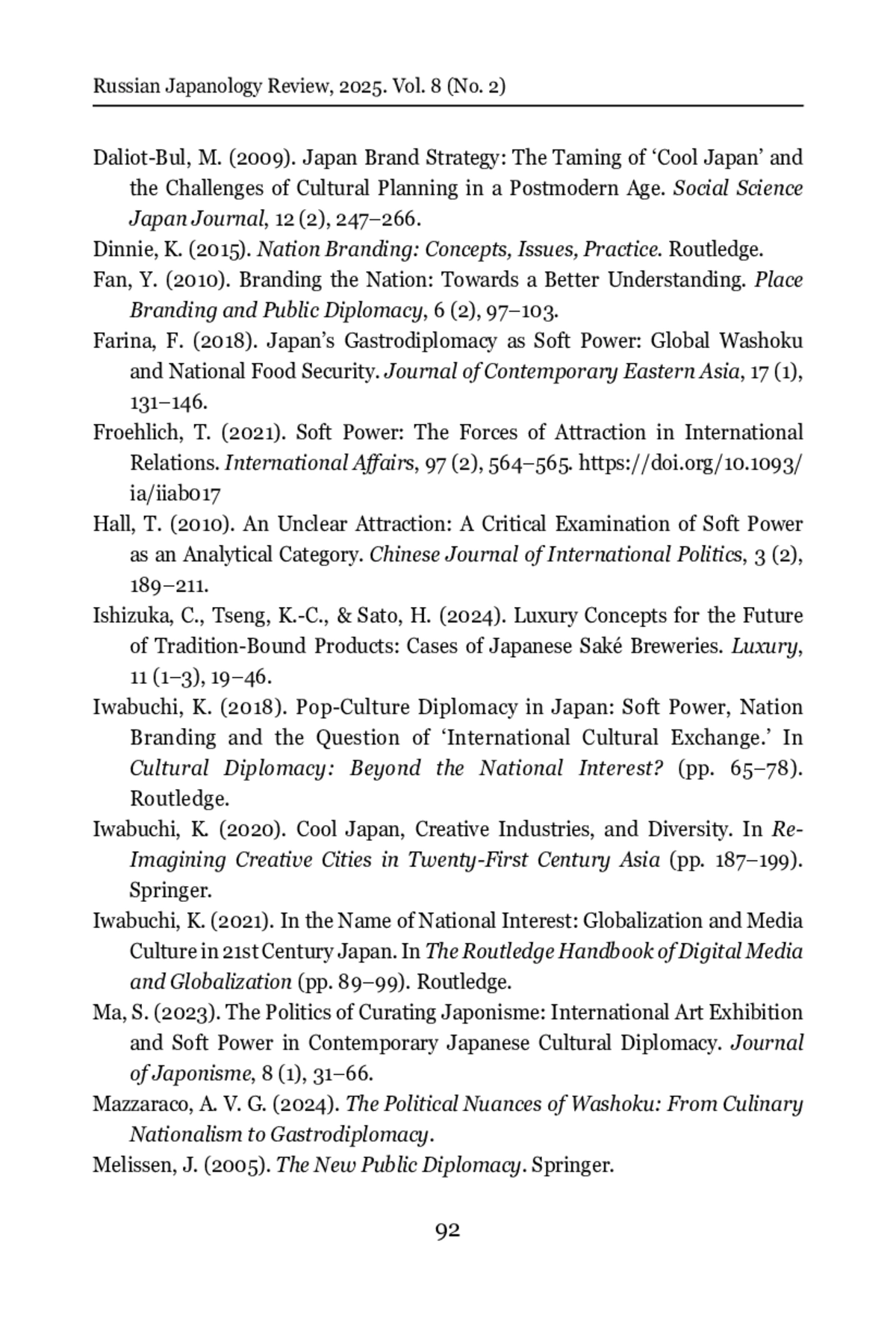
1. Akagawa, N. (2014). Heritage Conservation and Japan’s Cultural Diplomacy: Heritage, National Identity and National Interest. Routledge.
2. Anholt, S. (2007). Competitive Identity and Development. In Competitive Identity: The New Brand Management for Nations, Cities and Regions (pp. 113-128). Springer.
3. Anholt, S. (2010). Definitions of Place Branding - Working Towards a Resolution. Place Branding and Public Diplomacy, 6 (1), 1-10.
4. Assmann, S. (2017). Global Recognition and Domestic Containment: Culinary Soft Power in Japan. In Feeding Japan: The Cultural and Political Issues of Dependency and Risk (pp. 113-137). Springer.
5. Association. (2024). Japan Sake and Shochu Makers Association. Sake Export Trends 2023. Retrieved from https://www.japansake.or.jp/sake/english/data/.
6. Bargain, O. (2024). Globalization and Cultural Spillover in Trade: Evidence From the Japanese Food Culture. Review of World Economics, 160 (1), 55-73.
7. Boan, B. (2022). Nation Branding: The Case for Marketing Strategy in International Relations.
8. Bukh, A. (2014). Revisiting Japan’s Cultural Diplomacy: A Critique of the Agent-Level Approach to Japan’s Soft Power. Asian Perspective, 38 (3), 461-485.
9. Cull, N. J. (2009). Public Diplomacy: Lessons From the Past (Vol. 12). Figueroa Press Los Angeles.
10. Daliot-Bul, M. (2009). Japan Brand Strategy: The Taming of ‘Cool Japan’ and the Challenges of Cultural Planning in a Postmodern Age. Social Science Japan Journal, 12 (2), 247-266.
11. Dinnie, K. (2015). Nation Branding: Concepts, Issues, Practice. Routledge.
12. Fan, Y. (2010). Branding the Nation: Towards a Better Understanding. Place Branding and Public Diplomacy, 6 (2), 97-103.
13. Farina, F. (2018). Japan’s Gastrodiplomacy as Soft Power: Global Washoku and National Food Security. Journal of Contemporary Eastern Asia, 17 (1), 131-146.
14. Froehlich, T. (2021). Soft Power: The Forces of Attraction in International Relations. International Affairs, 97 (2), 564-565. https://doi.org/10.1093/ia/iiab017.
15. Hall, T. (2010). An Unclear Attraction: A Critical Examination of Soft Power as an Analytical Category. Chinese Journal of International Politics, 3 (2), 189-211.
16. Ishizuka, C., Tseng, K.-C., & Sato, H. (2024). Luxury Concepts for the Future of Tradition-Bound Products: Cases of Japanese Saké Breweries. Luxury, 11 (1-3), 19-46.
17. Iwabuchi, K. (2018). Pop-Culture Diplomacy in Japan: Soft Power, Nation Branding and the Question of ‘International Cultural Exchange.’ In Cultural Diplomacy: Beyond the National Interest? (pp. 65-78). Routledge.
18. Iwabuchi, K. (2020). Cool Japan, Creative Industries, and Diversity. In Re-Imagining Creative Cities in Twenty-First Century Asia (pp. 187-199). Springer.
19. Iwabuchi, K. (2021). In the Name of National Interest: Globalization and Media Culture in 21st Century Japan. In The Routledge Handbook of Digital Media and Globalization (pp. 89-99). Routledge.
20. Ma, S. (2023). The Politics of Curating Japonisme: International Art Exhibition and Soft Power in Contemporary Japanese Cultural Diplomacy. Journal of Japonisme, 8 (1), 31-66.
21. Mazzaraco, A. V. G. (2024). The Political Nuances of Washoku: From Culinary Nationalism to Gastrodiplomacy.
22. Melissen, J. (2005). The New Public Diplomacy. Springer.
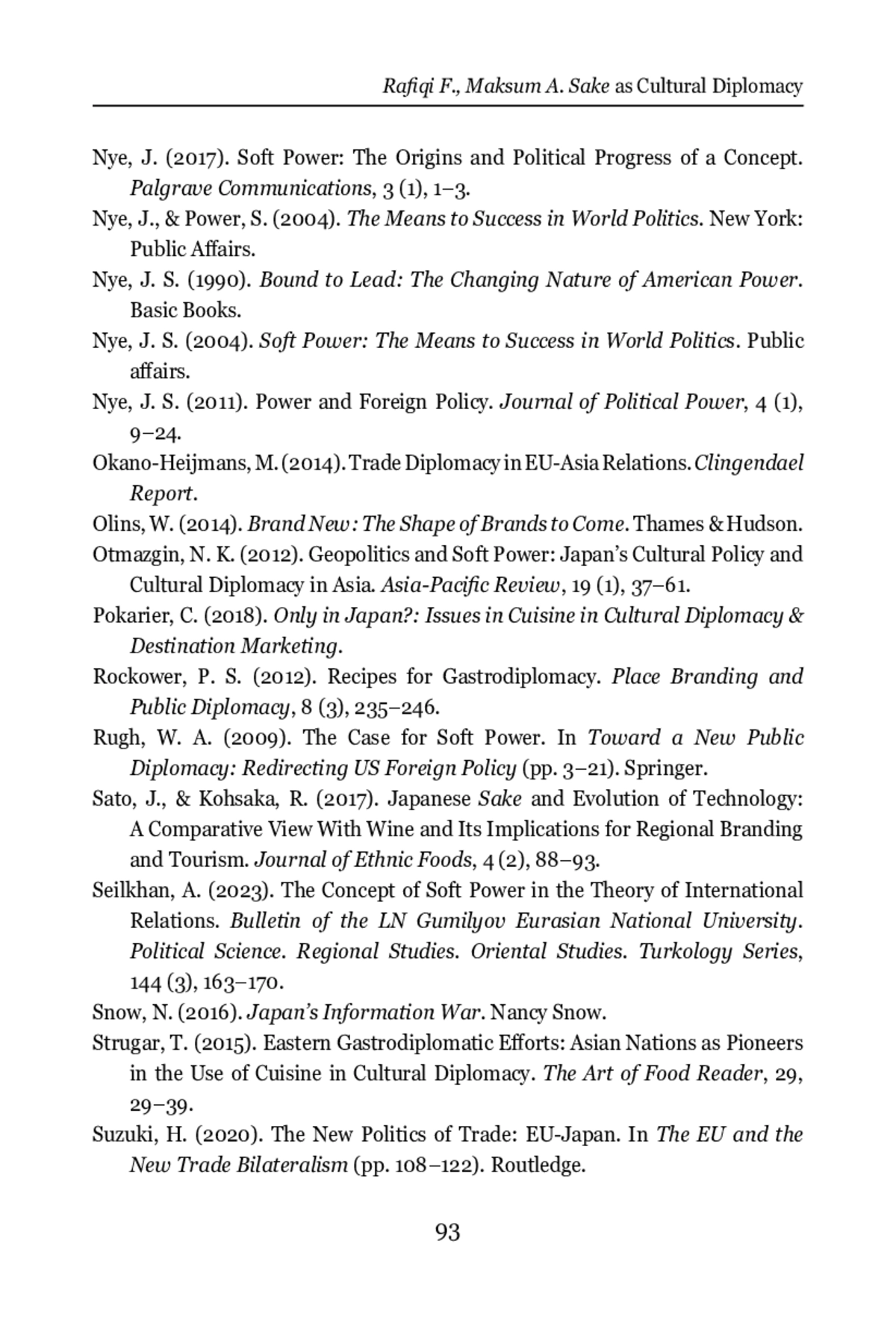
23. Nye, J. (2017). Soft Power: The Origins and Political Progress of a Concept. Palgrave Communications, 3 (1), 1-3.
24. Nye, J., & Power, S. (2004). The Means to Success in World Politics. New York: Public Affairs.
25. Nye, J. S. (1990). Bound to Lead: The Changing Nature of American Power. Basic Books.
26. Nye, J. S. (2004). Soft Power: The Means to Success in World Politics. Public affairs.
27. Nye, J. S. (2011). Power and Foreign Policy. Journal of Political Power, 4 (1), 9-24.
28. Okano-Heijmans, M. (2014). Trade Diplomacy in EU-Asia Relations. Clingendael Report.
29. Olins, W. (2014). Brand New: The Shape of Brands to Come. Thames & Hudson.
30. Otmazgin, N. K. (2012). Geopolitics and Soft Power: Japan’s Cultural Policy and Cultural Diplomacy in Asia. Asia-Pacific Review, 19 (1), 37-61.
31. Pokarier, C. (2018). Only in Japan?: Issues in Cuisine in Cultural Diplomacy & Destination Marketing.
32. Rockower, P. S. (2012). Recipes for Gastrodiplomacy. Place Branding and Public Diplomacy, 8 (3), 235-246.
33. Rugh, W. A. (2009). The Case for Soft Power. In Toward a New Public Diplomacy: Redirecting US Foreign Policy (pp. 3-21). Springer.
34. Sato, J., & Kohsaka, R. (2017). Japanese Sake and Evolution of Technology: A Comparative View With Wine and Its Implications for Regional Branding and Tourism. Journal of Ethnic Foods, 4 (2), 88-93.
35. Seilkhan, А. (2023). The Concept of Soft Power in the Theory of International Relations. Bulletin of the LN Gumilyov Eurasian National University. Political Science. Regional Studies. Oriental Studies. Turkology Series, 144 (3), 163-170.
36. Snow, N. (2016). Japan’s Information War. Nancy Snow.
37. Strugar, T. (2015). Eastern Gastrodiplomatic Efforts: Asian Nations as Pioneers in the Use of Cuisine in Cultural Diplomacy. The Art of Food Reader, 29, 29-39.
38. Suzuki, H. (2020). The New Politics of Trade: EU-Japan. In The EU and the New Trade Bilateralism (pp. 108-122). Routledge.
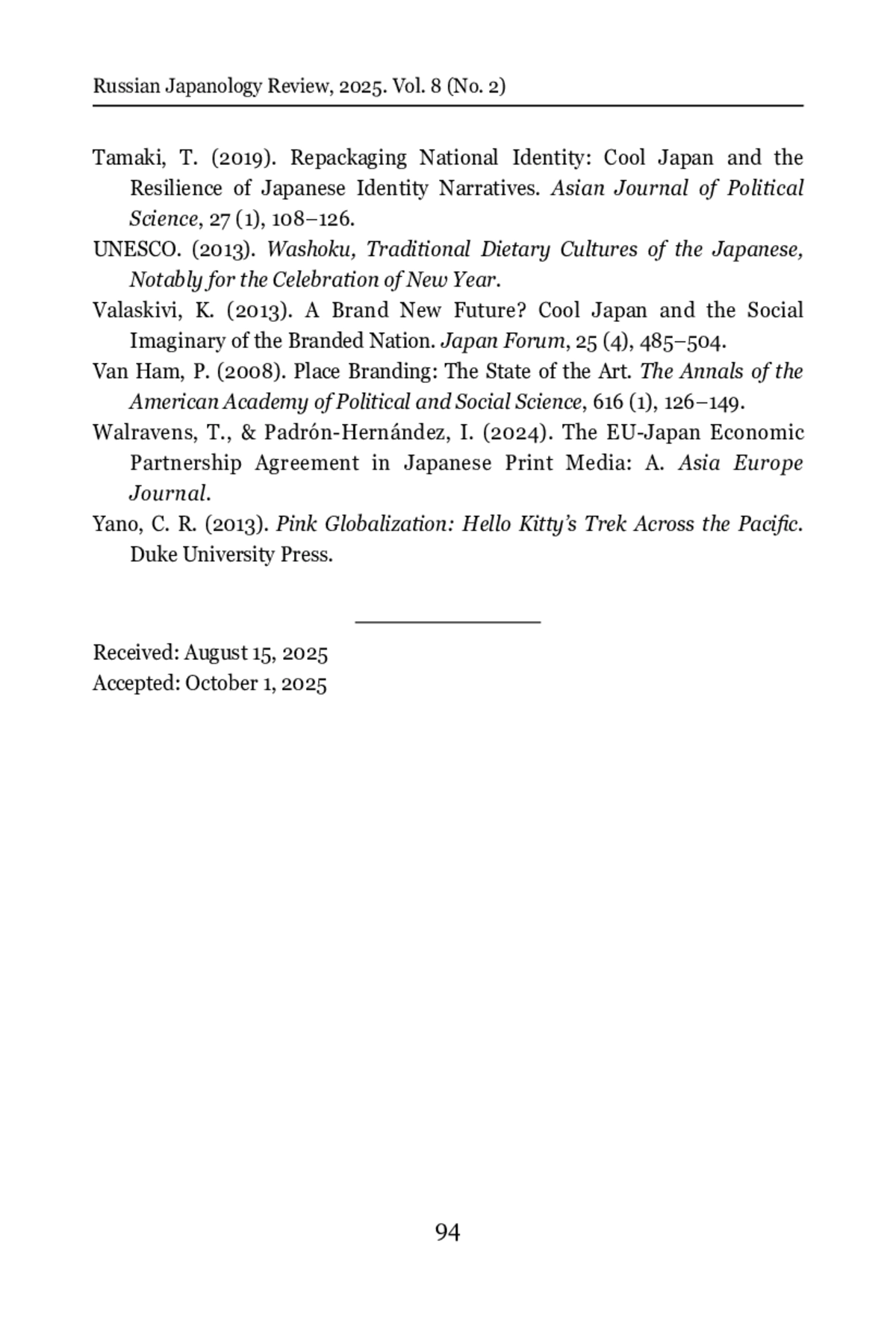
39. Tamaki, T. (2019). Repackaging National Identity: Cool Japan and the Resilience of Japanese Identity Narratives. Asian Journal of Political Science, 27 (1), 108-126.
40. UNESCO. (2013). Washoku, Traditional Dietary Cultures of the Japanese, Notably for the Celebration of New Year.
41. Valaskivi, K. (2013). A Brand New Future? Cool Japan and the Social Imaginary of the Branded Nation. Japan Forum, 25 (4), 485-504.
42. Van Ham, P. (2008). Place Branding: The State of the Art. The Annals of the American Academy of Political and Social Science, 616 (1), 126-149.
43. Walravens, T., & Padrón-Hernández, I. (2024). The EU-Japan Economic Partnership Agreement in Japanese Print Media: A. Asia Europe Journal.
44. Yano, C. R. (2013). Pink Globalization: Hello Kitty’s Trek Across the Pacific. Duke University Press.

Выпуск
Другие статьи выпуска
The article presents an overview of the collective monograph “Japanese Culture in the West” ed. by Katasonova, E. L. and Dolin, A. A (Moscow: Institute of Oriental Studies of RAS, 2024. 544 p. ISBN: 978-5-907846-81-4). The monograph, for the ¿rst time in the history of Russian Oriental studies, presents a comprehensive interdisciplinary analysis of the spread and inÀuence of Japanese culture on the countries of Europe and America in the 19th – 21st centuries. The reviewer notes that analyzing the experience of “exporting Japanese culture” makes it possible to develop a methodology for transcultural processes, broaden the concepts of cultural authenticity and identity, and propose an alternative to binary models of cultural interaction
The article revisits the policies of Abe ShinzŮ, Japan’s longest-serving prime minister, and places them in the context of the current trend of civilizations advancing as a major factor in international aɣairs. We brieÀy examine the development of the inÀuential concept of a “civilizational state,” today most often exempli¿ed by China, and suggest that this concept can be used to elucidate Abe’s vision of Japanese polity and its position on the global arena. Based on the review of the relevant scholarly literature, we argue that Japan’s traditional selfidenti¿cation as a mediator between Asia and the West also conforms to the idea of a civilizational state. We highlight that the key factor inÀuencing the international situation over Abe’s second administration (2012–2020) was the rise of China in the aftermath of the 2008–2009 ¿nancial crisis, which exposed the West’s relative economic decline. In these circumstances, Japan attempted to assume a position of a mediator between the two poles of power, a position that we relate to Abe’s political aspirations such as his quest for Japan’s greater political autonomy and his appeal both to Asian identity and universal values. In certain respects, this tendency continues after Abe’s resignation in 2020 as well, though whether current and future leaders of Japan will continue with his general approach is a complicated question. We conclude by arguing for urgency of the discussion of the political ideas that mediate between the universal and the local values and identities – a task for which Abe’s legacy appears to us to be particularly relevant.
The article presents a comparative study of the sanctions policy of Japan and the Republic of Korea towards Russia after February 2022 and the assessment of the impact of their sanctions on the development of RussianJapanese and Russian-South Korean cooperation in the Russian Far East. Based on the results of the study of the economic ties of Russia, Japan, and South Korea (in the areas of trade, investment, ¿nance, tourism, and transport) and their interaction in the educational and cultural-humanitarian spheres under sanctions restrictions, the authors come to the conclusion that the sanctions policy of Japan and South Korea towards Russia has a common basis due to their belonging to the “collective West,” and the anti-Russian measures they take are aimed at weakening the industrial and technological potential of the Russian Federation. At the same time, like most of their Western partners, Japan and South Korea are not ready to impose such sanctions that could cause signi¿cant damage to their own economic and strategic interests. There are important diɣerences in the sanctions approaches of Japan and South Korea – Japan pursues a much tougher policy towards Russia, not only limiting exports to Russia, but also imposing a ban on imports of a number of goods from Russia. South Korea is much more willing to maintain ties with Russia and its Far Eastern territories, despite the unfavorable political situation, which is expressed, in particular, in the ongoing oɤcial contacts between Primorsky Krai and Vladivostok and a number of provinces and municipalities of the Republic of Korea. The authors suggest that ties between the Russian Far East and South Korea can be quickly restored once the situation around Ukraine is resolved, while the prospects for restoring relations with Japan look much less certain
In the modern world, primarily in developed countries, education has become the main factor of intergenerational social mobility. Sociologists judge the degree of openness or rigidity of the social structure by whether the inÀuence of “birth circumstances” on access to education increases or, conversely, softens. Although higher education has become widespread in Japan by now, this does not mean that the degree of social inequality in this area has decreased. Structuring children’s chances of access to higher education along the lines dividing society into diɣerent social strata begins here at the stage of schooling – ¿rst, in lower secondary school, and then in upper secondary school. The inequality of chances that forms at the stage of school education aɣects the choice of university rank and directions of specialization by children and their parents, employment opportunities in the future, determining, in fact, the entire life path of a person. Based on the works of famous Japanese sociologists and the data of Japanese statistics, the author shows that the Japanese education system plays a dual role. On the one hand, it provides a chance to break away from one’s social roots and move up the social ladder to an increasing number of young people. On the other hand, it preserves and reproduces social inequality. According to calculations by Japanese sociologists, indicators of relative social mobility, reÀecting the ratio of chances to access higher education for people from diɣerent backgrounds, were remarkably stable throughout the post-war period. On the one hand, this does not con¿rm the widely accepted thesis about the growing inequality in education in the last two or three decades. On the other hand, it allows us to assert that both before and now Japanese society is a kakusa shakai, or a gap society. However, the increase of the share of second-generation university degree holders in the structure of Japanese university graduates suggests that the scale of the inÀuence of the factor of social inequality in education will gradually decrease.
The article is devoted to identi¿cation of similarities and diɣerences in the historical memory of Japan and the Federal Republic of Germany after World War II. These issues are a relevant topic for research in the face of the enduring inÀuence of historical grievances on Japan’s relations with its former victims, in contrast to similar relations of Germany. As a theoretical framework, the paper uses O. Malinova’s approach, which interprets historical memory as a product of social construction and a variation of symbolic politics. In addition, the author uses the classi¿cation of historical memory proposed by Matteo Dian. In the scope of the study, the author examines the impact of occupation policies on the further development of historical memory in the two countries. The paper compares the original content of the main narratives of historical memory in each country, the main mnemonic actors promoting them, and the evolution of these narratives from the end of the war to the present day. The author also highlights the reasons for the diɣerences in the content and evolution of the narratives in Japan and the FRG. The author concludes that, despite a certain similarity of the occupation policy in the two countries, as well as the formation of two traditions (conservative and left-progressive) in each country’s historical memory, its content and evolution are substantially diɣerent. In the FRG, the conservative tradition initially included the narratives of self-victimhood and amnesia, while the progressive tradition included the narrative of contrition; over the years however, the traditions have evolved from polarization to a consensus around contrition and elements of self-victimhood. In Japan, the conservative tradition initially included glori¿cation of the past in addition to self-victimhood, i. e., it was more revisionist, while the progressive tradition focused on self-victimhood rather than contrition. Over time, the traditions in Japan shifted from a consensus around self-victimhood to a sharp polarization: progressives moved to a contrition narrative, while revisionists gained ground among conservatives
In Japan, there are many regional legends and traditions associated with water, ¿sh, and fantastic creatures inhabiting the sea. These legends go back many centuries; the ¿rst mentions of large ¿sh are found already in the ¿rst Japanese poetic anthology Man’yōshū (8th century) and in the mythological and chronicle text Nihon Shoki (720). In diɣerent provinces, legends and traditions vary, some motifs are interpreted diɣerently by folklorists, however. Evidently, we can talk about a single body of related texts, united not only by plots where the main characters are whales, dolphins, etc., but also by accompanying actions: matsuri festivals in honor of ¿sh and ¿shing, ritual performance of magical texts, dancing, songs, cooking, making amulets, etc. The symbolism that unites the theme of ¿sh and ¿shing in Chinese and Japanese culture is also obvious: wealth and prosperity, which is reÀected not only in written monuments, but also in works of art. Whales, for example, are associated with numerous legends, traditions, and mythological motifs of local signi¿cance, ideas about these mammals as deities of the sea, to whom Shinto shrines are dedicated. Images of ¿sh were part of oɣerings to the bride’s family due to the auspicious meaning of the item. It is noteworthy that the legends about the sea included famous literary and legendary characters and episodes from famous works of Japanese history and literature, such as Kojiki, Nihon Shoki, Man’yōshū, Heike Monogatari
Издательство
- Издательство
- АССОЦИАЦИЯ ЯПОНОВЕДОВ
- Регион
- Россия, Москва
- Почтовый адрес
- 117218, г. Москва, Нахимовский проспект, 32
- Юр. адрес
- 117218, г. Москва, Нахимовский проспект, 32
- ФИО
- Стрельцов Дмитрий Викторович (ПРЕДСЕДАТЕЛЬ)
- E-mail адрес
- japanassoc@gmail.com