
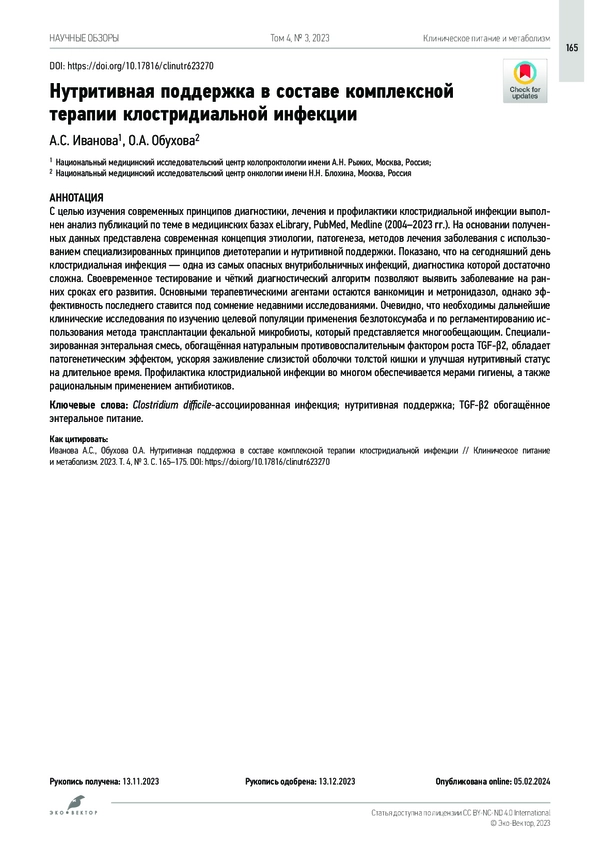
С целью изучения современных принципов диагностики, лечения и профилактики клостридиальной инфекции выполнен анализ публикаций по теме в медицинских базах eLibrary, PubMed, Medline (2004–2023 гг.). На основании полученных данных представлена современная концепция этиологии, патогенеза, методов лечения заболевания с использованием специализированных принципов диетотерапии и нутритивной поддержки. Показано, что на сегодняшний день клостридиальная инфекция — одна из самых опасных внутрибольничных инфекций, диагностика которой достаточно
сложна. Своевременное тестирование и чёткий диагностический алгоритм позволяют выявить заболевание на ранних сроках его развития. Основными терапевтическими агентами остаются ванкомицин и метронидазол, однако эффективность последнего ставится под сомнение недавними исследованиями. Очевидно, что необходимы дальнейшие клинические исследования по изучению целевой популяции применения безлотоксумаба и по регламентированию использования метода трансплантации фекальной микробиоты, который представляется многообещающим. Специализированная энтеральная смесь, обогащённая натуральным противовоспалительным фактором роста TGF-β2, обладает патогенетическим эффектом, ускоряя заживление слизистой оболочки толстой кишки и улучшая нутритивный статуна длительное время. Профилактика клостридиальной инфекции во многом обеспечивается мерами гигиены, а также
рациональным применением антибиотиков.
Идентификаторы и классификаторы
Современную медицину невозможно представить без применения антибиотиков, которые широко используются для профилактики и лечения инфекционных осложнений во всех областях медицины. Платой за успех становятся побочные эффекты, в том числе антибиотик-
ассоциированная диарея. Наиболее частым патогеном, который приводит к развитию данного осложнения, является Clostridium difficile (C. difficile).
Если у вас возникли вопросы или появились предложения по содержанию статьи, пожалуйста, направляйте их в рамках данной темы.
Список литературы
1. Riley T.V. Clostridium. In: Irving W.L., Medical Microbiology: A Guide to Microbial Infections: Pathogenesis, Immunity, Laboratory Investigation and Control. Barer M.R., Swann A., Perera N., editors. Elsevier, 2019.
2. Bartlett J.G., Onderdonk A.B., Cisneros R.L. Clindamycinassociated colitis in hamsters: protection with vancomycin // Gastroenterology. 1977. Vol. 73, 4 Pt 1. P. 772–776.
3. Czepiel J., Dróżdż M., Pituch H., et al. Clostridium difficile infection: review // Eur J Clin Microbiol Infect Dis. 2019. Vol. 38. P. 1211–1221. doi: 10.1007/s10096-019-03539-6
4. Tedesco F.J., Barton R.W., Alpers D.H. Clindamycin-associated colitis. A prospective study // Ann Intern Med. 1974. Vol. 81, N 4. P. 429–433. doi: 10.7326/0003-4819-81-4-429
5. Hookman P., Barkin J.S. Clostridium difficile associated infection, diarrhea and colitis // World J Gastroenterol. 2009. Vol. 15, N 13. P. 1554–1580. doi: 10.3748/wjg.15.1554
6. Avi P., Ben Izhar Sh., Orna N., et al. Clostridium difficile infection: associations with chemotherapy, radiation therapy, and targeting therapy treatments // Curr Med Chem. 2016. Vol. 23, N 39. P. 4442–4449. doi: 10.2174/0929867323666161028162018
7. Драпкина О.М., Лазебник Л.Б., Бакулин И.Г., и др. Инфекция Clostridioides difficile: диагностика, лечение и профилактика. Клинические рекомендации Российского научного медицинского общества терапевтов, Научного общества гастроэнтерологов России,
Общества гастроэнтерологов и гепатологов «Северо-Запад» // Экспериментальная и клиническая гастроэнтерология. 2023. № 2. С. 4–32. EDN: TKKDIC doi: 10.31146/1682-8658-ecg-210-2-4-32
8. McDonald L.C., Coignard B., Dubberke E., et al. Recommendations for surveillance of Clostridium difficile-associated disease // Infect Control Hosp Epidemiol. 2007. Vol. 28, N 2. P. 140–145. doi: 10.1086/511798
9. Bouza E., Aguado J.M., Alcalá L., et al. Recommendations for the diagnosis and treatment of Clostridioides difficile infection: An official clinical practice guideline of the Spanish Society of Chemotherapy (SEQ), Spanish Society of Internal Medicine (SEMI) and the working group of Postoperative Infection of the Spanish Society of Anesthesia and Reanimation (SEDAR) // Rev Esp Quimioter. 2020. Vol. 33, N 2. P. 151–175. doi: 10.37201/req/2065.2020
10. Шляпников С.А., Насер Н.Р., Батыршин И.М., и др. Антибиотик-ассоциированный колит — новая проблема в хирургии // Вестник Национального медико-хирургического Центра
им. Н.И. Пирогова. 2020. Т. 15, № 2. С. 138–143. EDN: GDPLJK doi: 10.25881/BPNMSC.2020.62.96.024
11. Debast S.B., Bauer M.P., Kuijper E.J., European Society of Clinical Microbiology and Infectious Diseases. European Society of Clinical Microbiology and Infectious Diseases: update of the treatment guidance document for Clostridium difficile infection // Clin Microbiol Infect. 2014. Vol. 20, Suppl. 2. P. 1–26. doi: 10.1111/1469-0691.12418
12. Van Prehn J., Reigadas E., Vogelzang E.H., et al. Guideline committee of the European Study Group on Clostridioides difficile. European Society of Clinical Microbiology and Infectious Diseases: 2021 update on the treatment guidance document for Clostridioides difficile infection in adults // Clin Microbiol Infect. 2021. Vol. 27, Suppl. 2. P. S1–S21. doi: 10.1016/j.cmi.2021.09.038
13. Burke K.E, Lamont J.T. Clostridium difficile infection: a worldwide disease // Gut and Liver. 2014. Vol. 8, N 1. P. 1–6. doi: 10.5009/gnl.2014.8.1.1
14. Abt M.C., McKenney P.T., Pamer E.G. Clostridium difficile colitis: pathogenesis and host defence // Nature Reviews Microbiology. 2016. Vol. 14, N 10. P. 609–620. doi: 10.1038/nrmicro.2016.108
15. Elliott B., Androga G.O., Knight D.R., Riley T.V. Clostridium difficileinfection: evolution, phylogeny and molecular epidemiology //Infection, Genetics and Evolution. 2017. Vol. 49. P. 1– 11. doi: 10.1016/j.meegid.2016.12.018
16. Shen A. Clostridium difficile toxins: mediators of inflammation // J Innate Immun. 2012. Vol. 4, N 2. P. 149–158. doi: 10.1159/000332946
17. Hookman P., Barkin J.S. Clostridium difficile associated infection, diarrhea and colitis // World J Gastroenterol. 2009. Vol. 15, N 13. P. 1554–1580. doi: 10.3748/wjg.15.1554
18. Cohen S.H., Gerding D.N., Johnson S., et al. Clinical practice guidelines for Clostridium difficile infection in adults: 2010 update by the Society for Healthcare Epidemiology of America (SHEA) and the Infectious Diseases Society of America (IDSA) // Infect Control Hosp Epidemiol. 2010. Vol. 31, N 5. P. 431–455. doi: 10.1086/651706
19. Ooijevaar R.E., van Beurden Y.H., Terveer E.M., et al. Update of treatment algorithms for Clostridium difficile infection // Clin Microbiol Infect. 2018. Vol. 24, N 5. P. 452–462. doi: 10.1016/j.cmi.2017.12.022
20. Johnson S., Lavergne V., Skinner A.M., et al. Clinical practice guideline by the Infectious Diseases Society of America (IDSA) and Society for Healthcare Epidemiology of America (SHEA): 2021 focused update guidelines on management of Clostridioides difficile infection in adults // Clin Infect Dis. 2021. Vol. 73, N 5. P. 1029–1044. doi: 10.1093/cid/ciab549
21. Guery B., Galperine T., Barbut F. Clostridioides difficile: diagnosis and treatments // BMJ. 2019. Vol. 366. doi: 10.1136/bmj.l4609
22. Johnson S., Louie T.J., Gerding D.N., et al. Vancomycin, metronidazole, or tolevamer for Clostridium difficile infection: results from two multinational, randomized, controlled trials // Clin Infect Dis. 2014. Vol. 59. P. 345–354. doi: 10.1093/cid/ciu313
23. Nelson R.L., Suda K.J., Evans C.T. Antibiotic treatment for Clostridium difficile-associated diarrhoea in adults // Cochrane Database Syst Rev. 2017. Vol. 3, N 3. P. CD004610. doi: 10.1002/14651858.CD004610.pub5
24. Stevens V.W., Nelson R.E., Schwab-Daugherty E.M., et al. Comparative effectiveness of vancomycin and metronidazole forthe prevention of recurrence and death in patients with Clostridium difficile infection // JAMA Intern Med. 2017. Vol. 177. P. 546–553.
doi: 10.1001/jamainternmed.2016.9045
25. Chen J., Li Y., Wang S., et al. Targeting Clostridioides difficile: New uses for old drugs // Drug Discov Today. 2022. Vol. 27, N 7. P. 1862–1873. doi: 10.1016/j.drudis.2022.03.021
26. Singh T., Bedi P., Bumrah K., et al. Fecal Microbiota Transplantation and Medical Therapy for Clostridium difficile Infection: Meta-analysis of Randomized Controlled Trials // J Clin Gastroenterol. 2022. Vol. 56, N 10. P. 881–888. doi: 10.1097/MCG.0000000000001610
27. Hota S.S., Sales V., Tomlinson G., et al. Oral vancomycin followed by fecal transplantation versus tapering oral vancomycin treatment for recurrent Clostridium difficile infection: an openlabel, randomized controlled trial // Clin Infect Dis. 2017. Vol. 64. P. 265–271. doi: 10.1093/cid/ciw731
28. Шедоева Л.Р., Чашкова Е.Ю., Рубцов А.С. Успешный опыт применения фекальной трансплантации у пациентки с тяжёлым псевдомембранозным колитом // Acta biomedica scientifica. 2020. Т. 5, № 6. С. 248–253. EDN: HRYDCQ doi: 10.29413/ABS.2020-5.6.32
29. Bischoff S.C., Bager P., Escher J., et al. ESPEN guideline on clinical nutrition in inflammatory bowel disease // Cl Nutr. 2023. Vol. 42, N 3. P. 352–379. doi: 10.1016/j.clnu.2022.12.004
30. Кашия Ш.Р., Курмуков И.А., Обухова О.А., и др. Применение антиоксидантов в комплексной интенсивной терапии инфекционных осложнений лекарственного противоопухолевого лечения // Клиническая онкогематология. Фундаментальные ис-
следования и клиническая практика. 2012. Т. 5, № 1. С. 54–60. EDN: SYADGD
31. Обухова О.А., Курмуков И.А., Кашия Ш.Р. Диагностика и ле- чение железодефицитной анемии в онкологии // Онкогинекология. 2014. № 2. С. 67–76. EDN: TAIZPH
32. Хорошилов И.Е., Иванов С.В. Энтеральное питание «Модуле- ном IBD» как метод патогенетической терапии воспалительных заболеваний кишечника // Эффективная фармакотерапия. 2011. № 5. С. 18–22. EDN: SJWIKR
33. Fell J.M.E. Control of systemic and local inflammation with transforming growth factor beta containing formulas // J Parenter Enteral Nutr. 2005. Vol. 29, N 4S. P. S126–S133. doi: 10.1177/01486071050290S4S126
34. Bannerjee K., Camacho-Hübner C., Babinska K., et al. Anti-inflammatory and growth-stimulating effects precede nutritional restitution during enteral feeding in Crohn disease // J Pediatr Gastroenterol Nutr. 2004. Vol. 38. P. 270–275. doi: 10.1097/00005176-200403000-00007
35. Hartman C., Berkowitz D., Weiss B., et al. Nutritional supplementation with polymeric diet enriched with transforming growth factor-beta 2 for children with Crohn’s disease // Isr Med Assoc J. 2008. Vol. 10. P. 503–507.
36. Михайлова Т.Л., Романов Р.И., Костенко Н.В., и др. Опыт применения энтерального питания в лечении пациентов с болезнью Крона толстой кишки и язвенным колитом // Колопроктология. 2006. № 1 (15). С. 19–23. EDN: MNIZKV
37. Karakan T., Ibis M., Arhan M., Unal S. PP110-MON: Exclusive enteral nutrition with TGF-beta supplements improve clinicalparameters and increase nutritional status of adult patients with
inflammatory bowel disease // Clin Nutr. 2014. Vol. 33 Suppl. 1. P. S170–S171. doi: 10.1016/S0261-5614(14)50445-1
38. Agin M., Yucel A., Gumus M., Yuksekkaya H.A., Tumgor G. The Effect of Enteral Nutrition Support Rich in TGF-β in the Treatment of Inflammatory Bowel Disease in Childhood // Medicina (Kaunas). 2019. Vol. 55, N 10. P. 620. doi: 10.3390/medicina55100620
39. Morello E., Brambilla G., Bernardi S., et al. Nutritional intervention with TGF-beta enriched food for special medical purposes (TGF-FSMP) is associated with a reduction of malnutrition, acute GVHD, pneumonia and may improve overall survival in patients undergoing allogeneic hematopoietic stem transplantation // Transpl Immunol. 2023. Vol. 81. P. 101954. doi: 10.1016/j.trim.2023.101954
Выпуск
Другие статьи выпуска
В рамках XXVII Российского онкологического конгресса состоялась секция «Нутритивная поддержка — недооценённый инструмент в руках онколога. Как обеспечить успешную непрерывную противоопухолевую терапию?» В представленном сообщении изложены тезисы докладов участников секции.
Доклад Геворкова А.Р. касался актуальности нутритивной поддержки в онкологии, негативного влияния нутритивной недостаточности на результаты хирругического, лекарственного и лучевого лечения онкологических больных на всех его этапах. Доклад Обуховой О.А. был посвящён эффективности нутритивной поддержки при проведении хирургического лечения онкологических больных, опирался на результаты хорошо спланированных и выполненных клинических исследований, в том числе первого отечественного проспективного многоцентрового рандомизированного исследования периоперационного высокобелкового энтерального питания NUTRILUNC. Доклад Кукош М.Ю. отразил роль реабилитации в непрерывности противоопухолевого лечения и место нутритивной поддержки в соответствующей программе реабилитации.
Авторы сделали вывод, что проведение нутритивной поддержки на всех этапах противоопухолевого лечения актуально, эффективно и безопасно и призвали онкологов к широкому внедрению искусственного питания в клиническую практику.
Нейрогенная орофарингеальная дисфагия остаётся широко распространённым осложнением неврологических заболеваний. Её распространённость у пациентов, перенёсших инсульт, достигает 50%, среди пациентов с рассеянным склерозом — 44%, при боковом амиотрофическом склерозе — 60%, после травмы головного мозга — 50%, при болезни Паркинсона — 84%. Нейрогенная орофарингеальная дисфагия способна привести к снижению потребления пищи, развитию недостаточности питания и обезвоживанию, а также может осложниться развитием аспирационной пневмонии с последующим летальным исходом. В настоящее время выявление дисфагии у госпитализированных пациентов часто проводится с опозданием или вне алгоритма, что значительно увеличивает риск развития белково-энергетической недостаточности, снижения качества жизни и других осложнений при приёме пищи. Клиническое исследование функции глотания в максимально ранние сроки госпитализации позволяет избежать задержек в диагностике и своевременно определить тактику питания пациента с нейрогенной дисфагией. Оценка функции глотания должна быть проведена в первые часы госпитализации пациента, и главный вывод, который необходимо сделать по результатам клинического исследования функции глотания, заключается в том, может ли пациент получать пищу через рот с удовлетворением потребностей в энергии и белке.
Несмотря на актуальность проблемы развития белково-энергетической недостаточности у пациентов с дисфагией, в отечественной литературе существует мало конкретных рекомендаций по этапам диагностики, медицинской реабилитации и нутритивной поддержки для данной категории больных. Данный обзор посвящён анализу необходимости корректного проведения диагностики и реабилитации пациентов с дисфагией и влияния дисфагии на качество жизни и нутритивный статус пациента.
В связи с тенденцией к увеличению продолжительности жизни и общим ростом количества пожилого населения, прогнозируется также рост распространённости остеопороза. Оценивая параметры состава тела у пациентов с остеопорозом, необходимо учитывать возможное снижение роста в этой группе как наиболее частое осложнение остеопороза на фоне компрессионных переломов тел позвонков.
В результате снижения роста пациентов могут быть завышены расчётные показатели оценки статуса питания, использующие в знаменателе квадрат роста (например, индекс массы тела), снижая чувствительность этих методов в оценке нутритивного статуса. У таких пациентов можно рассмотреть измерение длины тела или оценивать рост анамнестически, но требуются дальнейшие исследования на эту тему.
В качестве инструментальных методов определения состава тела оптимально использование денситометрии или биоимпедансного анализа. Оценка фазового угла у таких пациентов может иметь дополнительные преимущества, так как этот параметр не зависит от точности антропометрических измерений.
При отсутствии возможности проведения денситометрии и биоимпедансного анализа у таких пациентов косвенная оценка содержания скелетно-мышечной ткани в организме может проводиться с помощью измерения окружности мышц плеча и голени.
Поддержание оптимального нутритивного статуса пациентов с остеопорозом может вносить дополнительный вклад в эффективность лечения, снижая риски осложнений.
Около 60% больных раком лёгких теряют массу тела. Распространённость саркопении у пациентов с немелкоклеточным раком легкого (НМРЛ) составляет порядка 43% и является независимым предиктором худшей общей выживаемости. Было показано, что нутритивная поддержка улучшает результаты лечения больных НМРЛ.
Цель. Оценить влияние периоперационной нутритивной поддержки на непосредственные результаты хирургического лечения больных НМРЛ.
Материалы и методы. В исследование включено 112 первичных больных НМРЛ (из них 69 мужчин) в возрасте 57,2±8,2 года с риском развития нутритивной недостаточности (Nutritional Risk Screening Assessment 2002 ≥3 баллов, оценка по шкале состояния и производительности Eastern Cooperative Oncology Group 0–2 балла), которым планирова-
лось проведение оперативного вмешательства (анатомическая резекция лёгкого). Больные были рандомно разделены на 2 группы: исследовательская группа (n=55) получала сиппинг («Нутридринк Компакт Протеин», ООО «Нутриция») в дозе 250 мл/сут (36 г белка, 612 ккал) в течение 14 дней до и 14 дней после операции в дополнение к стандартной
диете. Контрольная группа (n=57) получала стандартную диету. Оценивали число респираторных осложнений в раннем послеоперационном периоде, сроки госпитализации, антропометрические, функциональные, лабораторные показатели, качество жизни (согласно опроснику EORTC QLQ-C30). Результаты представлены как среднее ± стандартное отклонение. Различия считали значимыми при p ≤0,05.
Результаты. Частота лёгочных инфекций и частота бронхоскопий были меньше в исследовательской группе (5,47% против 25%; 20% против 58%; p <0,01). Длительность госпитализации также была короче на 1,4 дня в группе исследования (p=0,03). Масса тела в исследовательской группе значимо не изменилась, а в контрольной группе снизилась (0,15±3,7 кг против потери 3,47±3,6 кг). Результаты теста шестиминутной ходьбы и определения силы мышц кисти были выше в исследовательской группе, чем в контрольной (411,8±56,0 м против 383,2±52,1 м; 33,5±8,4 кг против 27,1±6,8 кг),
В настоящее время известно о необходимости комплексной медицинской реабилитации на этапе адъювантного лучевого лечения рака молочной железы. Однако данные о совместном применении нутритивной поддержки и физических факторов на данном этапе онкологического лечения отсутствуют.
Цель. Оценка эффективности специализированного лечебно-профилактического питания у пациентов со злокачественными заболеваниями молочной железы и полихимиотерапией в анамнезе на этапе адъювантной лучевой терапии в составе комплексной медицинской реабилитации с применением низкотемпературной плазмы и общей магнитотерапии.
Методы. Проведено проспективное простое рандомизированное исследование, в котором приняли участие 60 пациенток на этапе адъювантной лучевой терапии рака молочной железы. Основная группа (n=30) получала курс медицинской реабилитации: нутритивная поддержка (специализированное лечебно-профилактическое питание
ЛЕОВИТ ONCO®), воздействие низкотемпературной аргоновой плазмой, общая магнитотерапия, лечебная физкультура и занятия с медицинским психологом. У пациентов группы сравнения (n=30) в курс реабилитации не были включены плазменное воздействие и лечебно-профилактическое питание. Полученные результаты фиксировались с помощью
клинико-функциональных, лабораторных, инструментальных исследований.
Результаты. Установлено, что применение специализированных диетических продуктов ЛЕОВИТ ONCO и физических факторов — эффективный метод реабилитации. Применение нутритивной поддержки демонстрирует поддержание белкового статуса пациента, уменьшает интоксикацию, снижает негативное влияние факторов окислительного стресса
в организме на этапе адъювантного лучевого лечения. Включение в программу реабилитации низкотемпературной плазмы и общей магнитотерапии оказывает благоприятное влияние на гемомикроциркуляцию в области воздействия ионизирующего излучения.
Заключение. Применение нутритивной поддержки и физических факторов как компонентов комплексной медицинской реабилитации способствует поддержанию оптимального нутри

Адекватное нутритивное обеспечение пациента в критическом состоянии — до сих пор одна из основных, сложных и до конца не решённых проблем современной реаниматологии, которая, к сожалению, часто остаётся без должного внимания. В повседневной практике для адекватной коррекции нутритивной недостаточности врач-реаниматолог должен прежде всего правильно оценить трофологический статус пациента. В настоящее время существует большой выбор нутриентов и разных методов оценки метаболического статуса. В работе представлен критический анализ существующих методов оценки нутритивного статуса и алгоритмы персонифицированного выбора каждого из них в конкретной клинической ситуации у пациентов в критическом состоянии.
Статистика статьи
Статистика просмотров за 2025 - 2026 год.
Издательство
- Издательство
- ЭКО-ВЕКТОР
- Регион
- Россия, Санкт-Петербург
- Почтовый адрес
- 191186, г Санкт-Петербург, Центральный р-н, Аптекарский пер, д 3 литера а, помещ 1Н
- Юр. адрес
- 191186, г Санкт-Петербург, Центральный р-н, Аптекарский пер, д 3 литера а, помещ 1Н
- ФИО
- Щепин Евгений Валентинович (ГЕНЕРАЛЬНЫЙ ДИРЕКТОР)
- E-mail адрес
- e.schepin@eco-vector.com
- Контактный телефон
- +7 (812) 6488366