
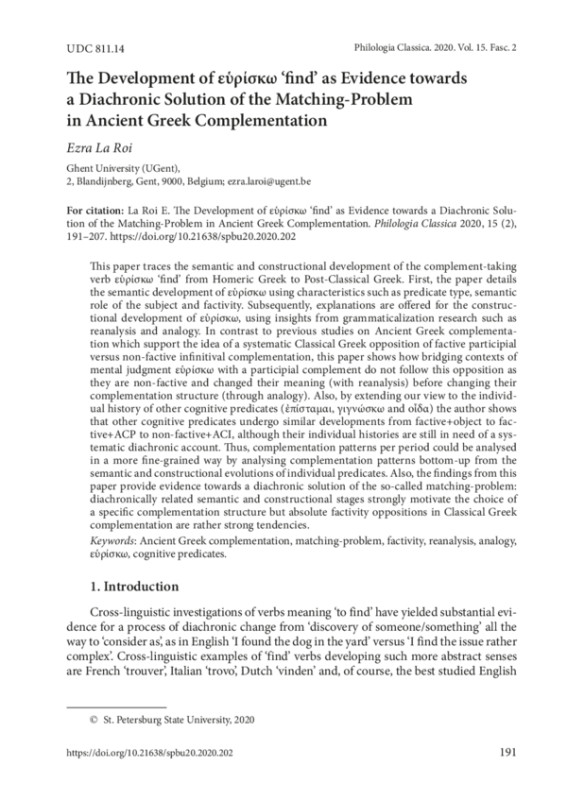
This paper traces the semantic and constructional development of the complement-taking verb εὑρίσκω ‘find’ from Homeric Greek to Post-Classical Greek. First, the paper details the semantic development of εὑρίσκω using characteristics such as predicate type, semantic role of the subject and factivity. Subsequently, explanations are offered for the constructional development of εὑρίσκω, using insights from grammaticalization research such as reanalysis and analogy. In contrast to previous studies on Ancient Greek complementation which support the idea of a systematic Classical Greek opposition of factive participial versus non-factive infinitival complementation, this paper shows how bridging contexts of mental judgment εὑρίσκω with a participial complement do not follow this opposition as they are non-factive and changed their meaning (with reanalysis) before changing their complementation structure (through analogy). Also, by extending our view to the individual history of other cognitive predicates (ἐπίσταμαι, γιγνώσκω and οἶδα) the author shows that other cognitive predicates undergo similar developments from factive+object to factive+ACP to non-factive+ACI, although their individual histories are still in need of a systematic diachronic account. Thus, complementation patterns per period could be analysed in a more fine-grained way by analysing complementation patterns bottom-up from the semantic and constructional evolutions of individual predicates. Also, the findings from this paper provide evidence towards a diachronic solution of the so-called matching-problem: diachronically related semantic and constructional stages strongly motivate the choice of a specific complementation structure but absolute factivity oppositions in Classical Greek complementation are rather strong tendencies
Предпросмотр статьи


Идентификаторы и классификаторы
- SCI
- Языкознание
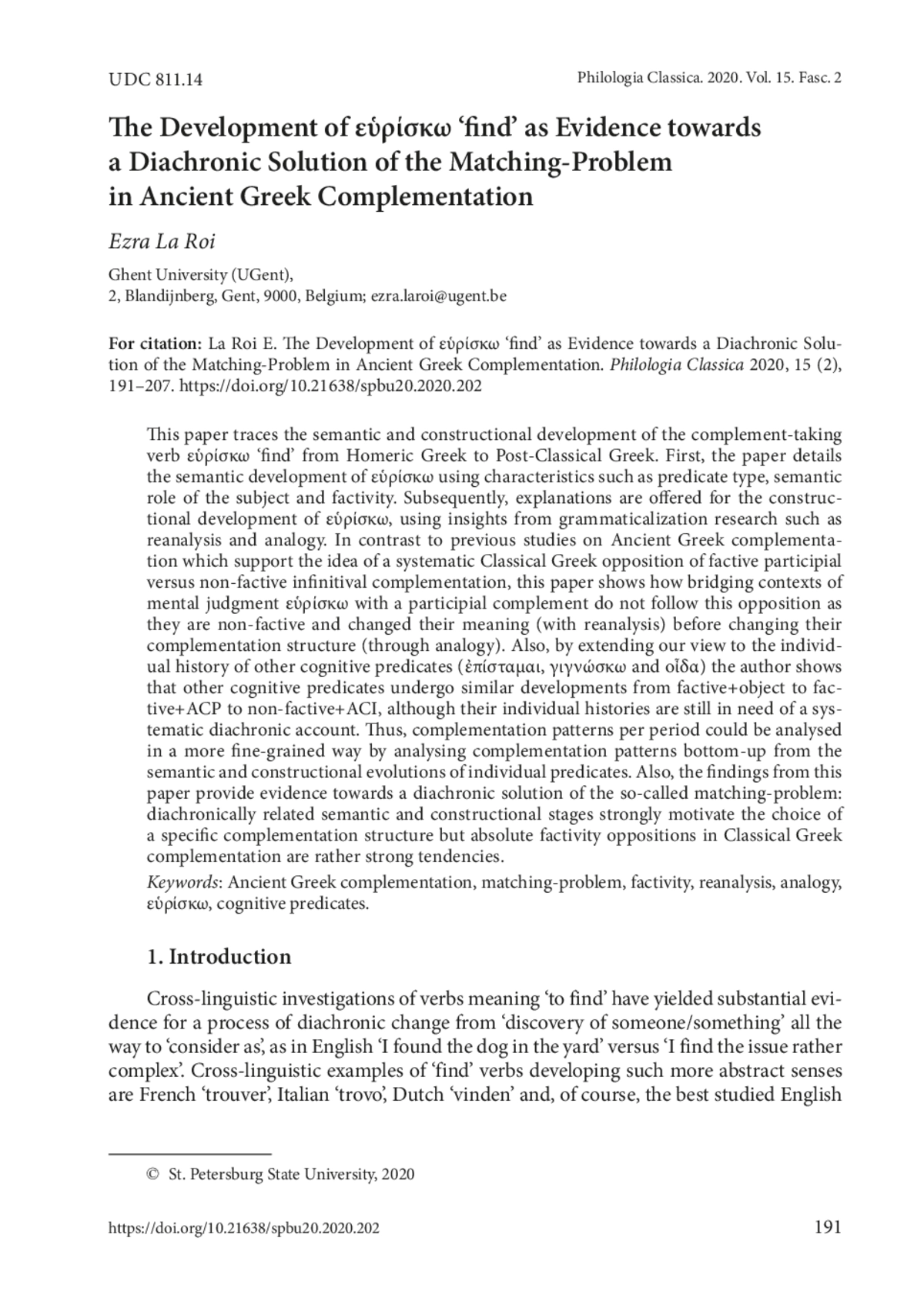
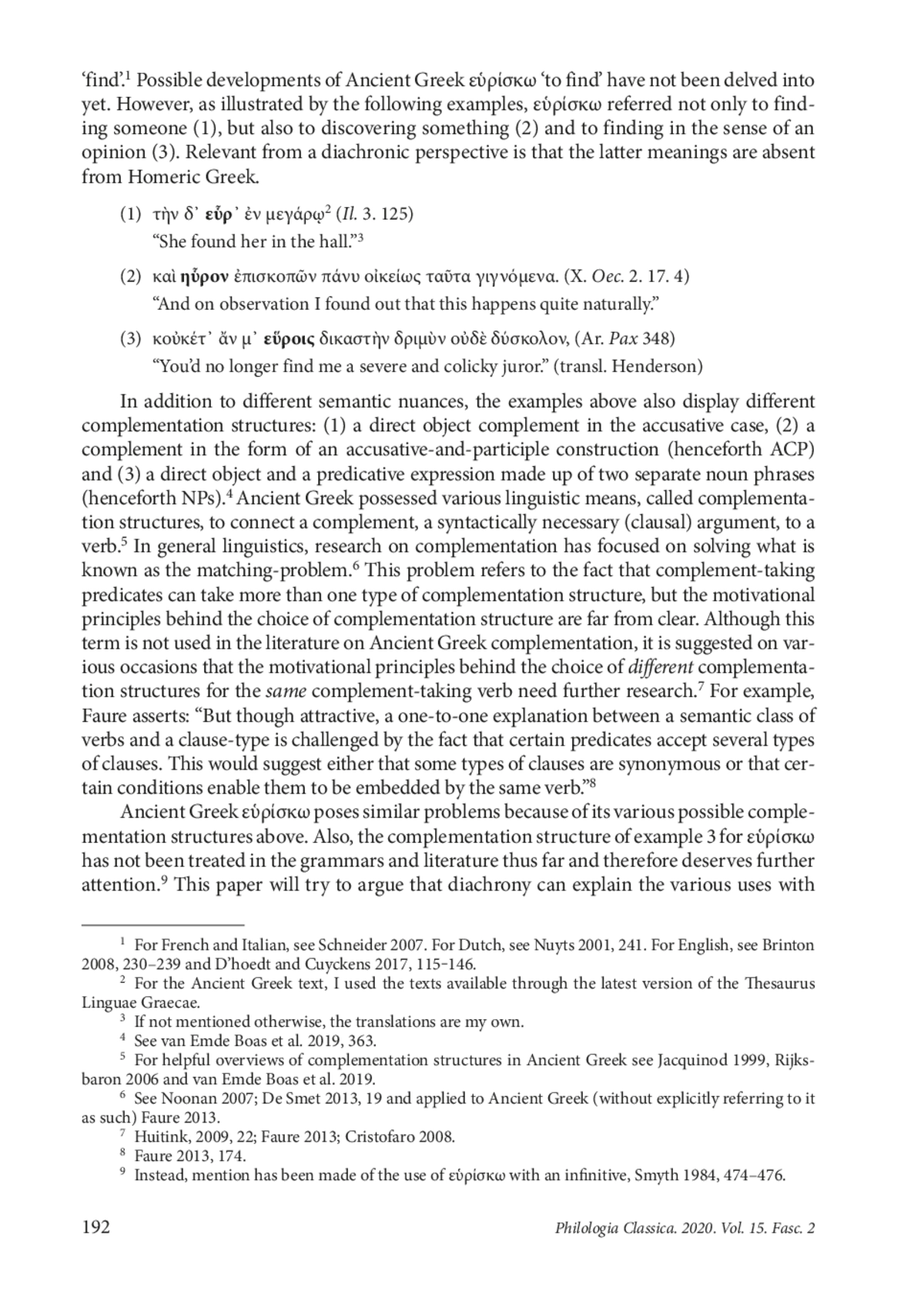
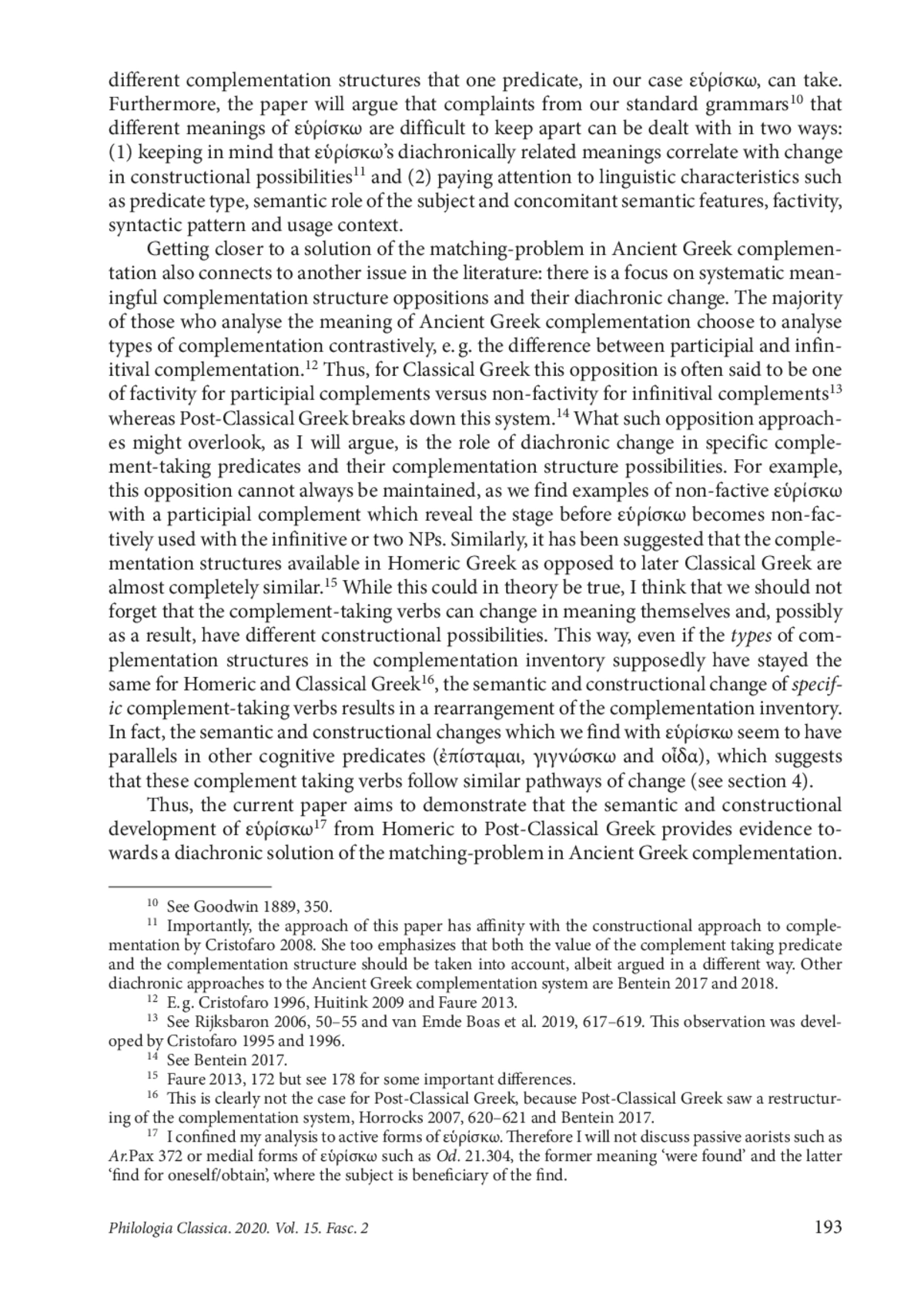
Cross-linguistic investigations of verbs meaning ‘to find’ have yielded substantial evidence for a process of diachronic change from ‘discovery of someone/something’ all the way to ‘consider as’, as in English ‘I found the dog in the yard’ versus ‘I find the issue rather complex’. Cross-linguistic examples of ‘find’ verbs developing such more abstract senses are French ‘trouver’, Italian ‘trovo’, Dutch ‘vinden’ and, of course, the best studied English
Если у вас возникли вопросы или появились предложения по содержанию статьи, пожалуйста, направляйте их в рамках данной темы.
Список литературы
1. Aarts B. Small clauses in English: the non-verbal types. Berlin - New York, De Gruyter, 1992.
2. Allan R. J. The Middle Voice in Ancient Greek A Study in Polysemy. Amsterdam, Gieben, 2003.
3. Allan R. J. Exploring modality’s semantic space: grammaticalisation, subjectification and the case of ὀφείλω. Glotta 2013, 89, 1-46.
4. Allan R. J. The History of the Future: Grammaticalization and Subjectification in Ancient Greek Future Expressions, in: F. Lambert, R. Allan and T. Markopoulos (eds). The Greek Future and its History. Le futur grec et son histoire, Louvain-La-Neuve, Peeters, 2017, 43-72.
5. Bentein K. Finite vs. non-finite complementation in Post-classical and Early Byzantine Greek. Towards a pragmatic restructuring of the complementation system? Journal of Greek Linguistics 2017, 17, 3-36.
6. Bentein K. The decline of infinitival complementation in Ancient Greek. Glotta 2018, 94, 82-108.
7. Brinton L. J. The Comment Clause in English: Syntactic Origins and Pragmatic Development. Cambridge, Cambridge University Press, 2008.
8. Cardinaletti A., Guasti M. T. Small clauses. San Diego, Academic Press, 1995.
9. Chantraine P. Grammaire homérique. Paris, Klinsieck, 1953.
10. Cristofaro S. La complementazione frasale dopo verbi di “dire” e “pensare”, in: P. Cuzzolin (ed.) Studi di linguistica greca, Milan, 1995, 91-112.
11. Cristofaro S. Aspetti sintattici e semantici delle frasi completive in greco antico. Firenze, Nuova Italia, 1996.
12. Cristofaro S. A constructionist approach to complementation: evidence from Ancient Greek. Linguistics 2008, 46/3, 571-606.
13. Cristofaro S. Participial and infinitival complement sentences in Ancient Greek, in: V. Gast, H. Diessel (eds) Clause Linkage in Cross-Linguistic Perspective, Berlin - New York, Mouton De Gruyter, 2012, 335-362.
14. De Smet H. Spreading Patterns: Diffusional Change in the English System of Complementation. Oxford, Oxford University Press, 2013.
15. D’hoedt F. and H. Cuyckens. Finite, infinitival and verbless complementation: The case of believe, suppose and find, in: L. Jedrzejowski and U. Demske (eds), Infinitives at the Syntax-Semantics Interface, Berlin - Boston, 2017, 115-146.
16. Emde Boas E. van, A. Rijksbaron, L. Huitink and M. de Bakker. 2019. The Cambridge grammar of Classical Greek. Cambridge, Cambridge University Press.
17. Faure R. Argument Clauses, in: G. K. Giannakis (ed.), Encyclopedia of Ancient Greek Language and Linguistics, Leiden - Boston, 2013, 172-178.
18. Godley A. D. Herodotus with an English translation. 4 vols. London, Heinemann, 1920.
19. Goldstein D. Classical Greek Syntax. Wackernagel’s law in Herodotus. Leiden, Brill, 2016.
20. Goodwin W. W. Syntax of the Moods and Tenses of the Greek Verb. Boston, Ginn and Heath, 1889.
21. Henderson J. Aristophanes. 5 vols. Cambridge, MA - London 1998-2007.
22. Hopper P. J. and E. C. Traugott. Grammaticalization. Cambridge, Cambridge University Press, 2003.
23. Horrocks G. C. Syntax: From Classical Greek to the Koine, in: A. P. Christidis (ed.) A History of Ancient Greek: From the Beginnings to Late Antiquity, Cambridge, 2007, 618-631.
24. Heine B. On the role of context in grammaticalization, in: I. Wischer and G. Diewald (eds) New Reflections on Grammaticalization, Amsterdam - Philadelphia, 2002, 83-101.
25. Huitink L. Pragmatic Presupposition and Complementation in Classical Greek, in: S. J. Bakker and G. C. Wakker (eds) Discourse Cohesion in Ancient Greek, Amsterdam, 2009, 21-40.
26. Jacquinod B. Les completives en grec ancient. Saint-Etienne, Publications de l’Université de Saint Etienne, 1999.
27. James P. Participial Complementation in the Roman and Byzantine Documentary Papyri: ἐπίσταμαι, μανθάνω, εὑρίσκω. Journal of Greco-Roman Christianity and Judaism 2001-2005, 2, 153-167.
28. Langacker R. W. Foundations of Cognitive Grammar, Vol. 2, Stanford, Stanford University Press, 1991.
29. Luraghi S. and E. Sausa. 2019. Aspects of aural perception in: Homeric Greek, in E. Mocciaro and W. Short Toward a Cognitive Classical Linguistics. The Embodied Basis of Constructions in Greek and Latin. Berlin, 2019, 149-175.
30. Mendez Dosuna J. V. Syntactic variation with verbs of perception and the ‘oblique imperfect’: once again on aspect, relative time reference and purported tense backshifting in Ancient Greek, in: K. Bentein, J. Soltic and M. Janse. Variation and Change in Ancient Greek Tense, Aspect and Modality. Leiden, 2017, 56-83.
31. Murray A. T. The Odyssey with an English translation. Cambridge, MA - London, Harvard University Press, 1919.
32. Murray A. T. The Iliad with an English translation. Cambridge, MA - London, Harvard University Press, 1924.
33. Murray A. T. Demosthenes with an English translation. Cambridge, MA - London, Harvard University Press, 1939.
34. Noonan M. Complementation, in: T. Shopen (ed.) Vol. 2 of Typology and Syntactic Description. Cambridge, Cambridge University Press, 2002.
35. Nuyts J. Epistemic modality, Language and Conceptualization: A Cognitivie-Pragmatic Perspective. Amsterdam - Philadelphia, John Benjamins, 2001.
36. Revuelta Puigdollers A. Illocutionary force and modality: How to tackle the issue in Ancient Greek, in: C. Denizot, O. Spevak (eds). Pragmatic approaches to Latin and Ancient Greek, Amsterdam - Philadelphia, John Benjamins, 2017, 17-43.
37. Rijksbaron A. The Syntax and Semantics of the Verb in Classical Greek. Amsterdam, Gieben, 2006.
38. Rix H., Kümmel M. et al. Lexikon der indogermanischen verben. Wiesbaden, dr. Ludwig Reichert Verlag, 2001.
39. Ruiz Yamuza E. Tres verbos que significan “deber” en griego antiguo. Zaragoza, Libros Pórtico, 2008.
40. Schneider S. Reduced parenthetical clauses as mitigators: a corpus study of spoken French, Italian and Spanish. Amsterdam, John Benjamins, 2007.
41. Smyth H. W. Greek Grammar. Harvard, Harvard University Press, 21984.
42. Sweetser E. From Etymology to Pragmatics: metaphorical and cultural aspects of semantic structure. Cambridge, Cambridge University Press, 1990.
43. Traugott E. On the Rise of Epistemic Meanings in English: an example of subjectification in semantic change. Language 1989, 57, 33-65.
Выпуск

Другие статьи выпуска
Der Vergleich des hebrä ischen Originaltextes 1. Sam. 19, 11 –17, wo die Episode mit dem Trick der Saulstochter Michal vor den Boten Sauls erzä hlt wird, mit dem entsprechenden Passus der Septuaginta-Übersetzung (1. Regn. 19) zeigt einen krassen Unterschied: Statt des masoretischen Ausdrucks, der gewöhnlich als ‘Ziegen-Haargeflecht’ oder ‘Ziegenfell’ übertragen wird (העִ זִּים כְּ בִ יר ) steht im griechischen Text ἧπαρ τῶν αἰγῶν, ‘Ziegenleber’. Die Entstehungsgründe dieser Merkwürdigkeit sind in der Forschung schon etliche Male erkannt worden; nach F. Field mag schon Origenes das hinter ἧπαρ steckende Geschichte des Abschreibens, Lesens und Deutens des Ursprungstextes treffend rekonstruiert haben, und zwar wie ein alexandrinischer Übersetzer a. a. O. hinter כבר oder כבד ein כָבֵ ד, also ‘Leber’, erahnt. Denn der Duktus von daleth und resh (ד and ר) sah sehr ä hnlich aus, was oft Anlass zu einer Verwechselung in beide Richtungen gab. Desto bemerkenswerter ist, dass die Masoreten die Lesart vorzogen, welche nicht allein traditionsmä ßig, sondern auch sinngemä ß bessere Chancen gibt, das einheitliche Bild von den virtuellen Geschehnissen zu bekommen: Ein behaarter Gegenstand auf dem Kissen kann doch natürlich den Eindruck eines Menschenkopfes machen. Was nun die allem Anschein nach fehlerhafte LXX-Deutung betrifft, so versucht Josephus Flavius (AJ VI, 11, 3–4), welcher, wie viele hellenistisch ausgebildeten Juden (u. a. Philo und Apostel Paulus), die Bibel in der griechischen Sprache popularisierte, diese Eigenheit der Septuaginta zu untermauern, indem er damit den eigentlichen Trick Michals verbindet: Wenn sie die mit einer Hülle verdeckte Ziegen-Leber leicht anrührt, antwortet die Masse mit einer Bewegung, welche den Eindruck eines mühsam atmenden (ἀσθμαίνειν) Menschen hervorruft. So entsteht aus einem (vermeintlichen) Überschrift- bzw. Übersetzungsfehler eine witzige Deutung, welche aus der Not eine Tugend macht und die Septuaginta über hebrä isches Original zu erheben versucht
Among the examples on how not to portray a character in tragedy, Aristotle names the female protagonist of the Iphigenia in Aulis, claiming that she is drawn in violation of the principle of consistency: begging to spare her life she is much unlike her later self. Philologists stood for Euripides, charging Aristotle with a lack of intuitive understanding. Moreover, as has been pointed out, the unaffected character of Iphigenia’s behaviour could find a footing in the ample observations on human psychology Aristotle himself made elsewhere in the Ethics and Rhethoric. Certain modern scholars, however, tend to side with Aristotle. To argumentatively prove or disprove the feasibility of the change Iphigenia undergoes seems thus to be close to impossible, both psychologically and aesthetically. A thought not alien to the Poetics goes as simple as that: not all the shifts and turns, so human and so easily observed in life, should find their way into art. One supposes Aristotle all too well recognised the fact that no example would in this case prove to be free of blame, while holding that the general applicability and inherent veracity of his theory goes unimpaired by the fact that it could in principle be assailed.
В основу статьи положены архивные материалы Ленинградского института философии, лингвистики и истории (ЛИФЛИ), хранящиеся в Центральном государственном архиве литературы и искусств Санкт-Петербурга, а также неопубликованные мемуарные заметки первого заведующего кафедрой классических языков О. М. Фрейденберг. Хронологические рамки исследования — 1932–1937 гг. — время существования кафедры в составе ЛИФЛИ. Кафедра классических языков и литератур, вновь созданная в 1932 г., стала связующим звеном между дореволюционным поколением филологов и молодым, сформировавшимся в 1920-е гг. Традиционные подходы к преподаванию древних языков слились здесь с марксистскими новациями, такими как установка на «практичность», и возникло сочетание прежних индивидуальных форм исследования с новыми коллективными. Назначение О. М. Фрейденберг как на пост заведующей кафедры было вполне ожидаемо, поскольку она была подходящей фигурой для раннесоветской бюрократии. Вместе с тем во многом благодаря ее административной деятельности прерывания традиций изучения и преподавания классических языков в Ленинграде в конце 1920-х — начале 1930-х гг. не произошло: кафедра стала преемницей аналогичных учреждений, функционировавших в рамках цикла древней истории на факультете языкознания и материальной культуры ЛГУ, а также в Научно-исследовательском институте сравнительной истории литератур и языков Запада и Востока ЛГУ и в Государственном институте культуры речи. Автор также приходит к выводу, что открытие/закрытие кафедр в 1930-е гг. было следствием не только деятельности государственных структур, но и борьбы внутри научного сообщества
Статья знакомит читателя с поэмой Ф. Б. Грефе (1780–1851), ординарного академика Императорской академии наук и профессора Санкт-Петербургского университета, написанной элегическими дистихами на древнегреческом языке к 100-летию Императорской академии наук. Грефе сопроводил греческую поэму из 424 стихов авторизованным поэтическим переводом en regard на родной немецкий язык. Насколько нам известно, с 1826 г. поэма не переиздавалась и не становилась предметом исследования. В статье приводится греческий и немецкий текст пролога, эпилога и трех небольших пассажей поэмы с русским переводом и комментарием. В прологе Грефе пишет об основании Санкт-Петербурга и Императорской академии наук Петром I, воспроизводя официальную петербургскую мифологию, оформленную литературными топосами (одинокий рыбак с убогой лачугой; царь-демиург на пустынном берегу Невы; город, воздвигнутый на болоте, etc.) и формулами (сходными с пушкинскими, опубликованными намного позднее: «где прежде…, там ныне»; «из тьмы лесов, из топи блат»). В избранных пассажах говорится о палеонтологической коллекции АН, в частности о мамонте, а также о сокровищах Египетского музея Академии, о мумиях, приобретенных у Франсуа де Кастильоне. Автор исследует возможные литературные источники Грефе, описывает исторический контекст и реалии петербургской и академической жизни того времени, а также говорит об отклике на поэму Грефе в Германии
Der Aufsatz untersucht die Rezeption der Antike in der Lyrik von Alexander Kuschner. Der Dialog mit der Antike ist ein zentraler Bestandteil der Lyrik des St. Petersburger Dichters, beginnend mit seinen ersten Gedichten der 1960er Jahre. Besonderes Augenmerk wird auf die Analyse des Gedichts „Перед лучшей в мире конной статуей…“ („Vor dem besten Reiterstandbild der Welt…“, 2008) im Zusammenhang mit dem Problem der literarischen Ekphrasis gerichtet. Der theoretische Teil des Artikels verdeutlicht die Bedeutung des Begriffs „Ekphrasis“ und gibt einen kurzen Überblick über die wichtigsten Konzepte in der Literaturwissenschaft. Der Begriff tauchte in der Antike auf, wurde im 19. Jahrhundert in der klassischen Philologie verwendet und seit dem 20. Jahrhundert auf die Analyse der modernen Literatur ausgedehnt. Dabei hat sich der Umfang des ursprünglichen Konzepts und seine Anwendung erheblich erweitert. Dichterinnen und Dichter der Gegenwart nutzen die Möglichkeiten der Ekphrasis auf unterschiedliche Art und Weise. Am hä ufigsten wird der Schwerpunkt von der Beschreibung des Kunstwerks selbst auf die Beschreibung eines subjektiven Eindrucks übertragen. Die Gedichte nehmen immer hä ufiger Bezug auf Kunstobjekte ohne sie detailliert zu beschreiben. Der analytische Teil zeigt die Relevanz des ekphrastischen Prinzips in Bezug auf die verschiedenen Ebenen des lyrischen Textes. Das kulturgeschichtliche Paradigma des poetischen Bildes von Reiterstatuen, das in Kuschners Gedicht in expliziter oder impliziter Form vorliegt, wird rekonstruiert. Erlä utert werden nicht nur explizite Anspielungen auf das Marcus-Aurelius-Denkmal, sondern auch implizite Reminiszenzen, die sich nicht zuletzt auf die Gedankenwelt der Antike entscheidend prä gende Philosophie der Stoiker beziehen
Как и подобает всякому настоящему ренессансу, русское поэтическое возрождение конца XIX — начала XX в. было ознаменовано всплеском интереса к греко-римской древности. Интенсивная разработка античных сюжетов, мотивов и топосов, в диапазоне от стилизации до тотального переосмысления, осознается как важнейшая особенность русской модернистской поэтики. Неудивительно, что в последние десятилетия исследование античных реминисценций в поэзии Cеребряного века регулярно становится темой многочисленных и многообразных работ. В настоящей статье, по жанру обзорно-полемической, автор надеется обратить внимание на некоторые уязвимые стороны соответствующих исследовательских практик и предполагает сформулировать своего рода «комментаторский кодекс» для изучения интертекстуальных параллелей между русскими поэтами рубежа XIX–XX вв. и древними авторами; непосредственным поводом к ее написанию стал 25-летний юбилей методологически важной, хотя и недостаточно известной книги пизанских лекций М. Л. Гаспарова «Античность в русской поэзии начала XX века». В статье затрагиваются такие вопросы, как степень знакомства того или иного писателя с античными памятниками, связь истории рецепции и гимназического образования, взвешивание и классификация аллюзий, проблема промежуточных источников, учет не только русских, но и иноязычных переводов, необходимость обращения к филологической литературе, современной не исследователю, а исследуемому автору, и пр. Изложение перемежается разборами частных случаев, в которых предлагаются новые либо уточняются прежние толкования отдельных стихотворений О. Э. Мандельштама, В. К. Шилейко, В. А. Комаровского, А. А. Кондратьева и других поэтов
Опубликованный С. И. Писаревым в 1771 г. перевод трактата ПлутархаDe liberis educandis (Περὶ παίδων ἀγωγῆς) неожиданно оказывается первым русским переводом Плутарха с языка оригинала («еллиногреческого»). Статья посвящена некоторым особенностям этого перевода, а главным образом, — выявлению его источника, то есть того базового издания, которым пользовался Писарев в своей переводческой работе (контаминация, конечно, не исключается). При этом поиске автор прежде всего уделяет внимание маркированию поэтических цитат. Встроенные в текст трактата цитаты в переводе Писарева выделены курсивом, частью — вместе с последующим авторским текстом Плутарха, который, очевидно, воспринимается переводчиком как продолжение цитаты. В латинских переводах, которые сопровождают греческий текст в доступных Писареву двуязычных греко-латинских изданиях цитаты даются с отступом и выделяются курсивом. Переводчик мог пользоваться одним из таких изданий. С другой стороны, указанного критерия недостаточно, поскольку единообразие оформления цитат отсутствует в изданиях трактата отдельными книгами. Поэтому для более уверенного опознания источника автор сравнивает текст перевода с греческим текстом нескольких изданий XVI–XVIII вв. Анализ разночтений последовательно исключает все издания, кроме двух, выбор между которыми затрудняется тем обстоятельством, что отличие между ними сводится к порядку слов в цитате. Тем не менее анализ порядка слов в переводах поэтических цитат у Писарева позволяет предположить, что его источником послужило франкфуртское издание 1599 г., переизданное в 1620 г. и затем в Париже в 1624 г
Авторство двадцати девяти рельефов, составляющих скульптурный ансамбль Летнего дворца Петра I, дискутируется в науке с начала XX в. Попытки приписать их Андреасу Шлютеру († май/июнь 1714), равно как и другим архитекторам и скульпторам, продолжавшим начатые Шлютером в России постройки (Браунштейну, Маттарнови, Леблону, Микетти), оказываются в той или иной степени уязвимыми. Между тем аллегорическая программа комплекса, общая композиция, размещение рельефов по фасадам определяются единым творческим замыслом, настолько же смелым, насколько и своеобразным. Мало сомнений в том, что автором этого трудноисполнимого замысла был сам Петр I, воплощать же его приходилось разным, в том числе местным, мастерам. О роли Петра свидетельствует и трактовка мифологических сюжетов, взятых из «Метаморфоз» Овидия (часть из них опознана ошибочно, другие не получили адекватного истолкования в аллегорическом ключе). На причастность царя к созданию рельефов указывает один из возможных источников их образности. Ренатой Кроль установлено, что для пяти рельефов таким источником были гравюры Дж. А. Мальоли, копированные А. Фуксом (их сюжеты также соотносимы с Овидием). Другим могли быть иллюстрации к «Метаморфозам» Ш. Лебрена, известные Петру по копии И. Крауса
Несмотря на кажущуюся хаотичность закупок произведений античного и европейского искусства для резиденций Петра I, при внимательном изучении можно проследить, что в основе императорского собрания античной скульптуры лежала задача создания Antikensammlung по образцу придворных коллекций того времени. Свидетельством этому служит в том числе и нереализованный план «Венусовой галереи», представленный Петру Юрием Кологривовым, приобретения которого во многом и определили состав коллекции. Даже учитывая то, что статуя Венеры Таврической была приобретена благодаря счастливой случайности и одной из последних, она стала центральным элементом задуманного Кологривовым ансамбля, выстроенного не по декоративноразвлекательному, а по историко-художественному принципу. Прогрессивные для своего времени методы построения экспозиции (разделение античных и современных скульптур; наличие нескольких статуй, представляющих одно божество, и др.) восходят к итальянскому культурному опыту Кологривова, который, хотя по ряду причин и не отразился в воплощении задуманного им музейного пространства, остается ценным для исследователей культурных тенденций как в России, так и в Западной Европе первой четверти XVIII века
Материал представляет собой первую публикацию гекзаметрической латинской сатиры Феофана Прокоповича (1681–1736), состоящей из 172 стихов и являющейся самым длинным его латинским поэтическим произведением петербургского периода. Рукопись входит в сборник сочинений Прокоповича, хранящийся в Отделе рукописей БАН в С.-Петербурге (Тек. Пост. 142. Л.245–247 об.), и, насколько нам известно, представляет собой единственный сохранившийся список сочинения. Хотя сатира никак не озаглавлена, с большой долей вероятности можно утверждать, что адресатом нападок был архиепископ Георгий (Дашков) (ум. 1739), — так же как и двух эпиграмм, которые предшествуют в рукописи сатире и определенно направлены против него, имея соответствующие заглавия. Дашков иносказательно выведен под именем Грунния (Grunnius) и изображен как человек, который не способен вынести успехов окружающих и неистово завидует им; в финале он предстает настоящим воплощением зла. Рассматриваются также две с половиной строки из этой сатиры (ст. 32–34), которые были на сегодняшний день опубликованы. Это произошло благодаря их цитированию Антиохом Кантемиром в комментариях к ст. 41 его третьей сатиры «О различии страстей человеческих. К архиепископу новгородскому». Во всех изданиях Кантемира латинский текст и, соответственно, русский перевод этого двустишия содержат ошибки, которые исправлены, а новый вариант текста и перевода предложено учесть при подготовке последующих изданий
This article offers an overview of the Greco-Latin and early modern Jesuit sources of Stefan Iavorskii’s (1658–1722) three bilingual panegyrics addressed to his patron Varlaam Iasinskii, rector of the Kiev-Mohyla college (1669–1689), the Orthodox metropolitan of Kiev (1690– 1707), Hercules post Atlantem infracto virtutum robore honorarium pondus sustinens published in Chernihiv in 1684, Arctos Caeli Rossiaci in Gentilitiis Syderibus and Pełnia nieubywaiącey chwały w herbowym xiężycu (The Plenitude of Inexhaustible Glory in the heraldic moon), published in Kiev in 1690 and 1691. Both these works are prosimetric bilinguals (some sections are in Latin, others in Polish), testifying to a significant classical erudition of their author. However, Hercules is one most traditionally “classical” in its dispositio and elocutio, while the style of the other two, written after Iavorskii’s educational journey through Jesuit schools in the Polish-Lithuanian Commonwealth, is much more innovative, highly metaphorical, allegorical, relying on the argumentation of surprise (based on acumen- and argutia-theory expounded in the rhetoric of Jan Kwiatkiwiecz) and emblems due to an extensive use of combinations of multiple pictorial-verbal themes (especially in Pełnia)
В статье публикуются две эпиграммы Д. Г. Мессершмидта, посвященные И. Ф. Брейну и сохранившиеся среди его бумаг. Первая представляет собой стихотворную подпись к портрету самого Брейна и была, скорее всего, отправлена из Петербурга уже после возвращения Мессершмидта из Сибири, то есть между 1727 и 1735 гг. (а не в 1701– 1800, как указано на сайте Дрезденского фотоархива). Правдоподобно, что подпись предназначалась для гравюры, один из экземпляров которой хранится в Staatliche Kunstsammlungen Dresden и представлен на сайте Deutsche Fotothek Dresden. Не исключено, что Иоганн Филипп Брейн послал в Петербург и портрет отца, и свой собственный (оба работы неизвестного мастера), и что к обоим Мессершмидт сделал стихотворные подписи. В 1739 г. был опубликован элегический дистих Мессершмидта, включенный в обрамление портрета Якоба Брейна работы знаменитого гравера П. Г. Буша. Как предположил С. С. Орехов, гравюра Г. П. Буша восходит к работе того же неизвестного мастера. Портрет Иоганна Филиппа не был опубликован, возможно потому, что поместить такой текст под своим портретом И. Ф. Брейн не мог. Второе стихотворение представляет собой запись в альбом, хранившийся в Музее И. Ф. Брейна в Гданьске, и датировано ноябрем 1716 г. Это стихотворение не имеет заголовка (что подчеркнуто в самом тексте), но предваряется древнееврейским эпиграфом, подробный комментарий к которому сделал К. А. Битнер. Латинское стихотворение, изобилующее звуковыми повторами и усложненное языковой игрой, оставляет ощущение некоторого нравственного надлома. Оба стихотворения характеризуют общую образованность и душевный склад Мессершмидта, а также его восторженную преданность И. Ф. Брейну как старшему коллеге по научным и медицинским занятиям
The article attempts, firstly, to critically analyze the traditional order of cases in Latin, secondly, to discover an internal mechanism that brings the elements of a paradigm together, and thirdly, to present a new model of the nominal and pronominal case paradigms in Latin. The authors develop the idea that the crucial role in structuring a case paradigm belongs to morphemic syncretism. The syncretism is treated as a systemic phenomenon of morpheme neutralization rather than a result of phonetic reduction. In the paradigm built on this principle, the cases marked with the same endings necessarily take adjacent positions. There is a certain correlation between the morphemic syncretism and the semantics of cases extensively exemplified in the Latin literature. Taking this as reference point, the authors establish a formally motivated paradigmatic order of cases and single out a set of semantic features that shape the case paradigm. This method enables authors to find the non-contradictory paradigmatic positions for both the core and the “marginal” cases (vocative and locative). Applied to the pronominal cases, however, it reveals the significant discrepancy between the nominal and pronominal paradigms concerning two cases — nominative and genitive. The pronominal nominative’s special status is determined by its pragmatic rather than syntactic functions, which is typical for pro-drop languages. The genitive case appears in three different forms that originate from the possessive pronouns and correspond to the three basic functions of the genitive — possessive, objective, and partitive ones. Such transparadigmatic syncretism brings together the paradigms of personal and possessive pronouns, which are related by nature. The ORBIS ROMANUS approach suggested in this study makes it possible to present in a new way the nominal and pronominal case paradigms, to demonstrate in what points they differ from each other, and to highlight some functional and semantic features of the particular cases
The ms. tradition of the Poetics is a mine, quite unexpectedly, when it comes to composition on literary matters: four independent witnesses — Parisinus 1741 (A), Riccardianus 46 (B), and mediaeval translations into Latin by William of Moerbecke and Arabic by Abū-Bishr Mattā made with the help of a Syriac interlinear (not to mention the recentiores which still could prove of some stemmatic value, as for instance Par. gr. 2038, Vat. gr. 1400, Berol. Philipp. and Mon. 493) — allow in most cases for a safe reconstruction of an archetype. Common errors suggest that this text differed from the autograph in some twenty passages, largely interpolations, ranging from a couple of words to a number of phrases. Several intrusions prove to be typologically close. All of them correct what was deemed to be inaccurate or loose argumentation by inserting syntactic complements or references adding cohesion. As a result, both the style and context go largely neglected. The first paragraphs of ch. 6, central to the Poetics, suffered most. This text also came down to us in a Syriac translation having a heavily glossed uncial ms. as its source. Insertions in ch. 6 cause ‘harmonising’ additions to the following text of the treatise. The ‘family of interpolations’ under discussion is tentatively attributed to a professor of Aristotelianism of late antiquity (the most suitable candidate seems to be Themistius): a school-room copy diffused by his pupils became the common ancestor of both the extant Greek mss. of the Poetics and the reconstructed Greek sources of the mediaeval translations. A fresh collation of the Syriac text together with the evidence of variae lectiones in the oldest independent Greek mss. offer a glimpse into the workings of his mind
Статистика статьи
Статистика просмотров за 2026 год.
Издательство
- Издательство
- СПБГУ
- Регион
- Россия, Санкт-Петербург
- Почтовый адрес
- Россия, 199034, Санкт-Петербург, Университетская наб., д. 7–9
- Юр. адрес
- 199034, г Санкт-Петербург, Василеостровский р-н, Университетская наб, д 7/9
- ФИО
- Кропачев Николай Михайлович (РЕКТОР)
- E-mail адрес
- spbu@spbu.ru
- Контактный телефон
- +7 (812) 3282000
- Сайт
- https://spbu.ru/