

This article examines the testimonia concerning Aeschylus’ purported brothers — Cynegirus and Ameinias — both of whom are said to have distinguished themselves during the Greco-Persian Wars. Cynegirus, a strategos, met a heroic death at the Battle of Marathon, while Ameinias earned renown for his bravery at Salamis. Although modern scholarship widely accepts Cynegirus as Aeschylus’ brother, the earliest extant testimony of their kinship derives from Heraclides of Pontus, later reiterated by an anonymous scholiast on Aristotle’s Nicomachean Ethics. The alleged kinship between Aeschylus and Ameinias, however, remains a subject of debate. This study aligns with the view that their association may stem from later conflation or errors within the ancient historiographical tradition. Regarding Aeschylus and Cynegirus, while Heraclides provides the primary testimony and the subsequent tradition is based on much later sources, their alleged fraternal relationship must be treated with due historiographical caution
Предпросмотр статьи

Идентификаторы и классификаторы
- SCI
- Литература
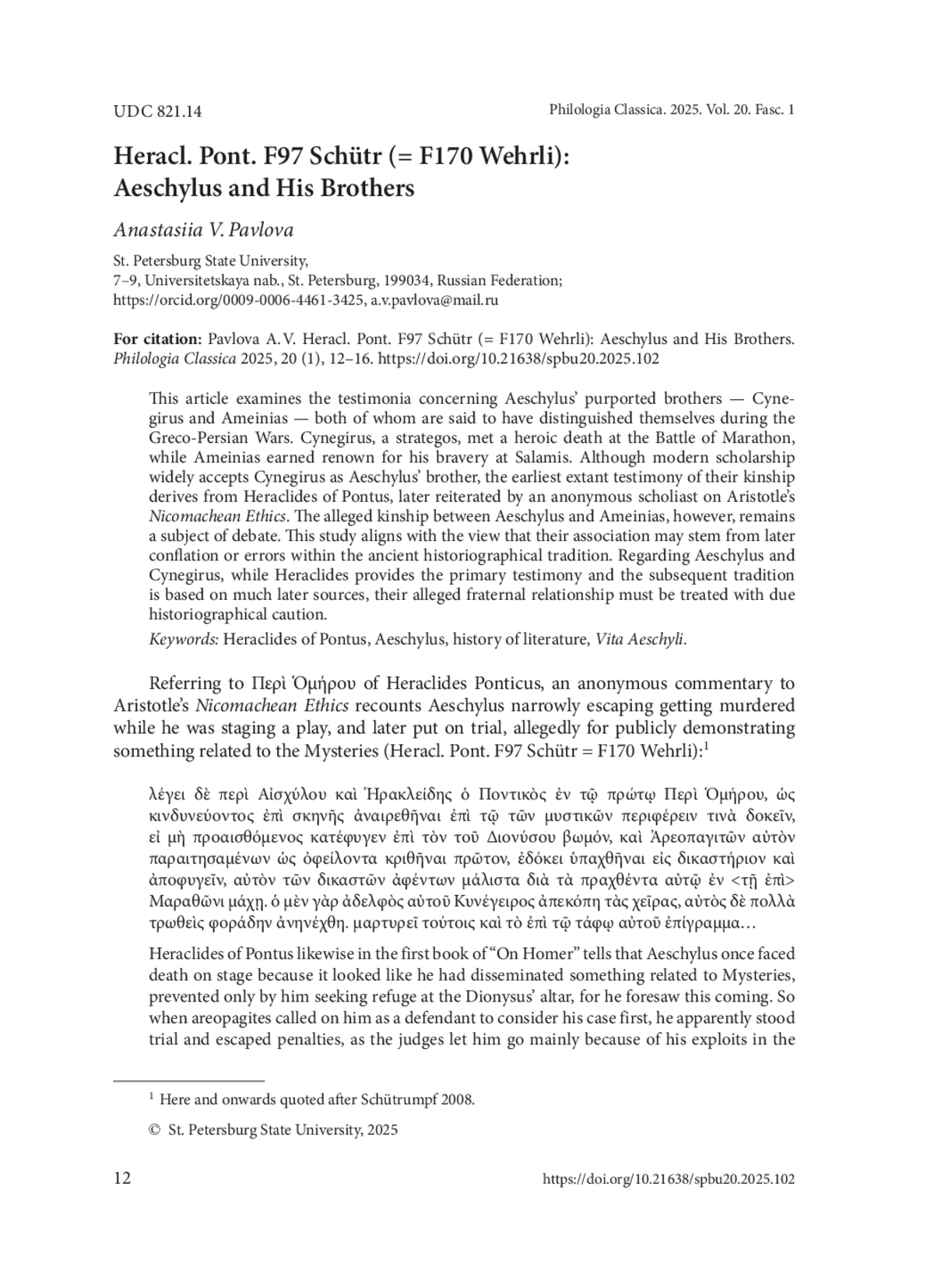
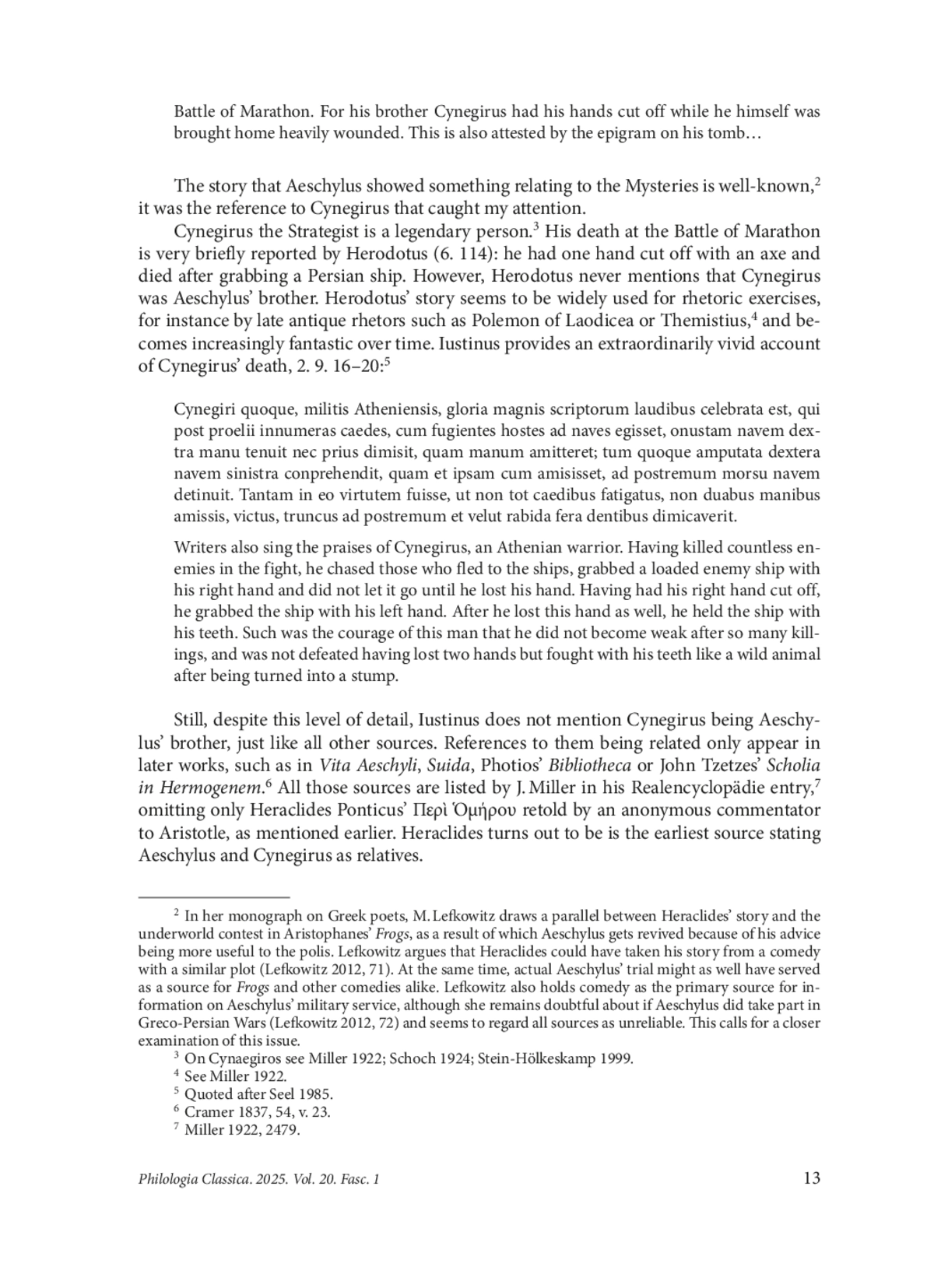
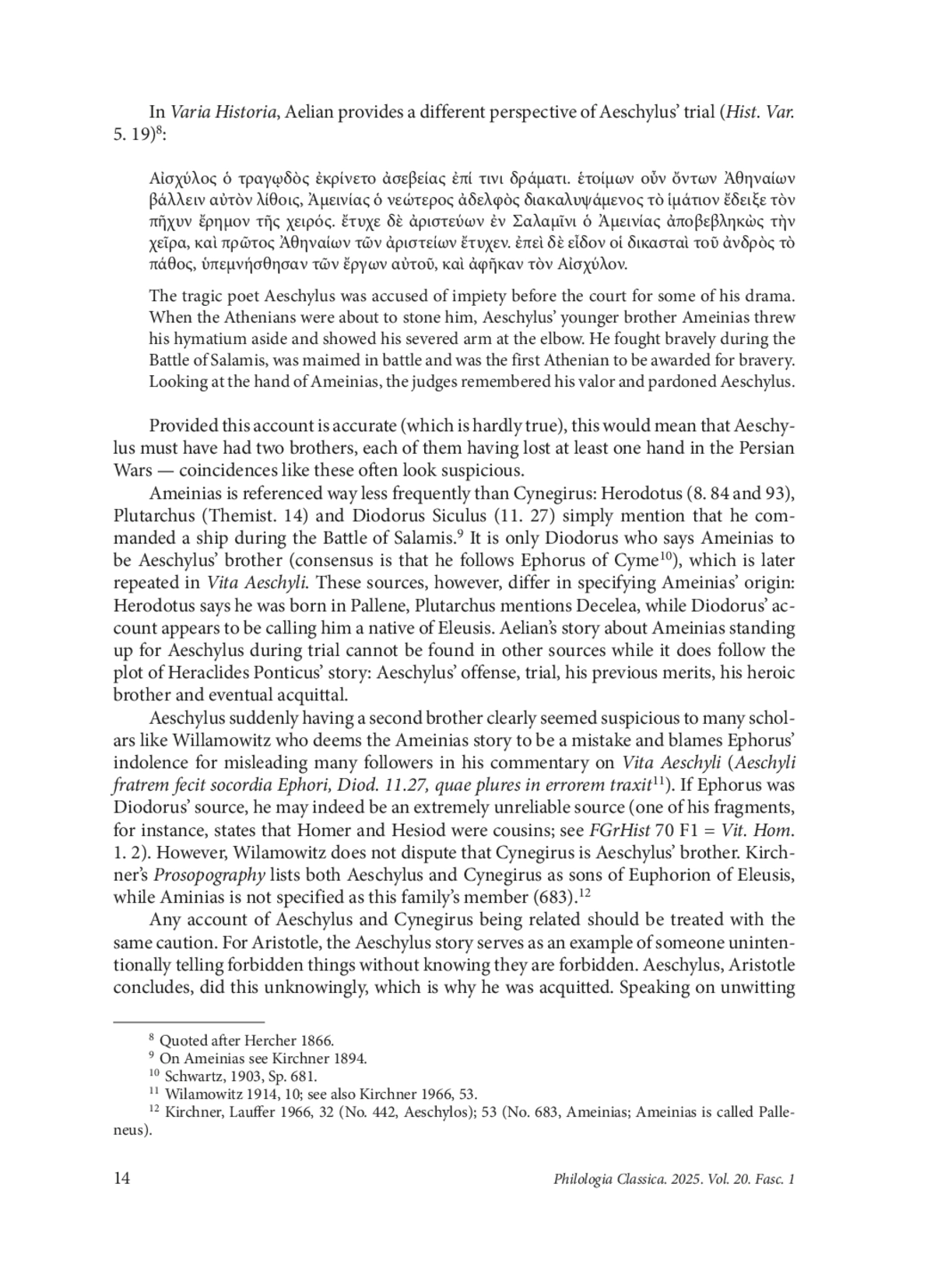
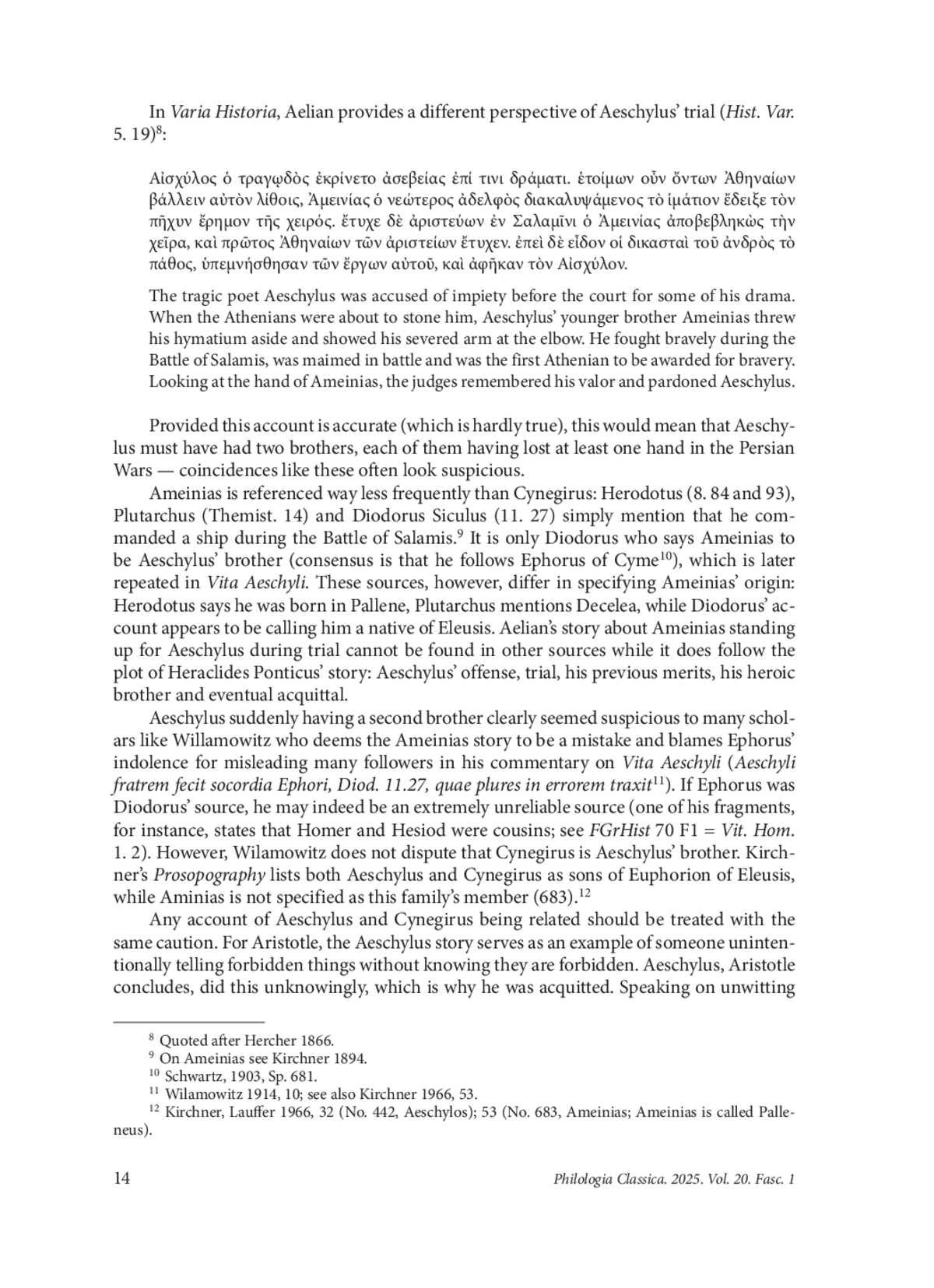
Referring to Περὶ Ὁμήρου of Heraclides Ponticus, an anonymous commentary to Aristotle’s Nicomachean Ethics recounts Aeschylus narrowly escaping getting murdered while he was staging a play, and later put on trial, allegedly for publicly demonstrating something related to the Мysteries (Heracl. Pont. F97 Schütr = F170 Wehrli):1
λέγει δὲ περὶ Αἰσχύλου καὶ Ἡρακλείδης ὁ Ποντικὸς ἐν τῷ πρώτῳ Περὶ Ὁμήρου, ὡς κινδυνεύοντος ἐπὶ σκηνῆς ἀναιρεθῆναι ἐπὶ τῷ τῶν μυστικῶν περιφέρειν τινὰ δοκεῖν, εἰ μὴ προαισθόμενος κατέφυγεν ἐπὶ τὸν τοῦ Διονύσου βωμόν, καὶ Ἀρεοπαγιτῶν αὐτὸν παραιτησαμένων ὡς ὀφείλοντα κριθῆναι πρῶτον, ἐδόκει ὑπαχθῆναι εἰς δικαστήριον καὶ ἀποφυγεῖν, αὐτὸν τῶν δικαστῶν ἀφέντων μάλιστα διὰ τὰ πραχθέντα αὐτῷ ἐν <τῇ ἐπὶ> Μαραθῶνι μάχῃ. ὁ μὲν γὰρ ἀδελφὸς αὐτοῦ Κυνέγειρος ἀπεκόπη τὰς χεῖρας, αὐτὸς δὲ πολλὰ τρωθεὶς φοράδην ἀνηνέχθη. μαρτυρεῖ τούτοις καὶ τὸ ἐπὶ τῷ τάφῳ αὐτοῦ ἐπίγραμμα
Если у вас возникли вопросы или появились предложения по содержанию статьи, пожалуйста, направляйте их в рамках данной темы.
Список литературы
1. Cramer J. A. (ed.). Anecdota Graeca. Vol. IV. Oxford, Oxford University Press, 1837.
2. Gottschalk Hans B. Heraclides of Pontus. New York, Oxford University Press, 1980.
3. Hercher R. (ed.). Claudii Aeliani Varia Historia, Epistolae, Fragmenta. Leipzig, Teubner, 1866.
4. Kirchner I. Ameinias (5). In: RE 1894, 1/2, 1818.
5. Kirchner I. (ed.), Lauffer S. (ed.). Prosopographia Attica. Vol. 1. Berlin, De Gruyter, 21966.
6. Lefkowitz M. The Lives of the Greek Poets. Baltimore, The John Hopkins University Press, 2012.
7. Miller J. Kynaigeiros. In: RE 1922, XI/2, 2479.
8. Schütrumpf E. (ed., transl.). Heraclides of Pontus. Texts and translations. New Brunswick, NJ, Transaction Publishers, 2008.
9. Osborn M. J., Byrne S. G. (eds). A Lexicon of Greek Personal Names. Vol. II: Attica. Oxford, Clarendon Press, 1994.
10. Robert C. Die Marathonschlacht in der Poikile unde weiteres über Polygnot. Halle, Max Niemeyer, 1895.
11. Schoch M. Kynegeiros. In: RE 1924, Suppl. IV, 1126.
12. Schwartz E. Diodoros (38). In: RE 1903, V/1, 663-704.
13. Seel O. (ed.). M. Iunuani Iustini Epitoma Historiarum Philippicarum Pompei Trogi. Stuttgart, Teubner, 1985.
14. Spiro F. (ed.). Pausaniae Graeciae descriptio. 3 vols. Leipzig, Teubner, 1903.
15. Stein-H.lkeskamp E. Kynaigeiros. In: DNP 1999, Bd. 6, 968.
16. Wehrli F. (ed., comm.). Die Schule des Aristoteles: [Heft 7] Herakleides Pontikos. Texte und Kommentar. Basel - Stuttgart, Schwabe & Co. Verlag, 1944-1959.
17. Wilamowitz-M.llemdorff U. (ed., comm.). Aeschyli Tragoediae. Berlin, Weidmann, 1914.
Выпуск
Другие статьи выпуска
This review focuses on the new book by the renowned German scholar Heinz-Günter Nesselrath on Lucian of Samosata, an author whom Nesselrath has been studying for over 40 years. The review gives a brief overview of the preface, the nine chapters and the afterword. Among the undoubted merits of this book is that Nesselrath has succeeded in presenting his view and his understanding of Lucian’s rich legacy, which have developed over many years of working with the texts. This is what distinguishes Nesselrath’s book from the companions popular nowadays, where a plurality of opinions and approaches of the authors of the articles naturally arises. On the one hand, the author perfectly shows that the genre and content diversity of the works, the heterogeneity of literary masks are quite amenable to comprehensive consideration. There is no reason to speak of “the comedy of nihilism” or “the palimpsestic evanescence of author’s voice” (T. Whitmarsh). Through Nesselrath’s book, a distinct, consistent portrait of Lucian as a writer is created. On the other hand, this book once again confirms the unfounded and biased judgements of J. Bernays, R. Helm, who regarded Lucian as a mere epigone and a mediocre writer. The book’s shortcomings may include the fact that the author speaks of the division of rhetoric and philosophy and notes that there is another opinion, but does not elaborate on it. Equally neglected is the manuscript tradition of Lucian. Nonetheless, the unified concept, the well-thought-out structure, the lively and lucid presentation of the material allow us to say that this book is the long-awaited basic study that has been sorely lacking for Lucian
A series of interconnected conjectures to the text of Ps.-Maur. VII B 17. 2,12 (8, 9–10, 33– 34 Dennis) is proposed, which makes the text more understandable: ἤτοι τὰ βά<θη> τῶν ἀκιῶν <ἤτοι τὰς ἀκίαςin mg>… ἀπὸ παλαιῶν [δὲ] καὶ νέων <ἔχοντα ἴσως καὶ ἀναλόγως τοὺς νεωτέρους>…. τὸν λεγόμενον ἰλάρχην [ἔχοντα ἴσως καὶ ἀναλόγως τοὺς νεωτέρους ἤτοι τὰς ἀκίας]. To explain this, author proposes the hypothesis of a transcription error in the archetype (ἤτοι τὰ βάθη > ἤτοι τὰ βάνδα), of compensatory asterisk and of the later marginal gloss (ἤτοι τὰς ἀκίας), as well as of the transmission of the passage ἔχοντα ἴσως καὶ ἀναλόγως τοὺς νεωτέρους ἤτοι τὰς ἀκίας from § 2 to § 12. The proposed hypothesis assumes a multiple processing (glosses, added leafs) of the codex of the archetype ξ, its active use and subsequent rewriting into a new codex (α), which is the precursor of both uncial families (λ and β). The five phases of the development of the discussed passages are proposed: (1a) the Urtext with the books I–III, V, VII A und VII B 1–15; (1b) creation of the text VII B 16–17 (4952 characters) on the three bifolia with a reading error (βάθη > βάνδα), the source for the § 12 being the passage II 20/19, 1 (4–7 Dennis), where are no parallels for the words “ἔχοντα ἴσως καὶ ἀναλόγως τοὺς νεωτέρους ἤτοι τὰς ἀκίας”; (1c) the appearance of marginalia — “ἤτοι τὰς ἀκίας” to the words “ἤτοι τὰ βάνδα τῶν ἀκιῶν”, as well as asteriskos to § 12 and § 2 after παλαιῶν; (2) moving the text “ἔχοντα ἴσως καὶ ἀναλόγως τοὺς νεωτέρους ἤτοι τὰς ἀκίας” from § 2 to § 12, replacement of the asteriskos with δὲ in § 2; (3) division of the tradition between λ (without marginalia) and β (integration of marginalia)
In chapter 41 of Petronius’ Satyricon, a boar is served in a hat (pilleatus) during Trimalchio’s feast, which puzzles the protagonist Encolpius. The interpretation of the passage considered in the article (Petron. Sat. 41. 3) involves a number of difficulties, which all commentators note. Firstly, the reader needs to decide whether the case of summa cena is accusative or nominative. The second difficulty has to do with the meaning of the adjective summus. The third question concerns the meaning of the verb vindicasset. And the last and most crucial question deals with the fact that both cena and aper can function as the subject of the verb vindicasset. The author of the article looks into the opinions of various scholars and offers several arguments for the manuscript reading, which enables us to restore the final -m in summa. The author examines examples with the verb vindico which means “to claim a legal right to” and draws attention to the fact that in such cases the subject is more often an animate noun. In order to understand which word cena or aper is a more suitable candidate for the function of the subject in the passage under consideration, the author analyses the use of these words as subjects in other texts. The examples of the personification of cena are found mainly in poetry, whereas the word aper is discovered in one example which contains a verb usually used with animate subjects (intrare). The latter can be regarded as an additional argument for animateness of aper and its functioning as the subject of the sentence cum heri… vindicasset
В 1936 г. в издательстве «Academia» вышли два тома произведений Квинта Горация Флакка, подготовленные в связи с празднованием 2000-летия со дня рождения римского поэта: «Полное собрание сочинений» («Opera omnia») под редакцией филолога-классика Ф. А. Петровского и «Избранная лирика» («Carmina selecta») в переводах А. П. Семенова-Тян-Шанского. В статье реконструируется процесс подготовки рукописей к изданию, начиная с этапа согласования и включения их в издательский план и за - канчивая принятием решения о публикации. Особое внимание уделяется конфликту, произошедшему в издательстве в связи с подготовкой «малого» тома произведений римского поэта, что привело к существенной корректировке первоначального плана издания. С точки зрения автора статьи, такой интерес к произведениям Горация не только наглядно демонстрирует принципиальную важность классического наследия в советской культуре 1930-х гг. и претензии Советского государства на «присвоение» произведений классиков («Великая апроприация»), но также отражает меняющуюся внутри- и внешнеполитическую ситуацию на протяжении 1930-х гг. По мнению автора статьи, история с публикацией Горация в переводах А. П. Семенова-Тян-Шанского ярко иллюстрирует возможность относительно «свободного» толкования произведений классиков в первой половине 1930-х гг. (период руководства издательством Л. Б. Каменевым и время инерции после его ареста), а также значительное ужесточение политики в 1935–1937 гг. и необходимость «ортодоксального» понимания текстов в условиях изменившегося политического контекста. В конечном итоге издание тех или иных рукописей ясно показывает значимость конкретных обстоятельств, которые зачастую остаются на периферии исследовательского внимания историков интеллектуальной культуры
This article fills the gap in the extant published correspondence of Ulrich von WilamowitzMoellendorff (1848–1931) and Victor Jernstedt (1854–1902). This time only Wilamowitz’ letter from 5 th June 1894 survives, housed in the St Petersburg Branch of the Archive of the Russian Academy of Sciences, and it is not clear whether an immediate answer in the eventually established correspondence followed; in all likelihood, it could have, although no trace or evidence of its existence was found by the author in the Archive of Niedersächsische Staatsund Universitätsbibliothek Göttingen back in the summer of 2021. A handwritten piece of three pages, with shelfmark call number 733.2.44.1r–2r, is a belated thank-you letter for the volume of Euripides’ Electra, edited by August Nauck (1822–1892) and posthumously published in 1893. It was seen through the press by Jernstedt himself and posted to Wilamowitz some time in late 1893 or early 1894, but somehow without any valid return address. A fresh transcription published here, while in agreement with the one made by Alexander Gavrilov, attempts to solve the problem the last word of the letter has presented ever since it was first trabscribed decades ago. A brief discussion of variants discarded follows. Since the decision taken is tentative, the images of the letter are attached in three plates, for the reader to try their hand and eye
Статья посвящена исследованию неопубликованного учебного пособия по искусству написания писем «О методе изучения эпистолярных стилей» (Περὶ τῆς τῶν ἐπιστολικῶν χαρακτήρων μεθόδου), составленного братьями Иоанникием и Софронием Лихудами для учеников Славяно-греко-латинской академии в конце XVII в. Данное руководство, текст которого сохранился в двух рукописных копиях, выполненных учениками Лихудов (Афон, Ивирский монастырь, No 98 и Санкт-Петербург, Российская национальная библиотека, ф. 906, No 506), представляет собой первый известный систематический курс по теории и практике эпистолографии в России. В статье проводится анализ руко - писной традиции пособия, устанавливается дата его создания (июнь 1687 г.) и обосновывается атрибуция сохранившихся списков первым ученикам Лихудов — Николаю Семеновичу Головину и Федору Герасимовичу Полетаеву. Определено место данного руководства в учебном плане академии как промежуточного курса, изучавшегося после грамматики и перед риторикой, что соответствовало как античной, так и поствизантийской образовательной парадигме. Исследование рассматривает античные прототипы руководства Лихудов — «Эпистолярные типы» Псевдо-Деметрия и «Эпистолярные стили» Псевдо-Либания — и прослеживает их значительное влияние на структуру и содержание пособия. Сочинение Лихудов также анализируется в контексте развития греческой и западноевропейской эпистолярной теории XVII в., выявляются его общие черты с другими современными пособиями и его специфические особенности. Особое внимание уделяется структуре руководства, включающей теоретическое введение в форме вопросов и ответов, и обсуждению ключевых эпистолографических концепций (определение письма, формулы приветствия и прощания, структура, стиль, датировка, титулование). Статья сопровождается критическим изданием греческого текста теоретического введения к сочинению Лихудов и его русским переводом
This article continues the series devoted to the study of an extensive zoological excursus in Hexaemeron by George of Pisidia, a 7th-century Byzantine poet. It deals with two accounts of the miraculous properties of vultures which offer their author(s) an opportunity to engage in anti-pagan polemics and to assert the truth of the virgin birth of Jesus (vv. 1077–1086, 1124a–r). The second of these passages is attested only in part of the paradosis, and it is placed differently in different MSS, which indicates that at least for some time it was transmitted in the margins. The question of whether these verses should be considered an interpolation or an author’s variant has been raised twice by Fabrizio Gonnelli, with opposite results. A doxographic commentary on both passages permits a cautious decision for the authenticity of vv. 1124a–r, since it involves a sophisticated and highly original theological development (or even a correction) of a phrase from Homilies in Hexaemeron of Basil the Great (8. 6. 76DE). At the same time, the second passage should be regarded as a later version of the first, since the position of vv. 1077–1086 in the poem seems to point to a hidden polemic with the famous story from Physiologus (ch. 4 of the oldest recension) about the pelican resurrecting its chicks with its own blood; vv. 1124a–r, where nothing is said about vultures feeding their chicks, could not fulfil this role. Incidentally, two unnoticed quotations from Hexaemeron are identified, namely in the scholia recentiora to Aristophanes’ Plutus (v. 63i Chantry) and in the anonymous Byzantine text Παράδειγμα περὶ τοῦ ἀλέκτορος
This article deals with the conflict between mercy and just retribution in the work of Dracontius, a Roman poet from Vandal Africa of the 5th–6th centuries. This conflict is characteristic of many works by Dracontius, but the scholars have not yet reached a complete consensus on how the author views resolution or what he regards as more important. This paper attempts to unravel the rhetorical tangle woven by Dracontius through an analysis of the two poems united by the time of creation, the theme of the Trojan War, and a number of shared motifs: “The Abduction of Helen” and “The Tragedy of Orestes”. The conclusion is drawn that the trial, which formally appears only once in the finale of “The Tragedy”, actually recurs more frequently in these works, although not explicitly indicated. In particular, the opening scene of “The Abduction”, which features the prophecies of Helenus and Cassandra and their proposal to kill Paris, is built on the same principles as the trial of Orestes that concludes “The Tragedy”. They also correspond to Orestes’ seemingly extrajudicial retribution against Clytemnestra. The idea of connecting the Trojan War, the massacre in the house of Atrides, and the trial of Orestes in a legal (or rather, quasi-legal) context and presenting it to the reader in this form had already arisen in ancient literature before Dracontius. Such attempts can be found in Aeschylus, whose Oresteia is considered one of the primary likely sources for the Carthaginian poet. In Dracontius, this idea is developed and given a new, original expression, the treatment of which directly affects the understanding of both the stated problem — mercy vs justice, and the general meaning of the poems
The Methodist school was a significant force in the field of medicine in ancient times. One of the core beliefs of this school was that theoretical explanations of diseases and the knowledge of the anatomical structure of the body are speculative and worthless for medical practice. The regular deviation from these principles has been noted by historians of medicine (Van der Eijk, Lloyd, Hanson et al.). However, the reasons why they violate these principles and the circumstances in which they do so are still unclear. This article attempts to explain the motivation of Methodists, specifically Caelius Aurelianus, for using anatomical knowledge and identifying hidden causes of diseases. I will focus on Aurelianus’ mention of meninx and its connection to mental diseases, which clearly conflicts with the fundamental principles of Methodism. The article will examine the views of Methodists themselves on meninx as well as the theories of physicians such as Erasistratus and Asclepiades, whose ideas, as will be shown, influenced the formation of the Methodist doctrine. As the theoretical foundations of methodism were still being laid, the views on the anatomy and physiology of internal organs were already being applied in practice. Although many of these inherited notions have been eliminated, some have become firmly entrenched in medical practice, which often explains the inconsistency of the Methodists.
The only two surviving poems by Sulpicius Lupercus still remain practically unexplored. Until now, the main object of researchers’ attention has been the portrait of the avids, wherewith Sulpicius Lupercus’ elegy “De cupiditate” is concluded; despite this, the identity of these avids has not yet been proven. This paper makes another attempt to analyse this portrait. Into account is taken not only the ecphrasis itself, but also its place in the elegy. The analysis of the elegy’s composition shows that the poem is structured in general in accordance with the rhetorical canon of epideictic speech. The previously advanced hypotheses that the portrait depicts a certain barbarian tribe seem unconvincing: thus, the expression barbaricae opes, the literal understanding of which serves as one of the main arguments for the attempts to identify the avids from the poem with a certain barbarian tribe, can also be understood idiomatically, which casts doubt on the seemingly unconditional mention of barbarians in the poem. It is more reasonable to assume that the ecphrasis, which is clearly based on the device of grotesque, depicts the teachers of rhetorics mentioned in the elegy shortly before the portrait; this assumption is supported, among other things, by the tradition of Renaissance editions of this Sulpicius Lupercus’ elegy. A cumulative consideration of the elegy from a compositional point of view allows a conclusion that the discussed portrait serves as a final figurative argument in an ethical invective against avidity as such
A large group of adjectives in Apicius’ De re coquinaria is formed with the suffix -atus. Although they contain a suffix which is typical of the perfect participle, their base is not verbal, but nominal: this is their peculiarity. They are all adjectives referring to food; their meaning is possessing “the quality/condition expressed by the base-noun” (e. g. Apic. 8. 7. 14 liquamen piperatum). Many of them are Apicius’ creations and attested only in his cooking book (e. g. allecatum, coriandratus, syringiatus); a great number of them have a Greek origin. This paper proposes not only a semantic analysis of denominal adjectives with the suffix -atus, but also a comparison with adjectives ending in -osus, which have the meaning “full of ”. The formations in -atus of De re coquinaria are also examined according to the qualia theory, the principles of which are clearly recognisable in these adjectives. Apicius’ denominal adjectives in -atus can be compared to suffixed adjectives in some modern languages (Italian -ato, Spanish -ado, French -é), which express the concept of possession of a quality, and which derive from a noun, not from a verb, although they are formally identical to past participle, as it happens in Latin
In this article, three textually problematic passages from the Ciris, a variously dated short poem from the Appendix Vergiliana, are discussed. In line 63, it is suggested that B. Kayachev’s proposal to change erroribus auctor to auctoribus error should be accompanied by an emendation of istorum to est idem (the meaning of the line will then be “the mistaken versions of the less authoritative poets are actually not unanimous”). In line 90, it is proposed to read Aonisin… placeat instead of omnia sim… liceat (“let the Muses be benign to the idea of giving renown to my version of Scylla”). Greek forms of Dative in -sin often provoke similar nonsensical errors, and aoni- could be transformed into omnia uia loss of a at the beginning of the line and a misunderstood attempt to restore it above the text. In line 208, it is hardly possible to be sure what was the original reading in place of the transmitted iactabat (hardly appropriate and perhaps introduced by a scribe under the influence of the parallel passage in Verg. Ecl. 2.5), but it is argued that to the set of possibilities considered by the scholars one should add alternabat (meaning “relieved watch”)
This article compares the use of two similar ways of expressing relative future tense in Latin: the future passive infinitive and the construction fore/futurum (esse) ut. This construction is regularly found in the same contexts as the future infinitives, and may serve as an alternative for verbs lacking a supine form. What appears to be of particular interest is its widespread use in cases where a supine is available, and the future infinitive could have been used. Up to the present day, there have been very few studies on this topic. In the present study, the author aims to fill this gap and to examine the relevant syntactic constructions in the passive voice, to begin with a limited corpus of examples. Cicero’s texts were chosen as the material for the study, since they preserve the largest number of these forms, furthermore, such material allows us to conduct the study within the language of one author. The study was conducted with the help of the computer database PHI-5. Having examined the resulting sample, the author identifies tendencies typical for the use of the infinitive and the construction, as well as their pragmatic features and differences. The infinitive is used in objective contexts with a high degree of epistemic support and, as a rule, when there are valid reasons to believe that a certain event will happen. The fore ut construction in our corpus is chosen either to denote the events that were not destined to happen or to convey someone else’s opinion, and introduces a subjective and sometimes counterfactual overtone into the embedded predication. The set of verbs that occur as future infinitives and those used in the predication embedded under fore ut does not overlap, with few exceptions, which may be due to the different aspectual characteristics of these verbs.
In the second book of the Histories, Herodotus recounts a legend that attributes the establishment of the oracle of Dodona to Egypt’s influence: a more fantastical variant of the tale features a black dove capable of human speech, while a more realistic rendition identifies an abducted Egyptian priestess as the founder. Notably absent from Herodotus’ account are the Selloi, a group of ascetic diviners mentioned in the Iliad’s brief depiction of Dodona, where they are said to sleep on the ground and refrain from washing their feet, presumably to maintain a spiritual connection to earth. This absence of the ancient priesthood from the Histories led some scholars to conclude that the Selloi must have disappeared by the time of Herodotus, fully replaced by a college of priestesses said to derive their sacred knowledge from the Egyptian Thebes. This point of view was challenged lately, as more evidence for the continued presence of male priests in Dodona had been uncovered and cataloged. Hence it seems consequent to suppose that the exclusion of the Selloi from the Histories may have been entirely intentional on Herodotus’ part, since the existence of this college and its acknowledgement in the Iliad could be difficult to reconcile with a theory proposed in the second book, which suggests that Dodona had a foundational role in the early development of the Greek religion as a conductor of the Egyptian influence in the pre-Homeric Greece
Статистика статьи
Статистика просмотров за 2026 год.
Издательство
- Издательство
- СПБГУ
- Регион
- Россия, Санкт-Петербург
- Почтовый адрес
- Россия, 199034, Санкт-Петербург, Университетская наб., д. 7–9
- Юр. адрес
- 199034, г Санкт-Петербург, Василеостровский р-н, Университетская наб, д 7/9
- ФИО
- Кропачев Николай Михайлович (РЕКТОР)
- E-mail адрес
- spbu@spbu.ru
- Контактный телефон
- +7 (812) 3282000
- Сайт
- https://spbu.ru/