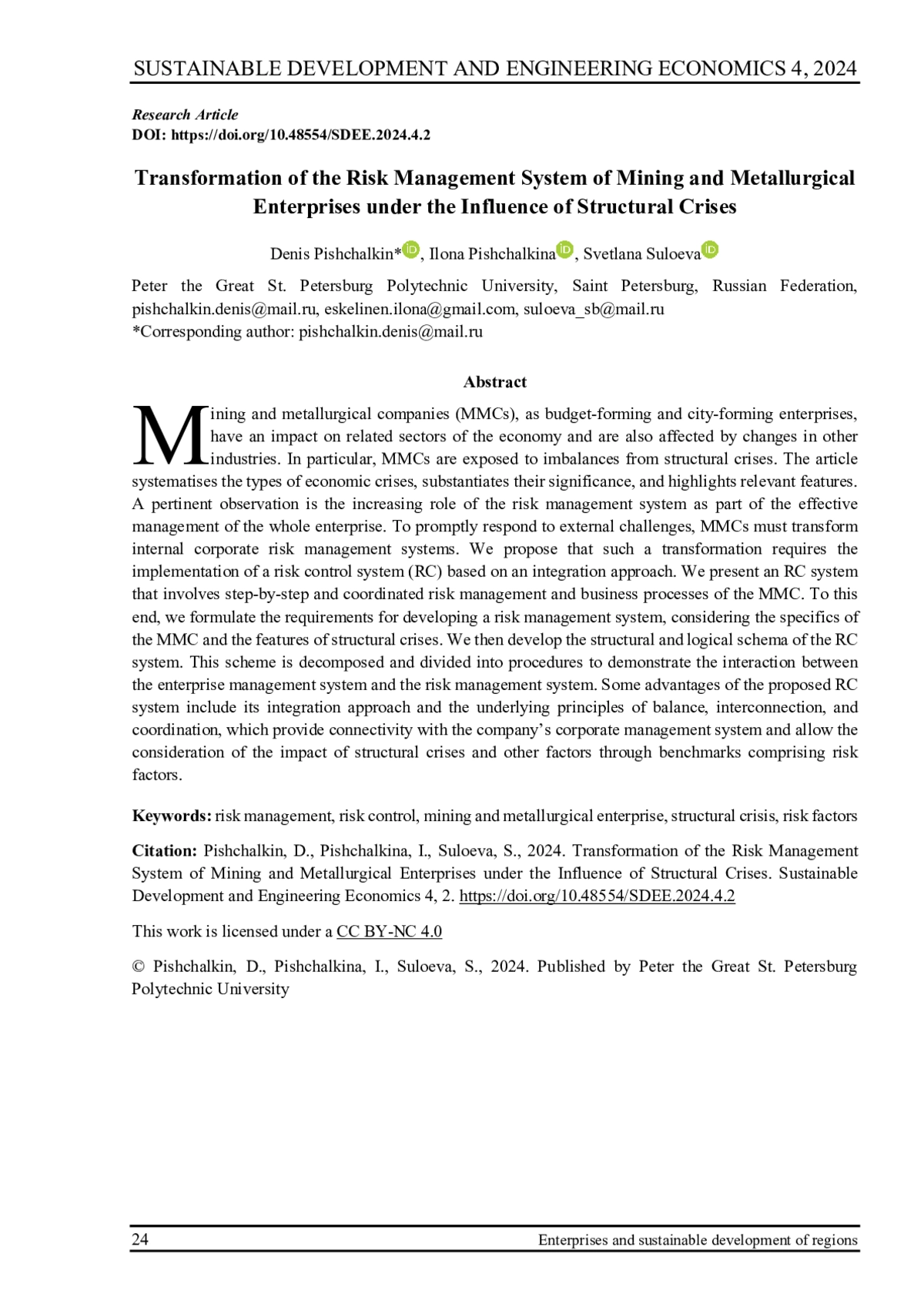
Mining and metallurgical companies (MMCs), as budget-forming and city-forming enterprises, have an impact on related sectors of the economy and are also affected by changes in other industries. In particular, MMCs are exposed to imbalances from structural crises. The article systematises the types of economic crises, substantiates their significance, and highlights relevant features. A pertinent observation is the increasing role of the risk management system as part of the effective management of the whole enterprise. To promptly respond to external challenges, MMCs must transform internal corporate risk management systems. We propose that such a transformation requires the implementation of a risk control system (RC) based on an integration approach. We present an RC system that involves step-by-step and coordinated risk management and business processes of the MMC. To this end, we formulate the requirements for developing a risk management system, considering the specifics of the MMC and the features of structural crises. We then develop the structural and logical schema of the RC system. This scheme is decomposed and divided into procedures to demonstrate the interaction between the enterprise management system and the risk management system. Some advantages of the proposed RC system include its integration approach and the underlying principles of balance, interconnection, and coordination, which provide connectivity with the company’s corporate management system and allow the consideration of the impact of structural crises and other factors through benchmarks comprising risk factors.
Идентификаторы и классификаторы
- SCI
- Экономика
The theories examined in this study include two broad categories: those that reflect the causes of cyclical and market economy crises in endogenous (internal, subjective) factors, and those that reflect the causes in exogenous (external, objective) factors. In the fundamental study of the features of structural crises, structural problems, and imbalances, we analysed several studies of well-known economists and scientists, such as J. A. Schumpeter, J.-B. Say, A. Aftalion, R. F. Harrod, J. R. Hicks, M. I. Tugan-Baranovsky, N. D. Kondratiev, I. P. Faminsky, V. E. Khrutsky, A. I. Belchuk, and L. V. Kantarovich (Schumpeter, 1939; Perez, 1983; Freeman and Perez, 1988; Boehm-Bawerk, 2009; Bagrova, 2016; Kumkar, 2018). The literature was analysed using methods of comparative analysis, data synthesis, systematic approach, and content analysis.
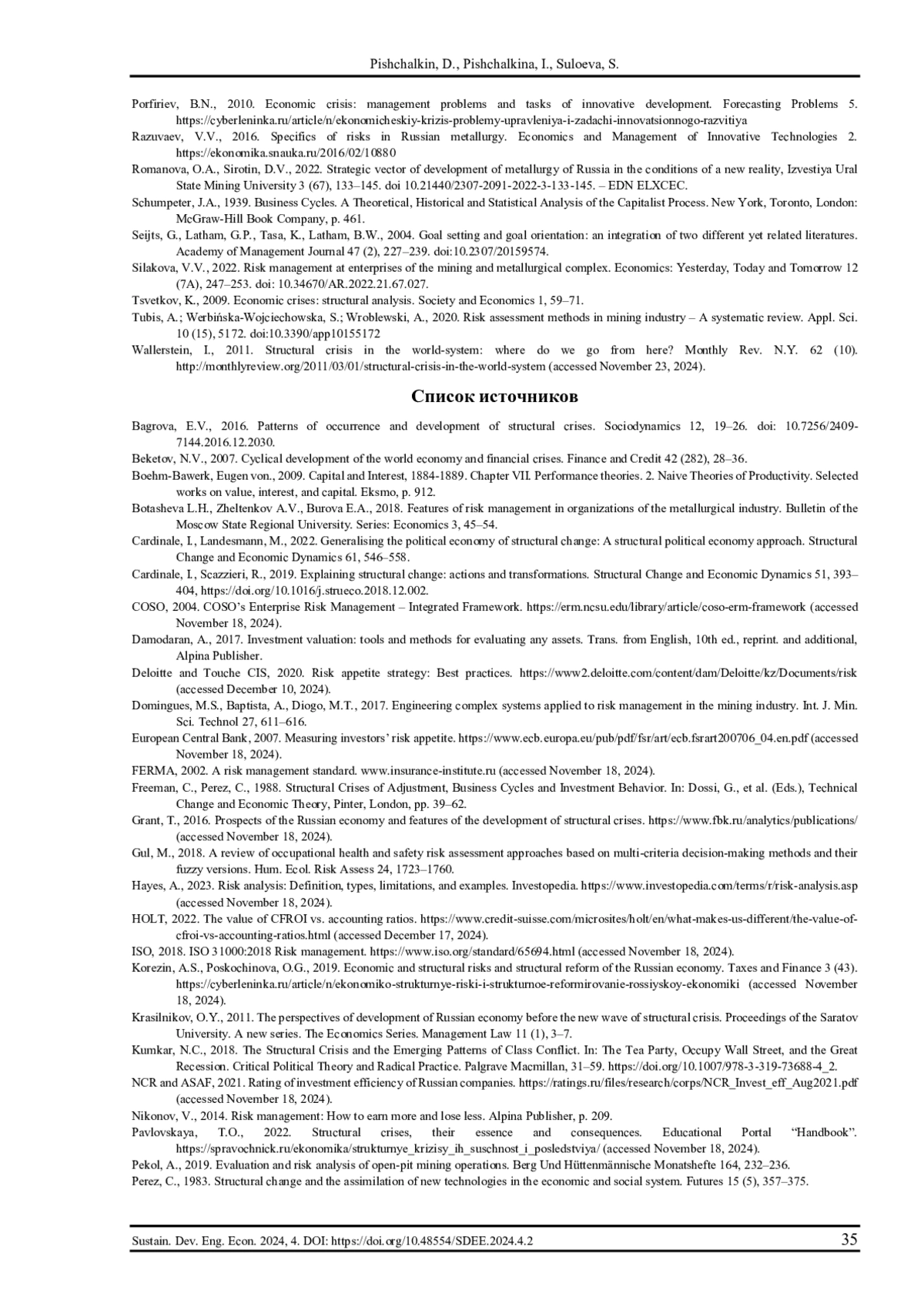
Список литературы
1. Bagrova, E.V., 2016. Patterns of occurrence and development of structural crises. Sociodynamics 12, 19-26. DOI: 10.7256/2409-7144.2016.12.2030
2. Beketov, N.V., 2007. Cyclical development of the world economy and financial crises. Finance and Credit 42 (282), 28-36. EDN: IBBALD
3. Boehm-Bawerk, Eugen von., 2009. Capital and Interest, 1884-1889. Chapter VII. Performance theories. 2. Naive Theories of Productivity. Selected works on value, interest, and capital. Eksmo, p. 912.
4. Botasheva L.H., Zheltenkov A.V., Burova E.A., 2018. Features of risk management in organizations of the metallurgical industry. Bulletin of the Moscow State Regional University. Series: Economics 3, 45-54. EDN: YAANXN
5. Cardinale, I., Landesmann, M., 2022. Generalising the political economy of structural change: A structural political economy approach. Structural Change and Economic Dynamics 61, 546-558. EDN: CCEEDS
6. Cardinale, I., Scazzieri, R., 2019. Explaining structural change: actions and transformations. Structural Change and Economic Dynamics 51, 393-404,. DOI: 10.1016/j.strueco.2018.12.002
7. COSO, 2004. COSO’s Enterprise Risk Management - Integrated Framework. https://erm.ncsu.edu/library/article/coso-erm-framework (accessed November 18, 2024).
8. Damodaran, A., 2017. Investment valuation: tools and methods for evaluating any assets. Trans. from English, 10th ed., reprint. and additional, Alpina Publisher.
9. Deloitte and Touche CIS, 2020. Risk appetite strategy: Best practices. https://www2.deloitte.com/content/dam/Deloitte/kz/Documents/risk (accessed December 10, 2024).
10. Domingues, M.S., Baptista, A., Diogo, M.T., 2017. Engineering complex systems applied to risk management in the mining industry. Int. J. Min. Sci. Technol 27, 611-616.
11. European Central Bank, 2007. Measuring investors’ risk appetite. https://www.ecb.europa.eu/pub/pdf/fsr/art/ecb.fsrart200706_04.en.pdf (accessed November 18, 2024).
12. FERMA, 2002. A risk management standard. www.insurance-institute.ru (accessed November 18, 2024).
13. Freeman, C., Perez, C., 1988. Structural Crises of Adjustment, Business Cycles and Investment Behavior. In: Dossi, G., et al. (Eds.), Technical Change and Economic Theory, Pinter, London, pp. 39-62.
14. Grant, T., 2016. Prospects of the Russian economy and features of the development of structural crises. https://www.fbk.ru/analytics/publications/ (accessed November 18, 2024).
15. Gul, M., 2018. A review of occupational health and safety risk assessment approaches based on multi-criteria decision-making methods and their fuzzy versions. Hum. Ecol. Risk Assess 24, 1723-1760.
16. Hayes, A., 2023. Risk analysis: Definition, types, limitations, and examples. Investopedia. https://www.investopedia.com/terms/r/risk-analysis.asp (accessed November 18, 2024).
17. HOLT, 2022. The value of CFROI vs. accounting ratios. https://www.credit-suisse.com/microsites/holt/en/what-makes-us-different/the-value-of-cfroi-vs-accounting-ratios.html (accessed December 17, 2024).
18. ISO, 2018. ISO 31000:2018 Risk management. https://www.iso.org/standard/65694.html (accessed November 18, 2024).
19. Korezin, A.S., Poskochinova, O.G., 2019. Economic and structural risks and structural reform of the Russian economy. Taxes and Finance 3 (43). https://cyberleninka.ru/article/n/ekonomiko-strukturnye-riski-i-strukturnoe-reformirovanie-rossiyskoy-ekonomiki (accessed November 18, 2024).
20. Krasilnikov, O.Y., 2011. The perspectives of development of Russian economy before the new wave of structural crisis. Proceedings of the Saratov University. A new series. The Economics Series. Management Law 11 (1), 3-7. EDN: OGDMCR
21. Kumkar, N.C., 2018. The Structural Crisis and the Emerging Patterns of Class Conflict. In: The Tea Party, Occupy Wall Street, and the Great Recession. Critical Political Theory and Radical Practice. Palgrave Macmillan, 31-59. DOI: 10.1007/978-3-319-73688-4_2
22. NCR and ASAF, 2021. Rating of investment efficiency of Russian companies. https://ratings.ru/files/research/corps/NCR_Invest_eff_Aug2021.pdf (accessed November 18, 2024).
23. Nikonov, V., 2014. Risk management: How to earn more and lose less. Alpina Publisher, p. 209.
24. Pavlovskaya, T.O., 2022. Structural crises, their essence and consequences. Educational Portal “Handbook”. https://spravochnick.ru/ekonomika/strukturnye_krizisy_ih_suschnost_i_posledstviya/ (accessed November 18, 2024).
25. Pekol, A., 2019. Evaluation and risk analysis of open-pit mining operations. Berg Und Hüttenmännische Monatshefte 164, 232-236.
26. Perez, C., 1983. Structural change and the assimilation of new technologies in the economic and social system. Futures 15 (5), 357-375.
27. Perez, S.R., 2022. How to do a quantitative risk assessment (QRA). https://www.gexcon.com/blog/how-to-do-a-quantitative-risk-assessment-qra/ (accessed November 23, 2024).
28. Pishchalkina, I. Y., 2022. Development of a conceptual model of the risk-controlling system for a vertically integrated enterprise of the mining and metallurgical industry. Business. Education Law 3, 80-85. DOI: 10.25683/VOLBI.2022.60.335 EDN: GJDHED
29. Pishchalkina, I.Y., 2021. Development of a reference model for a modern mining and metallurgical enterprise. Production Organizer 29 (4), 25-34. DOI: 10.36622/VSTU.2021.99.44.003 EDN: XXQFKR
30. Porfiriev, B.N., 2010. Economic crisis: management problems and tasks of innovative development. Forecasting Problems 5. https://cyberleninka.ru/article/n/ekonomicheskiy-krizis-problemy-upravleniya-i-zadachi-innovatsionnogo-razvitiya.
31. Razuvaev, V.V., 2016. Specifics of risks in Russian metallurgy. Economics and Management of Innovative Technologies 2. https://ekonomika.snauka.ru/2016/02/10880.
32. Romanova, O.A., Sirotin, D.V., 2022. Strategic vector of development of metallurgy of Russia in the conditions of a new reality, Izvestiya Ural State Mining University 3 (67), 133-145. DOI: 10.21440/2307-2091-2022-3-133-145 EDN: ELXCEC
33. Schumpeter, J.A., 1939. Business Cycles. A Theoretical, Historical and Statistical Analysis of the Capitalist Process. New York, Toronto, London: McGraw-Hill Book Company, p. 461.
34. Seijts, G., Latham, G.P., Tasa, K., Latham, B.W., 2004. Goal setting and goal orientation: an integration of two different yet related literatures. Academy of Management Journal 47 (2), 227-239. DOI: 10.2307/20159574
35. Silakova, V.V., 2022. Risk management at enterprises of the mining and metallurgical complex. Economics: Yesterday, Today and Tomorrow 12 (7A), 247-253. DOI: 10.34670/AR.2022.21.67.027 EDN: KEPSCV
36. Tsvetkov, K., 2009. Economic crises: structural analysis. Society and Economics 1, 59-71. EDN: LRGRLR
37. Tubis, A.; Werbińska-Wojciechowska, S.; Wroblewski, A., 2020. Risk assessment methods in mining industry - A systematic review. Appl. Sci. 10 (15), 5172. DOI: 10.3390/app10155172 EDN: OQAOBF
38. Wallerstein, I., 2011. Structural crisis in the world-system: where do we go from here? Monthly Rev. N.Y. 62 (10). http://monthlyreview.org/2011/03/01/structural-crisis-in-the-world-system (accessed November 23, 2024).

Выпуск
Другие статьи выпуска
Современная геополитическая картина мира стала для многих стран серьезным вызовом. Помимо множества различных турбулентных явлений, в глобальной экономике текущего периода можно также наблюдать изменения в логистических и транспортных путях между странами. Наряду со сменой ролей, борьбой за различные геополитические интересы, вопросы транспортных коммуникаций и возможностей стран с точки зрения транзита выходят на первый план. Проблема развития транспортных логистических путей для Армении стала еще более насущной и требующей незамедлительного решения. Ключевой целью исследования стала оценка возможностей транспортной логистики Армении с точки зрения ее взаимодействия как со странами ЕАЭС, так и с третьими странами, в том числе в ракурсе расширения реэкспорта последние несколько лет. Методология исследования основана на анализе влияния транспортных коммуникаций на экономическое развитие и благосостояние Армении. Использованы методы качественного и статистического анализа, а также наблюдение и синтез. Информационная база включает статистику грузоперевозок и товарной структуры торговли Армении с ЕАЭС и третьими странами. В результате выявлено, что существующая транспортная логистическая система Армении слабо развита и существенно тормозит развитие экономического потенциала страны. Основным выводом исследования стал тезис о необходимости развития логистических транспортных систем, с целью положительного воздействия на экономический рост и развития Армении в долгосрочной перспективе.
The main objective of this study is to examine the influence of the transport system on CO2 emission levels. To achieve this goal, first, identify existing interrelationships between transport performance indicators and CO2 emissions was established, and the direction and degree of impact of significant performance indicators of the transport system on emissions were assessed. Next, based on analysis and synthesis of the literature - both domestic and foreign - factors that have the greatest influence on the level of CO2 emissions were identified and systematized. Assuming that there are causal relationships between the amount of CO2 emissions and the performance of the transport system, three hypotheses were put forward. To test the hypotheses, two models - end-to-end regression and regressions with effects - were considered to characterize the dependence of CO2 emissions on transport system performance. Model testing was conducted to choose the best model for analysis. It was found that the fixed-effects regression model is preferable to the random-effects and end-to-end regression models with regard to identifying and assessing the transport system indicators that can be managed to improve environmental conditions in various regions of the Russian Federation.
This study examines the role of government subsidies and private sector lending in stimulating China’s economic growth while assessing the prospects for expanding the social credit system. This study covers the period from 1990 to 2023 and is based on data from the National Bureau of Statistics of China, the World Bank and the International Monetary Fund. The paper applies theoretical analysis, as well as correlation and regression methods, to assess the long-term impact of various types of subsidies on macroeconomic indicators. The article examines theoretical models describing the relationship between social subsidies and economic growth and analyzes government subsidy programs. Special attention is given to the analysis of the social credit system, which evaluates the behavior of citizens and organizations, encouraging compliance with laws and regulations to enhance social stability and predictability in economic agents’ behavior. The findings demonstrate significant correlations between the volume of social subsidies and economic growth, indicating that social subsidies encourage household spending. However, the long-term effectiveness of subsidies in increasing productivity and innovation remains limited. In conclusion, it is noted that there is a need to improve the mechanisms for distributing subsidies and integrating the social credit system in order to achieve more effective economic growth, taking into account the need to maintain social stability in Chinese society.
Allocation of operations to work centers is a key management task in modern production systems. Its relevance stems from the need to optimize the use of limited resources to achieve high efficiency and productivity. However, the problem is complicated by the combinatorial complexity associated with the discrete nature of operations and the need to consider multiple factors, including resource constraints, time constraints, and process requirements. This requires specialized approaches to find efficient solutions. This paper is devoted to analyzing such approaches. The paper considers actual problems of optimization of operations distribution to work centers in modern production systems. Particular attention is paid to the problems of minimizing variable costs associated with the changeover of equipment and increasing the overall efficiency of production processes. The paper considers the limitations of classical optimization methods such as linear programming, a review of modern approaches, including combinatorial algorithms, methods of the theory of schedules. Special attention is paid to heuristic algorithms, such as genetic algorithms, simulated annealing, and ant algorithms, which allow us to find acceptable solutions in a short time. The paper also discusses the key factors affecting the scheduling, such as resource constraints, time constraints, and technological requirements. Considering the conditions of the production problem posed in the paper problem and based on analyzing the advantages and disadvantages of existing methods of its solution, as an alternative it is proposed and substantiated the use of multi-agent approach with the application of heuristic algorithms for the distribution of work operations at production enterprises.
Издательство
- Издательство
- Политех
- Регион
- Россия, Санкт-Петербург
- Почтовый адрес
- 195251, г.Санкт-Петербург, ул. Политехническая, дом 29
- Юр. адрес
- 195251, г Санкт-Петербург, Калининский р-н, ул Политехническая, д 29 литера б
- ФИО
- Рудской Андрей Иванович (РЕКТОР)
- E-mail адрес
- office@spbstu.ru
- Контактный телефон
- +7 (812) 2972077
- Сайт
- https://spbstu.ru