
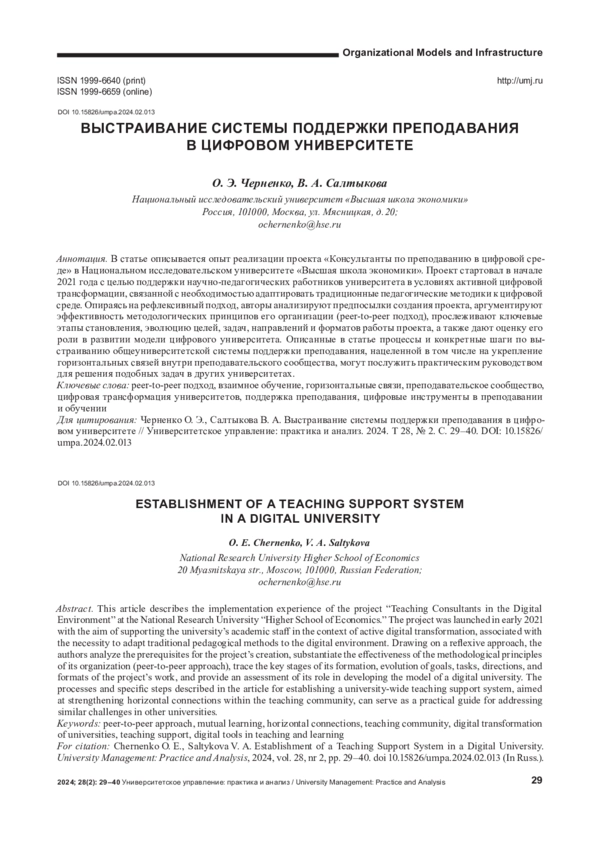
В статье описывается опыт реализации проекта «Консультанты по преподаванию в цифровой среде» в Национальном исследовательском университете «Высшая школа экономики». Проект стартовал в начале 2021 года с целью поддержки научно-педагогических работников университета в условиях активной цифровой трансформации, связанной с необходимостью адаптировать традиционные педагогические методики к цифровой среде. Опираясь на рефлексивный подход, авторы анализируют предпосылки создания проекта, аргументируют эффективность методологических принципов его организации (peer-to-peer подход), прослеживают ключевые этапы становления, эволюцию целей, задач, направлений и форматов работы проекта, а также дают оценку его роли в развитии модели цифрового университета. Описанные в статье процессы и конкретные шаги по выстраиванию общеуниверситетской системы поддержки преподавания, нацеленной в том числе на укрепление горизонтальных связей внутри преподавательского сообщества, могут послужить практическим руководством для решения подобных задач в других университетах.
Предпросмотр статьи
Идентификаторы и классификаторы
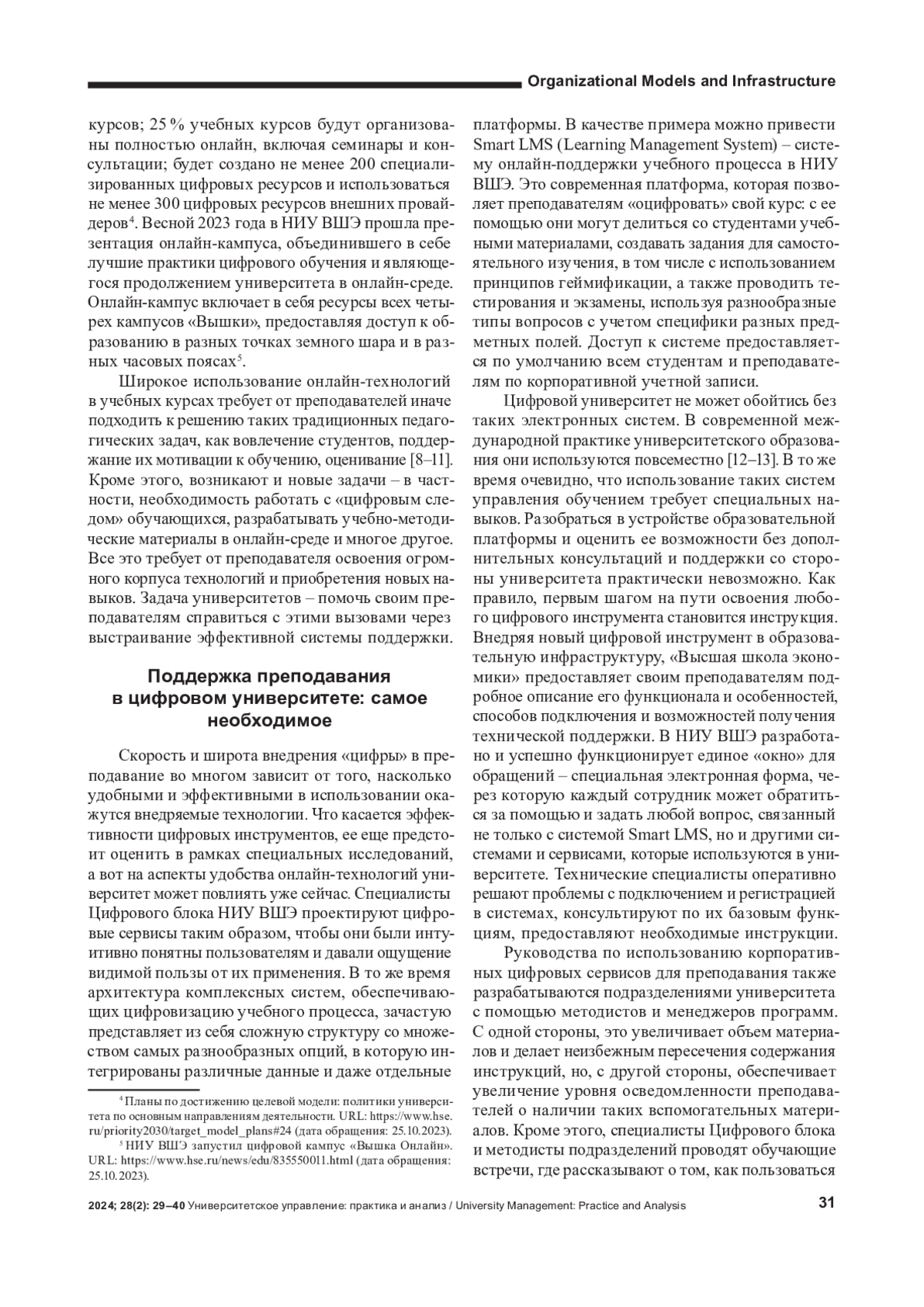
«Высшая школа экономики» входит в первую группу университетов, принявших участие в программе стратегического академического лидерства «Приоритет 2030». «Образовательная модель НИУ ВШЭ в наибольшей степени изменится к 2030 г. Главным драйвером ее изменения будет цифровая революция, радикально меняющая как рынок труда (по крайней мере, его верхние сегменты, на которые ориентирован НИУ ВШЭ) и привязанное к нему содержание программ полного среднего, высшего образования и дополнительного профессионального образования (далее – ДПО), так и образовательные ресурсы и методы обучения»,– свидетельствует информация с официального сайта университета 1.
Если у вас возникли вопросы или появились предложения по содержанию статьи, пожалуйста, направляйте их в рамках данной темы.
Список литературы
1. Afonso A., Morgado L., Roque L. Impact of Digital Transformation in Teacher Training Models. IGI Global, 2022, 313 p. (In Eng.). DOI: 10.4018/978-1-7998-9538-1
2. Ifenthaler D., Hofhues S., Egloffstein M., Helbig C. Digital Transformation of Learning Organizations. Springer, 2021, 252 p. (In Eng.). DOI: 10.1007/978-3-030-55878-9
3. Bates T. Teaching in a Digital Age: Guidelines for Designing and Learning. University of British Columbia, 2019, 517 p. (In Eng.).
4. Beck C., Kosnik C. Classroom Teaching in the 21st Century: Directions, Principles and Strategies. Open University Press, 2021, 228 p. (In Eng.).
5. Kergel D., Heidkamp-Kergel B., Arnett R. C., Mancino S. Communication and Learning in an Age of Digital Transformation. London, Routledge, 2020, 248 p. (In Eng.). DOI: 10.4324/9780429430114
6. Lynch A. Educational Goals for a Global Future: Teaching Technology Versus Teaching with Technology. Technology in Society, vol. 20 (3), pp. 339-345. 10.1016/ s0160-791x(98)00019-0 (In Eng.). DOI: 10.1016/s0160-791x(98)00019-0
7. McBride A. The Edtech Coaching Primer: Supporting Teachers in the Digital Age Classroom. International Society for Technology in Education, 2022, 175 p. (In Eng.).
8. Spector, J. M., Ifenthaler, D., Sampson, D. G., & Isaias, P. Competencies in Teaching, Learning and Educational Leadership in the Digital Age: Papers from CELDA 2014. Springer, 2016, 363 p. (In Eng.). DOI: 10.1007/978-3-319-30295-9
9. Starkey L. Teaching and Learning in the Digital Age. London, Routledge, 2012, 160 p. (In Eng.). DOI: 10.4324/9780203117422
10. Sampson D., Ifenthaler D., Spector J. M., Isaías P. Digital Technologies: Sustainable Innovations for Improving Teaching and Learning. Springer, 2018, 310 p. (In Eng.). DOI: 10.1007/978-3-319-73417-0
11. Yang N. ELearning for Quality Teaching in Higher Education: Teachers’ Perception, Practice, and Interventions. Singapore, Springer, 2020, 157 p. (In Eng.). DOI: 10.1007/978-981-15-4401-9 EDN: FAFDHJ
12. Paulsen M. F. Experiences with Learning Management Systems in 113 European Institutions. Educational Technology & Society, 2003, vol. 6 (4), pp. 134-148. (In Eng.).
13. Babo R., Azevedo A. Higher Education Institutions and Learning Management Systems: Adoption and Standardization. Information Science Reference, 2011, 398 p. (In Eng.). DOI: 10.4018/978-1-60960-884-2
14. O’Donnell A. M., King A. Cognitive Perspectives on Peer Learning. London, Routledge, 1999, 376 p. (In Eng.). DOI: 10.4324/9781410603715
15. Jackson C. K., Bruegmann E. Teaching Students and Teaching Each Other: The Importance of Peer Learning for Teachers. American Economic Journal: Applied Economics, 2009, vol. 1, nr 4, pp. 85-108. (In Eng.). DOI: 10.3386/w15202
16. Oeste-Reiß S. Leveraging the Potentials of Peer Learning: Conceptual Foundations and Reference Processes for Peer Learning. Kassel University Press GmbH, 2019, 320 p. (In Eng.).
17. Muijs D., Ainscow M., Chapman, C., West M. Collaboration and Networking in Education. Springer Science & Business Media, 2011, 182 p. (In Eng.). DOI: 10.1007/978-94-007-0283-7
18. Topping K., Buchs C., Duran D., Keer H. V. Effective Peer Learning: From Principles to Practical Implementation. Taylor & Francis, 2017, 192 p. (In Eng.). DOI: 10.4324/9781315695471
19. McClelland D. C., Atkinson J. W., Clark R. A., Lowell E. L. The Achievement Motive. New York, Appleton-Century-Crofts, 1953. (In Eng.). DOI: 10.1037/11144-000
20. Car nall C. Managing Change in Organizations. Pearson Education, 1995, 365 p. (In Eng.). DOI: 10.1016/0024-6301(96)81520-2
21. White A. From Comfort Zone to Performance Management: Understanding Development and Performance, available at: https://www.researchgate.net/publication/228957278_From_Comfort_Zone_to_Performance_Management (accessed 01.02.2024). (In Eng.).
Выпуск

Другие статьи выпуска
Предлагаем вашему вниманию журнальную версию одного из разделов доклада. В следующих номерах журнала мы представим материалы экспертной дискуссии о проблеме фундаментальности в науке и образовании. Иллюстрацией к дискуссии выступит описание экспериментальной практики пилотных университетов, которые уже сейчас решают вопрос, какое содержание и виды образовательной деятельности должны быть в фундаментальном сегменте ядра высшего образования и как они интегрируются с задачами усиления практической подготовки.
В работе исследуется вопрос об экономических потерях университетов РФ от отмены договоров, заключенных через систему государственных закупок. Для сбора статистической информации используется автоматизированная система научных исследований в экономике, разработанная на основе технологии RPA (Robotic Process Automation). Поиск информации в большой базе данных системы государственных закупок осуществляется с помощью интеллектуального программного робота. В работе приводится пример анализа данных об отмененных договорах для трех университетов: Московского государственного университета, Санкт-Петербургского политехнического университета имени Петра Великого и Севастопольского государственного университета. Для оценки потерь от отмены договоров предлагается использовать методы анализа упущенной выгоды и статистического анализа. Упущенная выгода оценивается на основании возможного депозитного дохода, который можно было бы получить, если бы запланированные на договор средства были положены в банк. Вводится понятие удельной упущенной выгоды на один отмененный договор. С помощью статистического анализа показано, что, несмотря на разный масштаб исследуемых университетов, удельная упущенная выгода для всех рассмотренных университетов имеет тенденцию к уменьшению со временем.
В статье представлены результаты исследования, цель которого - выявить факторы результативности научно-исследовательского сотрудничества вузов и бизнеса. Эмпирической основой исследования послужили количественные данные о деятельности 600 российских вузов за 2022 год. Для реализации цели исследования построены регрессионные модели. Зависимые переменные в моделях характеризуют размер внебюджетного дохода от научно-исследовательских и опытно-конструкторских работ, его долю в общем доходе от научных исследований и число публикаций, подготовленных вузом совместно с компаниями. В качестве независимых переменных рассмотрены индикаторы, характеризующие публикационную активность, состав и зарплату научно-педагогических работников, материальные ресурсы, структуру доходов вуза, участие вуза в государственных проектах, направленных на поддержку и развитие партнерства с бизнесом, форму собственности, территориальное расположение и специализацию вуза. Анализ показал, что для достижения высокой результативности сотрудничества вузов и бизнеса в области научных исследований и разработок первостепенное значение имеют человеческие ресурсы вуза: уровень квалификации и степень интернационализации состава научно-педагогических работников, их публикационная активность. Также немаловажна ориентация вуза на получение общего дохода преимущественно из внебюджетных источников и рассмотрение научно-исследовательского направления деятельности в качестве одной из приоритетных статей притока денежных средств. Полученные выводы основаны на статистически значимых закономерностях, выявленных в результате эконометрического анализа актуальных количественных данных о показателях деятельности большинства российских вузов. Результаты исследования могут представлять интерес для вузов, стремящихся развивать сотрудничество с бизнес-компаниями.
Исследование направлено на выявление ключевых характеристик вовлеченности в проектное обучение работодателей-заказчиков проектов и студентов, их заинтересованности в проектном обучении как образовательной технологии и мотивов выбора обучающимися конкретных проектов для реализации. В статье представлен опыт Уральского федерального университета, где формат проектного обучения активно развивается на системном уровне более семи лет. Авторы приводят результаты опроса работодателей, участвующих в проектном обучении в роли заказчиков, а также студентов вуза. Ключевым выводом из результатов исследования является наличие противоречий в понимании проектного обучения у этих двух групп и, как следствие, разрыва между их поведением. Авторы предлагают свои рекомендации по преодолению этого разрыва с точки зрения управления процессом проектного обучения. Статья будет полезна исследователям, изучающим практико-ориентированные форматы обучения, а также университетским управленцам, развивающим проектное обучение в своих вузах.
В статье анализируются особенности профессиональных стратегий профессорско-преподавательского состава (ППС) и научных сотрудников (НС) в российских университетах, а также сложившиеся подходы к их профессиональному развитию и мотивации. Рассмотрены составляющие профессиональной стратегии преподавателя высшей школы: мобильность, институциональные условия выбора карьерной траектории; желаемое и реальное соотношение методического / преподавательского, научного и административного видов работ. Обосновано, что российские преподаватели и научные сотрудники ориентированы на работу в своем вузе и регионе, мобильность носит горизонтальный характер. Значимыми мотивами переезда для работы в вузе являются карьерный рост (повышение по должности / занятие административной позиции) и повышение заработной платы в 2 раза. Существует запрос на увеличение доли научной работы в отдельных типах вузов. Отмечена необходимость учета индивидуальных запросов ППС на новые компетенции и треки профессионального развития со стороны руководства вузов. Обсуждается необходимость выделения треков, соответствующих основным видам деятельности - наука, преподавание и практическая / административная деятельность. Сделаны выводы о необходимости построения системы поддержки развития профессиональных стратегий ППС на уровне всей страны и внедрения такой системы с учетом особенностей и ресурсов каждого конкретного вуза. Материал подготовлен по итогам проведения исследования «Профессиональные стратегии преподавателей высшей школы в современной России» в рамках проекта «Зеркальные лаборатории НИУ ВШЭ».
Статья посвящена оценке доступности обучения в ведущих вузах России для жителей различных регионов страны. Цель публикации - описать методику оценки доступности обучения в ведущих вузах страны для потенциальных абитуриентов, проживающих в тех или иных субъектах Российской Федерации, и результаты ее апробации. В статье приводится анализ уровня территориальной, экономической, образовательной и организационной составляющих доступности обучения в ведущих вузах России по программам бакалавриата и специалитета по очной форме в отношении всех регионов страны, а также интегрального показателя доступности ведущих вузов для абитуриентов из каждого субъекта Российской Федерации. Исследование основано на данных сводных форм ВПО-1 Минобрнауки России о приеме на обучение по программам высшего образования в региональном разрезе, на сведениях Федеральной службы государственной статистики России и Единой межведомственной информационной справочной системы, а также на информации официальных сайтов ведущих вузов страны о стоимости обучения и результатах приемных кампаний 2023/24 уч. года. Результаты оценки позволили выделить группу регионов, характеризующихся относительно низким уровнем доступности обучения в ведущих вузах для их жителей, а также определить, чем именно это обусловлено. Полученные выводы могут служить основой для соответствующих управленческих решений федеральных и региональных органов государственного управления, а также руководства ведущих классических, федеральных и национальных исследовательских университетов страны по повышению уровня доступности обучения в этих вузах.
В статье рассматривается проблематика эволюции университетских кампусов и их взаимодействия с внешней средой. На сегодняшний день развитие университетских кампусов складывается на фоне глобальной трансформации сферы высшего образования; выделяются факторы и вызовы, оказывающие наиболее явное влияние на формирование запроса к университетским кампусам. На фоне стремительно меняющегося контекста происходит парадигмальный сдвиг в функциональном, пространственном и архитектурном осмыслении формирования и развития университетских кампусов, разрабатываются новые подходы к управлению кампусами, появляются новые тренды развития. На основе кейс-стади актуальных российских и международных примеров выявлены и представлены основные тренды развития университетских кампусов.
В работе приведены результаты исследования существующих организационных моделей проектного обучения в вузах России с учетом общемирового контекста их развития. Целью исследования является оценка применимости различных элементов моделей в российских университетах. На основе анализа статей, программ развития университетов и интервьюирования организаторов проектного обучения авторами выделены и представлены универсальные характеристики проектного обучения, предложена категориальная основа для выбора и формирования организационной модели проектного обучения в университете. Использованный подход позволяет учесть сочетание исторически сложившихся успешных практик и необходимость цифровизации данной образовательной технологии.
Статья посвящена проблеме фундаментального содержания образования, ставшей актуальной в ХХI веке. Целью представленного исследования выступает поиск объективных предпосылок и оснований для переопределения термина «фундаментальность» в системе высшего образования (следует отметить, что пересмотр термина «фундаментальный» может оказаться значимой задачей и для иных уровней образования). В историко-философском анализе дается обоснование отсутствия рефлексии по поводу данной проблемы в истории образования, начиная с античности, определяется понятие «фундаментальность априори», раскрывается значение эпохи Просвещения для формирования фундаментальности науки и образования. Фундаментальное содержание образования связывается с состоянием социокультурной реальности и с характером науки на том или ином этапе истории. Проводится анализ зарубежных подходов к определению фундаментального образования. Новизна статьи состоит в том, что на основе исторического исследования науки и образования дается понятие «новая фундаментальность» применительно к современному образованию. Материалы исследования (эмпирические и теоретические) получены на базе университетского образования, но его результаты могут быть использованы разработчиками образовательных программ других вузов, а также широким кругом исследователей для последующего выстраивания нового подхода к профессиональному образованию.
12 мая 2023 года вышел Указ Президента Российской федерации № 343 «О некоторых вопросах совершенствования системы высшего образования». Указом были утверждены шесть университетов, которые начали эксперимент по обновлению содержания и форм высшего образования.
Статистика статьи
Статистика просмотров за 2025 - 2026 год.
Издательство
- Издательство
- ВВГУ
- Регион
- Россия, Владивосток
- Почтовый адрес
- 690014, ДФО, Приморский край, г. Владивосток, ул. Гоголя, 41
- Юр. адрес
- 690014, ДФО, Приморский край, г. Владивосток, ул. Гоголя, 41
- ФИО
- Терентьева Татьяна Валерьевна (РЕКТОР)
- E-mail адрес
- rectorat@vvsu.ru
- Контактный телефон
- +8 (423) 2404289
- Сайт
- https://www.vvsu.ru/