1. Антонов И. А., Салеев В. М. Экономичный способ вычисления ЛПτ-последовательностей // Журнал вычислительной математики и математической физики. - 1979. - Т. 19. - № 1. - С. 243-245.
Antonov, I. A. and Saleev, V. M. (1979). An Economical Method for Computing LPτ-Sequences. Journal of Computational Mathematics and Mathematical Physics, 19(1), pp. 243-245. (In Russian).
2. Международный опыт разработки планов восстановления финансовой устойчивости: информационный доклад. - Банк России, 2021.
Bank of Russia (2021). International Experience in Developing Financial Stability Recovery Plans. Information Report. (In Russian).
3. О методических рекомендациях по организации кредитными организациями внутренних процедур оценки достаточности капитала: Письмо Банка России от 29 июня 2011 г. № 96-Т.
Bank of Russia (2011). On Methodological Recommendations for Credit Institutions on Organising Internal Capital Adequacy Assessment Processes. Bank of Russia Letter No. 96-T, dated 29 June 2011. (In Russian).
4. О порядке расчета величины кредитного риска банками с применением банковских методик управления кредитным риском и моделей количественной оценки кредитного риска: Положение Банка России от 2 ноября 2024 г. № 845-П.
Bank of Russia (2024). On the Procedure for Calculating Credit Risk by Banks Using Banks’ Credit Risk Management Methods and Quantitative Credit Risk Assessment Models. Bank of Russia Regulation No. 845-P, dated 2 November 2024. (In Russian).
5. О порядке расчета величины кредитного риска на основе внутренних рейтингов: Положение Банка России от 6 августа 2015 г. № 483-П (ред. от 7 июня 2023 г.).
Bank of Russia (2015a). On the Procedure for Calculating Credit Risk Using IRB Approaches. Bank of Russia Regulation No. 483-P, dated 6 August 2015. (In Russian).
6. О требованиях к системе управления рисками и капиталом кредитной организации и банковской группы: Указание Банка России от 15 апреля 2015 г. № 3624-У (ред. от 10 января 2023 г.).
Bank of Russia (2015b). On the Requirements for the Risk and Capital Management System of a Credit Institution or a Banking Group. Bank of Russia Ordinance No. 3624-U, dated 15 April 2015. (In Russian).
7. О требованиях к содержанию, порядке и сроках представления кредитными организациями в Банк России планов восстановления финансовой устойчивости <…>. Положение Банка России от 4 октября 2018 г. № 653-П (ред. от 3 августа 2020 г.).
Bank of Russia (2018). On the Requirements for the Content of Financial Stability Recovery Plans <…>. Bank of Russia Regulation No. 653-P, dated 4 October 2018. (In Russian).
8. Пеникас Г. И. Определение корреляции дефолтов по данным о дефолтах в США за период 1985-2021 гг. Тезисы IV международной научной конференции “Осенние математические чтения в Адыгее” (13-17 октября 2021 г., Майкоп). - 2021. - С. 90-94. EDN: IBPGLA
Penikas, H. (2021b). Determining Default Correlation Based on Defaults Data in the USA for the Period 1985-2021. In: Proceedings of the IV International Conference ‘Autumn Mathematical Readings in Adygea’, pp. 90-94. (In Russian).
9. Пеникас Г. Эффект корреляции дефолтов на оценку кредитного риска портфеля ссуд на примере “зеленого” финансирования // Банк России. Серия докладов об экономических исследованиях. - 2023. - № 121.
Penikas, H. (2023a). Default Correlation Impact on the Loan Portfolio Credit Risk Measurement for the ‘Green’ Finance as an Example. Bank of Russia Working Paper Series, N 121.
10. Соболь И. М. Равномерно распределенные последовательности с дополнительным свойством равномерности // Журнал вычислительной математики и математической физики. - 1976. - Т. 16. - № 5. - С. 1332-1337.
Sobol, I. M. (1976). Uniformly Distributed Sequences with an Additional Property of Uniformity. Journal of Computational Mathematics and Mathematical Physics, 16(5), pp. 1332-1337. (In Russian).
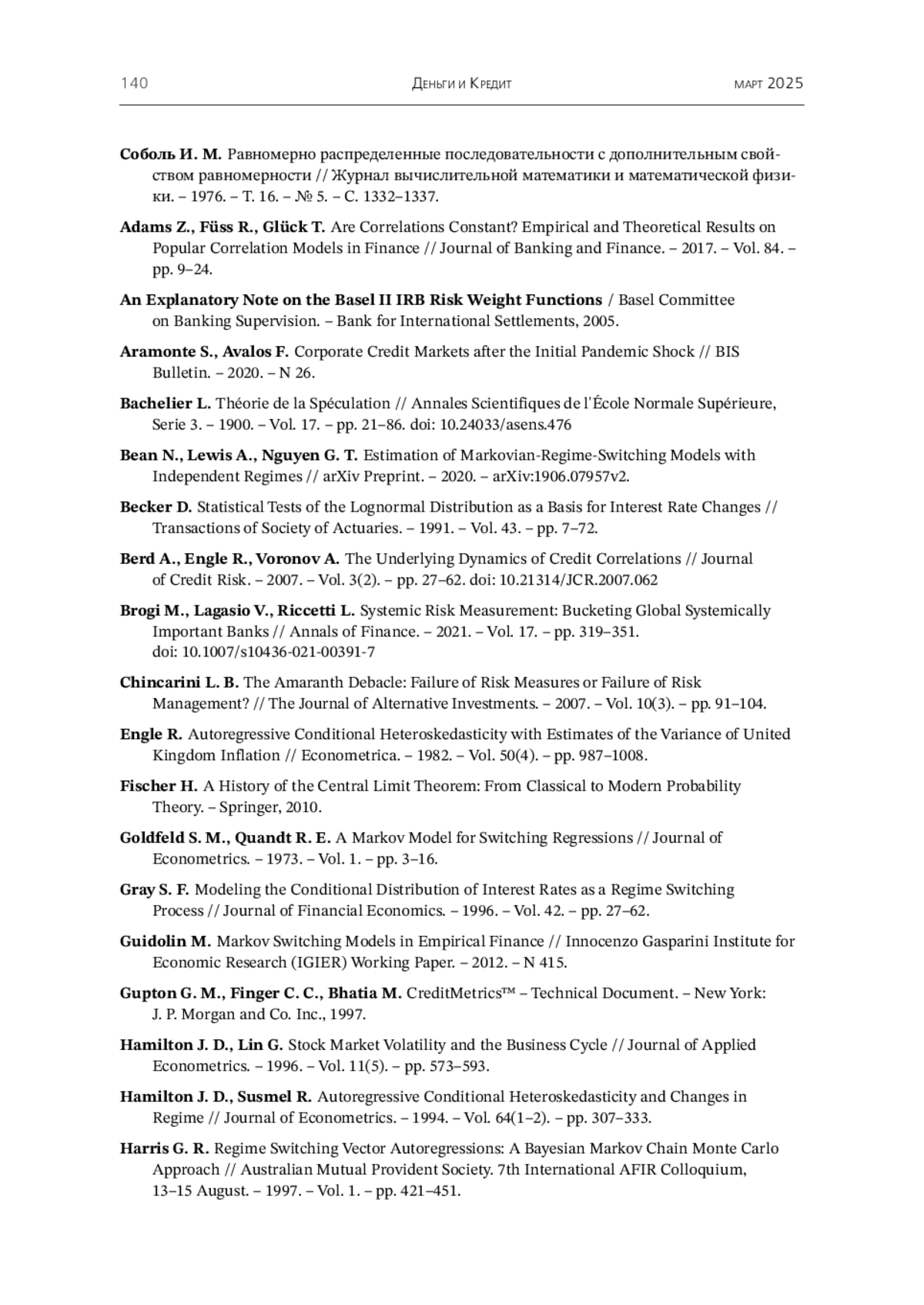
11. Adams Z., Füss R., Glück T. Are Correlations Constant? Empirical and Theoretical Results on Popular Correlation Models in Finance // Journal of Banking and Finance. - 2017. - Vol. 84. - pp. 9-24.
12. An Explanatory Note on the Basel II IRB Risk Weight Functions / Basel Committee on Banking Supervision. - Bank for International Settlements, 2005.
13. Aramonte S., Avalos F. Corporate Credit Markets after the Initial Pandemic Shock // BIS Bulletin. - 2020. - N 26.
14. Bachelier L. Théorie de la Spéculation // Annales Scientifiques de l’École Normale Supérieure, Serie 3. - 1900. - Vol. 17. - pp. 21-86. DOI: 10.24033/asens.476
15. Bean N., Lewis A., Nguyen G. T. Estimation of Markovian-Regime-Switching Models with Independent Regimes // arXiv Preprint. - 2020. - arXiv:1906.07957v2.
16. Becker D. Statistical Tests of the Lognormal Distribution as a Basis for Interest Rate Changes // Transactions of Society of Actuaries. - 1991. - Vol. 43. - pp. 7-72.
17. Berd A., Engle R., Voronov A. The Underlying Dynamics of Credit Correlations // Journal of Credit Risk. - 2007. - Vol. 3(2). - pp. 27-62. DOI: 10.21314/JCR.2007.062
18. Brogi M., Lagasio V., Riccetti L. Systemic Risk Measurement: Bucketing Global Systemically Important Banks // Annals of Finance. - 2021. - Vol. 17. - pp. 319-351. DOI: 10.1007/s10436-021-00391-7 EDN: IJJBTQ
19. Chincarini L. B. The Amaranth Debacle: Failure of Risk Measures or Failure of Risk Management? // The Journal of Alternative Investments. - 2007. - Vol. 10(3). - pp. 91-104.
20. Engle R. Autoregressive Conditional Heteroskedasticity with Estimates of the Variance of United Kingdom Inflation // Econometrica. - 1982. - Vol. 50(4). - pp. 987-1008.
21. Fischer H. A History of the Central Limit Theorem: From Classical to Modern Probability Theory. - Springer, 2010.
22. Goldfeld S. M., Quandt R. E. A Markov Model for Switching Regressions // Journal of Econometrics. - 1973. - Vol. 1. - pp. 3-16.
23. Gray S. F. Modeling the Conditional Distribution of Interest Rates as a Regime Switching Process // Journal of Financial Economics. - 1996. - Vol. 42. - pp. 27-62. EDN: ANLRHV
24. Guidolin M. Markov Switching Models in Empirical Finance // Innocenzo Gasparini Institute for Economic Research (IGIER) Working Paper. - 2012. - N 415.
25. Gupton G. M., Finger C. C., Bhatia M. CreditMetrics™ - Technical Document. - New York: J. P. Morgan and Co. Inc., 1997.
26. Hamilton J. D., Lin G. Stock Market Volatility and the Business Cycle // Journal of Applied Econometrics. - 1996. - Vol. 11(5). - pp. 573-593.
27. Hamilton J. D., Susmel R. Autoregressive Conditional Heteroskedasticity and Changes in Regime // Journal of Econometrics. - 1994. - Vol. 64(1-2). - pp. 307-333.
28. Harris G. R. Regime Switching Vector Autoregressions: A Bayesian Markov Chain Monte Carlo Approach // Australian Mutual Provident Society. 7th International AFIR Colloquium, 13-15 August. - 1997. - Vol. 1. - pp. 421-451.
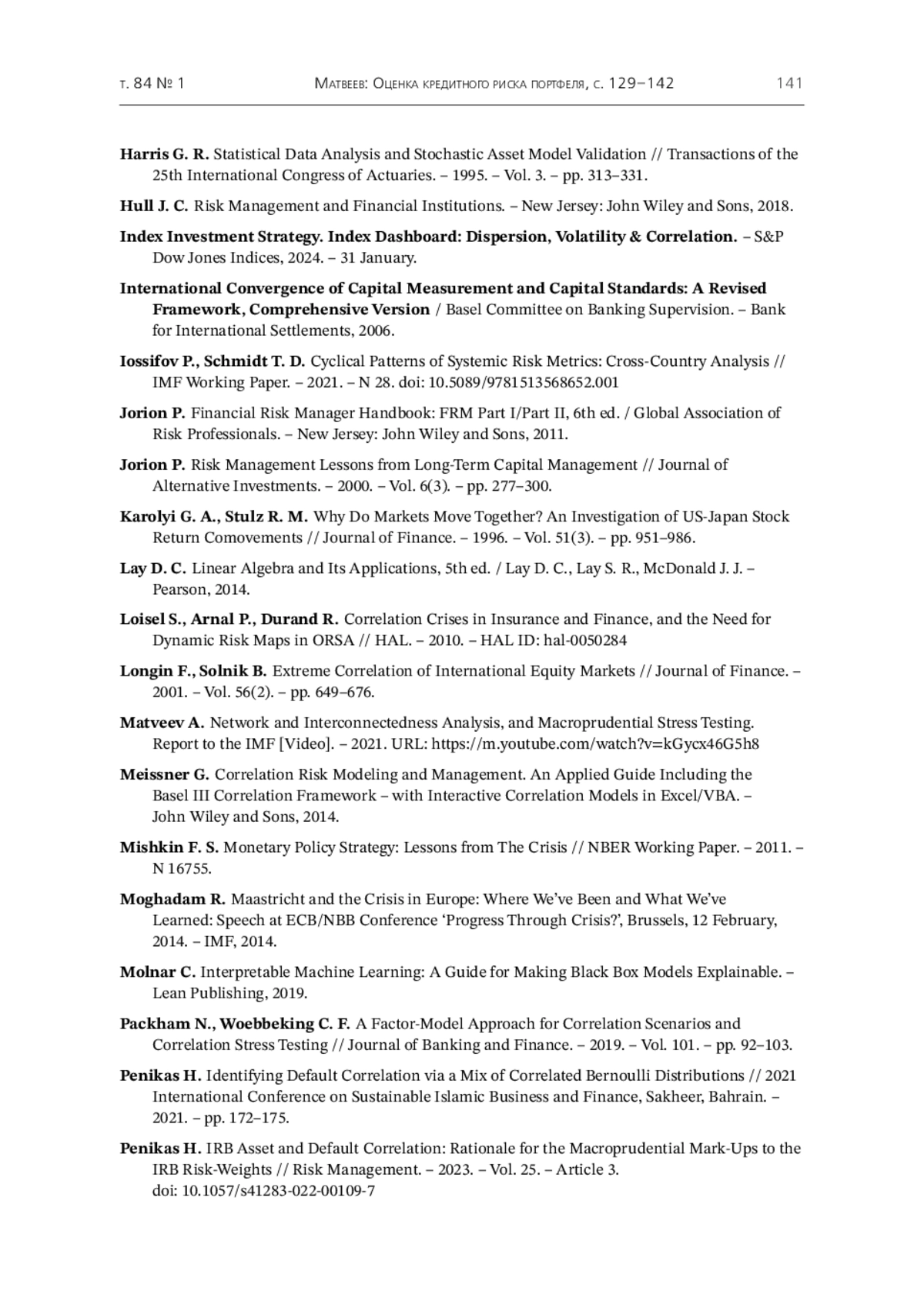
29. Harris G. R. Statistical Data Analysis and Stochastic Asset Model Validation // Transactions of the 25th International Congress of Actuaries. - 1995. - Vol. 3. - pp. 313-331.
30. Hull J. C. Risk Management and Financial Institutions. - New Jersey: John Wiley and Sons, 2018.
31. Index Investment Strategy. Index Dashboard: Dispersion, Volatility & Correlation. - S&P Dow Jones Indices, 2024. - 31 January.
32. International Convergence of Capital Measurement and Capital Standards: A Revised Framework, Comprehensive Version / Basel Committee on Banking Supervision. - Bank for International Settlements, 2006.
33. Iossifov P., Schmidt T. D. Cyclical Patterns of Systemic Risk Metrics: Cross-Country Analysis // IMF Working Paper. - 2021. - N 28. DOI: 10.5089/9781513568652.001
34. Jorion P. Financial Risk Manager Handbook: FRM Part I/Part II, 6th ed. / Global Association of Risk Professionals. - New Jersey: John Wiley and Sons, 2011.
35. Jorion P. Risk Management Lessons from Long-Term Capital Management // Journal of Alternative Investments. - 2000. - Vol. 6(3). - pp. 277-300.
36. Karolyi G. A., Stulz R. M. Why Do Markets Move Together? An Investigation of US-Japan Stock Return Comovements // Journal of Finance. - 1996. - Vol. 51(3). - pp. 951-986.
37. Lay D. C. Linear Algebra and Its Applications, 5th ed. / Lay D. C., Lay S. R., McDonald J. J. - Pearson, 2014.
38. Loisel S., Arnal P., Durand R. Correlation Crises in Insurance and Finance, and the Need for Dynamic Risk Maps in ORSA // HAL. - 2010. - HAL ID: hal-0050284.
39. Longin F., Solnik B. Extreme Correlation of International Equity Markets // Journal of Finance. - 2001. - Vol. 56(2). - pp. 649-676. EDN: DYRNLT
40. Matveev A.Network and Interconnectedness Analysis, and Macroprudential Stress Testing. Report to the IMF [Video]. - 2021. URL: https://m.youtube.com/watch?v=kGycx46G5h8.
41. Meissner G. Correlation Risk Modeling and Management. An Applied Guide Including the Basel III Correlation Framework - with Interactive Correlation Models in Excel/VBA. - John Wiley and Sons, 2014.
42. Mishkin F. S. Monetary Policy Strategy: Lessons from The Crisis // NBER Working Paper. - 2011. - N 16755.
43. Moghadam R. Maastricht and the Crisis in Europe: Where We’ve Been and What We’ve Learned: Speech at ECB/NBB Conference ‘Progress Through Crisis?’, Brussels, 12 February, 2014. - IMF, 2014.
44. Molnar C.Interpretable Machine Learning: A Guide for Making Black Box Models Explainable. - Lean Publishing, 2019.
45. Packham N., Woebbeking C. F. A Factor-Model Approach for Correlation Scenarios and Correlation Stress Testing // Journal of Banking and Finance. - 2019. - Vol. 101. - pp. 92-103. EDN: VNZYLI
46. Penikas H. Identifying Default Correlation via a Mix of Correlated Bernoulli Distributions // 2021 International Conference on Sustainable Islamic Business and Finance, Sakheer, Bahrain. - 2021. - pp. 172-175. EDN: DQZXUC
47. Penikas H. IRB Asset and Default Correlation: Rationale for the Macroprudential Mark-Ups to the IRB Risk-Weights // Risk Management. - 2023. - Vol. 25. - Article 3. DOI: 10.1057/s41283-022-00109-7 EDN: YDBOXS
48. Penikas H. Low Default Portfolios in Basel II and Basel III as a Special Case of Significantly Unbalanced Classes in Binary Choice Models // Russian Journal of Money and Finance. - 2020. - Vol. 79(2). - pp. 101-128. EDN: YXOGZA
49. Persio L. D., Matteo F. Maximum Likelihood Approach to Markov Switching Models // WSEAS Transactions on Business and Economics. - 2015. - Vol. 12. - pp. 239-242.
50. Pu X., Zhao X. Correlation in Credit Risk Changes // Journal of Banking and Finance. - 2012. - Vol. 36(4). - pp. 1093-1106.
51. Savine A., Andersen L. Modern Computational Finance: AAD and Parallel Simulations. - Wiley, 2018.
52. Smaga P. The Concept of Systemic Risk // The London School of Economics and Political Science, SRC Special Paper. - 2014. - N 5.
53. Spiegel M. R., Schiller J. J., Srinivasan R. A. Schaum’s Outline of Probability and Statistics, 4th ed. McGraw-Hill, 2012.
54. Taisuke N., Schmidt S. Expectations-Driven Liquidity Traps: Implications for Monetary and Fiscal Policy // ECB Working Paper Series. - 2019. - N 2304.
55. Teng L., Ehrhardt M., Günther M. The Dynamic Correlation Model and Its Application to the Heston Model // Innovations in Derivatives Markets. Springer Proceedings in Mathematics and Statistics, Vol. 165 / Glau K., Grbac Z., Scherer M., Zagst R., eds. - Springer, 2016. - pp. 437-449.
56. The Internal Ratings-Based Approach: Supporting Document to the New Basel Capital Accord / Basel Committee on Banking Supervision. - Bank for International Settlements, 2001.
57. Vasicek O. Probability of Loss on a Loan Portfolio / KMV Corporation. - San Francisco, 1987.
58. Walck C. Hand-book on Statistical Distributions for Experimentalists // University of Stockholm. SUF-PFY Internal Report. - 1996 (rev. 2007). - N 96-01.
59. Wooldridge M. J.Introductory Econometrics: A Modern Approach, 5th ed. - South-Western: Cengage Learning, 2013.
60. Yilmazkuday H. COVID-19 and Monetary Policy with Zero Bounds: A Cross-Country Investigation // Finance Research Letters. - 2022. - Vol. 44. - Article 102103. EDN: OVMBMJ