

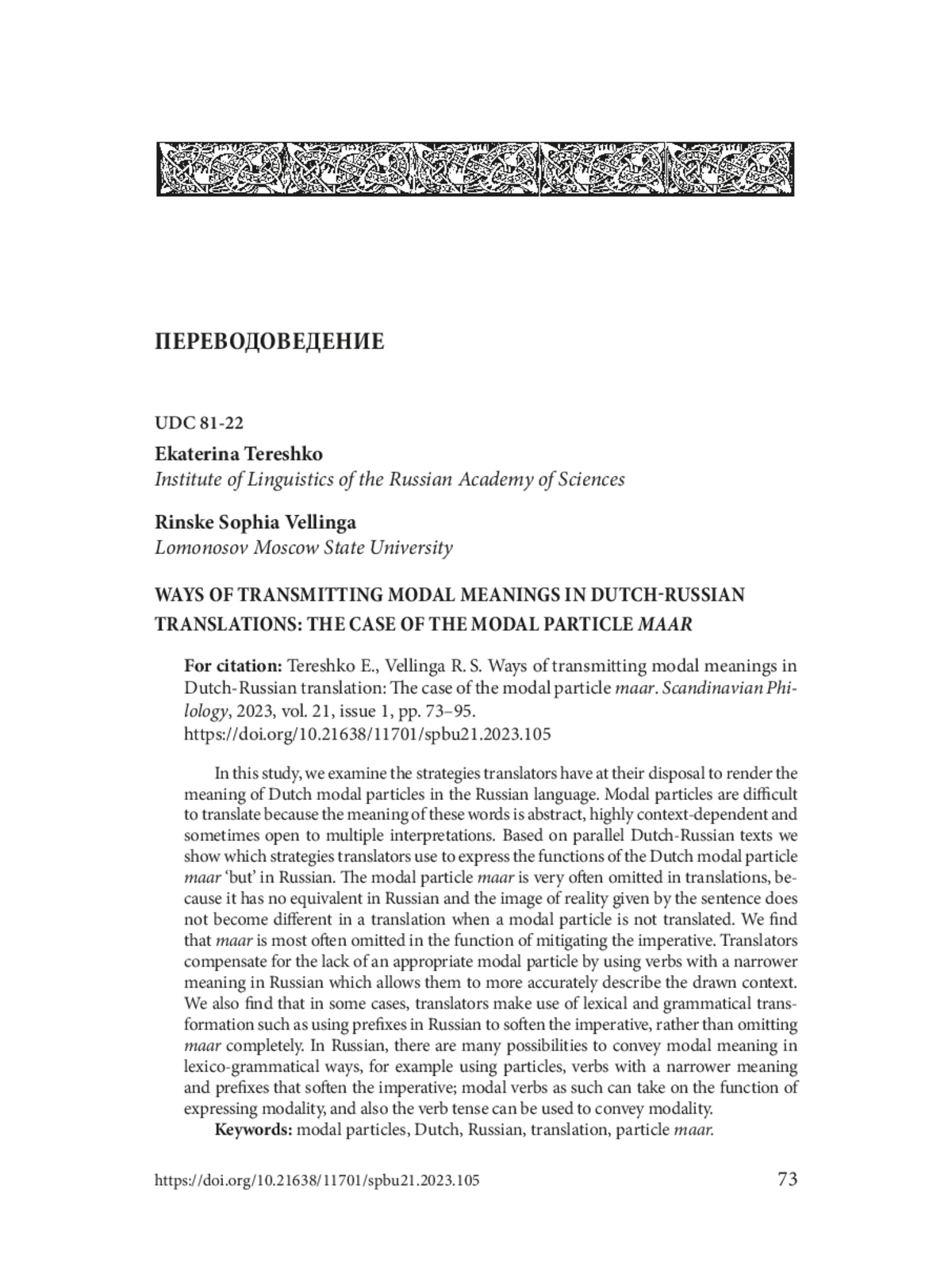
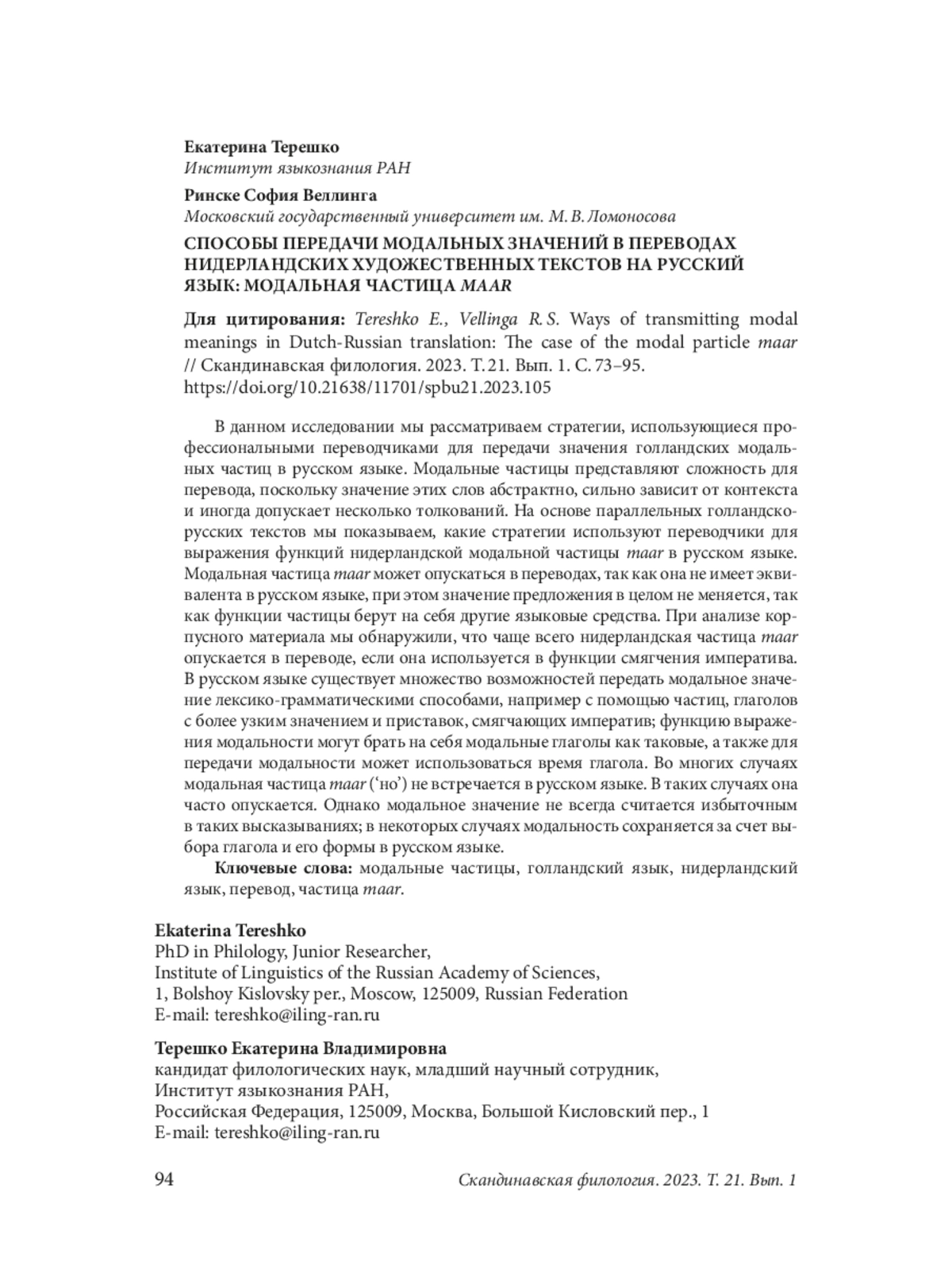
In this study, we examine the strategies translators have at their disposal to render the meaning of Dutch modal particles in the Russian language. Modal particles are difficult to translate because the meaning of these words is abstract, highly context-dependent and sometimes open to multiple interpretations. Based on parallel Dutch-Russian texts we show which strategies translators use to express the functions of the Dutch modal particle maar ‘but’ in Russian. The modal particle maar is very often omitted in translations, because it has no equivalent in Russian and the image of reality given by the sentence does not become different in a translation when a modal particle is not translated. We find that maar is most often omitted in the function of mitigating the imperative. Translators compensate for the lack of an appropriate modal particle by using verbs with a narrower meaning in Russian which allows them to more accurately describe the drawn context. We also find that in some cases, translators make use of lexical and grammatical transformation such as using prefixes in Russian to soften the imperative, rather than omitting maar completely. In Russian, there are many possibilities to convey modal meaning in lexico-grammatical ways, for example using particles, verbs with a narrower meaning and prefixes that soften the imperative; modal verbs as such can take on the function of expressing modality, and also the verb tense can be used to convey modality
Предпросмотр статьи
Идентификаторы и классификаторы
- SCI
- Языкознание
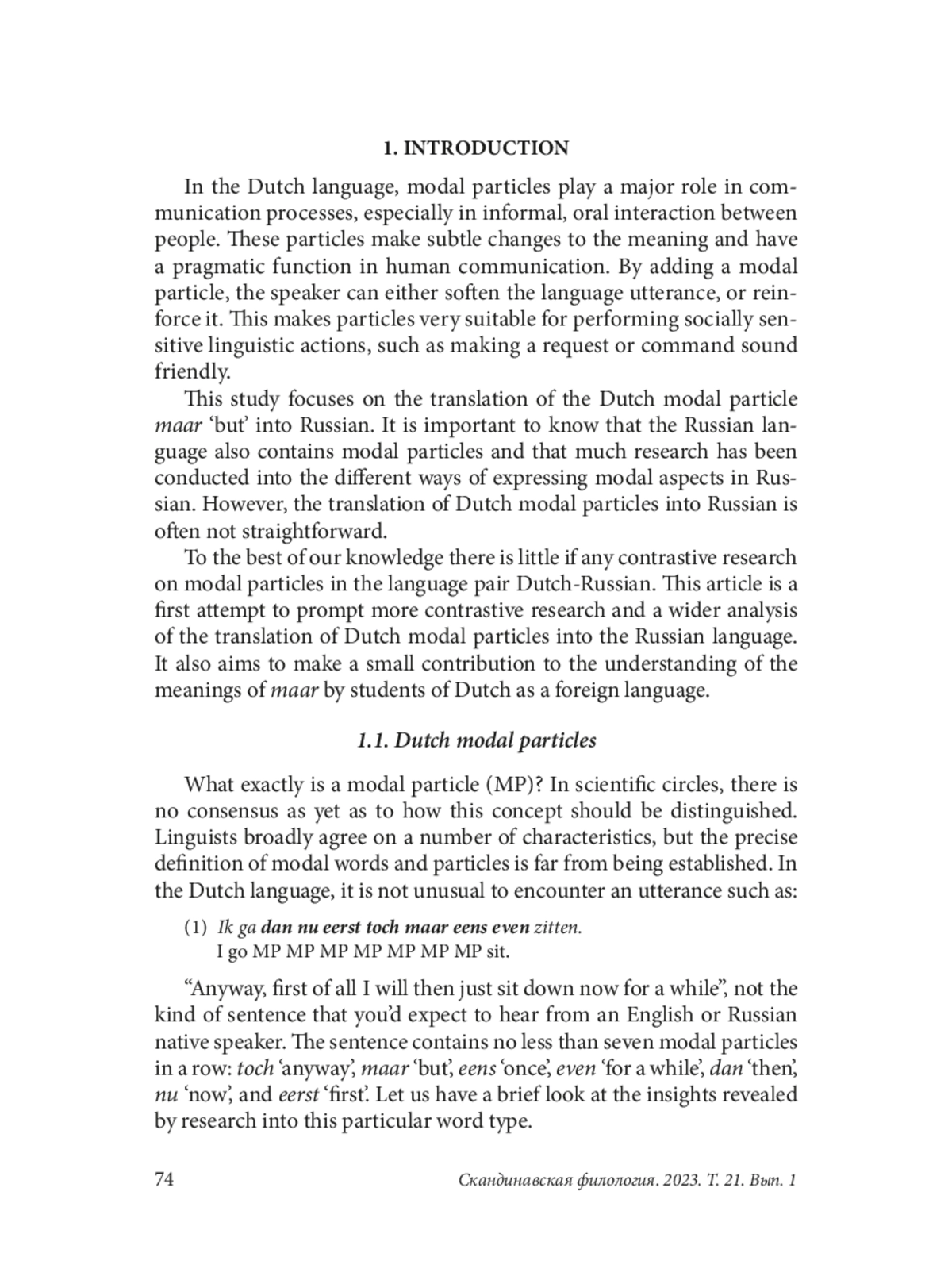
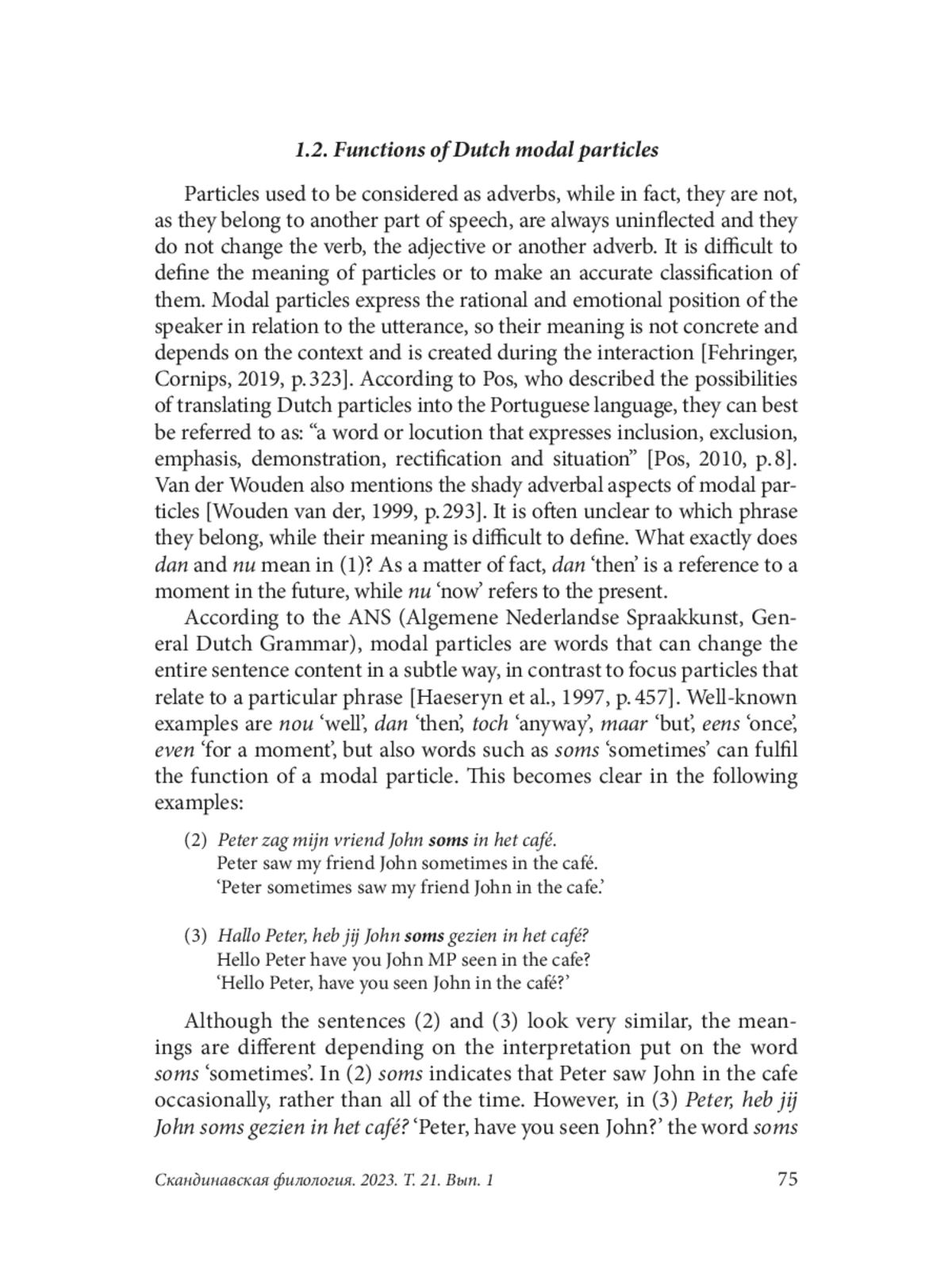
In the Dutch language, modal particles play a major role in communication processes, especially in informal, oral interaction between people. These particles make subtle changes to the meaning and have a pragmatic function in human communication. By adding a modal particle, the speaker can either soften the language utterance, or reinforce it. This makes particles very suitable for performing socially sensitive linguistic actions, such as making a request or command sound friendly
Если у вас возникли вопросы или появились предложения по содержанию статьи, пожалуйста, направляйте их в рамках данной темы.
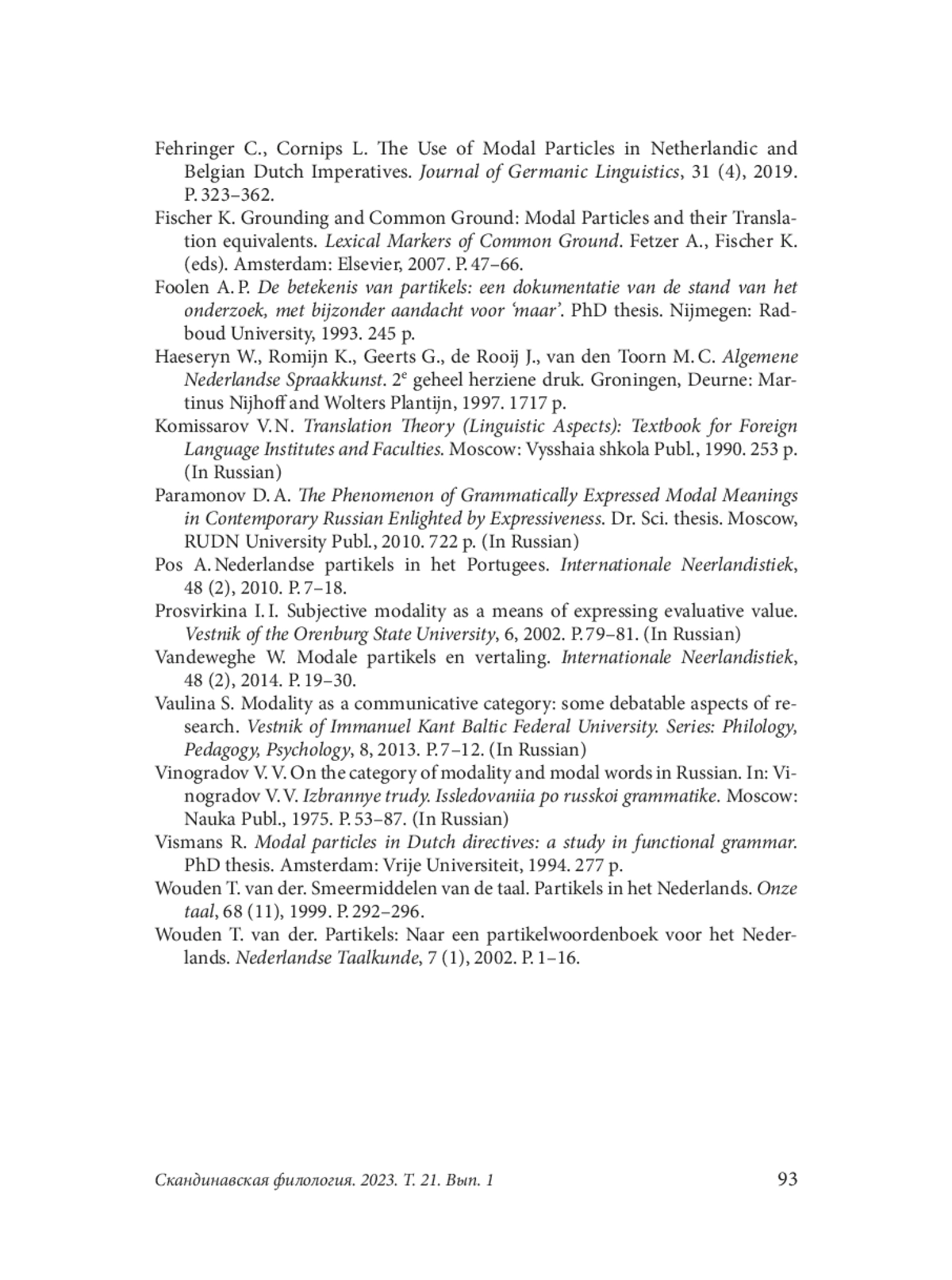
Список литературы
1. Barhudarov L. S. Language and translation (Questions of general and private theory of translation). Moscow: Mezhdunarodnye otnosheniia Publ., 1975. 240 p. (In Russian).
2. Fehringer C., Cornips L. The Use of Modal Particles in Netherlandic and Belgian Dutch Imperatives. Journal of Germanic Linguistics, 31 (4), 2019. P. 323-362.
3. Fischer K. Grounding and Common Ground: Modal Particles and their Translation equivalents. Lexical Markers of Common Ground. Fetzer A., Fischer K. (eds). Amsterdam: Elsevier, 2007. P. 47-66.
4. Foolen A. P. De betekenis van partikels: een dokumentatie van de stand van het onderzoek, met bijzonder aandacht voor ‘maar’. PhD thesis. Nijmegen: Radboud University, 1993. 245 p.
5. Haeseryn W., Romijn K., Geerts G., de Rooij J., van den Toorn M. C. Algemene Nederlandse Spraakkunst. 2e geheel herziene druk. Groningen, Deurne: Martinus Nijhoff and Wolters Plantijn, 1997. 1717 p.
6. Komissarov V. N. Translation Theory (Linguistic Aspects): Textbook for Foreign Language Institutes and Faculties. Moscow: Vysshaia shkola Publ., 1990. 253 p. (In Russian).
7. Paramonov D. A. The Phenomenon of Grammatically Expressed Modal Meanings in Contemporary Russian Enlighted by Expressiveness. Dr. Sci. thesis. Moscow, RUDN University Publ., 2010. 722 p. (In Russian). EDN: QESCYZ
8. Pos A. Nederlandse partikels in het Portugees. Internationale Neerlandistiek, 48 (2), 2010. P. 7-18.
9. Prosvirkina I. I. Subjective modality as a means of expressing evaluative value. Vestnik of the Orenburg State University, 6, 2002. P. 79-81. (In Russian). EDN: SBTMDL
10. Vandeweghe W. Modale partikels en vertaling. Internationale Neerlandistiek, 48 (2), 2014. P. 19-30.
11. Vaulina S. Modality as a communicative category: some debatable aspects of research. Vestnik of Immanuel Kant Baltic Federal University. Series: Philology, Pedagogy, Psychology, 8, 2013. P. 7-12. (In Russian).
12. Vinogradov V. V. On the category of modality and modal words in Russian. In: Vinogradov V. V. Izbrannye trudy. Issledovaniia po russkoi grammatike. Moscow: Nauka Publ., 1975. P. 53-87. (In Russian).
13. Vismans R. Modal particles in Dutch directives: a study in functional grammar. PhD thesis. Amsterdam: Vrije Universiteit, 1994. 277 p.
14. Wouden T. van der. Smeermiddelen van de taal. Partikels in het Nederlands. Onze taal, 68 (11), 1999. P. 292-296.
15. Wouden T. van der. Partikels: Naar een partikelwoordenboek voor het Nederlands. Nederlandse Taalkunde, 7 (1), 2002. P. 1-16.
Выпуск
Другие статьи выпуска
The article introduces Alexander Kuchin and his “Small Russian-Norwegian dictionary”, which was published in 1907 by the publishing house “Pomor” (Finnmarken) in Vardø (Norway) and was very popular at that time. Its author, Alexander Stepanovich Kuchin, a man with a unique destiny, is known to compatriots as the only Russian who participated in the discovery of the South Pole in the Roald Amundsen’s expedition, and also as the first of our countrymen who, after the discovery of Antarctica in 1820 by the expedition of Faddey F. Bellingshausen and Michael P. Lazarev, landed on the coast of the Southern continent. A talented young man who died in the expedition of Vladimir A. Rusanov at the age of only 25, made a great contribution to science, research and navigation. Born in the village of Kushereka in the Onega district of the Arkhangelsk province, Alexander received a good education for that time. He graduated from a two-grade parochial school in Kushereka, brilliantly studied at the Onega City School, attended classes at the Tromsø school for a year and was the only one in the course graduated from the Arkhangelsk Merchant and Maritime School with a gold medal. He read H. Ibsen, K. Hamsun, J. Falkberget and other writers in the original. Alexander was also lucky to work at the biological station in Bergen under the direction of Bjørn Hjelland-Hansen, one of the founders of oceanography as a science; here he also met Fridtjof Nansen, one of the national Norwegian heroes, which played a significant role in A. Kuchin’s life. The “Small Russian-Norwegian dictionary” was published in 2,000 copies and was very popular that time. The dictionary contains around 4,000 words on 48 pages. There are no proper names in it, but at the end of the dictionary basic information about the phonetics and grammar of the Norwegian language is disposed. It is focused on Russian users and arouses undoubted interest among linguists, since it appeared in 1907, two years after the termination of the union with Sweden. It is valuable that Alexander Kuchin, not being a linguist, fixed the language used by common people such as fishermen and trawlermen in the North of Norway (particularly in Finnmark and Troms). Such a democratic version of the language is also of special scientific interest. In general, the dictionary was caused by necessity, appeared at a proper time, was well compiled and completely fulfilled the functions assigned to it
In dit artikel worden vijf tekeningen van de Nederlandse schilder Pieter Quast (c. 1606–1647) uit de collectie van het State Hermitage Museum beschreven. De bladen zijn nooit eerder gepubliceerd. Ze zijn uitgevoerd in de voor de kunstenaar kenmerkende techniek: met zwart krijt op perkament. Sommige bladen zijn gesigneerd en gedateerd. Ze stammen uit drie verschillende verzamelingen. Vier van de tekeningen kwamen al in de 18 e eeuw in het bezit van het museum en één werd pas in 1972 aangekocht. Het gevarieerde oeuvre van de grotendeelsonbekende kunstenaar is in museale en particuliere collecties vooral vertegenwoordigd door grafisch materiaal, waaronder talrijke tekeningen. De voorkeur van de meester voor tekenen lijkt ook te zijn aangewakkerd door zijn slechte financiële situatie. Over de biografie van Quast is slechts weinig bekend enuit gepubliceerd archiefmateriaal wordt zijn complexe loopbaanduidelijk. Een studie van zijn werken uit de collectie van de Hermitagebevestigtdat hij de maker is en ze geeft aanleiding tot speculatie over de onderwerpen. De thema’s die hij kiest zijn onlosmakelijk verbonden met de picturale traditie. Hij is geïnteresseerd in 16 e eeuwse schilders, in het bijzonder Pieter Bruegel de Oude. Maar hij wendt zich ook tot het werk van zijn tijdgenoten als Adriaen Brouwer, Adriaen van Ostade en anderen. Een belangrijke inspiratiebron voor hem waren theatervoorstellingen: zowel bijbelse iconografie als volkse komische schetsen. In dit artikel worden zijn tekeningen zowel qua iconografie als qua formele en stilistische methodologie geanalyseerd. Er wordt een vergelijkende analyse toegepast, de tekeningen worden vergeleken met andere, beroemde werken van de kunstenaar
В статье рассматривается история творческих контактов великого норвежского драматурга Генрика Ибсена (1828–1906) и немецкого поэта Кристиана Моргенштерна (1871–1914). Жизнь последнего была короткой и омраченной физическими страданиями, но в творческом отношении фантастически наполненной и разнообразной. Значительная часть лирического и эпистолярного наследия поэта была опубликована только после его смерти благодаря стараниям его жены и друзей. Переводы произведений Генрика Ибсена, сделанные Кристианом Моргенштерном, относятся к тому периоду конца XIX в., когда новое берлинское издательство Соломона Фишера (S. Fischer Verlag) приняло решение выпустить полное собрание сочинений Ибсена в переводах на такой немецкий язык, который был бы достоин языка оригинала. Издательство обратилось к молодому и в то время еще малоизвестному поэту, который, будучи влюбленным в скандинавскую литературу и в Генрика Ибсена, с огромным энтузиазмом взялся за работу, поселился в семейном пансионе в окрестностях Христиании, за короткое время выучил норвежский язык, неоднократно консультировался и переписывался с Ибсеном и в результате создал для его пьес переводы, немецкий язык которых вызвал восторг и заслужил высокую оценку драматурга. Авторизованное издание переводов печаталось в Германии в период с 1898 по 1904 г. и в настоящее время является библиографической редкостью. Однако многие сочинения Ибсена до сих пор публикуются в Германии в переводе Кристиана Моргенштерна — непревзойденного мастера стихотворных миниатюр в уникальном жанре лирического юмора
The article focuses on the concept of time in human and global perspective in the poetry of two Swedish authors of the 19th century: Per Atterbom and Viktor Rydberg. These two poets belong to different branches of the Romantic movement. Atterbom represents the early mystic Romanticism and he is one of the first Romantic authors in Sweden. Rydberg is a post-Romantic poet: his poetic works contain features that are characteristic of the literature of Romanticism, but they were written in the last decades of the century. The theme of the power of time is one of the most important for both authors, it determines characters of lyrical heroes and poetics in many of their poems but in different ways. Atterbom represents the destructive power of time. Thus, the main characters of his fairy tale play “The Isle of Bliss”, Hyperborean king Astolf and nymph Felicia, live on a magical island and aspire to escape from Time, but Time overcomes them. Atterbom shows in his poetry that time hasn’t its limits in the world beyond. Rydberg represents the characters who try to apprehend the rules of time. The immortal mythological creatures in his poems (the Tomten, the elf of a river) cannot explain why time has such an influence on man and mankind. This theme corresponds with a philosophical matter of the meaning of human life. The humans in Rydberg’s lyrics do not try to overcome time as they perceive the nature and its rules throw their senses.
В статье рассматривается специфика сюжета в известном травелоге «Мой сын на галере» (1781) шведского автора Якоба Валленберга. Исследуются особенности, характерные для сюжетной структуры романа странствий (термин М. М. Бахтина) и литературного путешествия. «Мой сын на галере» представляет собой описание путешествия, совершенного автором из Швеции в Китай в 1769–1771 гг. Произведение обладает линейным, хронологическим сюжетом, включающим не только путевые, документальные материалы (в частности, информацию о географическом и демографическом положении стран, посещенных героем-повествователем, описания местной природы, традиций и др.), но и авантюрные эпизоды (например, о старых девах, напуганных появлением шведов; о судне, которое моряки приняли за пиратское; и др.). Разного рода отступления от основной темы — путешествия — иллюстрируют мысли герояповествователя, а природно-географические, этнографические, культурные и другие сведения, типичные для путевой прозы, занимают в книге «Мой сын на галере» незначительное место. В качестве основного предмета повествования выступает не посещение героем той или иной страны, а второстепенные, малозначительные, на первый взгляд, реалии окружающей действительности, а также навеянные путешествием размышления. В произведении встречаются также и главы, в которых речь идет о вещах, не имеющих прямого отношения к путешествию (например, насилие в семье и неверность жен). В результате предполагается, что травелог «Мой сын на галере» стоит у истоков шведской сентименталистской прозы, получившей развитие в конце XVIII в
Статья посвящена теме экзистенциального одиночества как категории поэтики, которая находит свое отражение в творчестве датского философа С. Киркегора и русского писателя Ф. Достоевского. Вопрос о типологических схождениях в картине мира Киркегора и Достоевского неоднократно поднимался в философских трудах, но в данном случае исследуется именно художественное воплощение онтологической категории одиночества, которая для Киркегора становится одним из самых важных концептов для понимания эволюции человеческой души (стадий на жизненном пути). Тема одиночества развивается в романтической литературе, где является одной из центральных, но Киркегор предлагает новый взгляд на человека, для чего вводится понятие экзистенции, тем самым одиночество личности в этом мире становится и предметом изображения, и предметом анализа, что подразумевает экзистенциальная диалектика. Подобное воплощение темы одиночества характерно и для произведений Достоевского, где герой, находящийся в поиске себя, должен сделать свой экзистенциальный выбор: принять или не принять собственное одиночество, и от этого выбора зависит его дальнейшая судьба: путь духовного возрождения или гибель. Тема одиночества тесно связана с концептом отчаяния, введенным Киркегором, который проецируется на желание героя быть самим собой. В ранних произведениях Достоевского («Двойник», «Бедные люди») наблюдается стремление героев избежать одиночества, отказавшись от собственного «я», что приводит к трагедии. В сочинениях зрелого периода одиночество становится средством обретения себя, которое может привести к жизненному краху героев (Человек из подполья, Смердяков, Иван Карамазов) или, наоборот, к духовному возрождению (Раскольников, Смешной человек). Осознанное одиночество могло быть спасительным для князя Мышкина, но он делает выбор в пользу страсти. Достоевский не только изображает эмоциональное состояние своих одиноких героев, но анализирует феномен одиночества, в чем проявляется очевидное сходство с Киркегором
The purpose of the paper is to identify the mechanisms of interaction between two sign systems: the verbal text of the Dutch rhymed psalms of the 19th century and the musical text of the melodies. The text is broadly understood as an ordered set of semiotic codes that carry certain information. The discussion of both linguistic and musical material with the use of musicological and linguopragmatic analysis is innovative. In the course of the study, an attempt was made to establish the relationship between the type of rhyme and the way of musical arrangement of the text. For poetic texts with a cross rhyme, there is a tendency to use repetitions of the melody in accordance with the rhyme. Texts with a more complex rhythmic organization of the verse are decorated with variations or author’s reworking of the original melody. At the same time, the processing of musical material obeys the generally accepted patterns of melody development within the range of one octave. With a more detailed analytical review, different types of ways of using the original melodies and adapting them to the needs of choral church singing can be identified. The determining factor in the choice and interpretation of the original folk melody is the text of the psalm. Melodies do not have independence, but are completely subordinated to the verbal text. At the same time, the musical arrangement serves as an auxiliary means of accentual articulation and enhances the aesthetic function of the poetic text
Language interaction has always been a matter of interest to linguists. Despite the fact of profound influence of Latin on many languages in many sciences, including medicine, the question concerning the borrowings of anatomical vocabulary, namely somatisms, or body parts, from Latin in Norwegian and its influence on the Norwegian anatomical terminology is of particular interest. The study focuses on the influence of Latin on the names of different body parts in Norwegian, thereby revealing some peculiarities of somatisms in the Norwegian language. Taking into account the historical background and cross-cultural interaction, some groups of somatisms have been distinguished. The most abundant group includes single word somatisms and compounds that do not have their norwegianized Latin form. The second group consists of the Norwegian somatisms, which have identical or nearly identical morphemic form with somatisms in Latin, incorporating single word somatisms as well as some compounds where one or even two parts are norwegianized Latin forms with some semantic peculiarities. We have also singled out the anatomical terms that have a norwegianized Latin form and a parallel native form. Mostly the borrowings in this group underwent orthographic changes adapting them to the Norwegian language. The results show that on the whole the Norwegian language preserves its identity, uniqueness and selective modifying purism in anatomical vocabulary, with some instances of being dependent on Latin
The article focuses on the system of deictic pronouns in Danish. It is argued that in addition to binary oppositions expressing the objective (nearest vs distant) location of objects in the physical space relative to the speaker, like this vs that — denne vs den, a three-term opposition develops in modern Danish. This allows to specify the subjective interaction between the three participants in the communicative act: the speaker (1 st person), the listener (2 nd person) and the objects of the surrounding world (3 rd person). The system of secondary demonstrative pronouns — deictic binomials — is investigated. “Deictic binomial” is used as a term for an analytical combination of a simple deictic pronoun and a spatial adverb. Four possible combinations of such binomials are considered. The Danish Corpus (KorpusDK) analysis made it possible to assert that combinations of proximal deixis indicators — such as denne her ‘this here’ — are subjective markers of 1 st person signaling that the deictic object enters into the speaker’s personal space. Combinations of indicators of distal and proximal deixis (such as den her ‘that here’) are “cohortatives” — subjective markers of the 2 nd person, signaling the common perception of shared attitude to the deictic object by the speaker and its addressee. Combinations of analytical indicators of distal deixis (such as den der ‘that there’) — shift the negatively evaluated object outside the personal space of the speaker and the space of communication, which corresponds to the communicative function of the 3 rd person. The search in the Danish Corpus for the fourth type of combinations, that is, combinations of proximal and distal deixis (such as denne der ‘this there’) gives practically no results. This confirms the conclusion that the paradigm for expressing the speakers subjective attitude to the object of deixis in modern Danish is represented by three categories that correspond to three “spatial areas” — the speaker’s personal space (1st person), the common communication space shared with the addressee (2nd person), an external space into which the speaker subjectively removes the disapproved or alienated objects of deixis (3rd person)
The notion that a language worldview is shaped by a system of key concepts as well as ideas and motifs linking them, which are expressed in the meaning of individual lexemes and phrases, has informed a number of studies of culturally specific words and even entire semantic fields. Comparison of different language worldviews has revealed many differences, which at first sight seem insignificant but may hinder successful communication. The concept of hygge occupies a special place in the Danish language worldview and has become somewhat of a Danish hallmark. Our study uses corpus data to analyse six co-occurrence patterns of words representing the concept hygge, which allows us to explicate the implicit meaning components of the lexemes in question and to identify the most frequent patterns. The material used was the Danish Gigaword Corpus (DAGW), which includes texts collected from the Internet. The corpus covers the Danish language in all its diversity: a variety of genres and types of texts are represented in the corpus (law, social media, subtitles, debates, conversation notes, encyclopaedia articles, fiction, news, etc.). The high frequency of the words representing the concept hygge in the corpus texts once again confirms the importance of this concept for Danish culture. The combinational properties of all the models studied show a striking uniformity: all collocations are characterized by positive connotations and can be categorized into a small set of thematic groups (place, time, atmosphere, hobbies, spending time together and communicating). The above co-occurrence analysis allows us to identify the following set of characteristics of the concept hygge: a feeling of peace, tranquillity and security, enjoyment and good mood that comes from being engaged in active pursuits, presence of close, familiar people, a familiar, wellknown place, a shared time together
The article is devoted to the identification and differentiation of Swedish parallels of the most common Belarusian proverbs according to the nature of interlingual correlation. The goal involves the use of interlingual structural-semantic modeling of proverbs to identify complete proverbial analogues in different languages, identical structural models of proverbs, identical proverbial images and concepts. The material for the study was 320 Swedish proverbs, which are interlingual correlates of Belarusian proverbs. Proverbs-analogues in the Swedish and Belarusian languages are differentiated according to the nature of the interlingual community into two typologically significant groups: universal proverbs and international proverbs. Interlingual correlates of Swedish and Belarusian proverbs, which have the same structural models, are differentiated into several typologically significant groups depending on the nature of the variability of the lexical composition, due to the difference in the conceptual and figurative plan of proverbs. As a result of the study, the authors come to the conclusion that in the Swedish language there are a significant number of proverbs that are full or partial correspondences of the most commonly used Belarusian proverbs. A comparative analysis based on the structural-semantic modeling of proverbs made it possible to differentiate Swedish and Belarusian proverbial parallels into three typologically significant groups of units: similar proverbs, proverbs with identical structural models, proverbs with identical images and concepts. Swedish proverbs containing images and concepts identical to Belarusian proverbs are characterized by partial ethnocultural marking of their content, as well as the absence of a strict connection between the correlation in the content of proverbs in different languages and the presence of identical images and concepts in proverbs. The absence of such a connection indicates the typological similarity of the figurative-conceptual spaces of the Swedish and Belarusian proverbial pictures of the world, in which manifestations of interlingual community and national specificity are deeply mutually determined
Статистика статьи
Статистика просмотров за 2026 год.
Издательство
- Издательство
- СПБГУ
- Регион
- Россия, Санкт-Петербург
- Почтовый адрес
- Россия, 199034, Санкт-Петербург, Университетская наб., д. 7–9
- Юр. адрес
- 199034, г Санкт-Петербург, Василеостровский р-н, Университетская наб, д 7/9
- ФИО
- Кропачев Николай Михайлович (РЕКТОР)
- E-mail адрес
- spbu@spbu.ru
- Контактный телефон
- +7 (812) 3282000
- Сайт
- https://spbu.ru/