

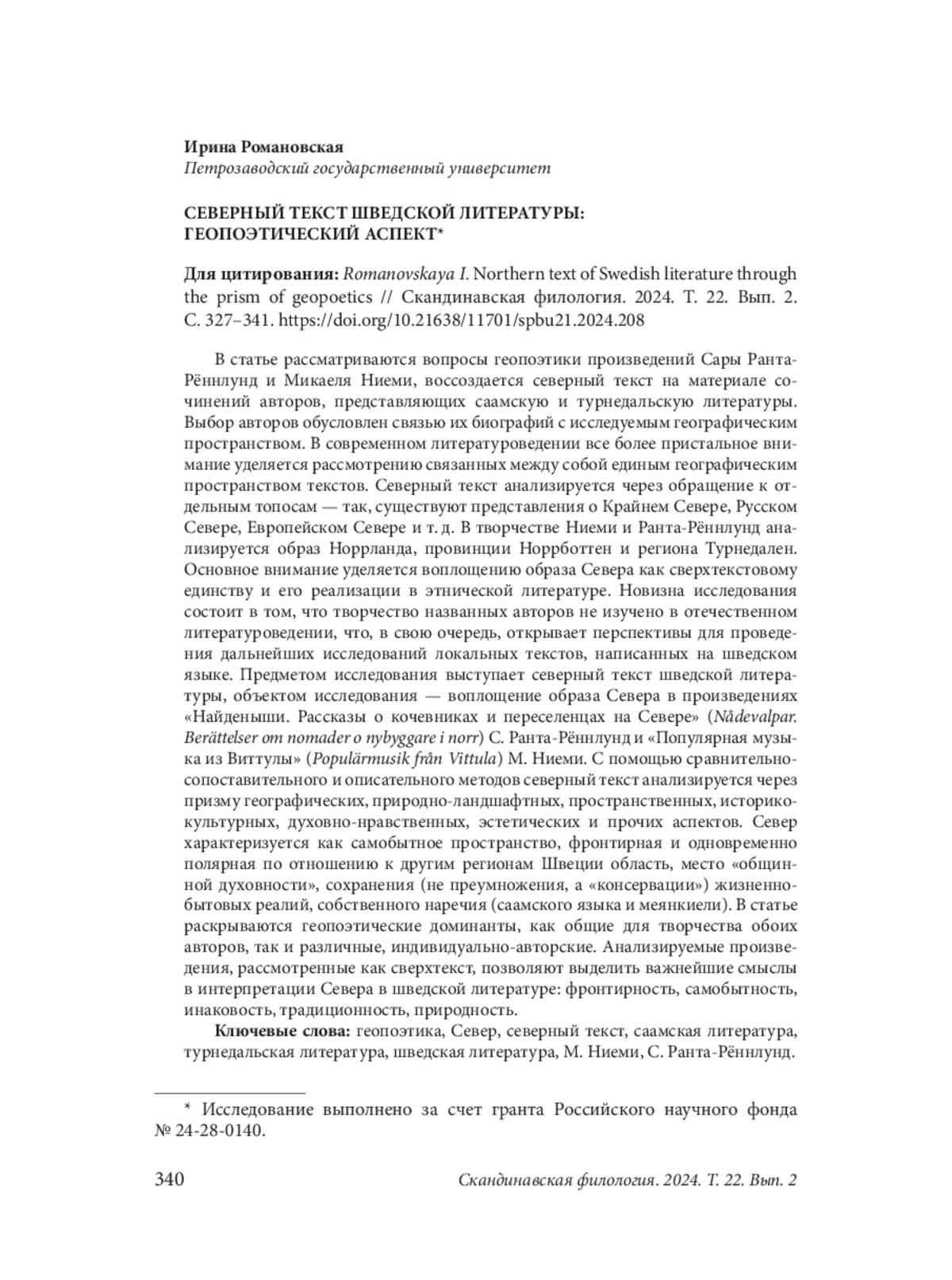
The article discusses the issues of geopoetics in the works of Sara Ranta-Rönnlund and Mikael Niemi, recreating the Northern text based on the writings of the authors representing the Sámi and the Tornedalian varieties of literature. The choice of authors is determined by the connection of their biographies with the researched geographical space. In contemporary literary studies increasing attention is paid to the examination of texts interconnected by a unified geographical space. The Northern text is analyzed through references to specific places — such as conceptions of the Far North, Russian North, European North etc. In the works of Niemi and Ranta-Rönnlund the image of Norrland, the province of Norrbotten, and the region of Tornedalen is comprehensively analyzed. The main focus is on embodying the image of the North as a supra-textual unity and its realization in ethnic literature. The novelty of the research lies in the fact that the works of these authors have not been studied in domestic literary studies, which in turn opens up prospects for further research on local texts written in Swedish. The subject of the research is the Northern text of Swedish literature, while the object is the embodiment of the image of the North in the work Nådevalpar. Berättelser om nomader o nybyggare i norr by S. Ranta- Rönnlund and Populärmusik från Vittula by M. Niemi. Using comparative and descriptive methods the Northern text is analyzed through geographical, natural-landscape, spatial, historical-cultural, spiritual-moral, aesthetic, and other aspects. The North is characterized as a unique space, frontier and at the same time polar in relation to other regions of Sweden, a place of “communal spirituality”, “preservation” (not multiplication, but “conservation”) of everyday realities, its own dialect (the Sámi language and Meänkieli). The article reveals both common geopoetic dominants for the works of the authors and different, individuallyauthorial ones. The analyzed works, considered as a supertext, allow highlighting key meanings in interpreting the North in Swedish literature: frontier spirit, uniqueness, otherness, traditionality and naturalness
Предпросмотр статьи
Идентификаторы и классификаторы
- SCI
- Языкознание
- УДК
- 821.11.
Geopoetics is one of the most popular and demanded directions in modern literary studies, having to date its own scientific methodology and tools. K. White [White, 1994], as well as D. Zamyatin [Zamyatin, 2006], V. Golovanov [Golovanov, 2002] stand at the origins of geopoetics in foreign and domestic literary studies respectively. A great contribution to the development of geopoetics has been made by V. Abashev [Abashev, 2000] and I. Sid [Sid, 2017]. The inquiry has defined a particular research lens, supported subsequently by literary scholars around the world. Today scientists from France, Italy, Switzerland, Russia, and various other countries, are engaged in the development of geopoetics as a specific scientific field of knowledge. All over the world there is an active development of science, the so-called “Philology of the earth” [Korablev, 2015].
Если у вас возникли вопросы или появились предложения по содержанию статьи, пожалуйста, направляйте их в рамках данной темы.
Список литературы
1. Abashev V. Perm as a text. Perm in Russian culture and literature of the 20th century. Perm: Perm University Publ., 2000. 404 p. (In Russian).
2. Aleksandrova-Osokina O. N. Questions of geopoetics in modern literary criticism. Nauchnyi dialog, 5, 2020. P. 216-241. (In Russian). EDN: LYCYNG
3. Antsiferov N. Soul of St. Petersburg. St. Petersburg: Lira Publ., 1990. 249 p. (In Russian).
4. Axman E. Asfaltsvägen kom till Pajala: Framtidens intåg i Populärmusik från Vittula. Gävle, 2011. 16 s.
5. Bakhtin M. Questions of literature and aesthetics. Moscow: Khudozhestvennaia literatura Publ., 1975. P. 234-407. (In Russian). EDN: WTJALN
6. Galimova E. Sh. Northern text of Russian literature: research methodology. Severnyi tekst kak logosnaia forma bytiia Russkogo Severa. Ed. by E. Sh. Galimova, A. G. Loshakov. vol. 1. Arkhangelsk: Imidzh-Press, 2017. P. 9-26. (In Russian).
7. Golovanov V. Geopoetics of Kenneth White. Oktiabr’, 4, 2002. P. 157-159. (In Russian).
8. Korablev A. A. Philology of the earth: principles and prospects of geopoetics. Literaturovedcheskii sbornik, 53-54, 2015. P. 20-30. (In Russian).
9. Likhachev D. Local history. Favorites: thoughts about life, history, culture. Moscow: Rossiiskii fond kul’tury, 2006. P. 71-87. (In Russian).
10. Lisovskaya P. A. “The Swedish project” in the works of Per Olov Enkvist. Nauka, obrazovanie i kul’tura, 2 (5), 2016. P. 27-34. (In Russian).
11. Lotman Yu. Semiosphere. St. Petersburg: Art-SPb Publ., 2000. 704 p. (In Russian).
12. Mednis N. E. Supertexts in Russian literature. Novosibirsk: Novosibirskii gosudarstvennyi pedagogicheskii universitet Publ., 2003. 170 p.
13. Mohnike Th. The Joy of Narration. Mikael Niemi’s Popular Music from Vittula. Journal of Nothern Studies, 8 (1), 2014. P. 169-187.
14. Niemi M. Popular music from Vittula: Novel. Moscow: Phantom Press, 2020. 288 p. (In Russian).
15. Niemi M. Populärmusik från Vittula. Stockholm: Norstedts, 2000. 244 s.
16. Ranta-Rönnlund S. Nådevalpar. Berättelser om nomader o nybyggare i norr. Stockholm: Askild & Kärnekull, 1971. 263 s.
17. Ranta-Rönnlund S. Nåjder. Berättelser om trollkarlar o trolldom i sameland. Stockholm: Askild & Kärnekull, 1972. 203 s.
18. Ranta-Rönnlund S. Njoalpas söner. Berättelser om dagligt liv i norr. Stockholm: Askild & Kärnekull, 1973. 231 s.
19. Ranta-Rönnlund S. Sist i raiden. Berättelsen om ett uppbrott. Stockholm: Askild & Kärnekull, 1978. 222 s.
20. Sid I. Geopoetics. Essays, articles, comments. St. Petersburg: Aleteiia Publ., 2017. 430 p. (In Russian).
21. Svenskt biografiskt lexikon. Available at: https://sok.riksarkivet.se/sbl/artikel/7541(accessed:23.01.2024).
22. White K. Albatross Rock: Introduction to Geopoetics. Transl. by V. Golovanov. Paris: Grasset, 1994. 363 p. (In Russian).
23. Zamyatin D. Culture and space: modeling of geographical images. Moscow: Znak Publ., 2006. 488 p. (In Russian).
Выпуск
Другие статьи выпуска
The stone architecture of medieval Norway holds a special place in the history of Norwegian architecture and the entire Scandinavian Peninsula. The definition of exact borders of the Norwegian dioceses predetermined the course of development of stone construction within the church’s administrative districts. Following the principles and order of liturgy in cathedral, Norwegian parishes adopted the layout of cathedrals. The symbolic mimesis, manifested in the appropriation by regions of certain properties and architectural qualities of cathedral, is ubiquitous in the five Norwegian dioceses, including Central Norway. Having analyzed certain monuments, albeit fragmentarily, we can conclude that the parish architecture of the central part of the country has much in common. Most importantly, one-nave temple layout with a square choir is prevalent, with most buildings featuring three portals in the nave and a portal in the south wall of the choir, which corresponded to the cathedral architecture of the Middle Ages. St Olav’s Cathedral in Trondheim, which held a special status not only within the diocese, but throughout the entire archiepiscopate, had a significant impact on the emergence of a number of constructive and decorative elements. The masons’ signs discovered in the parish churches are similar to those in St Olav’s Cathedral in Trondheim and indicate that metropolitan craftsmen were involved in the construction of small churches. At the same time, we should note the development of local specifics, expressed not only in the layout, but also in the special character of sculptural images whose origins require clarification and further research
The article is the second of two papers concerning the end of Frisian freedom. The first paper discussed the history of the only ratified charter that confirmed the so-called Charles Privilege that would have enacted Frisian freedom (a presumably thirteenth-century falsum). It gave a brief overview of the development of Frisian liberty in its relation to Frisian history. The present article focuses on the charter issued on September 23, 1493, by Roman King Maximilian I at the request of a delegation from the West Frisian lands. The charter text consists of five parts. The first part, the arenga, is a formal introduction. In the second part, Maximilian I praises the loyalty of the Frisians confirming their privileges, including the so-called Charles Privilege. In the third part, the Charles Privilege is rendered completely, giving it thus an official status. In the penultimate section, Maximilian modifies the Charles Privilege on two points. He wishes the Frisians not to be armed in the French manner, but to follow the custom of the Holy Roman Empire. On the second point, Maximilian I refers to Sigismund’s previous privilege of 1417 and demands the payment of a tribute. Furthermore, in the last paragraph, Maximilian calls on the Frisians to choose a potestate. As the Frisians proved unable to do so, they were eventually completely subjugated. Thus ended the Frisian freedom ended in 1498 for nearly 450 years. This paper obtains as well a complete edition of the Latin text of the charter and its English translation.
Letters from Russia by Robert Watt, published in Denmark in 1867, were born as a result of the Danish writer’s trip to Russia to cover Princess Dagmar of Denmark’s arrival in Russia and wedding with Grand Duke Alexander Alexandrovich in 1866. Robert Watt was a journalist, a writer, a translator, and the artistic director of Tivoli Gardens amusement park from 1866 to his death in 1894. Letters from Russia contains seventeen chapters, in which the writer describes his impressions of his trip to Russia, from the moment he said farewell to Denmark standing on the deck of “Mermaid” frigate, which was raising sails heading to Kronstadt, to the ceremonial reception of the Danish Princess. Road diaries of those who travelled across Russia have always been an important source of information about the country and the epoch, and Robert Watt’s book is no exception. Watt’s book is partly a guidebook — he describes all places of interest in Moscow and St Petersburg, but he also ponders on specific features of life in Russia and the national character. Most of his characteristics are highly positive, he doesn’t pay much attention to unsightly sides of life. The observer’s assessment depends on their personality, previous experience, the recipient (in this case the book was aimed at the Danish reader), and the political situation. We could assume that as the writer was sent to Russia to cover Princess Dagmar of Denmark’s wedding he did not intend to pay attention to the ugly sides of the Russian life. Nevertheless, Robert Watt’s book, unknown to a wide audience in Denmark and Russia, is an important cultural monument which supplements the history of relations between Denmark and Russia
The legend of the Wandering Jew, which appeared in the Middle Ages, attracted the attention of writers and artists in many countries during several centuries. Ahasuerus has become one of the eternal images of world literature. This image was especially often used in the works of Romantic writers in the early 19th century. A Swedish poet Viktor Rydberg who was influenced by Romanticism used this character in several poetic works such as the ballad The Flying Dutchman (Den Flygande Holländaren, 1876) and two poems: Prometheus and Anasuerus (Prometeus och Ahasverus, 1882) and New Song of Grotti (Den nya Grottesången, 1891). In Rydberg’s lyrics, the Wandering Jew interacts with other eternal images of world culture such as the Flying Dutchman and Prometheus. His role as a stranger who witnessed a lot of different epochs and nations is emphasized in Rydberg’s poetry. Ahasuerus expresses critical judgments about modern people and actually opposes society which is the feature of Romantic characters. In the poem New Song of Grotti the image of Ahasuerus is connected with social problems. It might have been the influence of Sue’s novel The Wandering Jew. In contradiction to Romantic characters, Ahasuerus in Rydberg’s interpretation appears to be a sustainable person, which is specific to heroes of Naturalistic and Neo-Romantic Scandinavian works
The article deals with K. Hamsun’s novel Victoria (1898). The author offers an overview of various researchers’ approaches to the work and points out that most literary scholars analyzed this story from the point of view of social roles and psychology of the characters. It is further argued that a productive method of research can be to analyze the genre similarities of the novel with medieval Scandinavian ballads, with the author relying on Hamsun’s own assertion that Victoria is nothing but a lyric. The article point at the features of the composition and plot of the story, which are also characteristic of the ballad genre, in particular, its episodic structure and hyperbolized dramatic quality of the plot. Special attention is paid to the analysis of the prose poem Labyrinths of Love, according to the plot written by the protagonist Johannes. The author of the article points out the intertextual connections in the poem with the Bible and medieval ballads, emphasizing that these connections have the character of dialogue. It is further argued that Labyrinths of Love plays an important role in the development of the plot, providing a smooth transition between the episodes of the story and affirming the main idea of the work about love as a powerful force that plays with people’s lives. The tragedy of the protagonists is not a consequence of their social inequality or inner discord, but is predetermined by fate. Due to the dialog with biblical texts and medieval ballads, the seemingly “banal” story of Johannes and Victoria acquires a timeless, universal character, and they become one of the long row of “eternal lovers” such as Hagbard and Signe, Tristan and Isolde, Romeo and Juliet
В статье анализируется метафора «Долины муми-троллей», базирующаяся на серии книг Туве Янссон (1914–2001), опубликованных в период с 1945 по 1970 г. Данная метафора рассматривается как в контексте творчества финской писательницы и художницы, так и в контексте шведоязычной финской литературы в целом. В статье представлена краткая история указанной литературы, ее современная ситуация (через показательную метафору «тесной комнаты») и связи с финской и родственной по языку шведской литературами. Также оцениваются прошлое и текущее положение финляндских шведов в финском обществе, тенденции, складывающиеся в последние десятилетия, противопоставление столичной и сельской шведоязычной Финляндии, история появления метафоры «Долины муми-троллей» и ее сопоставление с метафорой «Утиного пруда», постепенно утратившей свою актуальность из-за изменений, произошедших в финском обществе. Отдельно рассматривается восприятие шведоязычных финнов в Швеции через указанную метафору и появление особого «диалекта муми-троллей», основанного на финляндской версии шведского языка и представленного в теле- и радиопостановках на западном берегу Ботнического залива. С опорой на исследования творчества Туве Янссон и ряд биографических фактов, цитаты из произведений и рабочих записей проводятся параллели между географическим и климатическим описанием «Долины…» и «оазисами» Шведской Финляндии, между ключевыми персонажами и их современным прочтением шведоязычными финнами, между сюжетом и окружением автора историй про муми-троллей. Также упоминаются прототипы персонажей данной серии книг (например, Муми-мама, Муми-папа, Тофсла, Вифсла и др.) и их характеристические черты, важные для сопоставления метафоры «Долины муми-троллей» и социальных процессов в финском обществе XXI в. Упоминаются современные шведоязычные финские авторы и их связь с книгами и персонажами произведений Туве Янссон. В заключении анализируются перспективы шведоязычной финской литературы и их преломление в рассматриваемой метафоре.
On March 16, 2024, the Dutch writer, Slavic literature scholar, essayist and translator Kees Verheul, who made a huge contribution to Russian-Dutch literary contacts, passed away. As a researcher and translator of works by Russian poets and prose writers (Brodsky, Annensky, Akhmatova, Platonov, Mandelstam, etc.) and as a teacher of Russian literature at the Department of Slavic Studies at the University of Groningen, he sought to bring Russian literature closer to Dutch readers. As a participant in the Nijhoff Readings and other Dutch literature events in Russia, as well as the editor and co-author of the three-volume history of Dutch literature From “Reynard the Fox” to “Dream of the Gods” (2013–2015), he has helped our compatriots to understand the world of his native culture. As a member of the jury of the prestigious Martinus Nijhoff Vertaalprijs Translation Award and head of a number of large translation projects, he has done much to raise the standard of translations from Russian into Dutch and from Dutch into Russian. The article dedicated to his memory focuses on the origins of his work: based on new data, it describes Verheul’s first steps as a grammar school student in the literary field, his first acquaintance with Russian letters, and traces the connection between the underlying ideas of his books and his life philosophy, which also manifested itself in his everyday relationships with people. In addition, the author of the article — translator of K. Verheul’s works into Russian — shares the lessons of literary translation that Verheul taught her. The article concludes with a fragment of a poem written by Verheul in his grammar school years.
Роман современной шведской писательницы Сары Лёвестам «Сердце джаза» примечателен своей интересной композицией: в нем переплетаются два пласта бытия — прошлое и настоящее. Прошлое представлено воспоминаниями Альвара Свенссона о своем пути становления в качестве джазового музыканта. Пока в мире бушует Вторая мировая война, юный Альвар отправляется в Стокгольм, чтобы играть «музыку черных». На фоне его судьбы автор рисует всеобъемлющую картину шведского уклада жизни и развития еще запретного в ту пору музыкального направления. Любовь к джазу становится своеобразным мостом между прошлым и современностью, которая представлена историей школьницы Стеффи, подвергающейся нападкам со стороны сверстников и находящей утешение в музыке. В тексте произведения содержится большое количество экспрессивных оборотов и тропов, а также национально-культурных реалий, отражающих специфику шведской жизни и менталитета в различные временны ́ е периоды. Как правило, они представляют сложность для переводчика, так как зачастую не имеют точных аналогов в целевом языке. Следовательно, вопрос, касающийся специфики перевода реалий, является актуальным в рамках современной лингвистики. В большей степени в тексте произведения представлены топонимы (названия городов, населенных пунктов, площадей, улиц) и эргонимы (названия клубов, организаций, культурных объектов, творческих союзов). Читателю открывается возможность прогуляться вместе с героями по улицам старой Швеции, узнать их историю, заглянуть в клубы, где в 1940-е гг. играли запретный джаз. При этом упоминаемые в повествовании места по-новому показаны в восприятии девочки-подростка, что позволяет читателю выстроить в сознании образ уже современной Швеции и ее жителей. При переводе реалий использовались различные приемы (транскрибирование, транслитерирование, калькирование, опущение, генерализация и конкретизация) как в сочетании, так и по отдельности для сохранения и передачи национального колорита в целевом языке
The article represents an analysis of lexical and grammatical interference phenomena, which arise between French and Dutch under active bilinguism in Belgium. A language contact in the social environment and in the consciousness of an individual is the reason for active mixing of these two language systems, whilst a regular, mostly consensual transfer of lexical units or grammatical constructions results in their gradual entrenching in the language variants and coming into usage. The investigation is primarily concentrated on the cases of insertions from French into the Flemish variants of Dutch and on the description of interference peculiarities in this situation. The article gives a special attention to the language situation and its backgrounds in Belgium, as well as to the statistical data on the number of those speaking the main languages of the country. In addition, an assumption is made that the multitude of the languages of migrants constantly inhabiting Belgium is a thread to the Belgian bilinguism. The cases of lexical interference are divided according to the categories of parts of speech. Most often interference occurs in case of nouns or verbs; adjectives, adverbs, conjunctions and interjections reveal this phenomenon rarer. The lexical interference is represented by the cases of direct borrowings or calquing (semantically or morphologically). Classifying these lexemes thematically is rather difficult, because in the most cases they cover all possible themes of everyday communication. The grammar interference primarily reveals in altering the standard word order in the Flemish variants of Dutch (especially, in French Flemish) under the influence of French syntax, as well as in the situations, when double negation is used
The article considers the properties of phonaesthemes -ps(–), -fs(–) and -pp(–) in Norwegian on the basis of Stanislav Voronin’s phonosemantic paradigm. A phonaestheme is interpreted as a combination of phonemes conveying a certain meaning in genetically unrelated words. The impetus for the study was the name of the relatively new payment service Vipps in Norway and the verb vip(p)se formed from this name with the meaning “to transfer money using an application (vipps) on a mobile phone”. The name of the service is the interjection vips, conveying the meaning of quick and unexpected movement. The extra letter was added for extra-linguistic reasons. The form of this new verb corresponds to the broad class of weak verbs with a two-syllable infinitive ending in schwa. Among the eleven infinitives of verbs ending in -pse, six were found to denote either an unexpected quick movement or a movement (action) accompanied by a specific sound. One of the six has a dialectal variant in -fse, which is the most frequent final cluster with phonosemantic properties in Swedish. Twenty-two verbs with this cluster have been found in Norwegian, all of them sound symbolic. The correlation between -pse and -fse verbs is explained by the developmental history of Norwegian dialects. Five dictionary entries refer to occurrences containing the final element -pp, which the Swedish researcher Åsa Abelin treats as a consonant cluster, but without justifying this decision. The paper argues in favour of this interpretation of -pp in Norwegian and Swedish. More than half of the forty-three verbs containing this consonant cluster, represent sound symbolic forms. It confirms the thesis that the phonaesthemes in related languages do not necessarily coincide. The question of the expressive function of geminates and the interaction of initial root consonants and vowels in the formation of the semantics of the verb requires separate consideration.
The article is devoted to the determining of the volume, composition and principles of lexicographic description of Belarusian and Swedish proverbs in a bilingual dictionary, which is intended for Belarusians studying Swedish as a foreign language. The study showed that the optimal volume of the Belarusian-Swedish dictionary of proverbs should not be less than 500 units of the input language and 1,100 units of the output language. The dictionary should include, first of all, functionally active proverbs in the Belarusian language. The main principle for determining the composition of Belarusian proverbs and their Swedish equivalents in a bilingual translation dictionary is the “principle of completeness of dictionary units”, which most closely corresponds to the variety of requests of its users and various aspects of translation of proverbs. This principle involves a description in the dictionary of all formal variants and all synonyms of both the input language and the output language. In this case, the formal versions of Swedish proverbs should be described in the dictionary as separate units. To select proverbs of the input language, the typological criterion of their generality and specificity in relation to other languages, including Swedish, is also important. Therefore, it is important to include in the dictionary all universal proverbs and functionally active international proverbs, as well as the inclusion in the dictionary of all specific Belarusian proverbs (which have no analogues in European languages) without exception
Статистика статьи
Статистика просмотров за 2026 год.
Издательство
- Издательство
- СПБГУ
- Регион
- Россия, Санкт-Петербург
- Почтовый адрес
- Россия, 199034, Санкт-Петербург, Университетская наб., д. 7–9
- Юр. адрес
- 199034, г Санкт-Петербург, Василеостровский р-н, Университетская наб, д 7/9
- ФИО
- Кропачев Николай Михайлович (РЕКТОР)
- E-mail адрес
- spbu@spbu.ru
- Контактный телефон
- +7 (812) 3282000
- Сайт
- https://spbu.ru/