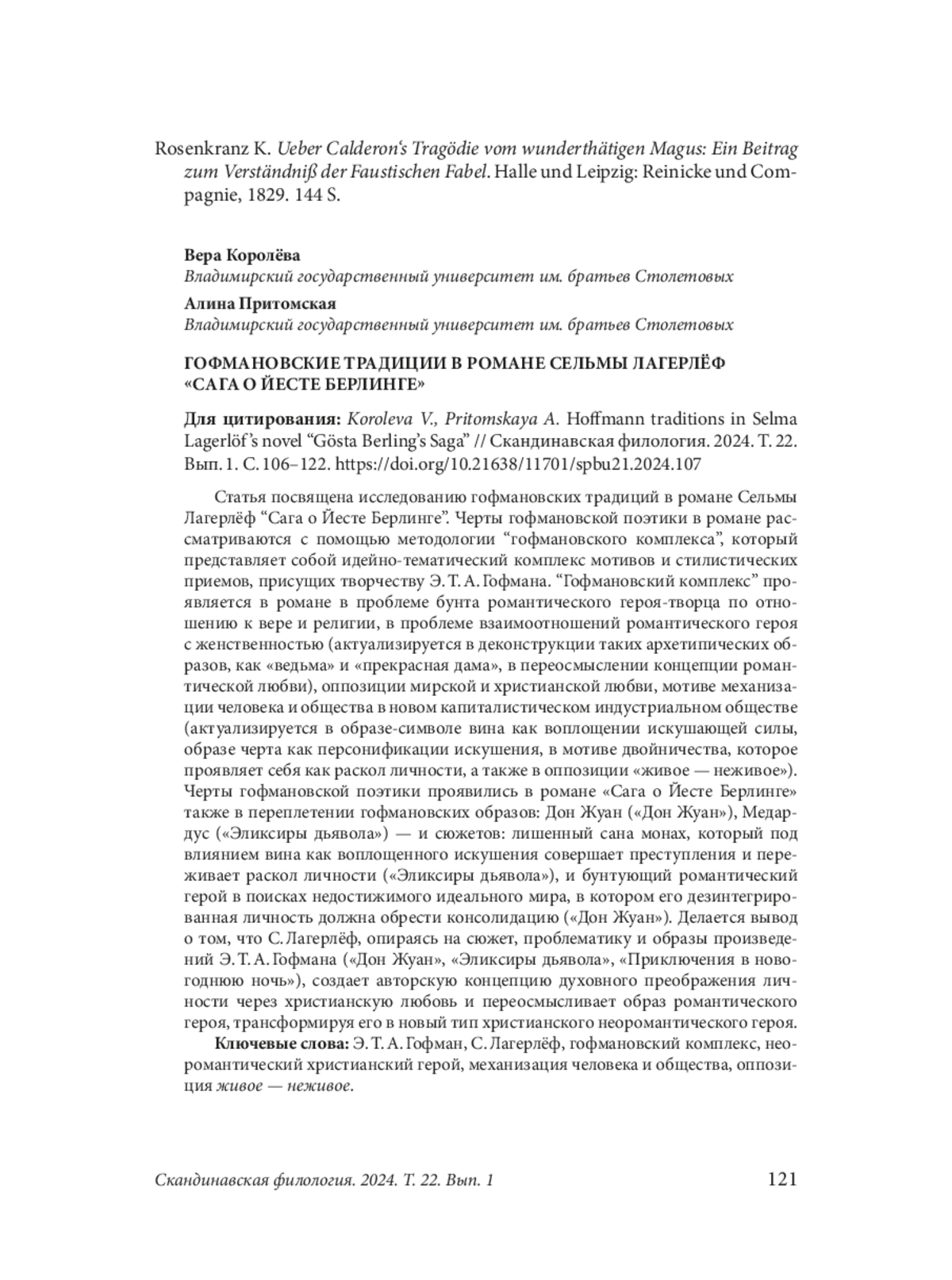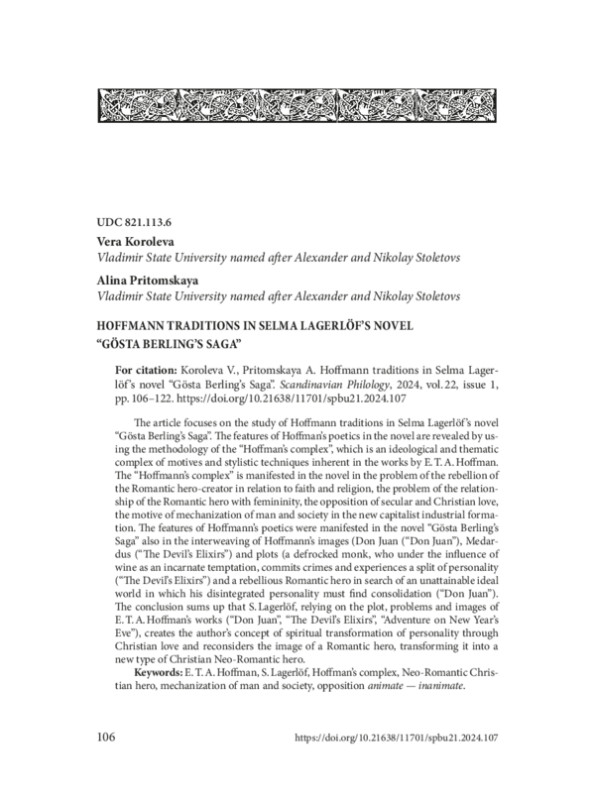
The article focuses on the study of Hoffmann traditions in Selma Lagerlöf ’s novel “Gösta Berling’s Saga”. The features of Hoffman’s poetics in the novel are revealed by using the methodology of the “Hoffman’s complex”, which is an ideological and thematic complex of motives and stylistic techniques inherent in the works by E. T. A. Hoffman. The “Hoffmann’s complex” is manifested in the novel in the problem of the rebellion of the Romantic hero-creator in relation to faith and religion, the problem of the relationship of the Romantic hero with femininity, the opposition of secular and Christian love, the motive of mechanization of man and society in the new capitalist industrial formation. The features of Hoffmann’s poetics were manifested in the novel “Gösta Berling’s Saga” also in the interweaving of Hoffmann’s images (Don Juan (“Don Juan”), Medardus (“The Devil’s Elixirs”) and plots (a defrocked monk, who under the influence of wine as an incarnate temptation, commits crimes and experiences a split of personality (“The Devil’s Elixirs”) and a rebellious Romantic hero in search of an unattainable ideal world in which his disintegrated personality must find consolidation (“Don Juan”). The conclusion sums up that S. Lagerlöf, relying on the plot, problems and images of E. T. A. Hoffman’s works (“Don Juan”, “The Devil’s Elixirs”, “Adventure on New Year’s Eve”), creates the author’s concept of spiritual transformation of personality through Christian love and reconsiders the image of a Romantic hero, transforming it into a new type of Christian Neo-Romantic hero
Идентификаторы и классификаторы
- SCI
- Языкознание
- УДК
- 821.11.
E. T. A. Hoffmann (1776–1822) was a German Romantic who significantly influenced world literature. The emphasis on the fantastic and the terrible, innovative literary devices and a far-sighted view on the social development determined his success. The traces of Hoffmann’s poetics are to be revealed in many national literatures: Russian, English, American, French [Koroleva, 2020, 2023] and German [Koroleva, Pritomskaya, 2023]. The popularity of Hoffmann’s works in world literature occurred not only in the epoch of Romanticism, but also at the turn of the 19th–20th centuries, when Neo-Romanticism arose out of interest in the Romantic tradition.
Список литературы
1. Hoffmann E. T. A. The Collected Works. In 6 vols. Vol. 1 (A). Moscow: Khudozhestvennaia literatura Publ., 1991. 514 p. (In Russian).
2. Hoffmann E. T. A. The Collected Works. In 6 vols. Vol. 2 (B). Moscow: Khudozhestvennaia literatura Publ., 1994. 448 p. (In Russian).
3. Karmalova E. Yu. Neo-romantic tendencies in N. S. Gumilev’s lyrics 1900-1910: thesis work abstract. Omsk, 1999. 188 p. (In Russian). EDN: QCZPIX
4. Koblenkova D. V. Swedish literature of the last third of the 20th - beginning of the 21st century. Novyi filologicheskii vestnik, 1, 2010. P. 138-149. (In Russian).
5. Koroleva V. V. “Hoffman complex” in the story by E. Poe “Without breathing”. Vestnik Tomskogo gosudarstvennogo universiteta. Filologiia, 82, 2023. P. 288-302. (In Russian). EDN: ELPTCX
6. Koroleva V. V. The “Hoffman Complex” in Russian Literature of the late 19th - early 20th centuries. Vladimir: Sherlok-press Publ., 2020. 306 p. (In Russian).
7. Koroleva V. V., Pritomskaya A. R. “Hoffman complex” in P. Suskind’s novel “The Perfumer”. Vestnik Kostromskogo gosudarstvennogo universiteta, 29, 2023. P. 110-116. (In Russian). EDN: XKXVXO
8. Korovin A. V. Romantic prose by B. S. Ingemann. Scandinavian Philology, 12, 2012. Available at: https://cyberleninka.ru/article/n/romanticheskaya-prozab-s-ingemanna (accessed: 12.11.2023). (In Russian). EDN: VNFKPZ
9. Krasavchenko T. N. The Magic of Fairy Tales and Realism: Selma Lagerlöf in Russia. Social’nye i gumanitarnye nauki. Otechestvennaia i zarubezhnaia literatura. Ser. 7, Literaturovedenie: Referativnyi zhurnal, 2, 2023. P. 56-64. (In Russian).
10. Lagerlöf S. The Saga of Goest Berling. Moscow: Gosudarstvennoe izdatel’stvo khudozhestvennoi literatury Publ., 1959. 418 p. (In Russian).
11. Matsevich A. A. Swedish literature. The short literary encyclopedia. Moscow: Sovetskaia entsiklopediia Publ., 1975. 1136 p. (In Russian).
12. Neustroev V. P. Literature of the Scandinavian countries (1870-1970): Textbook for philological faculties of universities. Moscow: Vysshaia Shkola Publ., 1980. 279 p. (In Russian).
13. Pakhsaryan N. T. Neo-Romanticism. Cultural studies: encyclopedia. In 2 vols. Vol. 2. Moscow: ROSSPEN Publ., 2007. P. 38. (In Russian).
14. Rosenkranz K. Ueber Calderon‘s Tragödie vom wunderthätigen Magus: Ein Beitrag zum Verständniß der Faustischen Fabel. Halle und Leipzig: Reinicke und Compagnie, 1829. 144 S.
Выпуск
Другие статьи выпуска
В статье рассматривается проблема использования в боевых условиях и классификации однолезвийного короткоклинкового оружия германских и соседних с ними народов Европы раннего Средневековья — боевых ножей-саксов. Авторы рассматривают имеющиеся многочисленные археологические находки в контексте терминов, употребляющихся в современных скандинавских языках, а также обращаются к анализу вариантов использования терминов «сакс» и «скальм» в архаических текстах. Представлен контекстный анализ употребления этих терминов в поэтических текстах песен «Старшей Эдды» и прозе исландских саг, относящихся к различным подтипам. По мнению авторов, термин «скальм» имел весьма специфическое назначение и вышел из повседневного употребления — как обозначение реального типа оружия — задолго до эпохи викингов. В текстах, описывающих эпоху викингов, скальмами устойчиво вооружены не люди, а противостоящие им темные и негативные персонажи — тролли, йотуны и т. д. Однако в героической эпической традиции скальмами, напротив, пользуются герои; именно скальмы вошли в состав поэтических формул, описывающих экипировку героев эпоса. Есть основания полагать, что этот термин приходит из глубокой древности и к эпохе викингов становится анахронизмом, приобретая новые коннотации и негативный смысл
In dit artikel worden drie tekeningen van Nederlandse schilder Cornelis Moninckx (1623–1666) uit de collectie van de Hermitage beschreven. De bladen, die hier voor het eerst gepubliceerd worden, zijn afkomstig uit drie verschillende collecties die een belangrijk onderdeel vormen van de verzamelingen van het museum. Ze zijn uitgevoerd een kenmerkende techniek: met zwart krijt op perkament. Twee tekeningen zijn gesigneerd door Moninckx zelf. Een ander blad wordt door de auteur van dit artikel op basis van de stilistische kenmerken toegeschreven aan het werk van Cornelis Moninckx. Van zijn oeuvre is niet veel bewaardgebleven: een corpus genretekeningen, een paar gravures en een beeldhouwwerkproject. Drie volledig afgewerkte bladen op groot formaat uit de Hermitage breiden het bekende veld van zijn werken aanzienlijk uit. Dit onderzoek van Moninckx’ werken uit de Hermitage geeft aanleiding om na te denken over mogelijke interpretaties van zijn onderwerpen. De thema’s zijn onlosmakelijk verbonden met visuele traditie en volkse humor. Moninckx richtte zich op het werk van zestiende-eeuwse meesters, met name Pieter Bruegel de Oude. Ook toonde hij belangstelling voor zijn tijdgenoten zoalsAdriaen Brouwer, Adriaen van Ostade. In dit artikel worden zijn tekeningen zowel iconografisch als qua vorm en stilistiek onderzocht. Er wordt een vergelijkende analyse toegepast en de werken worden in een kader geplaatst met andere bekende werken van de kunstenaar
The article discusses the history of the only ratified charter that confirmed the so-called Charles Privilege that would have enacted Frisian freedom (a presumably thirteenth-century falsum). This charter was issued by Roman King Maximilian I on 23 September 1493 on request of representatives from the West Frisian territories. This article discusses the background of this privilege. It gives a brief overview of the development of Frisian liberty in its relation to Frisian history. Then the so-called Magnus Legend, being connected with Frisian freedom, is discussed. It discusses briefly the alleged privilege of Charlemagne and the Frisian privileges of Roman King and Count of Holland William II (1248) and the Emperor Sigismund (1417). A sequel of this article is planned for publication in the next issue of Scandinavian Philology. In that paper, a more closely look will be given at Maximilian’s privilege, after which Frisian freedom ended in 1498 for nearly 450 years. It will obtain as well a complete edition of the Latin text of the charter and its English translation.
The paper analyses Karen Blixen’s short story “The Sailor-boy’s Tale”, which opens her collection “Winter’s Tales” (1942), in comparison with the Danish translation made by the author in the same year. The Danish text is considered the result of a process of auto-translation, recoding, and adaptation of the text for the Scandinavian reader. In the Danish version, the prose is more rhythmic and the descriptions are more vivid, which enhances the sensual authenticity. However, allusions to English and American authors and quotations are translated into Danish, which obscures their significance as markers of intertextual dialogue. Additionally, the dialogue with Scandinavian pretexts and paintings familiar to the Danish reader becomes more pronounced.
Artikeln redogör för hur den ryske tsaren Peter den store är avbildad och tolkad i några texter av vissa framstående nordiska författare vid slutet av 1800-talet och början av 1900-talet. Analysens medelpunkt står dock vid en kort novell av August Strindberg under rubriken ”Den store”, som ingår i samlingen ”Historiska miniatyrer” (1905). Förvånansvärt nog är denna berättelse ett exempel på en i högsta grad apologetisk tolkning av den berömde ryske regenten och hans dåd. Strindbergs bild av Peter den store läses ställd mot bakrunden av författarens ambivalenta inställning till tsarens främsta fiende Karl XII, samt till den svenska författarens självuppfattande och position inom samtida litterära kretser. Dessutom bekräftar novellen ”Den store” den providetialistiska historiesynen, som författaren förklarar vara huvudprincipen för sin uppfattning av historiens gång. Den ryske Peter blir alltså den, som till skillnad från den svenske Karl lyder Guds plan och vilja. I motsats till Strindberg antyder hans landsmän Selma Lagerlöf och Verner von Heidenstam en betydligt mindre komplimentär läsning av Peter och hans styre. Däremot uttrycker dansken Georg Brandes på 1880-talet och normannen Knut Hamsun i början av 1900-talet ett fullständigt godkännande av Peter I. Båda två gör det som följd av sina respektive Rysslandsbesök. Dock i fallet med Hamsun är detta godkännande väldigt svagt och kontroversiellt grundat. En av slutsatserna kan var den att när de ovannämnda författarna avbildar monarken i frågan är det snarare fallet av självprojektion än av historiskt berättande
The article focuses on the specific type of literary hero that is common in the short stories of Holger Drachmann, who was considered the most prominent Danish writer in the early 20th century. His first books, “Poems” and a collection of short stories, “With Charcoal and Chalk”, were published in 1872. At the time, Drachmann belonged to the modernist movement and was one of Georg Brandes’ students, but later he changed his political and aesthetic preferences and moved away from the group of Brandes’ followers. Drachman’s artistic style is very special because it has features of Naturalism, Romanticism, Impressionism and Symbolism. But it is possible to conclude that his artistic manner can be called “neo-romantic” according to the contemporary terminology. The characters in his early collections of short stories are vivid, honest, and strong, and they represent the common type of neo-romantic hero that is inherent in other texts related to Neo-Romanticism. Very often Neo-Romanticism is seen as a “reaction” to Naturalism and a return to the principles of Romanticism, but it seems that Neo-Romanticism is much more like Naturalism than Romanticism. The type of neo-romantic hero is closer to naturalistic characters than to romantic characters, because it is a courageous and extraordinary person, an outsider and a rebel, his life is full of desire, risk and adventure, and it looks like a romantic hero, but a neo-romantic hero is a physically and mentally healthy person, and this character is determined by nature and genesis, which is the main feature of Naturalism. Drachman creates a new type of hero in Danish literature: the vital, strong character who struggles with nature and circumstances. His characters have the healthy genetics of ordinary people. Neo-Romanticism in Danish literature was strongly influenced by Naturalism and was the original phenomenon of national literature
This article explores the folklore components of Finnish rock poetry in Finnish and Swedish. It highlights how Finnish rock culture has revived an ancient tradition where poetry and music were intertwined. While musicians of Amorphis reference “Kalevala” mythology in the songs like “Tuonela”, “Sampo” and “Kantele”, they do not explicitly mention the names of “Kalevala” heroes in their adaptations of runes. The themes of their lyrics seem to take on a universal quality and are set in modern times. The influence of folklore traditions on Finnish authors is evident even in their English-language works. Ville Sorvali of Moonsorrow interprets the runes, trying to understand the intention of their creators, believing that these lyrics resonate with people worldwide. Similarly, Jan Jämsen (Katla), a Swedish-speaking Finn, infuses his native Swedish lyrics for Finntroll with imagery of fantastical creatures and incorporates Sámi folk chants joik to emphasize their uniqueness. Modern Finnish rock poetry stands out for its multilingualism and references to mythological themes from Finnish and Scandinavian folk poetry. However, the resurgence of metrics and imagery from the “Kalevala” and “Kanteletar” in rock poetry was unexpected. Authors use figurative symbolism that may require a deep understanding of Finnish culture to fully appreciate, even in Englishlanguage works. Finnish rock poetry is a diverse and vibrant art form that resonates with universal themes and emotions
Целью настоящей статьи является всестороннее изучение др.-исл. лексемы hel ‘загробный мир; владелица загробного мира’ в «Младшей Эдде», прозаическом произведении Снорри Стурлусона (1222–1225), и сравнительный анализ с соответствующей лексемой в «Старшей Эдде», древнеисландском поэтическом эпосе (основная рукопись Codex Regius 2365 второй половины XIII в.). Можно констатировать наличие фундаментальных схождений, обнаруживаемых у данной лексемы в «Старшей» и «Младшей Эдде», проявляющихся в различных сферах — в общих наиболее частотных падежах (род. и дат.) и синтаксической функции направления, цели, реализуемой глаголами движения, ассоциации с низом, синонимичных предикатах субъекта (быть, жить), экстралингвистической детали (ворот). Вместе с тем следует отметить и принципиальные расхождения, свойственные этой лексеме в исследуемых памятниках письменности. В «Младшей Эдде» др.-исл. hel является гипонимом по отношению к др.-исл. heimr, то есть хель является одним из миров наряду с Асгардом, Мидгардом и Миром великанов, в то время как в «Старшей Эдде» данная лексема представляет собой антоним к др.-исл. heimr, то есть она как царство смерти противопоставляется одному-единственному конкретному миру живых, населенному людьми, — Мидгарду, «среднему огороженному пространству». Этот феномен верифицируют и другие факты, например оппозиция в «Старшей Эдде» хель дому (др.-исл. hús), человеческому жилищу, ассоциации с людьми (др.-исл. halir, gumnom). Если в «Старшей Эдде» доминирует антропоцентрическая позиция при описании др.-исл. hel, выражающаяся в том числе и в выборе точки отсчета (отсюда (др.- исл. heðan), вниз от мира людей, под землю), то в «Младшей Эдде» превалирует теоцентризм (хель образует оппозицию Асгарду, «асов огороженному пространству», населенному богами)
The development of any language has always been the focus of close attention and thorough study in linguistics, especially at different historical stages. The Norwegian language is a good example to trace the development of anatomical terminology based on its historical stages, including Norwegian somatisms as well as those from other languages, mainly Latin and Greek, including the word-forming elements. Starting with Ancient Scandinavian through the period of Christianity, the Hanseatic League and further on, several structural models have been identified and distinguished. Each period is associated with adoption and adaptation (assimilation) of somatisms. The first group includes one-word somatisms of Germanic origin, one-word non-assimilated and assimilated somatisms of Latin or Greek origin. The second and the largest group consists of two-word somatisms formed by compounding according to different models based on different parts of speech (noun, adjective, numeral, and verb) and the word-forming elements. Each element in a collocation is represented by either a norwegianized Latin or a native part. Three-word somatisms are not so numerous in anatomical terminology. Despite its seeming simplicity, compounding is an interesting phenomenon for studying due to many patterns of combining words in the formation of somatisms. Concerning compounding special remarks are made, taking into account combinatory flexibility and plasticity of the Norwegian language, which makes it possible to enrich its anatomical vocabulary at low cost and to use its own language capacity and resources for developing this language segment
The paper focuses on the concept of the Jante law (janteloven), formulated by A. Sandemose in 1933 in his novel En flyktning krysser sitt spor. Fortelling om en morders barndom (A Fugitive Crosses His Tracks. A story about a murderer’s childhood), which later became an element of the cultural code of Denmark and Norway. In this study we follow C. Levisen in his distinguishing between the “literary Jante law”, described by A. Sandemose in his novel, and the “linguistic” Jante law, which is a collocation in the Danish and Norwegian languages. This lexicalization of the concept has been brought about by the specific Scandinavian mentality, conditioned by a number of reasons (the agrarian Scandinavian culture, the Lutheran ethos). In the modern Danish and Norwegian languages the concept of janteloven is negative and is used in specific types of discourse (sports, popular culture, business, politics, psychology, schooling, immigration problems, feminism). Besides, there are numerous reformulated Jante laws (den positive jantelov, den omvendte jantelov, antijantelov, jenteloven, Danskerloven), which proves the precedence of the notion in the Danish and Norwegian cultures. The dominating American individualistic culture influences the development of a new system of values (ambition, self-concern, pushiness are no longer viewed as negative qualities), which results in a conflict between the traditional and the new in the Danish and Norwegian cultures: the Jante law comes into conflict with the so-called achievement culture (præstationskulturen). As a social construct and a secret regulator of public relations the janteloven has found its place between the number of other concepts (hygge, trivsel and so on), yet the janteloven has been specifically reflected in political practices, both in its formal expression (development of various “canons”) and in the methods of countering the imposition of certain phenomena on the part of government authorities
The article is devoted to identifying of general patterns and distinctive features in the structure, meaning and evaluation of stable verbal complexes of comparative semantics of the Swedish and Russian languages with a component-demonym. Stable verbal complexes of comparative semantics with a demonic component are present in both the Swedish and Russian languages. There is a significant quantitative disproportion between stable comparisons and paremias of comparative semantics of both languages, but in the Swedish language in favor of proverbs, and in Russian — in favor of stable comparisons. It can be assumed that the names of evil spirits are more taboo in Swedish stable comparisons, and also comparative phraseological units in general were less subject to lexicographic fixation. The studied proverbs of the Swedish and Russian languages are quantitatively comparable. Structurally, the similarity of the proverbs of the two languages is manifested in the presence of such models as sentences with opposition introduced by adversative conjunctions, and sentences with the presence of a component in the comparative degree. But the analyzed Swedish proverbs are characterized by such models as sentences with adjacent components, identity sentences and sentences built according to the syntactic model “better… than…”, which are absent in the studied material of the Russian language. In turn, in the analyzed Russian proverbs one can note models that are absent in Swedish ones: sentences built on the principle of syntactic parallelism and collapsed comparison
Издательство
- Издательство
- СПБГУ
- Регион
- Россия, Санкт-Петербург
- Почтовый адрес
- Россия, 199034, Санкт-Петербург, Университетская наб., д. 7–9
- Юр. адрес
- 199034, г Санкт-Петербург, Василеостровский р-н, Университетская наб, д 7/9
- ФИО
- Кропачев Николай Михайлович (РЕКТОР)
- E-mail адрес
- spbu@spbu.ru
- Контактный телефон
- +7 (812) 3282000
- Сайт
- https://spbu.ru/