1. Андерсон Б. Воображаемые сообщества: Размышления об истоках и распространении национализма / пер. с англ. В. Николаева; вступ. ст. С. П. Баньковской. Москва: Кучково поле. 2016. 416 с.
2. Карелова Л., Чугров С. Глобализация: японские интерпретации социокультурных процессов // Вопросы философии. 2009. № 7. С. 44-54.
3. Крупянко М., Арешидзе Л. Японский национализм. Идеология и политика. Москва: Международные отношения. 2012. 416 с.
4. Мещеряков А. Н. Послевоенная Япония: этнологическое уничтожение истории // История и современность. 2008. № 1. С. 175-188.
5. Мещеряков А. Н. Стать японцем. Топография тела и его приключения. Москва: Наталис. 2014a. 432 с.
6. Мещеряков А. Н. Terra Nipponica: среда обитания и среда воображения. Москва: Дело. 2014b. 424 с.
7. Мещеряков А. Н. Остаться японцем: Янагита Кунио и его команда. Этнология как форма существования японского народа. Москва: Лингвистика. 2020. 352 с.
8. Скворцова Е. Япония: кризис культурной идентичности при встрече с западной цивилизацией // Вопросы философии. 2012. № 7. С. 52-63.
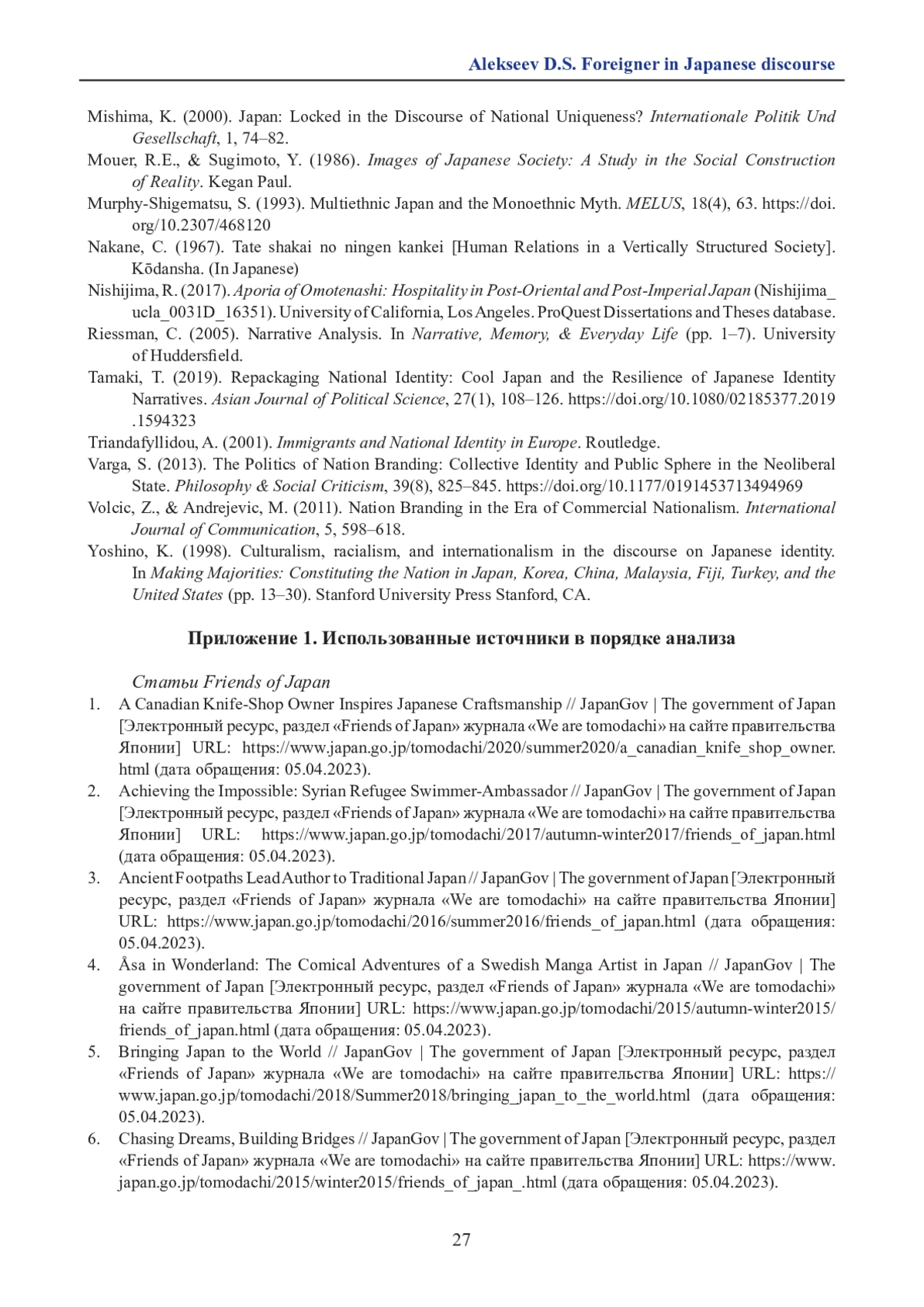
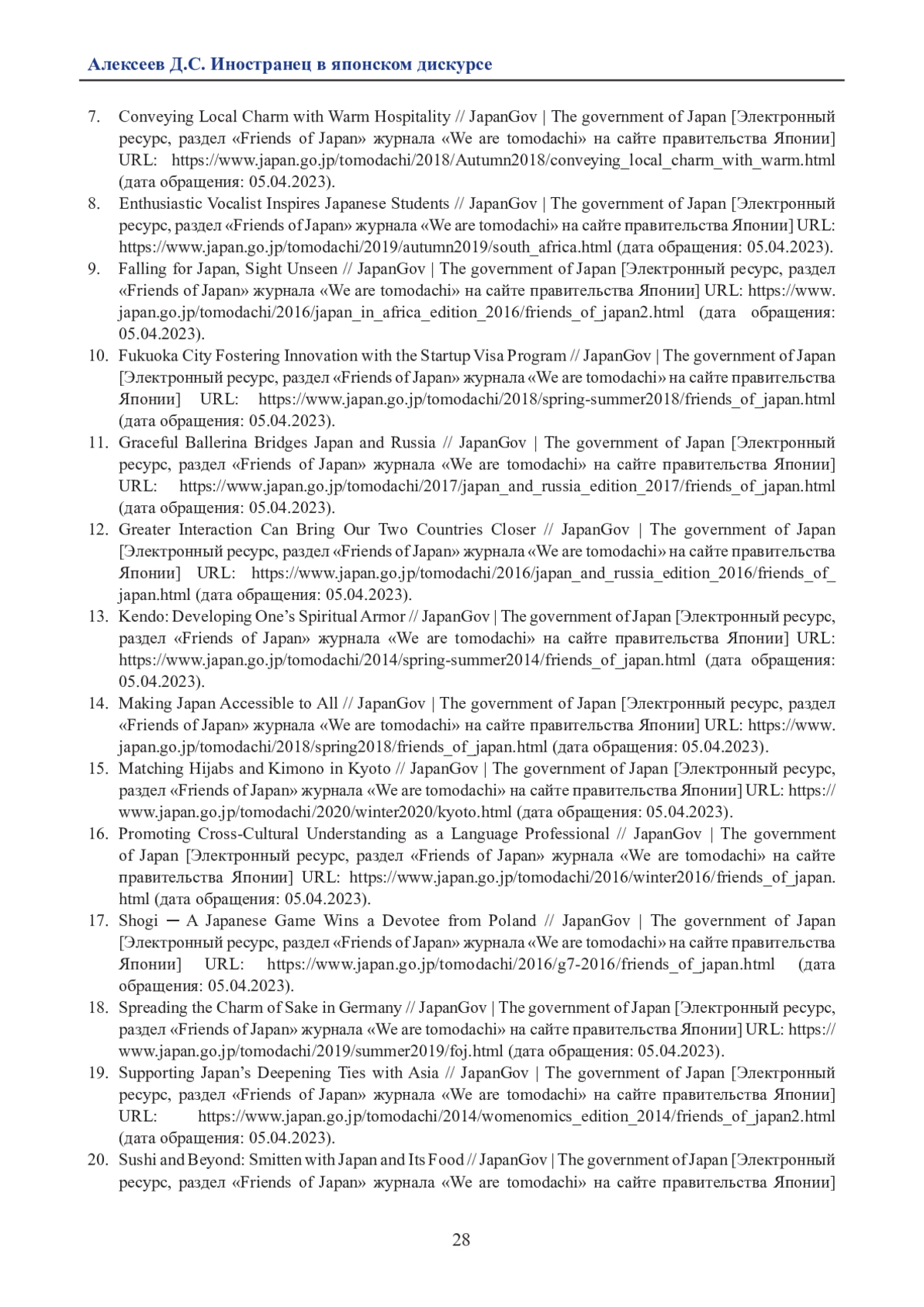
9. Agar, M. (2007). Emic/Etic. In The Blackwell Encyclopedia of Sociology. John Wiley & Sons, Ltd. https://doi.org/10.1002/9781405165518.wbeose035
10. Aida, Y. (1970). Nihonjin no ishiki kōzō [The Japanese Mind]. Kōdansha. (In Japanese).
11. Aronczyk, M. (2008). “Living the Brand”: Nationality, Globality and the Identity Strategies of Nation Branding Consultants. International Journal of Communication, 2, 41-65. https://doi.org/1932-8036/20080041
12. Aronczyk, M. (2013). Branding the Nation: The Global Business of National Identity. Oxford University Press.
13. Asakura, T., Gee, G.C., Nakayama, K., & Niwa, S. (2008). Returning to the “Homeland”: Work-Related Ethnic Discrimination and the Health of Japanese Brazilians in Japan. American Journal of Public Health, 98(4), 743-750. https://doi.org/10.2105/AJPH.2007.117309
14. Befu, H. (1993). Nationalism and Nihonjinron. In H. Befu (Ed.), Cultural Nationalism in East Asia: Representation and Identity (pp. 107-139). Berkeley, California: Institute of East Asian Studies, University of California. http://archive.org/details/culturalnational0000unse
15. Benedict, R. (1947). The Chrysanthemum and The Sword. The Riverside Press. http://archive.org/details/in.ernet.dli.2015.80008
16. Burgess, C. (2004). Maintaining Identities: Discourses of Homogeneity in a Rapidly Globalizing Japan. Electronic Journal of Contemporary Japanese Studies. https://www.japanesestudies.org.uk/articles/Burgess.html
17. Choo, K. (2013). Nationalizing “cool”: Japan’s global promotion of the content industry. In Popular Culture and the State in East and Southeast Asia (pp. 85-105). Routledge.
18. Dale, P.N. (1986). The Myth of Japanese Uniqueness. Taylor & Francis.
19. Daliot-Bul, M. (2009). Japan Brand Strategy: The Taming of ‘Cool Japan’ and the Challenges of Cultural Planning in a Postmodern Age. Social Science Japan Journal, 12(2), 247-266. https://doi.org/10.1093/ssjj/jyp037
20. Dinnie, K. (2009). Nation Branding: Concepts, Issues, Practice (Reprinted). Elsevier Butterworth-Heinemann.
21. Doi, T. (1971). Amae no kōzō [The Anatomy of Dependence]. Kōbundō. (In Japanese).
22. Fairclough, N. (2003). Analysing Discourse: Textual Analysis for Social Research. Routledge.
23. Flowers, P.R. (2008). Failure to Protect Refugees? Domestic Institutions, International Organizations, and Civil Society in Japan. Journal of Japanese Studies, 34(2), 333-361. https://www.jstor.org/stable/27756571
24. Foss, S.K. (2017). Rhetorical Criticism: Exploration and Practice. Waveland Press.
25. Goodman, R. (2005). Making Majority Culture. In A Companion to the Anthropology of Japan (pp. 59-72). John Wiley & Sons, Ltd. https://doi.org/10.1002/9780470996966.ch5
26. Hall, S. (1996). Who needs identity? In P. Du Gay & S. Hall (Eds.), Questions of Cultural Identity (pp. 1-19). Sage.
27. Hall, S. (1997). The spectacle of the other. In S. Hall (Ed.), Representation: Cultural Representations and Signifying Practices (Vol. 7, pp. 223-290). Sage.
28. Ito, M. (1998). Globalization of Japan: Japanese Sakoku Mentality and U. S. Efforts to Open Japan. St. Martin’s Press. http://archive.org/details/globalizationofj0000itoh
29. Iwabuchi, K. (1994). Complicit Exoticism: Japan and Its Other. Continuum, 8(2), 49-82. https://doi.org/10.1080/10304319409365669
30. Iwabuchi, K. (2015). Pop-culture diplomacy in Japan: Soft power, nation branding and the question of ‘international cultural exchange’. International Journal of Cultural Policy, 21(4), 419-432. https://doi.org/10.1080/10286632.2015.1042469
31. Lie, J. (2001). Multiethnic Japan. Harvard University Press.
32. McCormack, G. (1994). Kokusaika, Nichibunken, and the question of Japan‐bashing. Asian Studies Review, 17(3), 166-172. https://doi.org/10.1080/03147539408712964
33. McGray, D. (2002). Japan’s Gross National Cool. Foreign Policy, 130, 44-54. https://doi.org/10.2307/3183487
34. McLaren, S. (2015). Made in Cool Japan: Delights and Disasters. Griffith Review, 49, 165-173.
35. Mishima, K. (2000). Japan: Locked in the Discourse of National Uniqueness? Internationale Politik Und Gesellschaft, 1, 74-82.
36. Mouer, R.E., & Sugimoto, Y. (1986). Images of Japanese Society: A Study in the Social Construction of Reality. Kegan Paul.
37. Murphy-Shigematsu, S. (1993). Multiethnic Japan and the Monoethnic Myth. MELUS, 18(4), 63. https://doi.org/10.2307/468120
38. Nakane, C. (1967). Tate shakai no ningen kankei [Human Relations in a Vertically Structured Society]. Kōdansha. (In Japanese)
39. Nishijima, R. (2017). Aporia of Omotenashi: Hospitality in Post-Oriental and Post-Imperial Japan (Nishijima_ucla_0031D_16351). University of California, Los Angeles. ProQuest Dissertations and Theses database.
40. Riessman, C. (2005). Narrative Analysis. In Narrative, Memory, & Everyday Life (pp. 1-7). University of Huddersfield.
41. Tamaki, T. (2019). Repackaging National Identity: Cool Japan and the Resilience of Japanese Identity Narratives. Asian Journal of Political Science, 27(1), 108-126. https://doi.org/10.1080/02185377.2019.1594323
42. Triandafyllidou, A. (2001). Immigrants and National Identity in Europe. Routledge.
43. Varga, S. (2013). The Politics of Nation Branding: Collective Identity and Public Sphere in the Neoliberal State. Philosophy & Social Criticism, 39(8), 825-845. https://doi.org/10.1177/0191453713494969
44. Volcic, Z., & Andrejevic, M. (2011). Nation Branding in the Era of Commercial Nationalism. International Journal of Communication, 5, 598-618.
45. Yoshino, K. (1998). Culturalism, racialism, and internationalism in the discourse on Japanese identity. In Making Majorities: Constituting the Nation in Japan, Korea, China, Malaysia, Fiji, Turkey, and the United States (pp. 13-30). Stanford University Press Stanford, CA.