
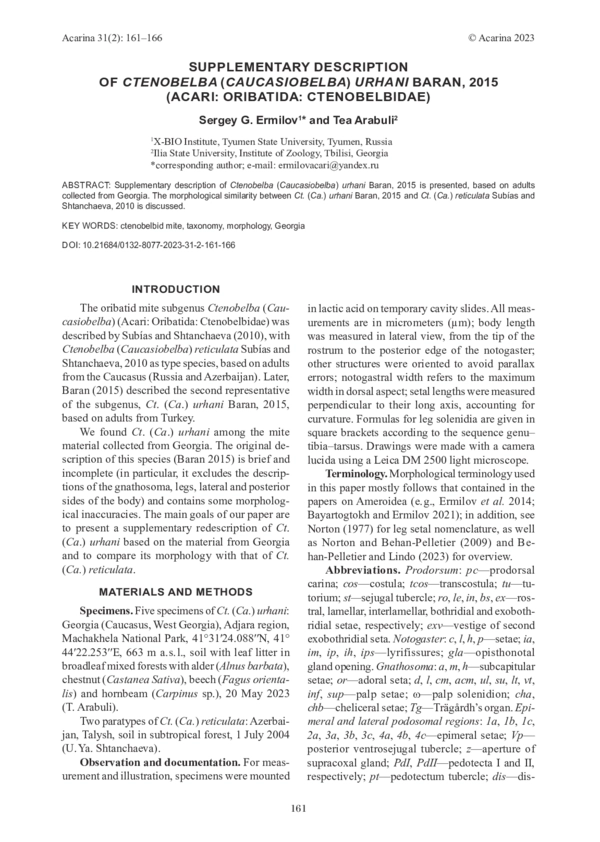
Supplementary description of Ctenobelba (Caucasiobelba) urhani Baran, 2015 is presented, based on adults collected from Georgia. The morphological similarity between Ct. (Ca.) urhani Baran, 2015 and Ct. (Ca.) reticulata Subías and Shtanchaeva, 2010 is discussed.
Идентификаторы и классификаторы
The oribatid mite subgenus Ctenobelba (Caucasiobelba) (Acari: Oribatida: Ctenobelbidae) was
described by Subías and Shtanchaeva (2010), with Ctenobelba (Caucasiobelba) reticulata Subías and Shtanchaeva, 2010 as type species, based on adults from the Caucasus (Russia and Azerbaijan). Later, Baran (2015) described the second representative of the subgenus, Ct. (Ca.) urhani Baran, 2015, based on adults from Turkey.
Если у вас возникли вопросы или появились предложения по содержанию статьи, пожалуйста, направляйте их в рамках данной темы.
Список литературы
1/Baran, S. 2015. New and firstly recorded oribatid mites from Turkey. Biologia, 70: 1388–1392.
2/Bayartogtokh, B. and Ermilov, S. G. 2021. A remarkable new species of Hungarobelbidae (Acari: Oribatida) exhibiting characteristic features of two genera, with notes on its systematic relationships. Systematic and Applied Acarology, 26: 624–640.
3/Behan-Pelletier, V. M. and Lindo, Z. 2023. Oribatid Mites—Biodiversity, Taxonomy and Ecology. CRC Press, Boca Raton–London–New York. 494 pp.
4/Ermilov, S. G., Shtanchaeva, U. Ya, Subias, L. S. and Anichkin, A. E. 2014. The family Ctenobelbidae
(Acari, Oribatida), with description of a new species and discussion on systematic placement and
taxonomic status of the genus Berndamerus Mahunka, 1977. ZooKeys, 395: 1–10.
5/Norton, R. A. 1977. A review of F. Grandjean’s system of leg chaetotaxy in the Oribatei (Acari) and its application to the family Damaeidae. In: D. L. Dindal (Ed.). Biology of Oribatid Mites. SUNY College of Environmental Science and Forestry, Syracuse, pp. 33–61.
6/Norton, R. A. and Behan-Pelletier, V. M. 2009. Suborder Oribatida. Ch. 15. In: G. W. Krantz and
D. E. Walter (Eds.). A Manual of Acarology. Texas Tech University Press, Lubbock, pp. 430–564.
Subias, L. S. and Shtanchaeva, U. Ya. 2010. Ctenobelba (Caucasiobelba) n. subg. del Cáucaso y 7/Ctenobelba (Bifurcobelba) n. subg. de España (Acari, Oribatida, Ctenobelbidae). Graellsia, 66: 79–83.
Выпуск

Другие статьи выпуска

Neoseiulus californicus is widely used as an effective biocontrol agent of spider mites. In this study, the complete mitochondrial genome sequence of N. californicus was determined using Oxford Nanopore sequencing technology. The complete mitochondrial genome is 21,318 bp in length and contains 13 protein-coding genes, 2 ribosomal rRNA genes and 22 transfer RNA
genes. Its AT content is 78.4%. All start and stop codons of the protein-coding genes are canonical, except for the missing stop codon for the cox3 gene. The control region was polymorphic in length between the sublines of N. californicus due to variable number of direct repeats. The mitogenome presented in this paper contributes to the study of the genetic structure of N. californicus biocontrol populations.
This paper provides an illustrated description of two water mite species of the genus Atractides—Atractides (Atractides) arzanensis sp. n. and Atractides (Atractides) teneroides sp. n.—from the running waters of Russia.
This paper provides a brief review of investigations of the spider mite fauna of Kyrgyzstan. 5 species—Eotetranychus libocedri, Eo. tiliarum, Eo. thujae, Oligonychus karamatus and O. lagodechii—were recorded from Kyrgyzstan for the first time. In addition, the presence of O. piceae in the studied region has been confirmed. Thus, the tetranychids fauna of Kyrgyzstan
consists of 58 species
The Tydeidae fauna of the Altay (Altayskiy Kray and Respublika Altay) is reviewed. A total of nine species of the genus Brachytydeus were found. Among them, Brachytydeus montanus sp. n., B. altaicus sp. n. and B. brevisetosus sp. n. are new to science. Brachytydeus politus (Kuznetsov), B. reticuloinsignius (Kazmierski and Panou) and B. sleipneri (Momen and Lundquist) comb. n. are recorded from Russia for the first time. Brachytydeus arkadiensis (Panou and Emmanouel), B. magus (Kuznetsov) and B. woolleyi (Baker) are reported from Altay for the first time.
The genus Raphignathus Dugès (Acari: Raphignathidae) of Asian Russia is reviewed. Raphignathus sakhalinensis sp. n. is described based on female and male specimens collected from spruce bark on Sakhalin Island; R. longipes sp. n. is described based on female and male specimens collected from various regions of Russia (Bashkortostan, Tyumenskaya Oblast, the Respublika Altay and Kamchatka). Raphignathus fani Doğan and Ayyildiz and R. ozkani Doğan are recorded from Russia for the first time and redescribed. Raphignathus gracilis (Rack) is recorded from Asian Russia for the first time. A key to the species of Raphignathus of Russia is also provided.
A new feather mite species, Dolichodectes sibiricus sp. n. (Pterodectinae), is described from the Dark-sided Flycatcher, Muscicapa sibirica Gmelin, JF, captured on the southern coast of Lake Baikal, Buryatia, Russia. The new species is closest to D. allocaulus (Gaud and Mouchet 1957) and D. platynocercus (Gaud and Mouchet, 1957) from Africa and is distinguished from them in the following features. In males of D. sibiricus, the lateral enlargements of opisthosomal lobes are of a complicated form and consist of distinct angular projections bearing setae f2 and rounded ledges at level of setae h2, and the aedeagus extends to the level of setae ps3; in females, the prodorsal and hysteronotal shields lack ornamentation, the terminal appendages at their bases are 2–2.5 times thicker that setae h2, and setae e2 are situated closer to the level of setae e1 than to the posterior margin of the hysteronotal shield. Brief comments on the systematics of the genus Dolichodectes, a key to the known species, an updated checklist of the world fauna, as well as host associations are provided.

The paper describes a new species, Trouessartia cyane sp. n., collected from the Siberian Blue Robin Larvivora cyane (Pallas) (type host) and the Rufous-tailed Robin L. sibilans Swinhoe in Primorsky Krai (the Russian Far East). The description is supplemented with barcoding data (mitochondrial cytochrome C oxidase subunit I gene).
Trouessartia cyane is closest to T. larvivorae Mironov, 2021 and T. rubecula Jablonska, 1968, differing mainly in measurable characteristics. In particular, in males of T. cyane, the length of terminal lamellae is 20–23 (vs. 25–30 in T. larvivorae and 30–35 in T. rubecula); in females, the length of idiosoma is 515–545 (vs. 555–590 in T. larvivorae and 570–625 in T. rubecula), the distance between setae se is 85–90 (vs. 100–120), the width of opisthosoma at the level of setae h2 is 87–97 (vs. 105–115), setae h1 are thin spiculiform (vs. lanceolate).
Genetic distances within T. cyane, as well as between the new species and four closely related Trouessartia species from four muscicapids distributed in northern Eurasia, have been analyzed using Kimura’s two-parameter (K2P) model. Intraspecific genetic distances within T. cyane varied between 0.006 and 0.01; interspecific distances between the new species and morphologically
close species ranged from 0.154 (T. rubecula) to 0.185 (T. calliope).

Phoretic deutonymphs of Winterschmidtia tawantinsuyuca sp. n. (Acari: Winterschmidtiidae) are described from Peru. This is the fourth species of the genus recorded in the Neotropical realm. Similar to the three other Peruvian species, the new species is phoretic on bark beetles, but this is the first finding of Winterschmidtia on the beetles of the genus Xyleborus (Coleoptera: Curculionidae: Scolytinae). The new species differs from all others in the ornamentation on of its prodorsal shield.
We describe unusual heteromorphic deutonymph of Mycetinopus striatipedis gen. and sp. n. (Acari: Acaridae) phoretic on the handsome fungus beetle Mycetina marginalis (Coleoptera, Endomychidae) in the Eastern Palearctic. These deutonymphs have a unique combination of character states that make them very distinct in the family Acaridae: an unpaired pigmented spot
on the anterior propodosoma is present; supracoxal setae scx filiform and bifurcate; genu I with two solenidia; tibia-tarsi I–II are distinctly elongated and striated; vertical setae ve are present, and tarsal setae aa are lacking. Our work emphasizes the importance of continued exploration and documentation of the biodiversity of astigmatid mites associated with invertebrate hosts.
This study is based on oribatid mite materials collected from forest litter in Taiwan. In particular, in the course of our study, we recorded 10 species from 10 genera and eight families. Of these, two species (Scheloribates guhitanus, Setogalumna luzonica) have been recorded for the first time from Taiwan. Additionally, a supplementary description of Pergalumna kunsti is presented based on specimens from Taiwan. An identification key to the known species of Pergalumna from the Oriental region is presented.
We present a revised generic diagnosis of Caucaseremaeus (Oribatida: Eremaeidae). The redescription of Caucaseremaeus krivolutskyi Shtanchaeva and Subías, 2006 is presented, based on the paratype (Armenia) and on the specimens collected from the Republic of Abkhazia. In addition, remarks on the family placement of Caucaseremaeus are provided.
Статистика статьи
Статистика просмотров за 2025 - 2026 год.
Издательство
- Издательство
- ТЮМГУ
- Регион
- Россия, Тюмень
- Почтовый адрес
- 625003, Уральский федеральный округ, Тюменская область, г. Тюмень, ул. Володарского, д. 6
- Юр. адрес
- 625003, Уральский федеральный округ, Тюменская область, г. Тюмень, ул. Володарского, д. 6
- ФИО
- Романчук Иван Сергеевич (РЕКТОР)
- E-mail адрес
- ceo@utmn.ru
- Контактный телефон
- +7 (345) 2597429